The Truth about NLP
and Hypnosis
NLP Canada Training Inc.
The Magic
People hope they can get what they want


• more quickly


• with little or no effort


• with little or no stress
If I can imagine it, I
can have it.
And as you listen to my voice, I’d
like you to think about something
you want as though you have it
now. And you can just make that
picture bigger and brighter and
more attractive. . .
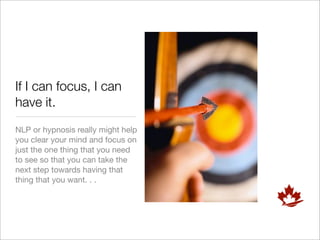
If I can focus, I can
have it.
NLP or hypnosis really might help
you clear your mind and focus on
just the one thing that you need
to see so that you can take the
next step towards having that
thing that you want. . .
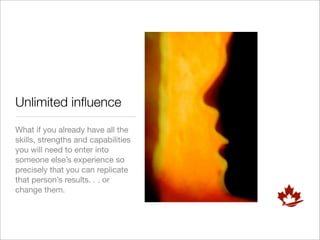
Unlimited influence
What if you already have all the
skills, strengths and capabilities
you will need to enter into
someone else’s experience so
precisely that you can replicate
that person’s results. . . or
change them.
There is no magic

• All achievement takes effort


• NLP & hypnosis offer:


   • Practices for noticing that all brains are capable of creating vivid ideas


   • Practices for controlling intention and attention


   • Practices for noticing more about the experience of other people


• With practice, you can learn to imagine better, to focus better, and to
  influence better
The Training
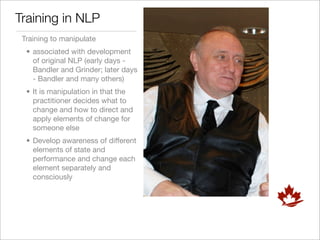
Training in NLP
 Training to manipulate
  • associated with development
    of original NLP (early days -
    Bandler and Grinder; later days
    - Bandler and many others)
  • It is manipulation in that the
    practitioner decides what to
    change and how to direct and
    apply elements of change for
    someone else
  • Develop awareness of different
    elements of state and
    performance and change each
    element separately and
    consciously
Training in NLP
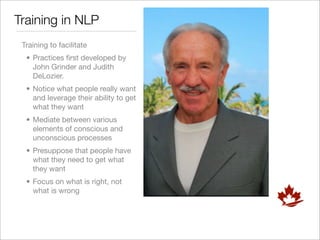
 Training to facilitate
  • Practices first developed by
    John Grinder and Judith
    DeLozier.
  • Notice what people really want
    and leverage their ability to get
    what they want
  • Mediate between various
    elements of conscious and
    unconscious processes
  • Presuppose that people have
    what they need to get what
    they want
  • Focus on what is right, not
    what is wrong
Training in Hypnosis
 Direct suggestion to induce
 deep trance
  • Client slips into state of
    passive acceptance and
    adopts suggestions for
    changing state and
    behaviours
  • Hypnotist installs
    programming and client
    carries it out
  • Success is signaled when
    client produces deep trance
    phenomena
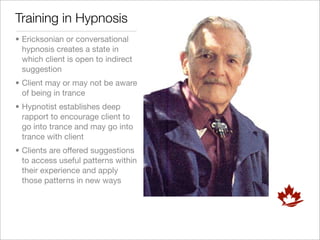
Training in Hypnosis
• Ericksonian or conversational
  hypnosis creates a state in
  which client is open to indirect
  suggestion
• Client may or may not be aware
  of being in trance
• Hypnotist establishes deep
  rapport to encourage client to
  go into trance and may go into
  trance with client
• Clients are offered suggestions
  to access useful patterns within
  their experience and apply
  those patterns in new ways
Training for Strength, Flexibility and Resilience

• Full range of abilities and options is better than part of a range


   • Getting what we want may require focus on goal or focus on process


   • Different outcomes require different behaviours


   • Influence requires ability to adapt to variety of situations, relationships and
     personalities


• The best training allows the greatest range of options and abilities
Credentials
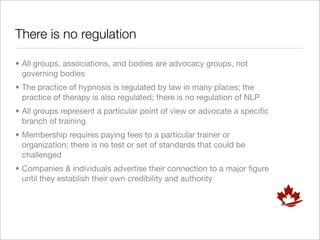
There is no regulation

• All groups, associations, and bodies are advocacy groups, not
  governing bodies
• The practice of hypnosis is regulated by law in many places; the
  practice of therapy is also regulated; there is no regulation of NLP
• All groups represent a particular point of view or advocate a specific
  branch of training
• Membership requires paying fees to a particular trainer or
  organization; there is no test or set of standards that could be
  challenged
• Companies & individuals advertise their connection to a major figure
  until they establish their own credibility and authority
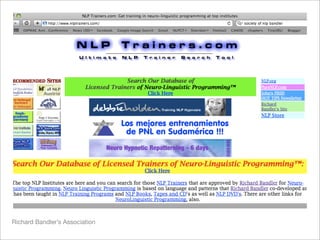
Richard Bandler
www.richardbandler.com
Richard Bandler’s Association
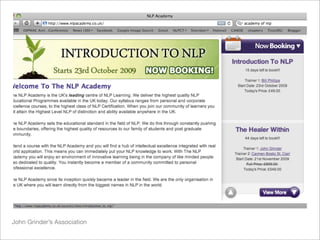
John Grinder
www.johngrinder.com
John Grinder’s Association
Other big names
Michael Hall
Tad James
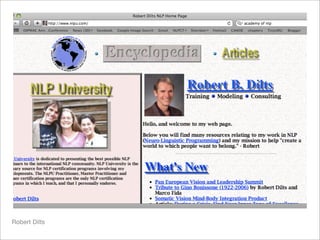
Robert Dilts
www.tonyrobbins.com
Some other famous names

• Inspiritive


• Sue Knight


• Jamie Smart (SALAD)


• Derren Brown


• Joseph O’Connor


• Steve Andreas
Trainers who have established credibility for their
own practices do not declare an affiliation to one or
the other of the founders.
Associations not linked to trainers
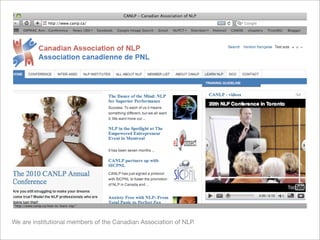
We are institutional members of the Canadian Association of NLP.
The Canadian Association of NLP

• voluntary advocacy group


• most members are NLP practitioners who use NLP but do not offer
  practitioner certifications


• small membership base and very small, volunteer Board


• slow process for updating standards and no authority for governance


• is one of the few associations in the world that includes representatives of
  both John Grinder and Richard Bandler strains of NLP
What about NLP Canada Training Inc?
Our mentor, Derek Balmer, trained with both
Richard Bandler and John Grinder. His practitioner
certificate, signed by both, hangs in our office.
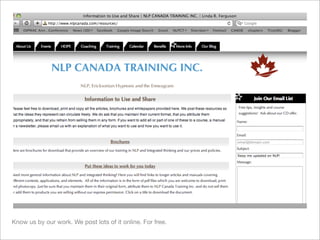
Know us by our work. We post lots of it online. For free.
These web pages include links to other websites, videos, books and
articles. There are 20, including www.squidoo.com/nlp4skeptics
There are about 35 one-page articles by Linda Ferguson available at
www.ezinearticles.com.
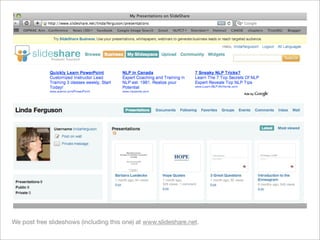
We post free slideshows (including this one) at www.slideshare.net.
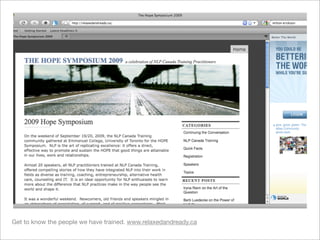
Get to know the people we have trained. www.relaxedandready.ca
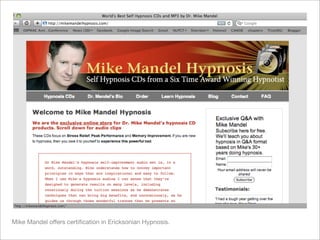
Mike Mandel offers certification in Ericksonian Hypnosis.
Judge us by our ideas, our work & our friends.
The practice of NLP
and Hypnosis
Enhanced Performance with NLP & Hypnosis

• Most people integrate the practice of NLP and the principles of Ericksonian
  hypnosis into their regular work


• They pay better attention and have a stronger ability to choose their focus,
  even under pressure


• They know what outcomes they want and they take the steps necessary to
  make them happen


• They build rapport and empathy with people for the purposes of learning and
  influence


• They elicit useful states in themselves, others, and teams
Professional Practices using NLP or Hypnosis

• life, athletic or business coaches


• therapists


• producers of audio or video materials


• writers


• trainers who apply NLP or hypnosis to specific fields or goals


• motivational speakers
Offering Practitioner Certifications

• Very few of the people who train in NLP or hypnosis become trainers of NLP
  or hypnosis


• Many trainers do not have training certifications. There is no governing body
  and no firm evidence that graduates of training certifications are better
  trainers


• Anyone (even someone who has never taken NLP) can claim to offer NLP
  certifications


• The best trainers often have experience training outside the field of NLP and
  hypnosis
The results
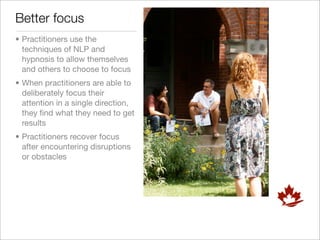
Better focus
• Practitioners use the
  techniques of NLP and
  hypnosis to allow themselves
  and others to choose to focus
• When practitioners are able to
  deliberately focus their
  attention in a single direction,
  they find what they need to get
  results
• Practitioners recover focus
  after encountering disruptions
  or obstacles
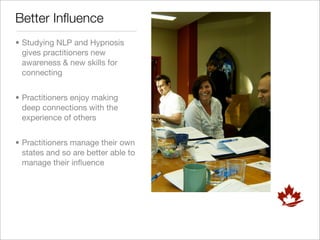
Better Influence
• Studying NLP and Hypnosis
  gives practitioners new
  awareness & new skills for
  connecting


• Practitioners enjoy making
  deep connections with the
  experience of others


• Practitioners manage their own
  states and so are better able to
  manage their influence
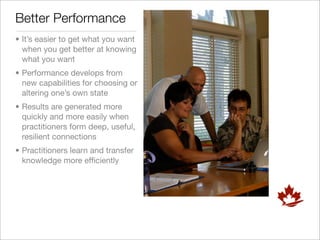
Better Performance
• It’s easier to get what you want
  when you get better at knowing
  what you want
• Performance develops from
  new capabilities for choosing or
  altering one’s own state
• Results are generated more
  quickly and more easily when
  practitioners form deep, useful,
  resilient connections
• Practitioners learn and transfer
  knowledge more efficiently
Think Better, Feel Better, Do Better

• It’s not magic: it takes a willingness to engage, to attempt and to practice


• It is reliable: if you develop the skills, you’ll get the results


• Practitioner think more clearly and habitually engage more of their brain in
  thinking


• Practitioners have the opportunity to “do” emotions: to make choices that
  lead to a state that satisfies them


• Practitioners get results that they like

The Truth About Nlp & Hypnosis

  • 1.
    The Truth aboutNLP and Hypnosis NLP Canada Training Inc.
  • 2.
  • 3.
    People hope theycan get what they want • more quickly • with little or no effort • with little or no stress
  • 4.
    If I canimagine it, I can have it. And as you listen to my voice, I’d like you to think about something you want as though you have it now. And you can just make that picture bigger and brighter and more attractive. . .
  • 5.
    If I canfocus, I can have it. NLP or hypnosis really might help you clear your mind and focus on just the one thing that you need to see so that you can take the next step towards having that thing that you want. . .
  • 6.
    Unlimited influence What ifyou already have all the skills, strengths and capabilities you will need to enter into someone else’s experience so precisely that you can replicate that person’s results. . . or change them.
  • 7.
    There is nomagic • All achievement takes effort • NLP & hypnosis offer: • Practices for noticing that all brains are capable of creating vivid ideas • Practices for controlling intention and attention • Practices for noticing more about the experience of other people • With practice, you can learn to imagine better, to focus better, and to influence better
  • 8.
  • 9.
    Training in NLP Training to manipulate • associated with development of original NLP (early days - Bandler and Grinder; later days - Bandler and many others) • It is manipulation in that the practitioner decides what to change and how to direct and apply elements of change for someone else • Develop awareness of different elements of state and performance and change each element separately and consciously
  • 10.
    Training in NLP Training to facilitate • Practices first developed by John Grinder and Judith DeLozier. • Notice what people really want and leverage their ability to get what they want • Mediate between various elements of conscious and unconscious processes • Presuppose that people have what they need to get what they want • Focus on what is right, not what is wrong
  • 11.
    Training in Hypnosis Direct suggestion to induce deep trance • Client slips into state of passive acceptance and adopts suggestions for changing state and behaviours • Hypnotist installs programming and client carries it out • Success is signaled when client produces deep trance phenomena
  • 12.
    Training in Hypnosis •Ericksonian or conversational hypnosis creates a state in which client is open to indirect suggestion • Client may or may not be aware of being in trance • Hypnotist establishes deep rapport to encourage client to go into trance and may go into trance with client • Clients are offered suggestions to access useful patterns within their experience and apply those patterns in new ways
  • 13.
    Training for Strength,Flexibility and Resilience • Full range of abilities and options is better than part of a range • Getting what we want may require focus on goal or focus on process • Different outcomes require different behaviours • Influence requires ability to adapt to variety of situations, relationships and personalities • The best training allows the greatest range of options and abilities
  • 14.
  • 15.
    There is noregulation • All groups, associations, and bodies are advocacy groups, not governing bodies • The practice of hypnosis is regulated by law in many places; the practice of therapy is also regulated; there is no regulation of NLP • All groups represent a particular point of view or advocate a specific branch of training • Membership requires paying fees to a particular trainer or organization; there is no test or set of standards that could be challenged • Companies & individuals advertise their connection to a major figure until they establish their own credibility and authority
  • 16.
  • 17.
  • 18.
  • 19.
  • 20.
  • 21.
  • 22.
  • 23.
  • 24.
  • 25.
  • 26.
  • 27.
    Some other famousnames • Inspiritive • Sue Knight • Jamie Smart (SALAD) • Derren Brown • Joseph O’Connor • Steve Andreas
  • 28.
    Trainers who haveestablished credibility for their own practices do not declare an affiliation to one or the other of the founders.
  • 29.
  • 30.
    We are institutionalmembers of the Canadian Association of NLP.
  • 31.
    The Canadian Associationof NLP • voluntary advocacy group • most members are NLP practitioners who use NLP but do not offer practitioner certifications • small membership base and very small, volunteer Board • slow process for updating standards and no authority for governance • is one of the few associations in the world that includes representatives of both John Grinder and Richard Bandler strains of NLP
  • 32.
    What about NLPCanada Training Inc?
  • 33.
    Our mentor, DerekBalmer, trained with both Richard Bandler and John Grinder. His practitioner certificate, signed by both, hangs in our office.
  • 34.
    Know us byour work. We post lots of it online. For free.
  • 35.
    These web pagesinclude links to other websites, videos, books and articles. There are 20, including www.squidoo.com/nlp4skeptics
  • 36.
    There are about35 one-page articles by Linda Ferguson available at www.ezinearticles.com.
  • 37.
    We post freeslideshows (including this one) at www.slideshare.net.
  • 38.
    Get to knowthe people we have trained. www.relaxedandready.ca
  • 39.
    Mike Mandel offerscertification in Ericksonian Hypnosis.
  • 40.
    Judge us byour ideas, our work & our friends.
  • 41.
    The practice ofNLP and Hypnosis
  • 42.
    Enhanced Performance withNLP & Hypnosis • Most people integrate the practice of NLP and the principles of Ericksonian hypnosis into their regular work • They pay better attention and have a stronger ability to choose their focus, even under pressure • They know what outcomes they want and they take the steps necessary to make them happen • They build rapport and empathy with people for the purposes of learning and influence • They elicit useful states in themselves, others, and teams
  • 43.
    Professional Practices usingNLP or Hypnosis • life, athletic or business coaches • therapists • producers of audio or video materials • writers • trainers who apply NLP or hypnosis to specific fields or goals • motivational speakers
  • 44.
    Offering Practitioner Certifications •Very few of the people who train in NLP or hypnosis become trainers of NLP or hypnosis • Many trainers do not have training certifications. There is no governing body and no firm evidence that graduates of training certifications are better trainers • Anyone (even someone who has never taken NLP) can claim to offer NLP certifications • The best trainers often have experience training outside the field of NLP and hypnosis
  • 45.
  • 46.
    Better focus • Practitionersuse the techniques of NLP and hypnosis to allow themselves and others to choose to focus • When practitioners are able to deliberately focus their attention in a single direction, they find what they need to get results • Practitioners recover focus after encountering disruptions or obstacles
  • 47.
    Better Influence • StudyingNLP and Hypnosis gives practitioners new awareness & new skills for connecting • Practitioners enjoy making deep connections with the experience of others • Practitioners manage their own states and so are better able to manage their influence
  • 48.
    Better Performance • It’seasier to get what you want when you get better at knowing what you want • Performance develops from new capabilities for choosing or altering one’s own state • Results are generated more quickly and more easily when practitioners form deep, useful, resilient connections • Practitioners learn and transfer knowledge more efficiently
  • 49.
    Think Better, FeelBetter, Do Better • It’s not magic: it takes a willingness to engage, to attempt and to practice • It is reliable: if you develop the skills, you’ll get the results • Practitioner think more clearly and habitually engage more of their brain in thinking • Practitioners have the opportunity to “do” emotions: to make choices that lead to a state that satisfies them • Practitioners get results that they like