Presented By:
            Pranamesh Chakraborty
        Department of Civil Engineering
1st Year M.Tech (Transportation Engineering)
    Indian Institute of Technology, Kanpur
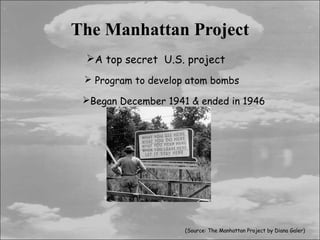
The Manhattan Project
 A top secret U.S. project
  Program to develop atom bombs

 Began December 1941 & ended in 1946


                     (Source: The Manhattan Project by Diana Galer)
How it started
In 1933 the charismatic Hitler rose to power causing a
great fear and hatred for him among the Jewish people
including Albert Einstein
In 1938 Germany was able to split an uranium atom
and was getting more aggressive.

Physicists Leo Szilard and Eugene Winger became
concerned with the recent aggression by Germany
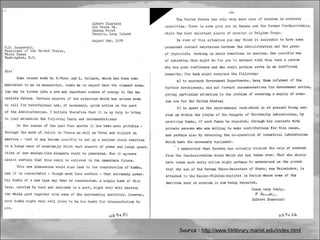
Leo and Eugene consulted with Einstein and they
wrote a letter to Roosevelt with his signature
Roosevelt received the Letter from Einstein on
October 11, 1939 from Alexander Sachs.

After Roosevelt read the Letter he assigned a
committee of people to study uranium chain reactions.
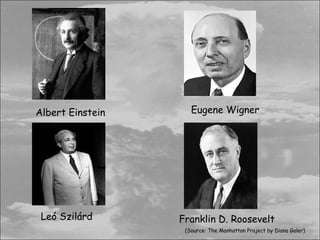
Albert Einstein      Eugene Wigner


 Leó Szilárd      Franklin D. Roosevelt
                   (Source: The Manhattan Project by Diana Galer)
Source : http://www.fdrlibrary.marist.edu/index.html
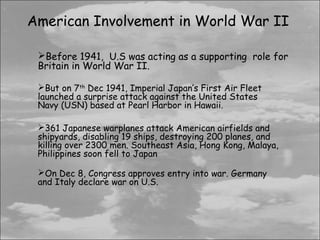
American Involvement in World War II

 Before 1941, U.S was acting as a supporting role for
 Britain in World War II.

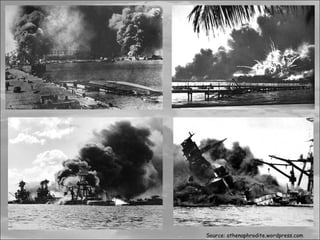
 But on 7th Dec 1941, Imperial Japan’s First Air Fleet
 launched a surprise attack against the United States
 Navy (USN) based at Pearl Harbor in Hawaii.

 361 Japanese warplanes attack American airfields and
 shipyards, disabling 19 ships, destroying 200 planes, and
 killing over 2300 men. Southeast Asia, Hong Kong, Malaya,
 Philippines soon fell to Japan

 On Dec 8, Congress approves entry into war. Germany
 and Italy declare war on U.S.
Source: athenaphrodite.wordpress.com
Nuclear Programs: Germany

 Germany started experimenting with
   Nuclear Fission in 1938.

 German scientist Otto Hahn, Fritz
   Strassman, Max Born, Max Planck,
   Heisenberg were involved in the
   project.
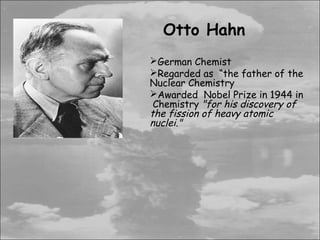
Otto Hahn
German Chemist
Regarded as “the father of the
Nuclear Chemistry
Awarded Nobel Prize in 1944 in
 Chemistry "for his discovery of
the fission of heavy atomic
nuclei."
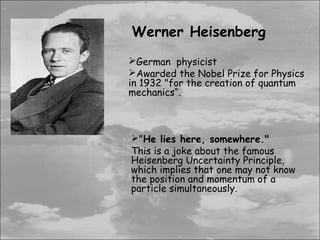
Werner Heisenberg
German physicist
Awarded the Nobel Prize for Physics
in 1932 "for the creation of quantum
mechanics“.


"He lies here, somewhere."
This is a joke about the famous
Heisenberg Uncertainty Principle,
which implies that one may not know
the position and momentum of a
particle simultaneously.
Failure of the German Nuclear Program

 June 1942 – German atomic program slows down
   because Germany felt victory in WWII was
   imminent.

 When Adolf Hitler was in power, Hitler
   encouraged many top scientists to leave Europe.
The Discovery of Fission


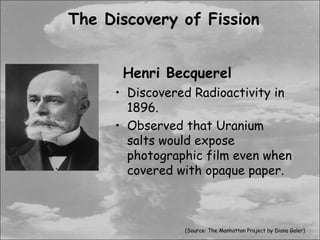
      Henri Becquerel
     • Discovered Radioactivity in
       1896.
     • Observed that Uranium
       salts would expose
       photographic film even when
       covered with opaque paper.


                (Source: The Manhattan Project by Diana Galer)
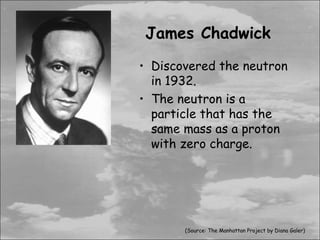
James Chadwick
• Discovered the neutron
  in 1932.
• The neutron is a
  particle that has the
  same mass as a proton
  with zero charge.


       (Source: The Manhattan Project by Diana Galer)
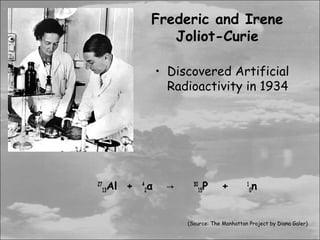
Frederic and Irene
                  Joliot-Curie

                   • Discovered Artificial
                     Radioactivity in 1934


27
   Al +
  13
          4
              2α    →     30
                             P
                            15       +        1
                                                  n
                                                  0


                        (Source: The Manhattan Project by Diana Galer)
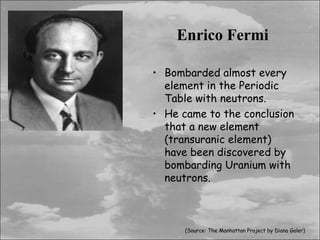
Enrico Fermi

• Bombarded almost every
  element in the Periodic
  Table with neutrons.
• He came to the conclusion
  that a new element
  (transuranic element)
  have been discovered by
  bombarding Uranium with
  neutrons.


      (Source: The Manhattan Project by Diana Galer)
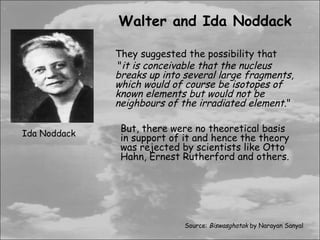
Walter and Ida Noddack

              They suggested the possibility that
              "it is conceivable that the nucleus
              breaks up into several large fragments,
              which would of course be isotopes of
              known elements but would not be
              neighbours of the irradiated element."

Ida Noddack
               But, there were no theoretical basis
               in support of it and hence the theory
               was rejected by scientists like Otto
               Hahn, Ernest Rutherford and others.


                             Source: Biswasghatak by Narayan Sanyal
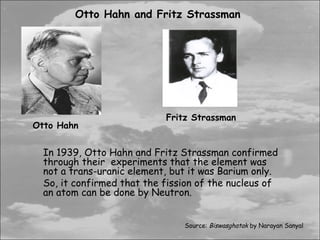
Otto Hahn and Fritz Strassman


                            Fritz Strassman
Otto Hahn


  In 1939, Otto Hahn and Fritz Strassman confirmed
  through their experiments that the element was
  not a trans-uranic element, but it was Barium only.
  So, it confirmed that the fission of the nucleus of
  an atom can be done by Neutron.


                                Source: Biswasghatak by Narayan Sanyal
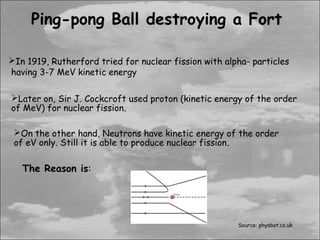
Ping-pong Ball destroying a Fort

In 1919, Rutherford tried for nuclear fission with alpha- particles
having 3-7 MeV kinetic energy

Later on, Sir J. Cockcroft used proton (kinetic energy of the order
of MeV) for nuclear fission.

 On the other hand, Neutrons have kinetic energy of the order
 of eV only. Still it is able to produce nuclear fission .

   The Reason is:


                                                       Source: physbot.co.uk
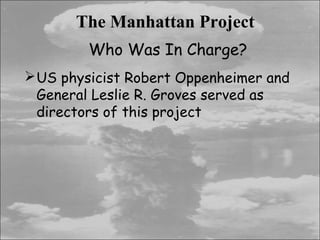
The Manhattan Project
        Who Was In Charge?
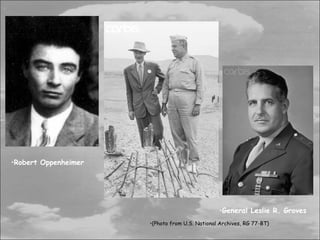
 US physicist Robert Oppenheimer and
  General Leslie R. Groves served as
  directors of this project
•Robert Oppenheimer


                                                •General Leslie R. Groves
                      •(Photo from U.S. National Archives, RG 77-BT)
The Manhattan Project (Contd.)
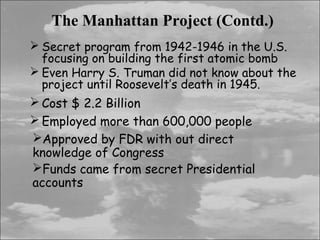
 Secret program from 1942-1946 in the U.S.
  focusing on building the first atomic bomb
 Even Harry S. Truman did not know about the
  project until Roosevelt’s death in 1945.
 Cost $ 2.2 Billion
 Employed more than 600,000 people
Approved by FDR with out direct
knowledge of Congress
Funds came from secret Presidential
accounts
Cost of Manhattan Project

In a meeting, the scientists told the production chief of
Manhattan Project, Daniel Bell that they require Silver
instead of Copper for their work as electrical conductivity
of silver is higher than that of copper.

Mr. Bell asked them how much silver they want?

The answer was: “For now, 15 thousand tons.”

Mr. Bell was astonished and told that silver is
measured in ounce, not in tons.

 Their reply was: “5.4*108 ounce”


                                  Source: Biswasghatak by Narayan Sanyal
Nuclear Reactions as an Energy
           Source


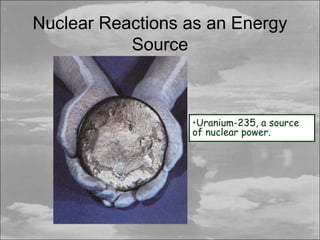
                  •Uranium-235, a source
                  of nuclear power.
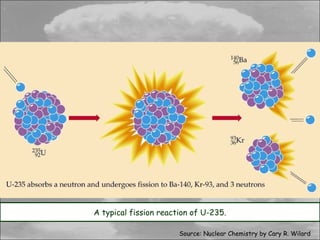
A typical fission reaction of U-235.

                       Source: Nuclear Chemistry by Cary R. Wilard
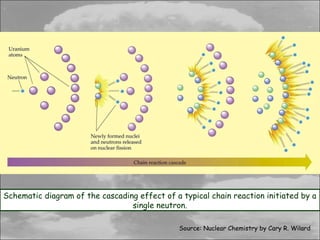
Schematic diagram of the cascading effect of a typical chain reaction initiated by a
                                 single neutron.

                                               Source: Nuclear Chemistry by Cary R. Wilard
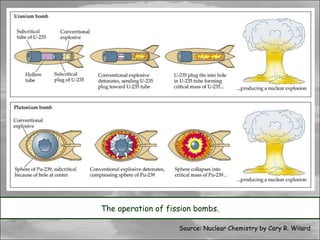
The operation of fission bombs.

                    Source: Nuclear Chemistry by Cary R. Wilard
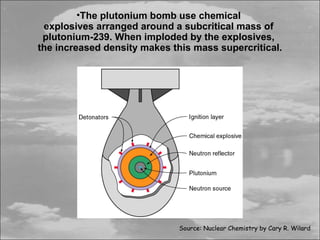
•The plutonium bomb use chemical
 explosives arranged around a subcritical mass of
 plutonium-239. When imploded by the explosives,
the increased density makes this mass supercritical.


                              Source: Nuclear Chemistry by Cary R. Wilard
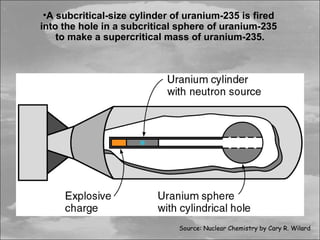
•A subcritical-size cylinder of uranium-235 is fired
into the hole in a subcritical sphere of uranium-235
    to make a supercritical mass of uranium-235.


                               Source: Nuclear Chemistry by Cary R. Wilard
Scientists Involved in Manhattan Project

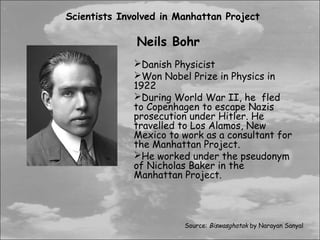
              Neils Bohr
              Danish Physicist
              Won Nobel Prize in Physics in
              1922
              During World War II, he fled
              to Copenhagen to escape Nazis
              prosecution under Hitler. He
              travelled to Los Alamos, New
              Mexico to work as a consultant for
              the Manhattan Project.
              He worked under the pseudonym
              of Nicholas Baker in the
              Manhattan Project.


                        Source: Biswasghatak by Narayan Sanyal
Scientists Involved in Manhattan Project (Contd.)

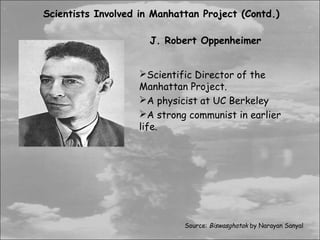
                      J. Robert Oppenheimer


                   Scientific Director of the
                   Manhattan Project.
                   A physicist at UC Berkeley
                   A strong communist in earlier
                   life.


                             Source: Biswasghatak by Narayan Sanyal
Scientists Involved in Manhattan Project (Contd.)


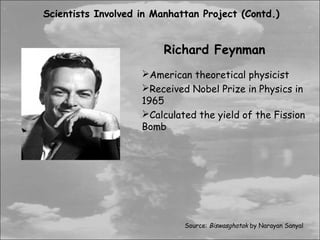
                         Richard Feynman
                    American theoretical physicist
                    Received Nobel Prize in Physics in
                    1965
                    Calculated the yield of the Fission
                    Bomb


                             Source: Biswasghatak by Narayan Sanyal
Scientists Involved in Manhattan Project (Contd.)


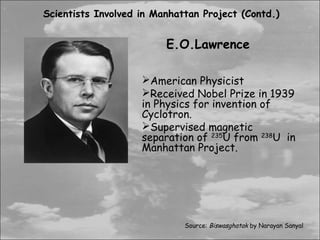
                         E.O.Lawrence

                    American Physicist
                    Received Nobel Prize in 1939
                    in Physics for invention of
                    Cyclotron.
                    Supervised magnetic
                    separation of 235U from 238U in
                    Manhattan Project.


                             Source: Biswasghatak by Narayan Sanyal
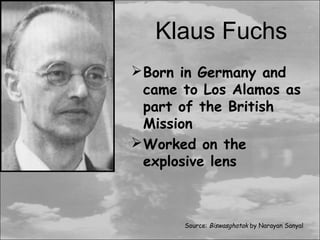
Klaus Fuchs
 Born in Germany and
  came to Los Alamos as
  part of the British
  Mission
 Worked on the
  explosive lens


       Source: Biswasghatak by Narayan Sanyal
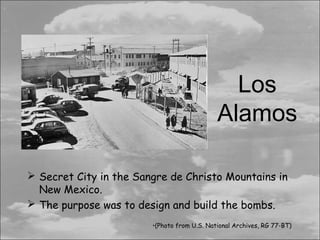
Los
                                             Alamos

 Secret City in the Sangre de Christo Mountains in
  New Mexico.
 The purpose was to design and build the bombs.
                        •(Photo from U.S. National Archives, RG 77-BT)
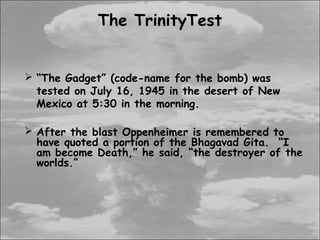
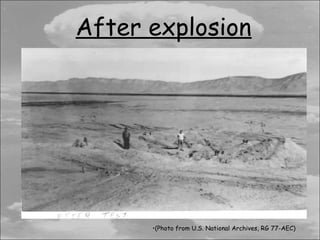
The TrinityTest


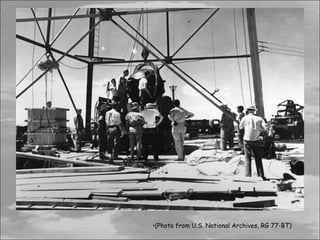
 “The Gadget” (code-name for the bomb) was
  tested on July 16, 1945 in the desert of New
  Mexico at 5:30 in the morning.

 After the blast Oppenheimer is remembered to
  have quoted a portion of the Bhagavad Gita. “I
  am become Death,” he said, “the destroyer of the
  worlds.”
•(Photo from U.S. National Archives, RG 77-BT)
After explosion


      •(Photo from U.S. National Archives, RG 77-AEC)
July, 1945
 With the war in Europe over, the Nazis and
  Hitler defeated, President Truman gives
  the Japanese an ultimatum.

 Potsdam Declaration in July 26, 1945
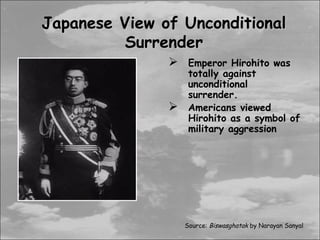
Japanese View of Unconditional
         Surrender
                Emperor Hirohito was
                    totally against
                    unconditional
                    surrender.
                   Americans viewed
                    Hirohito as a symbol of
                    military aggression


                   Source: Biswasghatak by Narayan Sanyal
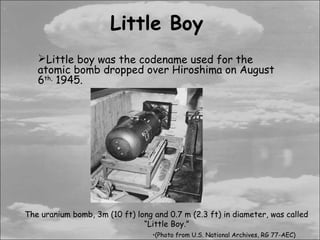
Little Boy
   Little boy was the codename used for the
   atomic bomb dropped over Hiroshima on August
   6th, 1945.


The uranium bomb, 3m (10 ft) long and 0.7 m (2.3 ft) in diameter, was called
                               “Little Boy.”
                                  •(Photo from U.S. National Archives, RG 77-AEC)
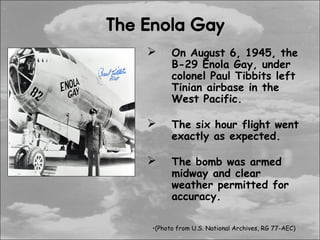
The Enola Gay
          On August 6, 1945, the
           B-29 Enola Gay, under
           colonel Paul Tibbits left
           Tinian airbase in the
           West Pacific.

          The six hour flight went
           exactly as expected.

          The bomb was armed
           midway and clear
           weather permitted for
           accuracy.

     •(Photo from U.S. National Archives, RG 77-AEC)
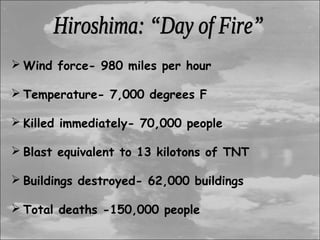
 Wind force- 980 miles per hour

 Temperature- 7,000 degrees F

 Killed immediately- 70,000 people

 Blast equivalent to 13 kilotons of TNT

 Buildings destroyed- 62,000 buildings

 Total deaths -150,000 people
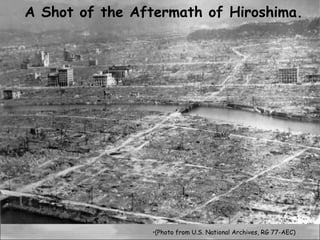
A Shot of the Aftermath of Hiroshima.


                 •(Photo from U.S. National Archives, RG 77-AEC)
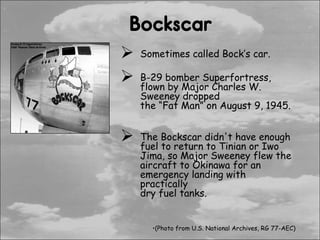
Bockscar
   Sometimes called Bock’s car.

   B-29 bomber Superfortress,
    flown by Major Charles W.
    Sweeney dropped
    the “Fat Man” on August 9, 1945.


   The Bockscar didn't have enough
    fuel to return to Tinian or Iwo
    Jima, so Major Sweeney flew the
    aircraft to Okinawa for an
    emergency landing with
    practically
    dry fuel tanks.


      •(Photo from U.S. National Archives, RG 77-AEC)
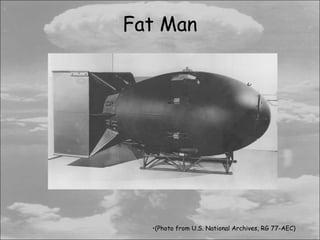
Fat Man


  •(Photo from U.S. National Archives, RG 77-AEC)
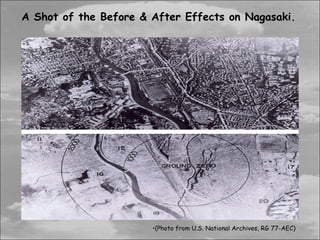
What did bomb do?
 Initial blast killed about 50,000
  people almost instantly.
 By the end of the year the total
  killed passed 80,000 people.
 1 sq. mile of total destruction
 2-3 sq. miles of fires
A Shot of the Before & After Effects on Nagasaki.


                       •(Photo from U.S. National Archives, RG 77-AEC)
Truman’s Motivations
   Many historians believe that a main reason
    for the use of the bomb was retaliation for
    the surprise and brutal attack on Pearl
    Harbor.

   After the bomb was dropped on Hiroshima,
    Truman said “This is the greatest thing in
    history.” and “Nobody is more disturbed over
    the use of atomic bombs than I am but I was
    greatly disturbed over the unwarranted
    attack by the Japanese on Pearl Harbor.
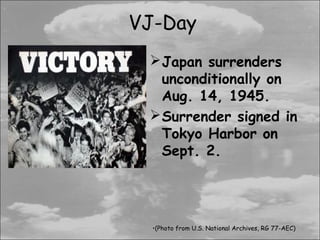
VJ-Day
  Japan surrenders
   unconditionally on
   Aug. 14, 1945.
  Surrender signed in
   Tokyo Harbor on
   Sept. 2.


  •(Photo from U.S. National Archives, RG 77-AEC)
The Treachery
On 14th Sept 1945, Truman received a letter from William
Lyon Mackenzie King, the President of Canada, informing
that the secrets of Manhattan Project and Atom Bomb has
been transferred to Soviet Union.
All necessary information were briefed in microfilm
(foolscap 8 pages only) and transferred within a CIGARETTE
PACKET.
It was transferred by Dexter(pseudonym) to Raymond
(pseudonym) on 11th August,1945.
Truman after receiving the letter told Henry L. Stimson,
the then Secretary of War, “This also requires action”
The investigation committee was headed by Col. Pash.


                                 Source: Biswasghatak by Narayan Sanyal
The Atomic Spies
David Greenglass
Confessed that he gave crude schematics of lab
experiments to the Russians.
He was sentenced to 15 years inprisonment.


Julius and Ethel Rosenberg
 Alleged to have been communist sympathizers
 They were executed in the electric chair at Sing
 Sing Prison
Who was Dexter ?
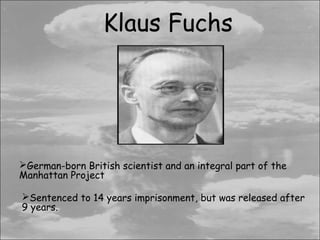
Klaus Fuchs


German-born British scientist and an integral part of the
Manhattan Project

Sentenced to 14 years imprisonment, but was released after
9 years.
Why?

The Manhattan Project made U.S.A. the sole owner of
the most disastrous weapon in world history, the ATOM
BOMB.
But the scientists who contributed in its discovery
were mostly foreigners, not Americans (except few like
Lawrence, Compton,etc).
But, the entire capital was invested by U.S.A
government.
Russia after getting information from Fuchs made
successful atom bomb test on 23rd Sept, 1949.
They were followed by Britain (1957), France (1960),
China (1964), India (1974).
This reduced the dominancy of U.S.A. to a great
extent.
Why?

After Fuchs was released, his father
told:
“Neither he nor I have ever blamed the
British people for his sentence. He
endured his fate bravely, with
determination and a clear conscience.
He said to himself ’If I don’t take this
step, the imminent danger to humanity
will never cease.’ I can only have
greatest respect for the decision he
took.”
                      Source: Biswasghatak by Narayan Sanyal
The monetary value of this treachery


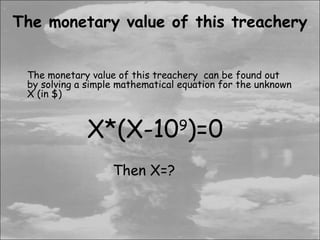
 The monetary value of this treachery can be found out
 by solving a simple mathematical equation for the unknown
 X (in $)


             X*(X-10 )=0         9


                   Then X=?
Bibliography
•Sanyal Narayan, 1974, 'Viswasghatak (Traitor)', Dey's Publishing, Calcutta
•"Archival Milestones". National Archives and Records Administration. Retrieved
2011-03-31
•Galer,D. The Manhattan Project.
•Cary R. Wilard. Nuclear Chemistry
•American Nation in the Modern Era. New York: Holt, Rinehart and Winston, 2005.
•"The Manhattan Project: An Interactive History." Department of Energy - CFO
Home. 20 Apr. 2009. <http://www.cfo.doe.gov/me70/manhattan/index.htm>.  
•"Key Issues: Nuclear Weapons: History: Pre Cold War: Manhattan Project."
Nuclear Files - From nuclear proliferation to nuclear testing, from Hiroshima to
North Korea, Nuclear Files offers the A to Z on nuclear issues. 26 Apr. 2009.
<http://www.nuclearfiles.org/menu/key-issues/nuclear-weapons/history/pre-cold-
war/manhattan-project/>.
•"The Manhattan Project." Travel and History. 26 Apr. 2009. <http://www.u-s-
history.com/pages/h1644.html>.
•http://www.gwu.edu/~nsarchiv/NSAEBB/NSAEBB162/index.htm
•America: Pathways to the Present, Prentice Hall
•http://www.gwu.edu/~nsarchiv/NSAEBB/NSAEBB162/index.htm
•http://www.loc.gov/index.html?gclid=CIrKuOifg4kCFQ2uSAod7irfAA
The Traitor?

The Traitor?

  • 1.
    Presented By: Pranamesh Chakraborty Department of Civil Engineering 1st Year M.Tech (Transportation Engineering) Indian Institute of Technology, Kanpur
  • 2.
    The Manhattan Project A top secret U.S. project  Program to develop atom bombs Began December 1941 & ended in 1946 (Source: The Manhattan Project by Diana Galer)
  • 3.
    How it started In1933 the charismatic Hitler rose to power causing a great fear and hatred for him among the Jewish people including Albert Einstein In 1938 Germany was able to split an uranium atom and was getting more aggressive. Physicists Leo Szilard and Eugene Winger became concerned with the recent aggression by Germany Leo and Eugene consulted with Einstein and they wrote a letter to Roosevelt with his signature Roosevelt received the Letter from Einstein on October 11, 1939 from Alexander Sachs. After Roosevelt read the Letter he assigned a committee of people to study uranium chain reactions.
  • 4.
    Albert Einstein Eugene Wigner Leó Szilárd Franklin D. Roosevelt (Source: The Manhattan Project by Diana Galer)
  • 5.
  • 6.
    American Involvement inWorld War II Before 1941, U.S was acting as a supporting role for Britain in World War II. But on 7th Dec 1941, Imperial Japan’s First Air Fleet launched a surprise attack against the United States Navy (USN) based at Pearl Harbor in Hawaii. 361 Japanese warplanes attack American airfields and shipyards, disabling 19 ships, destroying 200 planes, and killing over 2300 men. Southeast Asia, Hong Kong, Malaya, Philippines soon fell to Japan On Dec 8, Congress approves entry into war. Germany and Italy declare war on U.S.
  • 7.
  • 8.
    Nuclear Programs: Germany Germany started experimenting with Nuclear Fission in 1938.  German scientist Otto Hahn, Fritz Strassman, Max Born, Max Planck, Heisenberg were involved in the project.
  • 9.
    Otto Hahn German Chemist Regardedas “the father of the Nuclear Chemistry Awarded Nobel Prize in 1944 in Chemistry "for his discovery of the fission of heavy atomic nuclei."
  • 10.
    Werner Heisenberg German physicist Awardedthe Nobel Prize for Physics in 1932 "for the creation of quantum mechanics“. "He lies here, somewhere." This is a joke about the famous Heisenberg Uncertainty Principle, which implies that one may not know the position and momentum of a particle simultaneously.
  • 11.
    Failure of theGerman Nuclear Program  June 1942 – German atomic program slows down because Germany felt victory in WWII was imminent.  When Adolf Hitler was in power, Hitler encouraged many top scientists to leave Europe.
  • 12.
    The Discovery ofFission Henri Becquerel • Discovered Radioactivity in 1896. • Observed that Uranium salts would expose photographic film even when covered with opaque paper. (Source: The Manhattan Project by Diana Galer)
  • 13.
    James Chadwick • Discoveredthe neutron in 1932. • The neutron is a particle that has the same mass as a proton with zero charge. (Source: The Manhattan Project by Diana Galer)
  • 14.
    Frederic and Irene Joliot-Curie • Discovered Artificial Radioactivity in 1934 27 Al + 13 4 2α → 30 P 15 + 1 n 0 (Source: The Manhattan Project by Diana Galer)
  • 15.
    Enrico Fermi • Bombardedalmost every element in the Periodic Table with neutrons. • He came to the conclusion that a new element (transuranic element) have been discovered by bombarding Uranium with neutrons. (Source: The Manhattan Project by Diana Galer)
  • 16.
    Walter and IdaNoddack They suggested the possibility that "it is conceivable that the nucleus breaks up into several large fragments, which would of course be isotopes of known elements but would not be neighbours of the irradiated element." Ida Noddack But, there were no theoretical basis in support of it and hence the theory was rejected by scientists like Otto Hahn, Ernest Rutherford and others. Source: Biswasghatak by Narayan Sanyal
  • 17.
    Otto Hahn andFritz Strassman Fritz Strassman Otto Hahn In 1939, Otto Hahn and Fritz Strassman confirmed through their experiments that the element was not a trans-uranic element, but it was Barium only. So, it confirmed that the fission of the nucleus of an atom can be done by Neutron. Source: Biswasghatak by Narayan Sanyal
  • 18.
    Ping-pong Ball destroyinga Fort In 1919, Rutherford tried for nuclear fission with alpha- particles having 3-7 MeV kinetic energy Later on, Sir J. Cockcroft used proton (kinetic energy of the order of MeV) for nuclear fission. On the other hand, Neutrons have kinetic energy of the order of eV only. Still it is able to produce nuclear fission . The Reason is: Source: physbot.co.uk
  • 19.
    The Manhattan Project Who Was In Charge?  US physicist Robert Oppenheimer and General Leslie R. Groves served as directors of this project
  • 20.
    •Robert Oppenheimer •General Leslie R. Groves •(Photo from U.S. National Archives, RG 77-BT)
  • 21.
    The Manhattan Project(Contd.)  Secret program from 1942-1946 in the U.S. focusing on building the first atomic bomb  Even Harry S. Truman did not know about the project until Roosevelt’s death in 1945.  Cost $ 2.2 Billion  Employed more than 600,000 people Approved by FDR with out direct knowledge of Congress Funds came from secret Presidential accounts
  • 22.
    Cost of ManhattanProject In a meeting, the scientists told the production chief of Manhattan Project, Daniel Bell that they require Silver instead of Copper for their work as electrical conductivity of silver is higher than that of copper. Mr. Bell asked them how much silver they want? The answer was: “For now, 15 thousand tons.” Mr. Bell was astonished and told that silver is measured in ounce, not in tons. Their reply was: “5.4*108 ounce” Source: Biswasghatak by Narayan Sanyal
  • 23.
    Nuclear Reactions asan Energy Source •Uranium-235, a source of nuclear power.
  • 24.
    A typical fissionreaction of U-235. Source: Nuclear Chemistry by Cary R. Wilard
  • 25.
    Schematic diagram ofthe cascading effect of a typical chain reaction initiated by a single neutron. Source: Nuclear Chemistry by Cary R. Wilard
  • 26.
    The operation offission bombs. Source: Nuclear Chemistry by Cary R. Wilard
  • 27.
    •The plutonium bombuse chemical explosives arranged around a subcritical mass of plutonium-239. When imploded by the explosives, the increased density makes this mass supercritical. Source: Nuclear Chemistry by Cary R. Wilard
  • 28.
    •A subcritical-size cylinderof uranium-235 is fired into the hole in a subcritical sphere of uranium-235 to make a supercritical mass of uranium-235. Source: Nuclear Chemistry by Cary R. Wilard
  • 29.
    Scientists Involved inManhattan Project Neils Bohr Danish Physicist Won Nobel Prize in Physics in 1922 During World War II, he fled to Copenhagen to escape Nazis prosecution under Hitler. He travelled to Los Alamos, New Mexico to work as a consultant for the Manhattan Project. He worked under the pseudonym of Nicholas Baker in the Manhattan Project. Source: Biswasghatak by Narayan Sanyal
  • 30.
    Scientists Involved inManhattan Project (Contd.) J. Robert Oppenheimer Scientific Director of the Manhattan Project. A physicist at UC Berkeley A strong communist in earlier life. Source: Biswasghatak by Narayan Sanyal
  • 31.
    Scientists Involved inManhattan Project (Contd.) Richard Feynman American theoretical physicist Received Nobel Prize in Physics in 1965 Calculated the yield of the Fission Bomb Source: Biswasghatak by Narayan Sanyal
  • 32.
    Scientists Involved inManhattan Project (Contd.) E.O.Lawrence American Physicist Received Nobel Prize in 1939 in Physics for invention of Cyclotron. Supervised magnetic separation of 235U from 238U in Manhattan Project. Source: Biswasghatak by Narayan Sanyal
  • 33.
    Klaus Fuchs  Bornin Germany and came to Los Alamos as part of the British Mission  Worked on the explosive lens Source: Biswasghatak by Narayan Sanyal
  • 34.
    Los Alamos  Secret City in the Sangre de Christo Mountains in New Mexico.  The purpose was to design and build the bombs. •(Photo from U.S. National Archives, RG 77-BT)
  • 35.
    The TrinityTest  “TheGadget” (code-name for the bomb) was tested on July 16, 1945 in the desert of New Mexico at 5:30 in the morning.  After the blast Oppenheimer is remembered to have quoted a portion of the Bhagavad Gita. “I am become Death,” he said, “the destroyer of the worlds.”
  • 36.
    •(Photo from U.S.National Archives, RG 77-BT)
  • 37.
    After explosion •(Photo from U.S. National Archives, RG 77-AEC)
  • 38.
    July, 1945  Withthe war in Europe over, the Nazis and Hitler defeated, President Truman gives the Japanese an ultimatum.  Potsdam Declaration in July 26, 1945
  • 39.
    Japanese View ofUnconditional Surrender  Emperor Hirohito was totally against unconditional surrender.  Americans viewed Hirohito as a symbol of military aggression Source: Biswasghatak by Narayan Sanyal
  • 40.
    Little Boy Little boy was the codename used for the atomic bomb dropped over Hiroshima on August 6th, 1945. The uranium bomb, 3m (10 ft) long and 0.7 m (2.3 ft) in diameter, was called “Little Boy.” •(Photo from U.S. National Archives, RG 77-AEC)
  • 41.
    The Enola Gay  On August 6, 1945, the B-29 Enola Gay, under colonel Paul Tibbits left Tinian airbase in the West Pacific.  The six hour flight went exactly as expected.  The bomb was armed midway and clear weather permitted for accuracy. •(Photo from U.S. National Archives, RG 77-AEC)
  • 42.
     Wind force-980 miles per hour  Temperature- 7,000 degrees F  Killed immediately- 70,000 people  Blast equivalent to 13 kilotons of TNT  Buildings destroyed- 62,000 buildings  Total deaths -150,000 people
  • 43.
    A Shot ofthe Aftermath of Hiroshima. •(Photo from U.S. National Archives, RG 77-AEC)
  • 44.
    Bockscar  Sometimes called Bock’s car.  B-29 bomber Superfortress, flown by Major Charles W. Sweeney dropped the “Fat Man” on August 9, 1945.  The Bockscar didn't have enough fuel to return to Tinian or Iwo Jima, so Major Sweeney flew the aircraft to Okinawa for an emergency landing with practically dry fuel tanks. •(Photo from U.S. National Archives, RG 77-AEC)
  • 45.
    Fat Man •(Photo from U.S. National Archives, RG 77-AEC)
  • 46.
    What did bombdo?  Initial blast killed about 50,000 people almost instantly.  By the end of the year the total killed passed 80,000 people.  1 sq. mile of total destruction  2-3 sq. miles of fires
  • 47.
    A Shot ofthe Before & After Effects on Nagasaki. •(Photo from U.S. National Archives, RG 77-AEC)
  • 48.
    Truman’s Motivations  Many historians believe that a main reason for the use of the bomb was retaliation for the surprise and brutal attack on Pearl Harbor.  After the bomb was dropped on Hiroshima, Truman said “This is the greatest thing in history.” and “Nobody is more disturbed over the use of atomic bombs than I am but I was greatly disturbed over the unwarranted attack by the Japanese on Pearl Harbor.
  • 49.
    VJ-Day  Japansurrenders unconditionally on Aug. 14, 1945.  Surrender signed in Tokyo Harbor on Sept. 2. •(Photo from U.S. National Archives, RG 77-AEC)
  • 50.
    The Treachery On 14thSept 1945, Truman received a letter from William Lyon Mackenzie King, the President of Canada, informing that the secrets of Manhattan Project and Atom Bomb has been transferred to Soviet Union. All necessary information were briefed in microfilm (foolscap 8 pages only) and transferred within a CIGARETTE PACKET. It was transferred by Dexter(pseudonym) to Raymond (pseudonym) on 11th August,1945. Truman after receiving the letter told Henry L. Stimson, the then Secretary of War, “This also requires action” The investigation committee was headed by Col. Pash. Source: Biswasghatak by Narayan Sanyal
  • 51.
    The Atomic Spies DavidGreenglass Confessed that he gave crude schematics of lab experiments to the Russians. He was sentenced to 15 years inprisonment. Julius and Ethel Rosenberg Alleged to have been communist sympathizers They were executed in the electric chair at Sing Sing Prison
  • 52.
  • 53.
    Klaus Fuchs German-born Britishscientist and an integral part of the Manhattan Project Sentenced to 14 years imprisonment, but was released after 9 years.
  • 54.
    Why? The Manhattan Projectmade U.S.A. the sole owner of the most disastrous weapon in world history, the ATOM BOMB. But the scientists who contributed in its discovery were mostly foreigners, not Americans (except few like Lawrence, Compton,etc). But, the entire capital was invested by U.S.A government. Russia after getting information from Fuchs made successful atom bomb test on 23rd Sept, 1949. They were followed by Britain (1957), France (1960), China (1964), India (1974). This reduced the dominancy of U.S.A. to a great extent.
  • 55.
    Why? After Fuchs wasreleased, his father told: “Neither he nor I have ever blamed the British people for his sentence. He endured his fate bravely, with determination and a clear conscience. He said to himself ’If I don’t take this step, the imminent danger to humanity will never cease.’ I can only have greatest respect for the decision he took.” Source: Biswasghatak by Narayan Sanyal
  • 56.
    The monetary valueof this treachery The monetary value of this treachery can be found out by solving a simple mathematical equation for the unknown X (in $) X*(X-10 )=0 9 Then X=?
  • 57.
    Bibliography •Sanyal Narayan, 1974,'Viswasghatak (Traitor)', Dey's Publishing, Calcutta •"Archival Milestones". National Archives and Records Administration. Retrieved 2011-03-31 •Galer,D. The Manhattan Project. •Cary R. Wilard. Nuclear Chemistry •American Nation in the Modern Era. New York: Holt, Rinehart and Winston, 2005. •"The Manhattan Project: An Interactive History." Department of Energy - CFO Home. 20 Apr. 2009. <http://www.cfo.doe.gov/me70/manhattan/index.htm>.   •"Key Issues: Nuclear Weapons: History: Pre Cold War: Manhattan Project." Nuclear Files - From nuclear proliferation to nuclear testing, from Hiroshima to North Korea, Nuclear Files offers the A to Z on nuclear issues. 26 Apr. 2009. <http://www.nuclearfiles.org/menu/key-issues/nuclear-weapons/history/pre-cold- war/manhattan-project/>. •"The Manhattan Project." Travel and History. 26 Apr. 2009. <http://www.u-s- history.com/pages/h1644.html>. •http://www.gwu.edu/~nsarchiv/NSAEBB/NSAEBB162/index.htm •America: Pathways to the Present, Prentice Hall •http://www.gwu.edu/~nsarchiv/NSAEBB/NSAEBB162/index.htm •http://www.loc.gov/index.html?gclid=CIrKuOifg4kCFQ2uSAod7irfAA