Diet
Vs
Weight-Loss
Analysis
DESIGNS OF EXPERIMENT PROJECT
Hello!
Presented by:
Vidit Jain - M013
75251219007
Our Mentor:
Prof. Preeti Ravikiran
2
“ Did you know “DIET”
stands for :
DID I EAT THAT?
3
Table of
Content
▫ Introduction
▫ Methodology
▫ Our Data
▫ Descriptive Statistics
▫ Proposed Hypothesis
▫ Test for Normality & Homogeneity of Variance
▫ Analysis of Variance (ANOVA)
▫ Conclusions
▫ Post –Hoc Tests
▫ Inferences
4
Designs of
Experiment
Designs of experiment (DOE) is defined as a
branch of applied statistics that deals with
planning, conducting, analyzing, and interpreting
tests to evaluate the factors that control the value
of a parameter or group of parameters. DOE is a
powerful data collection and analysis tool that
can be used in a variety of experimental
situations.
5
ANOVA
ANALYSIS OF VARIANCE
Analysis of variance (ANOVA) is a statistical technique that is used to check
if the means of two or more groups are significantly different from each
other. ANOVA checks the impact of one or more factors by comparing the
means of different samples.
7
ASSUMPTIONS
1. All effects are additive.
2. The observations are independent of each
other.
3. eij’s ∼ N(0, σ2)
4. The dependent variables should be
measurable.
5. Parent population from which samples are
drawn should be normal.
6. Homogeneity of variance between the groups
should be satisfied. 8
A test that allows one to make comparisons
between the means of three or more groups
of data, where one independent variables is
considered.
The one-way ANOVA model is given by,
𝑥𝑖𝑗 = 𝜇 + 𝛼𝑖 + 𝜖𝑖𝑗
Dependent variable = overall mean +
treatment effect + random error
9
One-Way ANOVA
10
Null Hypothesis:
𝐻0: 𝜇1 = 𝜇2 = ⋯ = 𝜇𝑘
(There is no difference in the
population means)
VS
Alternative Hypothesis:
𝐻1: 𝜇𝑖 ≠ 𝜇𝑗
(At least two population
means are different)
TSS = SSTr + SSE
𝑇𝑆𝑆 = 𝑇𝑜𝑡𝑎𝑙 𝑆𝑢𝑚 𝑜𝑓 𝑆𝑞𝑢𝑎𝑟𝑒𝑠 =
𝑖 𝑗
(𝑥𝑖𝑗 − 𝑥. . )2
𝑆𝑆𝑇𝑟 = 𝑆𝑢𝑚 𝑜𝑓 𝑆𝑞𝑢𝑎𝑟𝑒𝑠 𝑑𝑢𝑒 𝑡𝑜 𝑇𝑟𝑒𝑎𝑡𝑚𝑒𝑛𝑡𝑠 =
𝑖 𝑗
(𝑥𝑖. −𝑥. . ) =
𝑖
𝑛𝑖( 𝑥𝑖. −𝑥. . )
𝑆𝑆𝐸 = 𝑆𝑢𝑚 𝑜𝑓 𝑆𝑞𝑢𝑎𝑟𝑒𝑠 𝑑𝑢𝑒 𝑡𝑜 𝐸𝑟𝑟𝑜𝑟𝑠 =
𝑖 𝑗
(𝑥𝑖𝑗 − 𝑥𝑖. )2
Source of
Variation
Sum of
Squared
Degree of
Freedom
Mean Sum
of Squares
Fcal Ftab
Treatment SSTr k-1 𝑀𝑆𝑆𝑇𝑟
=
𝑆𝑆𝑇𝑟
𝑘 − 1
𝐹
=
𝑀𝑆𝑆𝑇𝑟
𝑀𝑆𝑆𝐸
𝐹
𝛼(𝑘 − 1, 𝑁 − 𝑘)
Error SSE N-k 𝑀𝑆𝑆𝐸
=
𝑆𝑆𝐸
𝑁 − 𝑘
Total TSS N-1
11
A test that allows one to make comparisons
between the means of three or more groups of
data, where two independent variables are
considered.
The two-way ANOVA model is given by,
𝑥𝑖𝑗 = 𝜇 + 𝛼𝑖 + 𝛽𝑗 + 𝜖𝑖𝑗
Dependent variable = overall mean + treatment
effect + block effect + random error
12
Two Way ANOVA
13
VS
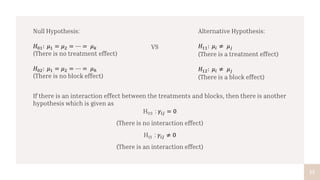
Null Hypothesis:
𝐻01: 𝜇1 = 𝜇2 = ⋯ = 𝜇𝑘
(There is no treatment effect)
𝐻02: 𝜇1 = 𝜇2 = ⋯ = 𝜇ℎ
(There is no block effect)
Alternative Hypothesis:
𝐻11: 𝜇𝑖 ≠ 𝜇𝑗
(There is a treatment effect)
𝐻12: 𝜇𝑖 ≠ 𝜇𝑗
(There is a block effect)
If there is an interaction effect between the treatments and blocks, then there is another
hypothesis which is given as
H03 : 𝛾𝑖𝑗 = 0
(There is no interaction effect)
H13 : 𝛾𝑖𝑗 ≠ 0
(There is an interaction effect)
14
Source of
Variation
Sum of
Squared
Degree of
Freedom
Mean Sum of
Squares
Fcal Ftab
Treatment SSTr p-1 𝑀𝑆𝑆𝑇𝑟
=
𝑆𝑆𝑇𝑟
𝑝 − 1
𝐹 =
𝑀𝑆𝑆𝑇𝑟
𝑀𝑆𝑆𝐸
𝐹
𝛼( 𝑝 − 1 , 𝑝𝑞(𝑚
Blocks SSB q-1
𝑀𝑆𝑆𝐵 =
𝑆𝑆𝐵
𝑞 − 1
𝐹 =
𝑀𝑆𝑆𝐵
𝑀𝑆𝑆𝐸
𝐹
𝛼( 𝑞 − 1 , 𝑝𝑞(𝑚
Interaction SSTr*B (p-1)(q-1) 𝑀𝑆𝑆𝑇𝑟 ∗ 𝐵
=
𝑆𝑆𝑇𝑟 ∗ 𝐵
(𝑝 − 1)(𝑞 − 1)
𝐹
=
𝑀𝑆𝑆𝑇𝑟 ∗ 𝐵
𝑀𝑆𝑆𝐸
𝐹
𝛼( 𝑝 − 1 (𝑞
Error SSE pq(m-1) 𝑀𝑆𝑆𝐸
=
𝑆𝑆𝐸
𝑚 − 1 𝑝𝑞
Total TSS Mpq-1
METHODOLOGY
1. Designing the experiment
2. Exploratory data analysis
3. Checking for normality
4. Homogeneity of variance
5. ANOVA
6. Conclusion
7. Inferences
15
DATA
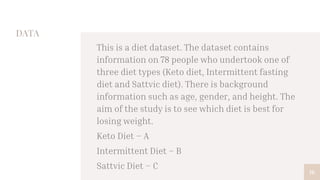
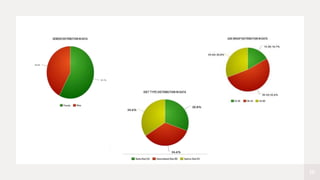
This is a diet dataset. The dataset contains
information on 78 people who undertook one of
three diet types (Keto diet, Intermittent fasting
diet and Sattvic diet). There is background
information such as age, gender, and height. The
aim of the study is to see which diet is best for
losing weight.
Keto Diet – A
Intermittent Diet – B
Sattvic Diet – C
16
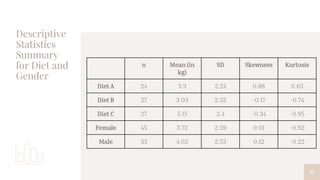
Descriptive
Statistics
Summary
for Diet and
Gender
17
n Mean (in
kg)
SD Skewness Kurtosis
Diet A 24 3.3 2.24 0.88 0.65
Diet B 27 3.03 2.52 -0.17 -0.74
Diet C 27 5.15 2.4 -0.34 -0.95
Female 45 3.72 2.59 0.01 -0.92
Male 33 4.02 2.53 0.12 -0.22
18
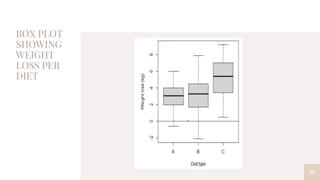
BOX PLOT
SHOWING
WEIGHT
LOSS PER
DIET
19
HYPOTHESIS
H01 : 𝜇1 = 𝜇2
(There is no effect
of gender on weight
loss)
v/s
H11 : 𝜇𝑖 ≠ 𝜇𝑗
(There is an effect
of gender on weight
loss)
H02 : 𝜇1 = 𝜇2 = 𝜇3
(There is no effect
of diet type on
weight loss)
v/s
H12 : 𝜇𝑖 ≠ 𝜇𝑗
(There is an effect
of diet type on
weight loss)
H03 : 𝛾𝑖𝑗 = 0
(There is no
interaction effect
between gender
and diet)
v/s
H13 : 𝛾𝑖𝑗 ≠ 0
(There is an
interaction effect
between gender
and diet)
20
21
TESTING
OUR DATA
FOR
NORMALITY
22
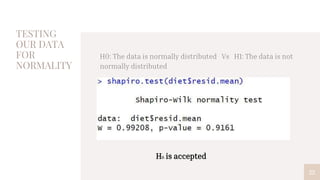
H0: The data is normally distributed Vs H1: The data is not
normally distributed
H0 is accepted
HOMOGENEITY
OF VARIANCE
23
H0: All groups have equal variance Vs H1: Variance of all
groups is not same
H0 is accepted
ANOVA TABLE
24
Degrees
of
Freedom
Sum of
Squares
Mean
Sum of
Squares
F-
calculate
d value
F-table
value
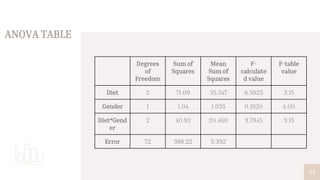
Diet 2 71.09 35.547 6.5925 3.15
Gender 1 1.04 1.035 0.1920 4.00
Diet*Gend
er
2 40.92 20.460 3.7945 3.15
Error 72 388.22 5.392
25
CONCLUSION
Diet type Gender Interaction effect
H0 is rejected H0 is rejected
H0 is accepted
1. Gender does not significantly affect average
weight loss.
2. Diet alone does not affect weight.
3. But combination of Gender and Diet has a
significant effect on weight loss.
26
27
28
t-value Degrees of
Freedom
p-value 95%
Confidence
Interval
A-B 0.40798 49 0.6851 (-1.075930,
1.624079)
A-C -2.8348 49 0.006644 (-3.1582988, -
0.5379975)
B-C -3.1693 52 0.00256 (-3.4658892, -
0.7785553)
Based on the Post Hoc
test, we can conclude
that Sattvic diet has a
significant effect.
30
Weight loss
(Mean value)
t-value
Degrees of
Freedom p-value
95%
Confidence
Interval
Male female
Ketto Diet(A) 3.65 3.05 -0.6385 22 0.5297
(-2.548793,
0.1066417)
Intermittent
Diet(B) 2.28 4.11 -1.9460 25 0.06298
(-3.7923236,
0.1066417)
Sattvic Diet
( C) 4.23 5.88 1.8564 25 0.7522
(-0.1801614,
3.4734948)
▫ Dieticians can use the result of this study to
analyse which diet is suitable for weight loss
for males and females.
▫ Further analysis can be done using the factors
age-group and diet.
31
FUTURE
SCOPE OF
THE STUDY
Thanks!
32

DOE Project ANOVA Analysis Diet Type

  • 1.
  • 2.
    Hello! Presented by: Vidit Jain- M013 75251219007 Our Mentor: Prof. Preeti Ravikiran 2
  • 3.
    “ Did youknow “DIET” stands for : DID I EAT THAT? 3
  • 4.
    Table of Content ▫ Introduction ▫Methodology ▫ Our Data ▫ Descriptive Statistics ▫ Proposed Hypothesis ▫ Test for Normality & Homogeneity of Variance ▫ Analysis of Variance (ANOVA) ▫ Conclusions ▫ Post –Hoc Tests ▫ Inferences 4
  • 5.
    Designs of Experiment Designs ofexperiment (DOE) is defined as a branch of applied statistics that deals with planning, conducting, analyzing, and interpreting tests to evaluate the factors that control the value of a parameter or group of parameters. DOE is a powerful data collection and analysis tool that can be used in a variety of experimental situations. 5
  • 6.
  • 7.
    Analysis of variance(ANOVA) is a statistical technique that is used to check if the means of two or more groups are significantly different from each other. ANOVA checks the impact of one or more factors by comparing the means of different samples. 7
  • 8.
    ASSUMPTIONS 1. All effectsare additive. 2. The observations are independent of each other. 3. eij’s ∼ N(0, σ2) 4. The dependent variables should be measurable. 5. Parent population from which samples are drawn should be normal. 6. Homogeneity of variance between the groups should be satisfied. 8
  • 9.
    A test thatallows one to make comparisons between the means of three or more groups of data, where one independent variables is considered. The one-way ANOVA model is given by, 𝑥𝑖𝑗 = 𝜇 + 𝛼𝑖 + 𝜖𝑖𝑗 Dependent variable = overall mean + treatment effect + random error 9 One-Way ANOVA
  • 10.
    10 Null Hypothesis: 𝐻0: 𝜇1= 𝜇2 = ⋯ = 𝜇𝑘 (There is no difference in the population means) VS Alternative Hypothesis: 𝐻1: 𝜇𝑖 ≠ 𝜇𝑗 (At least two population means are different) TSS = SSTr + SSE 𝑇𝑆𝑆 = 𝑇𝑜𝑡𝑎𝑙 𝑆𝑢𝑚 𝑜𝑓 𝑆𝑞𝑢𝑎𝑟𝑒𝑠 = 𝑖 𝑗 (𝑥𝑖𝑗 − 𝑥. . )2 𝑆𝑆𝑇𝑟 = 𝑆𝑢𝑚 𝑜𝑓 𝑆𝑞𝑢𝑎𝑟𝑒𝑠 𝑑𝑢𝑒 𝑡𝑜 𝑇𝑟𝑒𝑎𝑡𝑚𝑒𝑛𝑡𝑠 = 𝑖 𝑗 (𝑥𝑖. −𝑥. . ) = 𝑖 𝑛𝑖( 𝑥𝑖. −𝑥. . ) 𝑆𝑆𝐸 = 𝑆𝑢𝑚 𝑜𝑓 𝑆𝑞𝑢𝑎𝑟𝑒𝑠 𝑑𝑢𝑒 𝑡𝑜 𝐸𝑟𝑟𝑜𝑟𝑠 = 𝑖 𝑗 (𝑥𝑖𝑗 − 𝑥𝑖. )2
  • 11.
    Source of Variation Sum of Squared Degreeof Freedom Mean Sum of Squares Fcal Ftab Treatment SSTr k-1 𝑀𝑆𝑆𝑇𝑟 = 𝑆𝑆𝑇𝑟 𝑘 − 1 𝐹 = 𝑀𝑆𝑆𝑇𝑟 𝑀𝑆𝑆𝐸 𝐹 𝛼(𝑘 − 1, 𝑁 − 𝑘) Error SSE N-k 𝑀𝑆𝑆𝐸 = 𝑆𝑆𝐸 𝑁 − 𝑘 Total TSS N-1 11
  • 12.
    A test thatallows one to make comparisons between the means of three or more groups of data, where two independent variables are considered. The two-way ANOVA model is given by, 𝑥𝑖𝑗 = 𝜇 + 𝛼𝑖 + 𝛽𝑗 + 𝜖𝑖𝑗 Dependent variable = overall mean + treatment effect + block effect + random error 12 Two Way ANOVA
  • 13.
    13 VS Null Hypothesis: 𝐻01: 𝜇1= 𝜇2 = ⋯ = 𝜇𝑘 (There is no treatment effect) 𝐻02: 𝜇1 = 𝜇2 = ⋯ = 𝜇ℎ (There is no block effect) Alternative Hypothesis: 𝐻11: 𝜇𝑖 ≠ 𝜇𝑗 (There is a treatment effect) 𝐻12: 𝜇𝑖 ≠ 𝜇𝑗 (There is a block effect) If there is an interaction effect between the treatments and blocks, then there is another hypothesis which is given as H03 : 𝛾𝑖𝑗 = 0 (There is no interaction effect) H13 : 𝛾𝑖𝑗 ≠ 0 (There is an interaction effect)
  • 14.
    14 Source of Variation Sum of Squared Degreeof Freedom Mean Sum of Squares Fcal Ftab Treatment SSTr p-1 𝑀𝑆𝑆𝑇𝑟 = 𝑆𝑆𝑇𝑟 𝑝 − 1 𝐹 = 𝑀𝑆𝑆𝑇𝑟 𝑀𝑆𝑆𝐸 𝐹 𝛼( 𝑝 − 1 , 𝑝𝑞(𝑚 Blocks SSB q-1 𝑀𝑆𝑆𝐵 = 𝑆𝑆𝐵 𝑞 − 1 𝐹 = 𝑀𝑆𝑆𝐵 𝑀𝑆𝑆𝐸 𝐹 𝛼( 𝑞 − 1 , 𝑝𝑞(𝑚 Interaction SSTr*B (p-1)(q-1) 𝑀𝑆𝑆𝑇𝑟 ∗ 𝐵 = 𝑆𝑆𝑇𝑟 ∗ 𝐵 (𝑝 − 1)(𝑞 − 1) 𝐹 = 𝑀𝑆𝑆𝑇𝑟 ∗ 𝐵 𝑀𝑆𝑆𝐸 𝐹 𝛼( 𝑝 − 1 (𝑞 Error SSE pq(m-1) 𝑀𝑆𝑆𝐸 = 𝑆𝑆𝐸 𝑚 − 1 𝑝𝑞 Total TSS Mpq-1
  • 15.
    METHODOLOGY 1. Designing theexperiment 2. Exploratory data analysis 3. Checking for normality 4. Homogeneity of variance 5. ANOVA 6. Conclusion 7. Inferences 15
  • 16.
    DATA This is adiet dataset. The dataset contains information on 78 people who undertook one of three diet types (Keto diet, Intermittent fasting diet and Sattvic diet). There is background information such as age, gender, and height. The aim of the study is to see which diet is best for losing weight. Keto Diet – A Intermittent Diet – B Sattvic Diet – C 16
  • 17.
    Descriptive Statistics Summary for Diet and Gender 17 nMean (in kg) SD Skewness Kurtosis Diet A 24 3.3 2.24 0.88 0.65 Diet B 27 3.03 2.52 -0.17 -0.74 Diet C 27 5.15 2.4 -0.34 -0.95 Female 45 3.72 2.59 0.01 -0.92 Male 33 4.02 2.53 0.12 -0.22
  • 18.
  • 19.
  • 20.
    HYPOTHESIS H01 : 𝜇1= 𝜇2 (There is no effect of gender on weight loss) v/s H11 : 𝜇𝑖 ≠ 𝜇𝑗 (There is an effect of gender on weight loss) H02 : 𝜇1 = 𝜇2 = 𝜇3 (There is no effect of diet type on weight loss) v/s H12 : 𝜇𝑖 ≠ 𝜇𝑗 (There is an effect of diet type on weight loss) H03 : 𝛾𝑖𝑗 = 0 (There is no interaction effect between gender and diet) v/s H13 : 𝛾𝑖𝑗 ≠ 0 (There is an interaction effect between gender and diet) 20
  • 21.
  • 22.
    TESTING OUR DATA FOR NORMALITY 22 H0: Thedata is normally distributed Vs H1: The data is not normally distributed H0 is accepted
  • 23.
    HOMOGENEITY OF VARIANCE 23 H0: Allgroups have equal variance Vs H1: Variance of all groups is not same H0 is accepted
  • 24.
    ANOVA TABLE 24 Degrees of Freedom Sum of Squares Mean Sumof Squares F- calculate d value F-table value Diet 2 71.09 35.547 6.5925 3.15 Gender 1 1.04 1.035 0.1920 4.00 Diet*Gend er 2 40.92 20.460 3.7945 3.15 Error 72 388.22 5.392
  • 25.
    25 CONCLUSION Diet type GenderInteraction effect H0 is rejected H0 is rejected H0 is accepted
  • 26.
    1. Gender doesnot significantly affect average weight loss. 2. Diet alone does not affect weight. 3. But combination of Gender and Diet has a significant effect on weight loss. 26
  • 27.
  • 28.
    28 t-value Degrees of Freedom p-value95% Confidence Interval A-B 0.40798 49 0.6851 (-1.075930, 1.624079) A-C -2.8348 49 0.006644 (-3.1582988, - 0.5379975) B-C -3.1693 52 0.00256 (-3.4658892, - 0.7785553)
  • 29.
    Based on thePost Hoc test, we can conclude that Sattvic diet has a significant effect.
  • 30.
    30 Weight loss (Mean value) t-value Degreesof Freedom p-value 95% Confidence Interval Male female Ketto Diet(A) 3.65 3.05 -0.6385 22 0.5297 (-2.548793, 0.1066417) Intermittent Diet(B) 2.28 4.11 -1.9460 25 0.06298 (-3.7923236, 0.1066417) Sattvic Diet ( C) 4.23 5.88 1.8564 25 0.7522 (-0.1801614, 3.4734948)
  • 31.
    ▫ Dieticians canuse the result of this study to analyse which diet is suitable for weight loss for males and females. ▫ Further analysis can be done using the factors age-group and diet. 31 FUTURE SCOPE OF THE STUDY
  • 32.