Tysen Quaintance
      11-4-11
   History 140
   Dr. Arguello
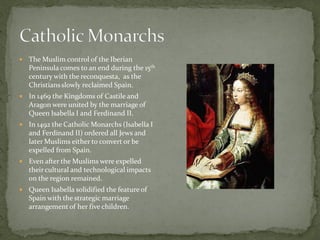
   The Muslim control of the Iberian
    Peninsula comes to an end during the 15th
    century with the reconquesta, as the
    Christians slowly reclaimed Spain.
   In 1469 the Kingdoms of Castile and
    Aragon were united by the marriage of
    Queen Isabella I and Ferdinand II.
   In 1492 the Catholic Monarchs (Isabella I
    and Ferdinand II) ordered all Jews and
    later Muslims either to convert or be
    expelled from Spain.
   Even after the Muslims were expelled
    their cultural and technological impacts
    on the region remained.
   Queen Isabella solidified the feature of
    Spain with the strategic marriage
    arrangement of her five children.
 With the extraction of Mexican
  Silver fueling the economy, the
  16th and 17th centuries were
  known as the Spanish golden
  age.
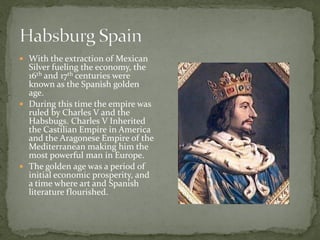
 During this time the empire was
  ruled by Charles V and the
  Habsbugs. Charles V Inherited
  the Castilian Empire in America
  and the Aragonese Empire of the
  Mediterranean making him the
  most powerful man in Europe.
 The golden age was a period of
  initial economic prosperity, and
  a time where art and Spanish
  literature flourished.
 Unfortunately the Spanish
  became so rich with gold and
  silver that it lead to terrible
  inflation towards the end of the
  16th century. It was said that,
  "Everything is dear in Spain
  except silver".[
 The Habsburg Dynasty also
  bankrupted Spain many times
  financing European War in
  including the 30 year was that
  consumed all of Europe.
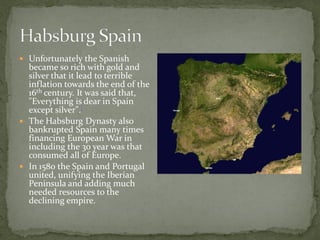
 In 1580 the Spain and Portugal
  united, unifying the Iberian
  Peninsula and adding much
  needed resources to the
  declining empire.
 From 1598-1602 Spain lost 10% of its
  population and it’s much needed
  work force to the Plague.
 In 1640 as the 30 year war continued,
  Portugal and Catalonia rebelled.
  Spain was successful in expelling the
  French and controlling the
  Catalonia rebellion but Portugal was
  never regained.
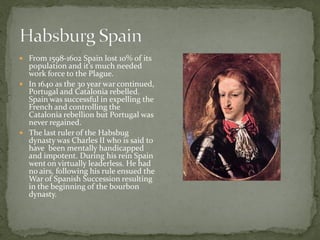
 The last ruler of the Habsbug
  dynasty was Charles II who is said to
  have been mentally handicapped
  and impotent. During his rein Spain
  went on virtually leaderless. He had
  no airs, following his rule ensued the
  War of Spanish Succession resulting
  in the beginning of the bourbon
  dynasty.
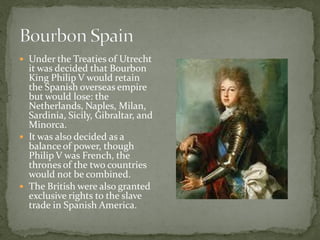
 Under the Treaties of Utrecht
  it was decided that Bourbon
  King Philip V would retain
  the Spanish overseas empire
  but would lose: the
  Netherlands, Naples, Milan,
  Sardinia, Sicily, Gibraltar, and
  Minorca.
 It was also decided as a
  balance of power, though
  Philip V was French, the
  thrones of the two countries
  would not be combined.
 The British were also granted
  exclusive rights to the slave
  trade in Spanish America.
 Philip V organizationally
  reformed Spanish
  government.
 Philip V brought along
  tighter, more efficient
  control over the colonies of
  the Spanish Empire.
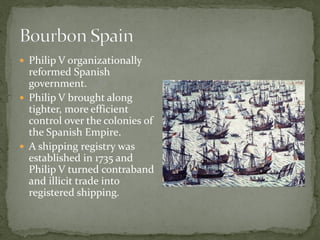
 A shipping registry was
  established in 1735 and
  Philip V turned contraband
  and illicit trade into
  registered shipping.

Theme 3 part 2

  • 1.
    Tysen Quaintance 11-4-11 History 140 Dr. Arguello
  • 2.
    The Muslim control of the Iberian Peninsula comes to an end during the 15th century with the reconquesta, as the Christians slowly reclaimed Spain.  In 1469 the Kingdoms of Castile and Aragon were united by the marriage of Queen Isabella I and Ferdinand II.  In 1492 the Catholic Monarchs (Isabella I and Ferdinand II) ordered all Jews and later Muslims either to convert or be expelled from Spain.  Even after the Muslims were expelled their cultural and technological impacts on the region remained.  Queen Isabella solidified the feature of Spain with the strategic marriage arrangement of her five children.
  • 3.
     With theextraction of Mexican Silver fueling the economy, the 16th and 17th centuries were known as the Spanish golden age.  During this time the empire was ruled by Charles V and the Habsbugs. Charles V Inherited the Castilian Empire in America and the Aragonese Empire of the Mediterranean making him the most powerful man in Europe.  The golden age was a period of initial economic prosperity, and a time where art and Spanish literature flourished.
  • 4.
     Unfortunately theSpanish became so rich with gold and silver that it lead to terrible inflation towards the end of the 16th century. It was said that, "Everything is dear in Spain except silver".[  The Habsburg Dynasty also bankrupted Spain many times financing European War in including the 30 year was that consumed all of Europe.  In 1580 the Spain and Portugal united, unifying the Iberian Peninsula and adding much needed resources to the declining empire.
  • 5.
     From 1598-1602Spain lost 10% of its population and it’s much needed work force to the Plague.  In 1640 as the 30 year war continued, Portugal and Catalonia rebelled. Spain was successful in expelling the French and controlling the Catalonia rebellion but Portugal was never regained.  The last ruler of the Habsbug dynasty was Charles II who is said to have been mentally handicapped and impotent. During his rein Spain went on virtually leaderless. He had no airs, following his rule ensued the War of Spanish Succession resulting in the beginning of the bourbon dynasty.
  • 6.
     Under theTreaties of Utrecht it was decided that Bourbon King Philip V would retain the Spanish overseas empire but would lose: the Netherlands, Naples, Milan, Sardinia, Sicily, Gibraltar, and Minorca.  It was also decided as a balance of power, though Philip V was French, the thrones of the two countries would not be combined.  The British were also granted exclusive rights to the slave trade in Spanish America.
  • 7.
     Philip Vorganizationally reformed Spanish government.  Philip V brought along tighter, more efficient control over the colonies of the Spanish Empire.  A shipping registry was established in 1735 and Philip V turned contraband and illicit trade into registered shipping.