5/29/2016
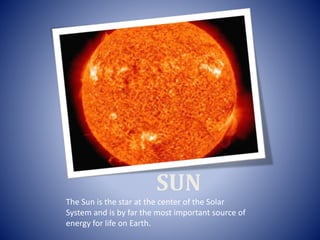
SUN
The Sun is the star at the center of the Solar
System and is by far the most important source of
energy for life on Earth.
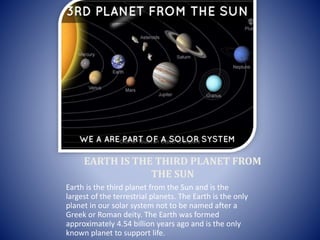
EARTH IS THE THIRD PLANET FROM
THE SUN
Earth is the third planet from the Sun and is the
largest of the terrestrial planets. The Earth is the only
planet in our solar system not to be named after a
Greek or Roman deity. The Earth was formed
approximately 4.54 billion years ago and is the only
known planet to support life.
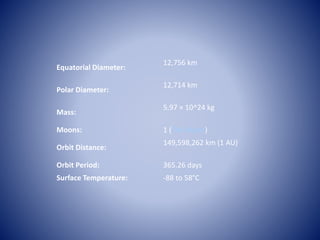
Equatorial Diameter:
12,756 km
Polar Diameter:
12,714 km
Mass:
5.97 × 10^24 kg
Moons: 1 (The Moon)
Orbit Distance:
149,598,262 km (1 AU)
Orbit Period: 365.26 days
Surface Temperature: -88 to 58°C
NOW LETS LEARN ABOUT ALL
PLANETS IN THE SOLAR SYSTEM
Here there is a video about our solar system
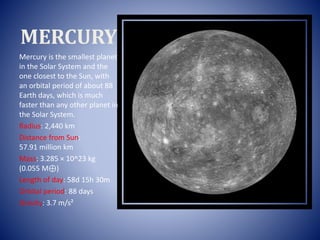
MERCURY
Mercury is the smallest planet
in the Solar System and the
one closest to the Sun, with
an orbital period of about 88
Earth days, which is much
faster than any other planet in
the Solar System.
Radius: 2,440 km
Distance from Sun:
57.91 million km
Mass: 3.285 × 10^23 kg
(0.055 M⊕)
Length of day: 58d 15h 30m
Orbital period: 88 days
Gravity: 3.7 m/s²
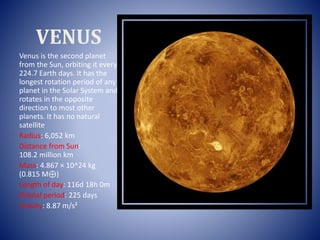
VENUS
Venus is the second planet
from the Sun, orbiting it every
224.7 Earth days. It has the
longest rotation period of any
planet in the Solar System and
rotates in the opposite
direction to most other
planets. It has no natural
satellite
Radius: 6,052 km
Distance from Sun:
108.2 million km
Mass: 4.867 × 10^24 kg
(0.815 M⊕)
Length of day: 116d 18h 0m
Orbital period: 225 days
Gravity: 8.87 m/s²
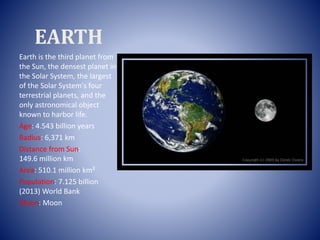
EARTH
Earth is the third planet from
the Sun, the densest planet in
the Solar System, the largest
of the Solar System's four
terrestrial planets, and the
only astronomical object
known to harbor life.
Age: 4.543 billion years
Radius: 6,371 km
Distance from Sun:
149.6 million km
Area: 510.1 million km²
Population: 7.125 billion
(2013) World Bank
Moon: Moon
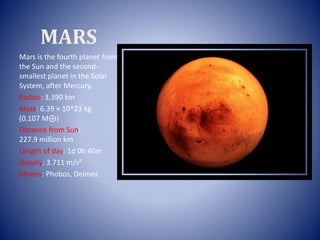
MARS
Mars is the fourth planet from
the Sun and the second-
smallest planet in the Solar
System, after Mercury.
Radius: 3,390 km
Mass: 6.39 × 10^23 kg
(0.107 M⊕)
Distance from Sun:
227.9 million km
Length of day: 1d 0h 40m
Gravity: 3.711 m/s²
Moons: Phobos, Deimos
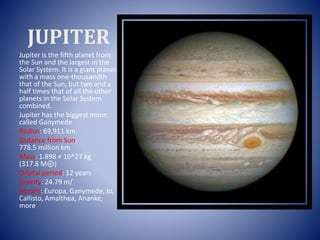
JUPITER
Jupiter is the fifth planet from
the Sun and the largest in the
Solar System. It is a giant planet
with a mass one-thousandth
that of the Sun, but two and a
half times that of all the other
planets in the Solar System
combined.
Jupiter has the biggest moon
called Ganymede
Radius: 69,911 km
Distance from Sun:
778.5 million km
Mass: 1.898 × 10^27 kg
(317.8 M⊕)
Orbital period: 12 years
Gravity: 24.79 m/
Moons: Europa, Ganymede, Io,
Callisto, Amalthea, Ananke,
more
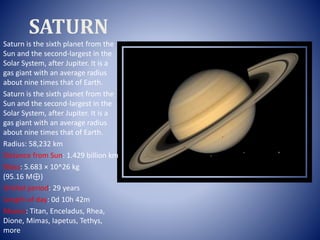
SATURN
Saturn is the sixth planet from the
Sun and the second-largest in the
Solar System, after Jupiter. It is a
gas giant with an average radius
about nine times that of Earth.
Saturn is the sixth planet from the
Sun and the second-largest in the
Solar System, after Jupiter. It is a
gas giant with an average radius
about nine times that of Earth.
Radius: 58,232 km
Distance from Sun: 1.429 billion km
Mass: 5.683 × 10^26 kg
(95.16 M⊕)
Orbital period: 29 years
Length of day: 0d 10h 42m
Moons: Titan, Enceladus, Rhea,
Dione, Mimas, Iapetus, Tethys,
more
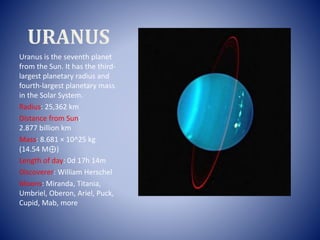
URANUS
Uranus is the seventh planet
from the Sun. It has the third-
largest planetary radius and
fourth-largest planetary mass
in the Solar System.
Radius: 25,362 km
Distance from Sun:
2.877 billion km
Mass: 8.681 × 10^25 kg
(14.54 M⊕)
Length of day: 0d 17h 14m
Discoverer: William Herschel
Moons: Miranda, Titania,
Umbriel, Oberon, Ariel, Puck,
Cupid, Mab, more
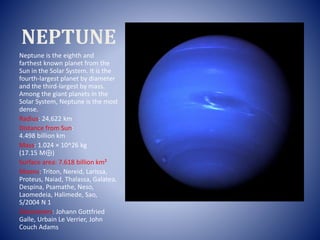
NEPTUNE
Neptune is the eighth and
farthest known planet from the
Sun in the Solar System. It is the
fourth-largest planet by diameter
and the third-largest by mass.
Among the giant planets in the
Solar System, Neptune is the most
dense.
Radius: 24,622 km
Distance from Sun:
4.498 billion km
Mass: 1.024 × 10^26 kg
(17.15 M⊕)
Surface area: 7.618 billion km²
Moons: Triton, Nereid, Larissa,
Proteus, Naiad, Thalassa, Galatea,
Despina, Psamathe, Neso,
Laomedeia, Halimede, Sao,
S/2004 N 1
Discoverers: Johann Gottfried
Galle, Urbain Le Verrier, John
Couch Adams
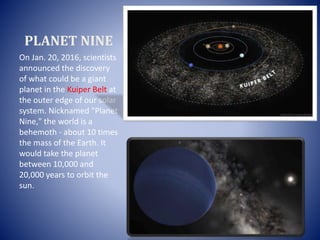
PLANET NINE
On Jan. 20, 2016, scientists
announced the discovery
of what could be a giant
planet in the Kuiper Belt at
the outer edge of our solar
system. Nicknamed "Planet
Nine," the world is a
behemoth - about 10 times
the mass of the Earth. It
would take the planet
between 10,000 and
20,000 years to orbit the
sun.
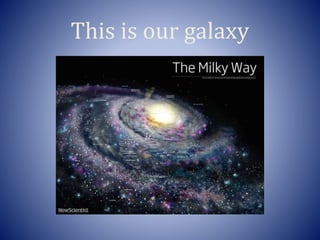
This is our galaxy
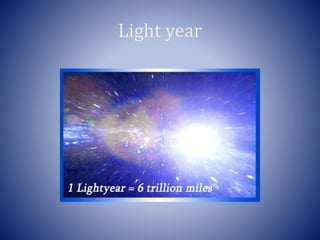
Light year
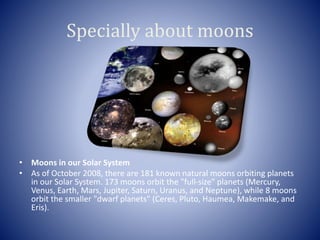
Specially about moons
• Moons in our Solar System
• As of October 2008, there are 181 known natural moons orbiting planets
in our Solar System. 173 moons orbit the "full-size" planets (Mercury,
Venus, Earth, Mars, Jupiter, Saturn, Uranus, and Neptune), while 8 moons
orbit the smaller "dwarf planets" (Ceres, Pluto, Haumea, Makemake, and
Eris).
Now lets study about asteroids
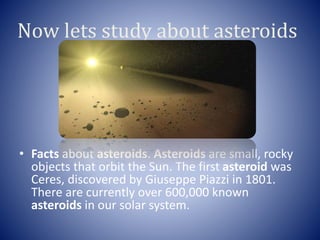
• Facts about asteroids. Asteroids are small, rocky
objects that orbit the Sun. The first asteroid was
Ceres, discovered by Giuseppe Piazzi in 1801.
There are currently over 600,000 known
asteroids in our solar system.
Now comes Meteoroids
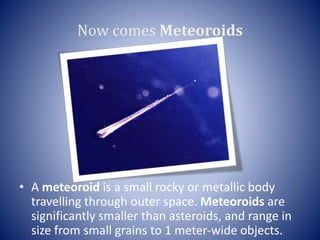
• A meteoroid is a small rocky or metallic body
travelling through outer space. Meteoroids are
significantly smaller than asteroids, and range in
size from small grains to 1 meter-wide objects.
Now meteorite
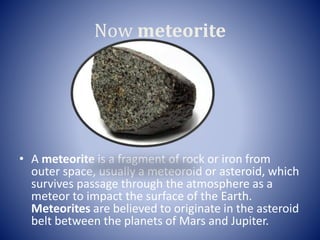
• A meteorite is a fragment of rock or iron from
outer space, usually a meteoroid or asteroid, which
survives passage through the atmosphere as a
meteor to impact the surface of the Earth.
Meteorites are believed to originate in the asteroid
belt between the planets of Mars and Jupiter.
Comets
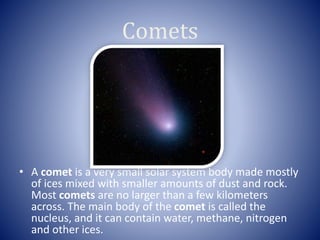
• A comet is a very small solar system body made mostly
of ices mixed with smaller amounts of dust and rock.
Most comets are no larger than a few kilometers
across. The main body of the comet is called the
nucleus, and it can contain water, methane, nitrogen
and other ices.
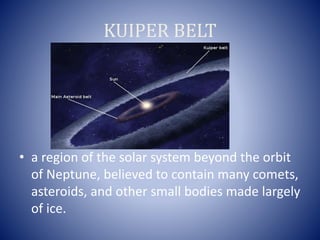
KUIPER BELT
• a region of the solar system beyond the orbit
of Neptune, believed to contain many comets,
asteroids, and other small bodies made largely
of ice.
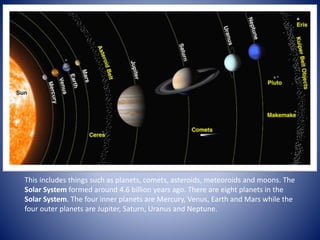
This includes things such as planets, comets, asteroids, meteoroids and moons. The
Solar System formed around 4.6 billion years ago. There are eight planets in the
Solar System. The four inner planets are Mercury, Venus, Earth and Mars while the
four outer planets are Jupiter, Saturn, Uranus and Neptune.
BY:BASHIL AHAMED
CLASS:VI-B_M
ABU DHABI INDIAN SCHOOL BRANCH-1 AL WATHBA

The earth our planet [recovered]

  • 1.
  • 2.
    SUN The Sun isthe star at the center of the Solar System and is by far the most important source of energy for life on Earth.
  • 3.
    EARTH IS THETHIRD PLANET FROM THE SUN Earth is the third planet from the Sun and is the largest of the terrestrial planets. The Earth is the only planet in our solar system not to be named after a Greek or Roman deity. The Earth was formed approximately 4.54 billion years ago and is the only known planet to support life.
  • 4.
    Equatorial Diameter: 12,756 km PolarDiameter: 12,714 km Mass: 5.97 × 10^24 kg Moons: 1 (The Moon) Orbit Distance: 149,598,262 km (1 AU) Orbit Period: 365.26 days Surface Temperature: -88 to 58°C
  • 5.
    NOW LETS LEARNABOUT ALL PLANETS IN THE SOLAR SYSTEM Here there is a video about our solar system
  • 6.
    MERCURY Mercury is thesmallest planet in the Solar System and the one closest to the Sun, with an orbital period of about 88 Earth days, which is much faster than any other planet in the Solar System. Radius: 2,440 km Distance from Sun: 57.91 million km Mass: 3.285 × 10^23 kg (0.055 M⊕) Length of day: 58d 15h 30m Orbital period: 88 days Gravity: 3.7 m/s²
  • 7.
    VENUS Venus is thesecond planet from the Sun, orbiting it every 224.7 Earth days. It has the longest rotation period of any planet in the Solar System and rotates in the opposite direction to most other planets. It has no natural satellite Radius: 6,052 km Distance from Sun: 108.2 million km Mass: 4.867 × 10^24 kg (0.815 M⊕) Length of day: 116d 18h 0m Orbital period: 225 days Gravity: 8.87 m/s²
  • 8.
    EARTH Earth is thethird planet from the Sun, the densest planet in the Solar System, the largest of the Solar System's four terrestrial planets, and the only astronomical object known to harbor life. Age: 4.543 billion years Radius: 6,371 km Distance from Sun: 149.6 million km Area: 510.1 million km² Population: 7.125 billion (2013) World Bank Moon: Moon
  • 9.
    MARS Mars is thefourth planet from the Sun and the second- smallest planet in the Solar System, after Mercury. Radius: 3,390 km Mass: 6.39 × 10^23 kg (0.107 M⊕) Distance from Sun: 227.9 million km Length of day: 1d 0h 40m Gravity: 3.711 m/s² Moons: Phobos, Deimos
  • 10.
    JUPITER Jupiter is thefifth planet from the Sun and the largest in the Solar System. It is a giant planet with a mass one-thousandth that of the Sun, but two and a half times that of all the other planets in the Solar System combined. Jupiter has the biggest moon called Ganymede Radius: 69,911 km Distance from Sun: 778.5 million km Mass: 1.898 × 10^27 kg (317.8 M⊕) Orbital period: 12 years Gravity: 24.79 m/ Moons: Europa, Ganymede, Io, Callisto, Amalthea, Ananke, more
  • 11.
    SATURN Saturn is thesixth planet from the Sun and the second-largest in the Solar System, after Jupiter. It is a gas giant with an average radius about nine times that of Earth. Saturn is the sixth planet from the Sun and the second-largest in the Solar System, after Jupiter. It is a gas giant with an average radius about nine times that of Earth. Radius: 58,232 km Distance from Sun: 1.429 billion km Mass: 5.683 × 10^26 kg (95.16 M⊕) Orbital period: 29 years Length of day: 0d 10h 42m Moons: Titan, Enceladus, Rhea, Dione, Mimas, Iapetus, Tethys, more
  • 12.
    URANUS Uranus is theseventh planet from the Sun. It has the third- largest planetary radius and fourth-largest planetary mass in the Solar System. Radius: 25,362 km Distance from Sun: 2.877 billion km Mass: 8.681 × 10^25 kg (14.54 M⊕) Length of day: 0d 17h 14m Discoverer: William Herschel Moons: Miranda, Titania, Umbriel, Oberon, Ariel, Puck, Cupid, Mab, more
  • 13.
    NEPTUNE Neptune is theeighth and farthest known planet from the Sun in the Solar System. It is the fourth-largest planet by diameter and the third-largest by mass. Among the giant planets in the Solar System, Neptune is the most dense. Radius: 24,622 km Distance from Sun: 4.498 billion km Mass: 1.024 × 10^26 kg (17.15 M⊕) Surface area: 7.618 billion km² Moons: Triton, Nereid, Larissa, Proteus, Naiad, Thalassa, Galatea, Despina, Psamathe, Neso, Laomedeia, Halimede, Sao, S/2004 N 1 Discoverers: Johann Gottfried Galle, Urbain Le Verrier, John Couch Adams
  • 14.
    PLANET NINE On Jan.20, 2016, scientists announced the discovery of what could be a giant planet in the Kuiper Belt at the outer edge of our solar system. Nicknamed "Planet Nine," the world is a behemoth - about 10 times the mass of the Earth. It would take the planet between 10,000 and 20,000 years to orbit the sun.
  • 15.
  • 16.
  • 17.
    Specially about moons •Moons in our Solar System • As of October 2008, there are 181 known natural moons orbiting planets in our Solar System. 173 moons orbit the "full-size" planets (Mercury, Venus, Earth, Mars, Jupiter, Saturn, Uranus, and Neptune), while 8 moons orbit the smaller "dwarf planets" (Ceres, Pluto, Haumea, Makemake, and Eris).
  • 18.
    Now lets studyabout asteroids • Facts about asteroids. Asteroids are small, rocky objects that orbit the Sun. The first asteroid was Ceres, discovered by Giuseppe Piazzi in 1801. There are currently over 600,000 known asteroids in our solar system.
  • 19.
    Now comes Meteoroids •A meteoroid is a small rocky or metallic body travelling through outer space. Meteoroids are significantly smaller than asteroids, and range in size from small grains to 1 meter-wide objects.
  • 20.
    Now meteorite • Ameteorite is a fragment of rock or iron from outer space, usually a meteoroid or asteroid, which survives passage through the atmosphere as a meteor to impact the surface of the Earth. Meteorites are believed to originate in the asteroid belt between the planets of Mars and Jupiter.
  • 21.
    Comets • A cometis a very small solar system body made mostly of ices mixed with smaller amounts of dust and rock. Most comets are no larger than a few kilometers across. The main body of the comet is called the nucleus, and it can contain water, methane, nitrogen and other ices.
  • 22.
    KUIPER BELT • aregion of the solar system beyond the orbit of Neptune, believed to contain many comets, asteroids, and other small bodies made largely of ice.
  • 23.
    This includes thingssuch as planets, comets, asteroids, meteoroids and moons. The Solar System formed around 4.6 billion years ago. There are eight planets in the Solar System. The four inner planets are Mercury, Venus, Earth and Mars while the four outer planets are Jupiter, Saturn, Uranus and Neptune.
  • 25.
    BY:BASHIL AHAMED CLASS:VI-B_M ABU DHABIINDIAN SCHOOL BRANCH-1 AL WATHBA