Our Universe
IndiSmart
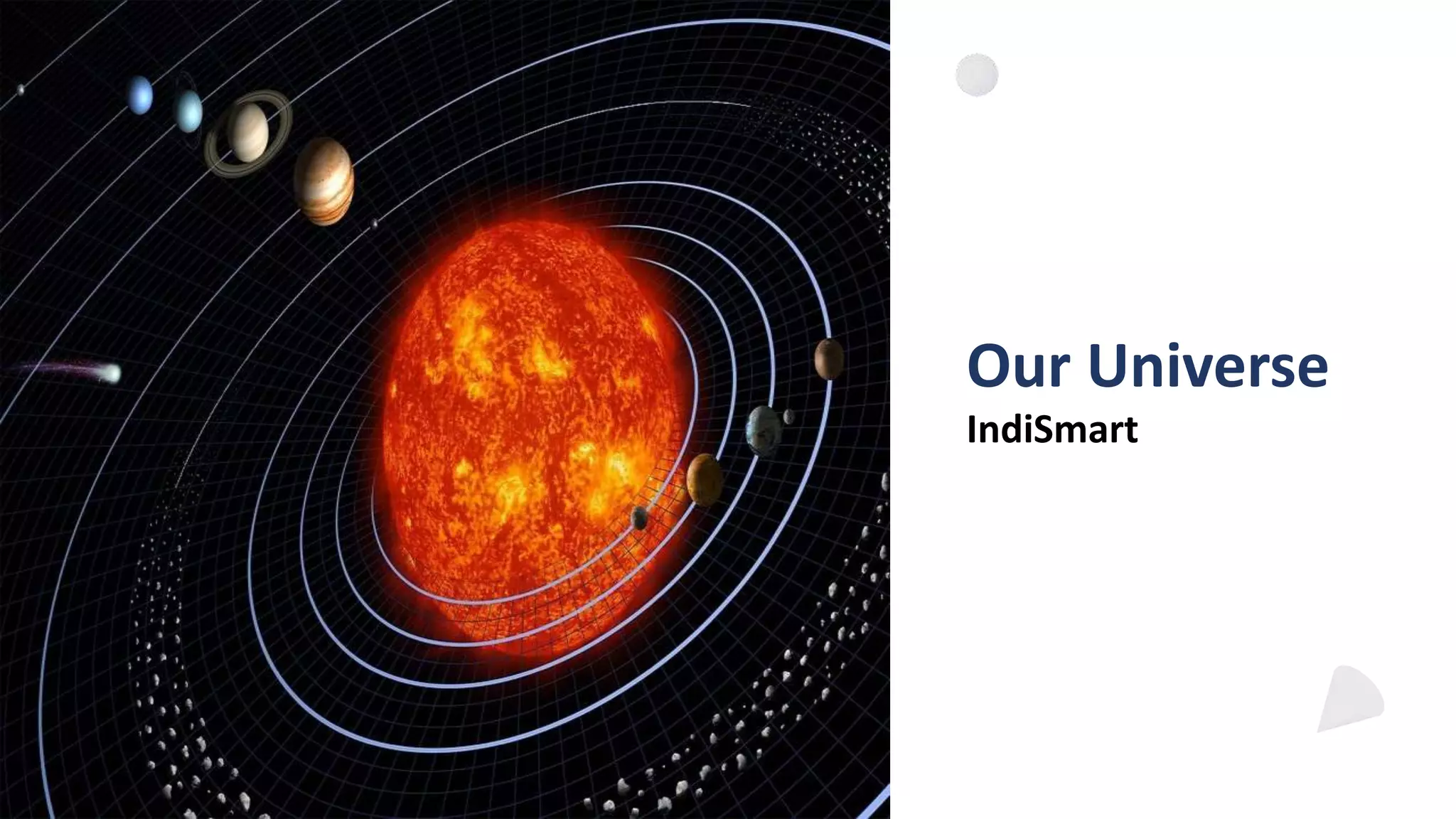
Our Universe
Our Universe is Everything that exists Stars,
Planets, Moons and other heavenly bodies.
Everything that exists on heavenly bodies such as
Animals and Plants on the Earth and the Vast
empty space between. The estimated diameter of
the observable universe is 94 billion light years.
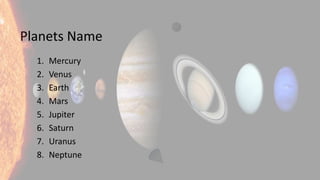
Planets Name
1. Mercury
2. Venus
3. Earth
4. Mars
5. Jupiter
6. Saturn
7. Uranus
8. Neptune
Sun
The Sun is the largest object in our solar system. The Sun’s volume would need 1.3
million Earths to fill it. Sun is the star at the center of the Solar System. It is almost
similar and consists of hot plasma interwoven with magnetic fields . It has
diameter of about 1.3927 km. The Sun is mostly composed of the elements
hydrogen (H) and helium (He). By mass the composition of the sun is 92.1%
hydrogen and 7.9% helium.
t is the closest star to the Earth. It is the source of almost all energy on the earth as
well as on the other planets.
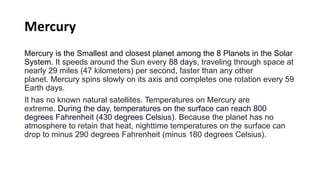
Mercury
Mercury is the Smallest and closest planet among the 8 Planets in the Solar
System. It speeds around the Sun every 88 days, traveling through space at
nearly 29 miles (47 kilometers) per second, faster than any other
planet. Mercury spins slowly on its axis and completes one rotation every 59
Earth days.
It has no known natural satellites. Temperatures on Mercury are
extreme. During the day, temperatures on the surface can reach 800
degrees Fahrenheit (430 degrees Celsius). Because the planet has no
atmosphere to retain that heat, nighttime temperatures on the surface can
drop to minus 290 degrees Fahrenheit (minus 180 degrees Celsius).
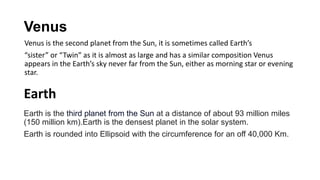
Venus
Venus is the second planet from the Sun, it is sometimes called Earth’s
“sister” or “Twin” as it is almost as large and has a similar composition Venus
appears in the Earth’s sky never far from the Sun, either as morning star or evening
star.
Earth
Earth is the third planet from the Sun at a distance of about 93 million miles
(150 million km).Earth is the densest planet in the solar system.
Earth is rounded into Ellipsoid with the circumference for an off 40,000 Km.
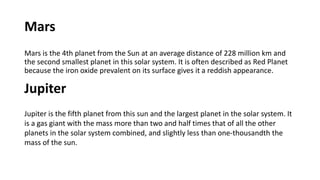
Mars
Mars is the 4th planet from the Sun at an average distance of 228 million km and
the second smallest planet in this solar system. It is often described as Red Planet
because the iron oxide prevalent on its surface gives it a reddish appearance.
Jupiter
Jupiter is the fifth planet from this sun and the largest planet in the solar system. It
is a gas giant with the mass more than two and half times that of all the other
planets in the solar system combined, and slightly less than one-thousandth the
mass of the sun.
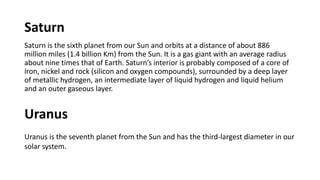
Saturn
Saturn is the sixth planet from our Sun and orbits at a distance of about 886
million miles (1.4 billion Km) from the Sun. It is a gas giant with an average radius
about nine times that of Earth. Saturn’s interior is probably composed of a core of
iron, nickel and rock (silicon and oxygen compounds), surrounded by a deep layer
of metallic hydrogen, an intermediate layer of liquid hydrogen and liquid helium
and an outer gaseous layer.
Uranus
Uranus is the seventh planet from the Sun and has the third-largest diameter in our
solar system.
Neptune
Neptune is the 8th largest and the farthest planet from the sun in the solar system.
it is the 4th largest planet by the diameter in the solar system. It is 17 times mass of
the earth
Thank You
10

Our Universe.pptx

  • 1.
  • 2.
    Our Universe Our Universeis Everything that exists Stars, Planets, Moons and other heavenly bodies. Everything that exists on heavenly bodies such as Animals and Plants on the Earth and the Vast empty space between. The estimated diameter of the observable universe is 94 billion light years.
  • 3.
    Planets Name 1. Mercury 2.Venus 3. Earth 4. Mars 5. Jupiter 6. Saturn 7. Uranus 8. Neptune
  • 4.
    Sun The Sun isthe largest object in our solar system. The Sun’s volume would need 1.3 million Earths to fill it. Sun is the star at the center of the Solar System. It is almost similar and consists of hot plasma interwoven with magnetic fields . It has diameter of about 1.3927 km. The Sun is mostly composed of the elements hydrogen (H) and helium (He). By mass the composition of the sun is 92.1% hydrogen and 7.9% helium. t is the closest star to the Earth. It is the source of almost all energy on the earth as well as on the other planets.
  • 5.
    Mercury Mercury is theSmallest and closest planet among the 8 Planets in the Solar System. It speeds around the Sun every 88 days, traveling through space at nearly 29 miles (47 kilometers) per second, faster than any other planet. Mercury spins slowly on its axis and completes one rotation every 59 Earth days. It has no known natural satellites. Temperatures on Mercury are extreme. During the day, temperatures on the surface can reach 800 degrees Fahrenheit (430 degrees Celsius). Because the planet has no atmosphere to retain that heat, nighttime temperatures on the surface can drop to minus 290 degrees Fahrenheit (minus 180 degrees Celsius).
  • 6.
    Venus Venus is thesecond planet from the Sun, it is sometimes called Earth’s “sister” or “Twin” as it is almost as large and has a similar composition Venus appears in the Earth’s sky never far from the Sun, either as morning star or evening star. Earth Earth is the third planet from the Sun at a distance of about 93 million miles (150 million km).Earth is the densest planet in the solar system. Earth is rounded into Ellipsoid with the circumference for an off 40,000 Km.
  • 7.
    Mars Mars is the4th planet from the Sun at an average distance of 228 million km and the second smallest planet in this solar system. It is often described as Red Planet because the iron oxide prevalent on its surface gives it a reddish appearance. Jupiter Jupiter is the fifth planet from this sun and the largest planet in the solar system. It is a gas giant with the mass more than two and half times that of all the other planets in the solar system combined, and slightly less than one-thousandth the mass of the sun.
  • 8.
    Saturn Saturn is thesixth planet from our Sun and orbits at a distance of about 886 million miles (1.4 billion Km) from the Sun. It is a gas giant with an average radius about nine times that of Earth. Saturn’s interior is probably composed of a core of iron, nickel and rock (silicon and oxygen compounds), surrounded by a deep layer of metallic hydrogen, an intermediate layer of liquid hydrogen and liquid helium and an outer gaseous layer. Uranus Uranus is the seventh planet from the Sun and has the third-largest diameter in our solar system.
  • 9.
    Neptune Neptune is the8th largest and the farthest planet from the sun in the solar system. it is the 4th largest planet by the diameter in the solar system. It is 17 times mass of the earth
  • 10.