OUR SOLAR SYSTEM
OISHANI SEET ,CLASS 6
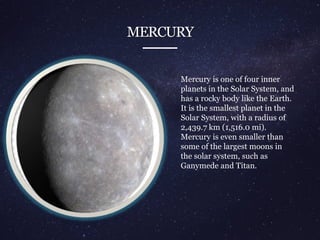
MERCURY
Mercury is one of four inner
planets in the Solar System, and
has a rocky body like the Earth.
It is the smallest planet in the
Solar System, with a radius of
2,439.7 km (1,516.0 mi).
Mercury is even smaller than
some of the largest moons in
the solar system, such as
Ganymede and Titan.
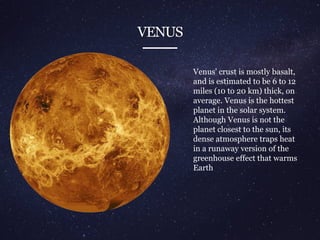
VENUS
Venus' crust is mostly basalt,
and is estimated to be 6 to 12
miles (10 to 20 km) thick, on
average. Venus is the hottest
planet in the solar system.
Although Venus is not the
planet closest to the sun, its
dense atmosphere traps heat
in a runaway version of the
greenhouse effect that warms
Earth
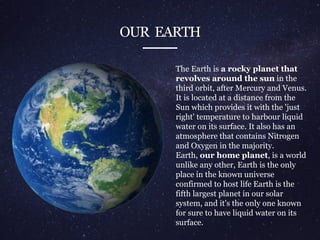
OUR EARTH
The Earth is a rocky planet that
revolves around the sun in the
third orbit, after Mercury and Venus.
It is located at a distance from the
Sun which provides it with the 'just
right' temperature to harbour liquid
water on its surface. It also has an
atmosphere that contains Nitrogen
and Oxygen in the majority.
Earth, our home planet, is a world
unlike any other, Earth is the only
place in the known universe
confirmed to host life Earth is the
fifth largest planet in our solar
system, and it's the only one known
for sure to have liquid water on its
surface.
MARS
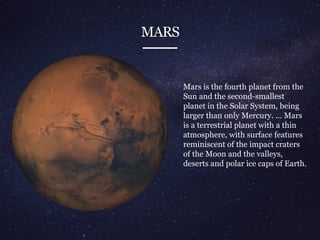
Mars is the fourth planet from the
Sun and the second-smallest
planet in the Solar System, being
larger than only Mercury. ... Mars
is a terrestrial planet with a thin
atmosphere, with surface features
reminiscent of the impact craters
of the Moon and the valleys,
deserts and polar ice caps of Earth.
JUPITER
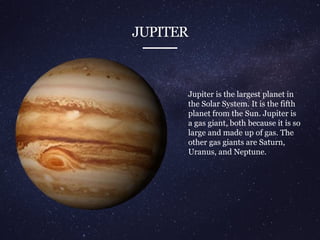
Jupiter is the largest planet in
the Solar System. It is the fifth
planet from the Sun. Jupiter is
a gas giant, both because it is so
large and made up of gas. The
other gas giants are Saturn,
Uranus, and Neptune.
SATURN
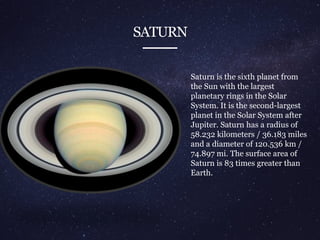
Saturn is the sixth planet from
the Sun with the largest
planetary rings in the Solar
System. It is the second-largest
planet in the Solar System after
Jupiter. Saturn has a radius of
58.232 kilometers / 36.183 miles
and a diameter of 120.536 km /
74.897 mi. The surface area of
Saturn is 83 times greater than
Earth.
URANUS
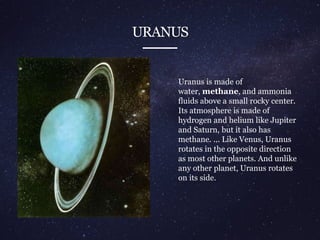
Uranus is made of
water, methane, and ammonia
fluids above a small rocky center.
Its atmosphere is made of
hydrogen and helium like Jupiter
and Saturn, but it also has
methane. ... Like Venus, Uranus
rotates in the opposite direction
as most other planets. And unlike
any other planet, Uranus rotates
on its side.
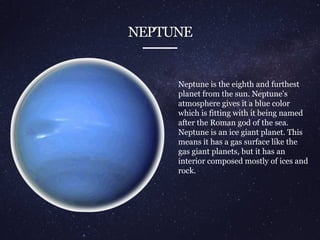
NEPTUNE
Neptune is the eighth and furthest
planet from the sun. Neptune's
atmosphere gives it a blue color
which is fitting with it being named
after the Roman god of the sea.
Neptune is an ice giant planet. This
means it has a gas surface like the
gas giant planets, but it has an
interior composed mostly of ices and
rock.
THANK YOU
THE END
THANK YOU

Our solar system

  • 1.
  • 2.
    MERCURY Mercury is oneof four inner planets in the Solar System, and has a rocky body like the Earth. It is the smallest planet in the Solar System, with a radius of 2,439.7 km (1,516.0 mi). Mercury is even smaller than some of the largest moons in the solar system, such as Ganymede and Titan.
  • 3.
    VENUS Venus' crust ismostly basalt, and is estimated to be 6 to 12 miles (10 to 20 km) thick, on average. Venus is the hottest planet in the solar system. Although Venus is not the planet closest to the sun, its dense atmosphere traps heat in a runaway version of the greenhouse effect that warms Earth
  • 4.
    OUR EARTH The Earthis a rocky planet that revolves around the sun in the third orbit, after Mercury and Venus. It is located at a distance from the Sun which provides it with the 'just right' temperature to harbour liquid water on its surface. It also has an atmosphere that contains Nitrogen and Oxygen in the majority. Earth, our home planet, is a world unlike any other, Earth is the only place in the known universe confirmed to host life Earth is the fifth largest planet in our solar system, and it's the only one known for sure to have liquid water on its surface.
  • 5.
    MARS Mars is thefourth planet from the Sun and the second-smallest planet in the Solar System, being larger than only Mercury. ... Mars is a terrestrial planet with a thin atmosphere, with surface features reminiscent of the impact craters of the Moon and the valleys, deserts and polar ice caps of Earth.
  • 6.
    JUPITER Jupiter is thelargest planet in the Solar System. It is the fifth planet from the Sun. Jupiter is a gas giant, both because it is so large and made up of gas. The other gas giants are Saturn, Uranus, and Neptune.
  • 7.
    SATURN Saturn is thesixth planet from the Sun with the largest planetary rings in the Solar System. It is the second-largest planet in the Solar System after Jupiter. Saturn has a radius of 58.232 kilometers / 36.183 miles and a diameter of 120.536 km / 74.897 mi. The surface area of Saturn is 83 times greater than Earth.
  • 8.
    URANUS Uranus is madeof water, methane, and ammonia fluids above a small rocky center. Its atmosphere is made of hydrogen and helium like Jupiter and Saturn, but it also has methane. ... Like Venus, Uranus rotates in the opposite direction as most other planets. And unlike any other planet, Uranus rotates on its side.
  • 9.
    NEPTUNE Neptune is theeighth and furthest planet from the sun. Neptune's atmosphere gives it a blue color which is fitting with it being named after the Roman god of the sea. Neptune is an ice giant planet. This means it has a gas surface like the gas giant planets, but it has an interior composed mostly of ices and rock.
  • 10.