SOLAR SYSTEM
BY ARYADEV
WHAT IS SOLAR SYSTEM
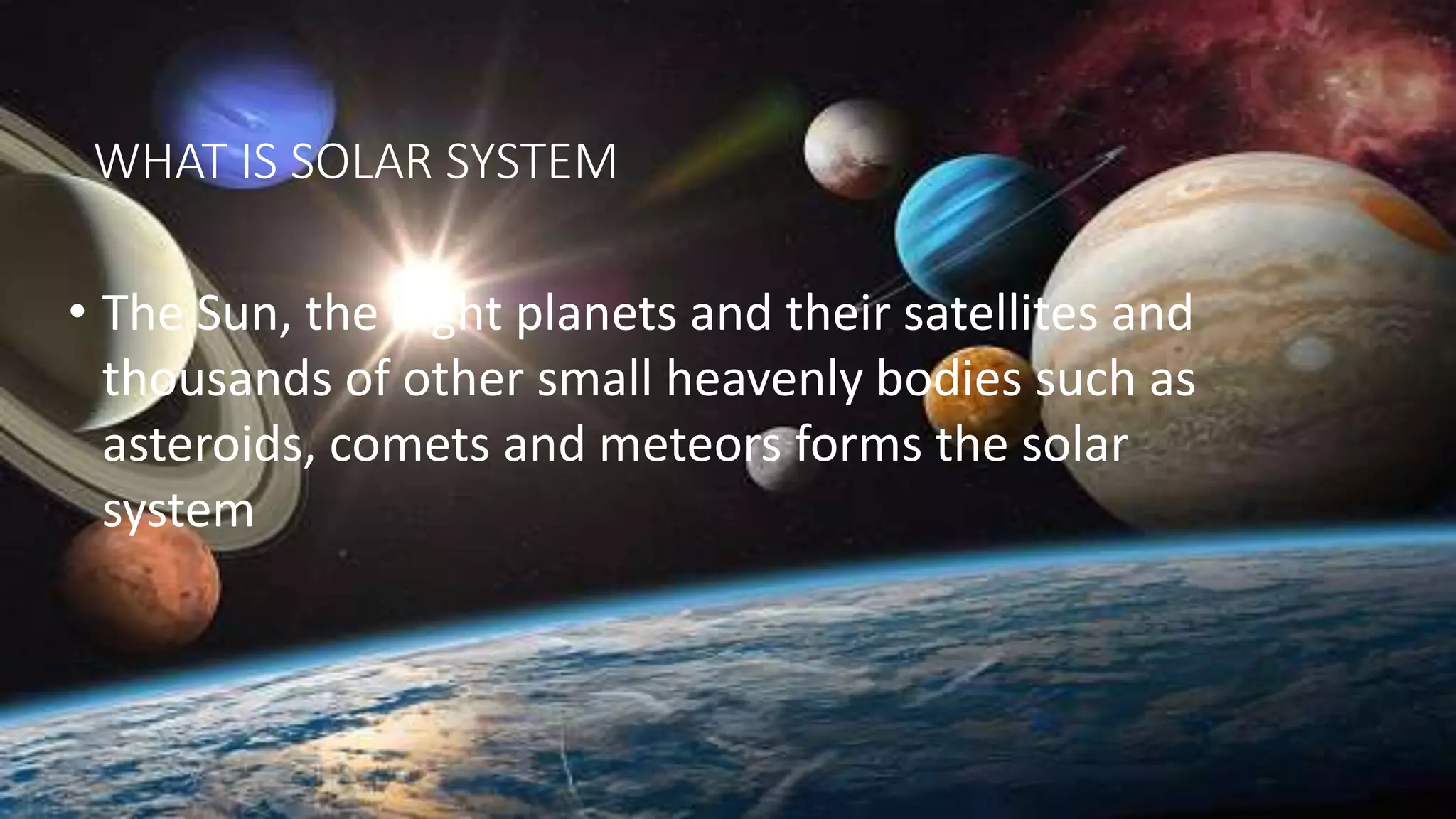
• The Sun, the eight planets and their satellites and
thousands of other small heavenly bodies such as
asteroids, comets and meteors forms the solar
system
THE SOLAR SYSTEM CONSISTS OF 1 STAR 8 PLANETS
THEY ARE
1. Sun (star)
2. Mercury
3. Venus
4. Earth
5. Mars
6. Jupiter
7. Saturn
8. Uranus
9. Neptune
THE SUN
• The Sun is the nearest star to the Earth. All the
planets and celestial bodies revolve around the Sun.
So, the Sun is the head of the solar system
MERCURY
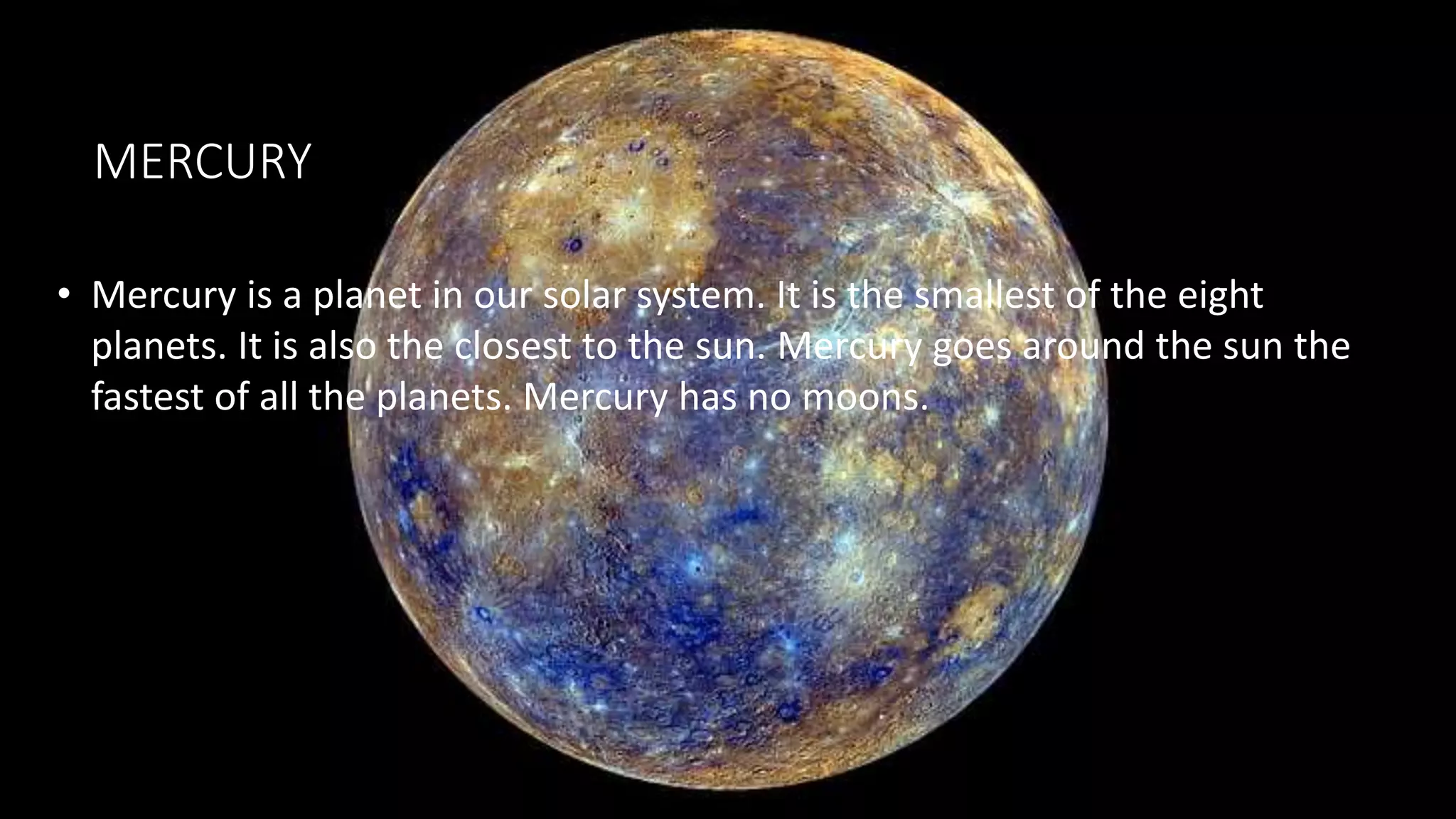
• Mercury is a planet in our solar system. It is the smallest of the eight
planets. It is also the closest to the sun. Mercury goes around the sun the
fastest of all the planets. Mercury has no moons.
VENUS
• Venus is the second planet from the Sun. It is sometimes called
Earth’s “sister” or “twin” planet as it is almost as large and has a
similar composition. As an interior planet to Earth, Venus appears
in Earth’s sky never far from the Sun, either as morning star or
evening star.
EARTH
• Earth is the third planet from the Sun and the only place in the
universe known to harbor life. While large volumes of water can be
found throughout the Solar System, only Earth sustains liquid
surface water. About 71% of Earth’s surface is made up of the
ocean, dwarfing Earth’s polar ice, lakes, and rivers. The remaining
29% of Earth’s surface is land, consisting of continents and islands.
MARS
• Mars is the fourth planet from the Sun and the second-smallest
planet in the Solar System, only being larger than Mercury. In the
English language, Mars is named for the Roman god of war.
JUPITER
• Jupiter is the fifth planet from the Sun and the largest in the Solar
System. It is a gas giant with a mass more than two and a half
times that of all the other planets in the Solar System combined,
while being slightly less than one-thousandth the mass of the Sun.
SATURN
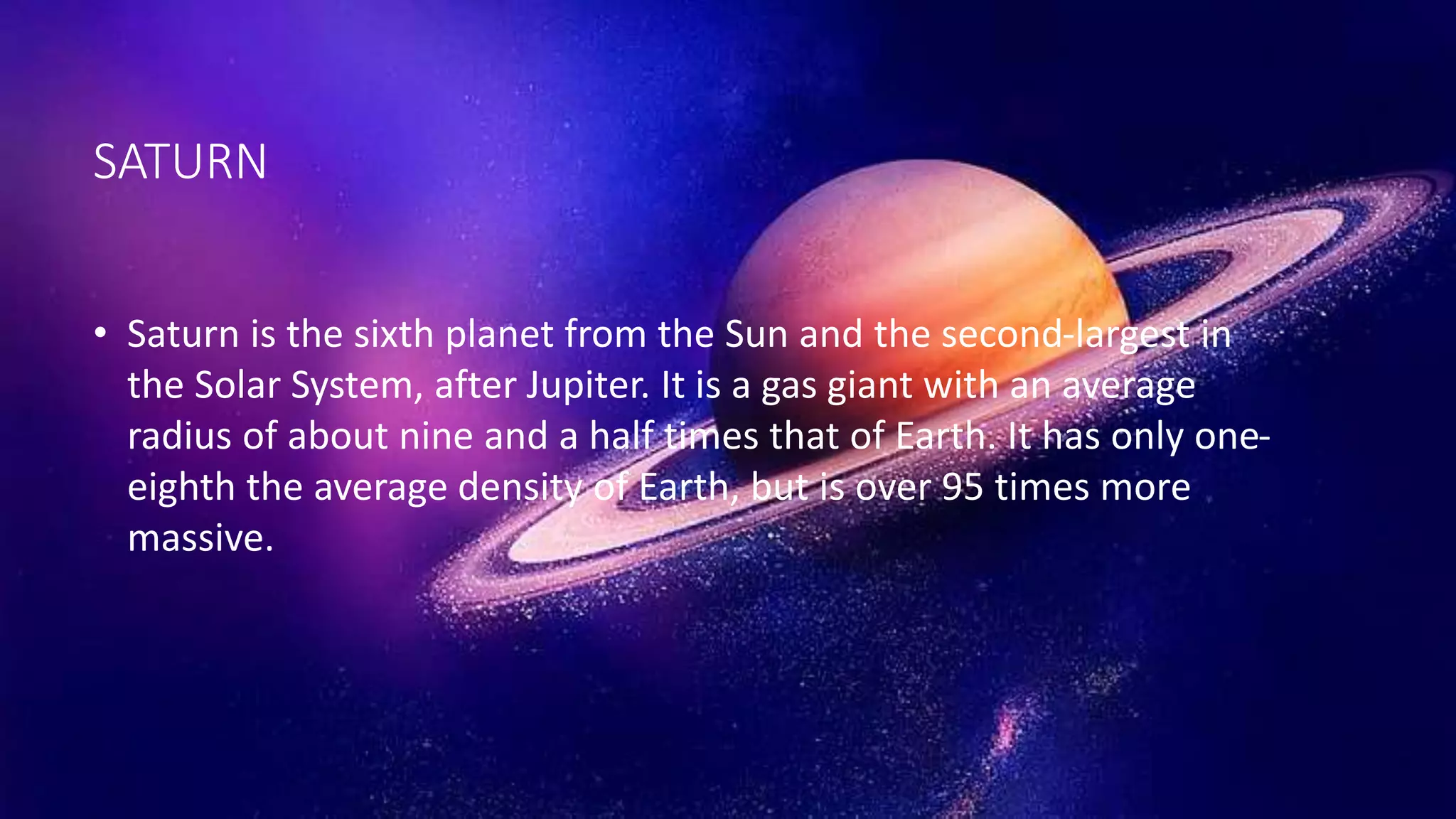
• Saturn is the sixth planet from the Sun and the second-largest in
the Solar System, after Jupiter. It is a gas giant with an average
radius of about nine and a half times that of Earth. It has only one-
eighth the average density of Earth, but is over 95 times more
massive.
URANUS
• Uranus is the seventh planet from the Sun. It is named after Greek
sky deity Uranus, who in Greek mythology is the father of Cronus,
a grandfather of Zeus and great-grandfather of Ares. Uranus has
the third-largest planetary radius and fourth-largest planetary
mass in the Solar System.
NEPTUNE
•
• Neptune is the eighth planet from the Sun and the farthest known
planet in the Solar System. It is the fourth-largest planet in the
Solar System by diameter, the third-most-massive planet, and the
densest giant planet. It is 17 times the mass of Earth, and slightly
more massive than its near-twin Uranus.
solar system.pptx

solar system.pptx

  • 1.
  • 2.
    WHAT IS SOLARSYSTEM • The Sun, the eight planets and their satellites and thousands of other small heavenly bodies such as asteroids, comets and meteors forms the solar system
  • 3.
    THE SOLAR SYSTEMCONSISTS OF 1 STAR 8 PLANETS THEY ARE 1. Sun (star) 2. Mercury 3. Venus 4. Earth 5. Mars 6. Jupiter 7. Saturn 8. Uranus 9. Neptune
  • 4.
    THE SUN • TheSun is the nearest star to the Earth. All the planets and celestial bodies revolve around the Sun. So, the Sun is the head of the solar system
  • 5.
    MERCURY • Mercury isa planet in our solar system. It is the smallest of the eight planets. It is also the closest to the sun. Mercury goes around the sun the fastest of all the planets. Mercury has no moons.
  • 6.
    VENUS • Venus isthe second planet from the Sun. It is sometimes called Earth’s “sister” or “twin” planet as it is almost as large and has a similar composition. As an interior planet to Earth, Venus appears in Earth’s sky never far from the Sun, either as morning star or evening star.
  • 7.
    EARTH • Earth isthe third planet from the Sun and the only place in the universe known to harbor life. While large volumes of water can be found throughout the Solar System, only Earth sustains liquid surface water. About 71% of Earth’s surface is made up of the ocean, dwarfing Earth’s polar ice, lakes, and rivers. The remaining 29% of Earth’s surface is land, consisting of continents and islands.
  • 8.
    MARS • Mars isthe fourth planet from the Sun and the second-smallest planet in the Solar System, only being larger than Mercury. In the English language, Mars is named for the Roman god of war.
  • 9.
    JUPITER • Jupiter isthe fifth planet from the Sun and the largest in the Solar System. It is a gas giant with a mass more than two and a half times that of all the other planets in the Solar System combined, while being slightly less than one-thousandth the mass of the Sun.
  • 10.
    SATURN • Saturn isthe sixth planet from the Sun and the second-largest in the Solar System, after Jupiter. It is a gas giant with an average radius of about nine and a half times that of Earth. It has only one- eighth the average density of Earth, but is over 95 times more massive.
  • 11.
    URANUS • Uranus isthe seventh planet from the Sun. It is named after Greek sky deity Uranus, who in Greek mythology is the father of Cronus, a grandfather of Zeus and great-grandfather of Ares. Uranus has the third-largest planetary radius and fourth-largest planetary mass in the Solar System.
  • 12.
    NEPTUNE • • Neptune isthe eighth planet from the Sun and the farthest known planet in the Solar System. It is the fourth-largest planet in the Solar System by diameter, the third-most-massive planet, and the densest giant planet. It is 17 times the mass of Earth, and slightly more massive than its near-twin Uranus.