find a set of instructions
      login and play
join a group if there are
    no free characters
The Social Network:
 Creating New Contexts for Learning

Mark Silberberg
msilberberg@lrei.org
@silberbergmark


         TodaysMeet: http://bit.ly/twt13-todaysmeet
     SpacePlace characters: http://bit.ly/twt13-characters
the world that's here
    and the one
 we're evolving into
the challenge
  for schools:
not just better,
  but different
       - Will Richardson
125 years?
what about
 5 years?
in 2008 NCTE
adopted a set of
  21st century
     literacies
active, successful
participants in this 21st
 century global society
   must be able to:
develop proficiency
and fluency with the
tools of technology
build intentional cross-
  cultural connections and
relationships with others so
to pose and solve problems
     collaboratively and
  strengthen independent
design and share
 information for global
communities to meet a
   variety of purposes
manage, analyze, and
synthesize multiple streams
of simultaneous information
create, critique,
analyze, and evaluate
  multimedia texts
attend to the ethical
responsibilities required
   by these complex
     environments.
are our students
literate for 2013 and
   what lies ahead?
or are we still teaching
   to a 20th century
 definition of literacy?
what purposes
   and what
responsibilities?
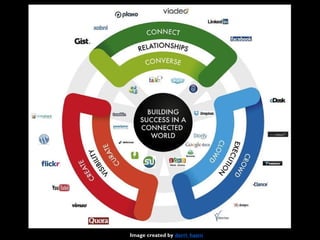
Image created by derri_hasm
"What we do online is something quite
  different: we curate our private lives for
  public exposure. . . . We edit out certain
bits, and highlight others. . . . [This] requires
 that we acknowledge that certain kinds of
 sharing can, in fact, advance a wider public
                   good. . . ."
"[We need] to recognize that their increasingly
public existence brings more promise than peril.
 We have to learn how to break with that most
elemental of parental commandments: Don't talk
  to strangers. It turns out that strangers have a
    lot to give us that's worthwhile, and we to
                        them."

            - Steven   Johnson in Time Magazine
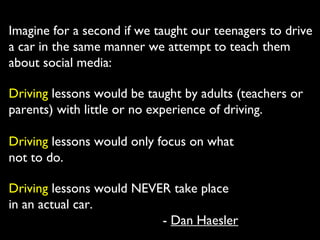
Imagine for a second if we taught our teenagers to drive
a car in the same manner we attempt to teach them
about social media:

Driving lessons would be taught by adults (teachers or
parents) with little or no experience of driving.

Driving lessons would only focus on what
not to do.

Driving lessons would NEVER take place
in an actual car.
                          - Dan Haesler
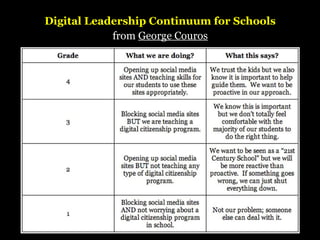
Digital Leadership Continuum for Schools
            from George Couros
external vs. internal "threat"
avatars, identity and messaging
     the myth of "privacy"
     my "public" personna
    citizenship obligations
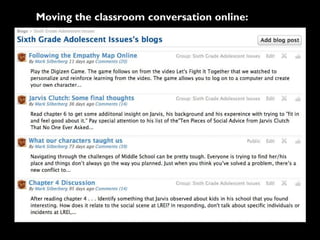
Moving the classroom conversation online:
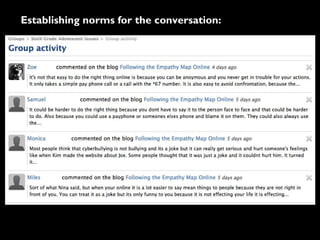
Establishing norms for the conversation:
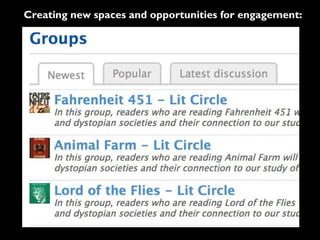
Creating new spaces and opportunities for engagement:
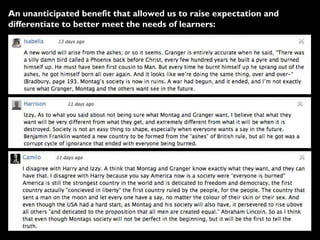
An unanticipated benefit that allowed us to raise expectation and
differentiate to better meet the needs of learners:
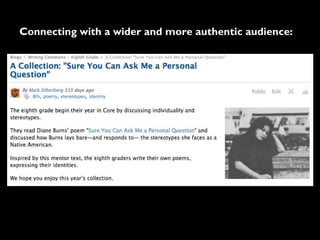
Connecting with a wider and more authentic audience:
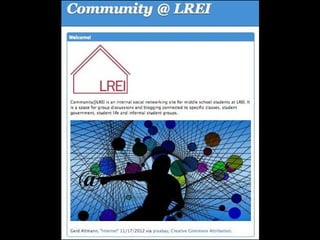
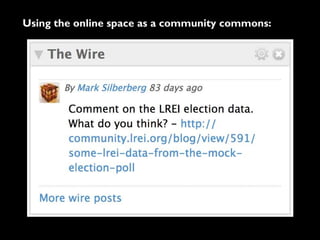
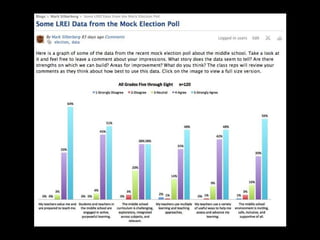
Using the online space as a community commons:
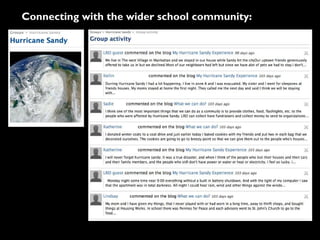
Connecting with the wider school community:
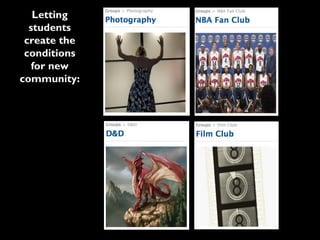
Letting
  students
 create the
 conditions
   for new
community:
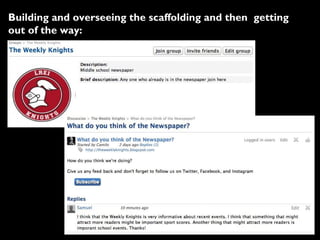
Building and overseeing the scaffolding and then getting
out of the way:
Making the technology invisible so that the focus
is on the learning:
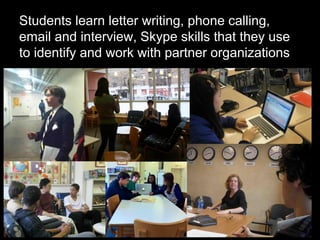
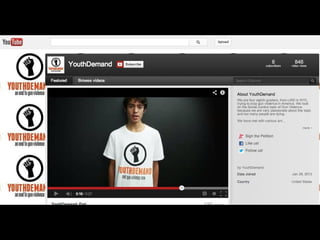
Students learn letter writing, phone calling,
email and interview, Skype skills that they use
to identify and work with partner organizations
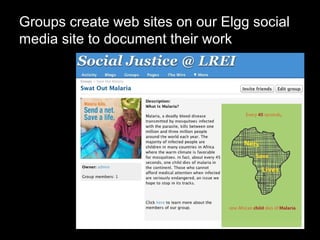
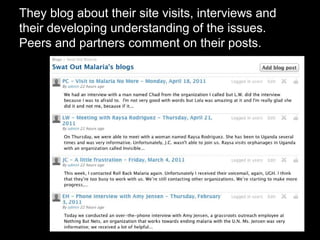
Groups create web sites on our Elgg social
media site to document their work
They blog about their site visits, interviews and
their developing understanding of the issues.
Peers and partners comment on their posts.
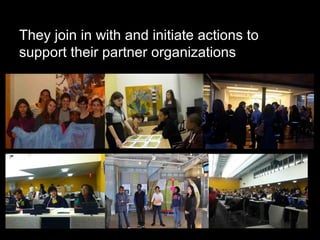
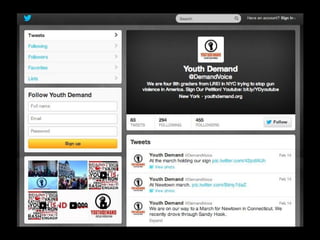
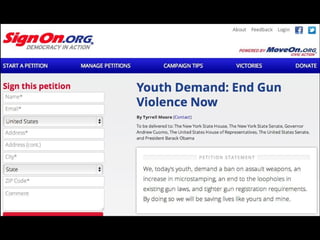
They join in with and initiate actions to
support their partner organizations
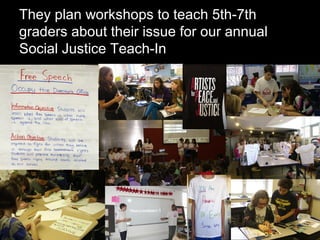
They plan workshops to teach 5th-7th
graders about their issue for our annual
Social Justice Teach-In
for our consideration:

how might educators engage with digital
technologies so that students can become
empowered citizens rather than passive consumers?

what technological innovations will help to create a
society where people can flourish within informed,
democratic and diverse communities, as opposed to
a culture of narcissists that are fragmented by a
continuous partial attention?

                            - Phil McRae
The Social Network:
 Creating New Contexts for Learning

Mark Silberberg
msilberberg@lrei.org
@silberbergmark


         TodaysMeet: http://bit.ly/twt13-todaysmeet
     SpacePlace characters: http://bit.ly/twt13-characters

The social network

  • 1.
    find a setof instructions login and play join a group if there are no free characters
  • 2.
    The Social Network: Creating New Contexts for Learning Mark Silberberg msilberberg@lrei.org @silberbergmark TodaysMeet: http://bit.ly/twt13-todaysmeet SpacePlace characters: http://bit.ly/twt13-characters
  • 3.
    the world that'shere and the one we're evolving into
  • 4.
    the challenge for schools: not just better, but different - Will Richardson
  • 5.
  • 6.
    in 2008 NCTE adopteda set of 21st century literacies
  • 7.
    active, successful participants inthis 21st century global society must be able to:
  • 8.
    develop proficiency and fluencywith the tools of technology
  • 9.
    build intentional cross- cultural connections and relationships with others so to pose and solve problems collaboratively and strengthen independent
  • 10.
    design and share information for global communities to meet a variety of purposes
  • 11.
    manage, analyze, and synthesizemultiple streams of simultaneous information
  • 12.
    create, critique, analyze, andevaluate multimedia texts
  • 13.
    attend to theethical responsibilities required by these complex environments.
  • 14.
    are our students literatefor 2013 and what lies ahead?
  • 15.
    or are westill teaching to a 20th century definition of literacy?
  • 16.
    what purposes and what responsibilities?
  • 17.
    Image created byderri_hasm
  • 19.
    "What we doonline is something quite different: we curate our private lives for public exposure. . . . We edit out certain bits, and highlight others. . . . [This] requires that we acknowledge that certain kinds of sharing can, in fact, advance a wider public good. . . ."
  • 20.
    "[We need] torecognize that their increasingly public existence brings more promise than peril. We have to learn how to break with that most elemental of parental commandments: Don't talk to strangers. It turns out that strangers have a lot to give us that's worthwhile, and we to them." - Steven Johnson in Time Magazine
  • 21.
    Imagine for asecond if we taught our teenagers to drive a car in the same manner we attempt to teach them about social media: Driving lessons would be taught by adults (teachers or parents) with little or no experience of driving. Driving lessons would only focus on what not to do. Driving lessons would NEVER take place in an actual car. - Dan Haesler
  • 22.
    Digital Leadership Continuumfor Schools from George Couros
  • 23.
    external vs. internal"threat" avatars, identity and messaging the myth of "privacy" my "public" personna citizenship obligations
  • 25.
    Moving the classroomconversation online:
  • 26.
    Establishing norms forthe conversation:
  • 27.
    Creating new spacesand opportunities for engagement:
  • 28.
    An unanticipated benefitthat allowed us to raise expectation and differentiate to better meet the needs of learners:
  • 29.
    Connecting with awider and more authentic audience:
  • 32.
    Using the onlinespace as a community commons:
  • 34.
    Connecting with thewider school community:
  • 35.
    Letting students create the conditions for new community:
  • 36.
    Building and overseeingthe scaffolding and then getting out of the way:
  • 38.
    Making the technologyinvisible so that the focus is on the learning:
  • 39.
    Students learn letterwriting, phone calling, email and interview, Skype skills that they use to identify and work with partner organizations
  • 40.
    Groups create websites on our Elgg social media site to document their work
  • 41.
    They blog abouttheir site visits, interviews and their developing understanding of the issues. Peers and partners comment on their posts.
  • 42.
    They join inwith and initiate actions to support their partner organizations
  • 43.
    They plan workshopsto teach 5th-7th graders about their issue for our annual Social Justice Teach-In
  • 49.
    for our consideration: howmight educators engage with digital technologies so that students can become empowered citizens rather than passive consumers? what technological innovations will help to create a society where people can flourish within informed, democratic and diverse communities, as opposed to a culture of narcissists that are fragmented by a continuous partial attention? - Phil McRae
  • 51.
    The Social Network: Creating New Contexts for Learning Mark Silberberg msilberberg@lrei.org @silberbergmark TodaysMeet: http://bit.ly/twt13-todaysmeet SpacePlace characters: http://bit.ly/twt13-characters