SECOND
CONDITIONAL
Andrea Valderrama M
If I were rich, I would travel
around the world.
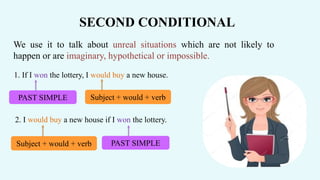
We use it to talk about unreal situations which are not likely to
happen or are imaginary, hypothetical or impossible.
SECOND CONDITIONAL
1. If I won the lottery, I would buy a new house.
PAST SIMPLE Subject + would + verb
2. I would buy a new house if I won the lottery.
PAST SIMPLESubject + would + verb
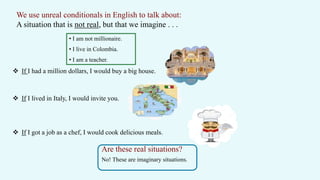
We use unreal conditionals in English to talk about:
A situation that is not real, but that we imagine . . .
 If I had a million dollars, I would buy a big house.
 If I lived in Italy, I would invite you.
 If I got a job as a chef, I would cook delicious meals.
• I am not millionaire.
• I live in Colombia.
• I am a teacher.
Are these real situations?
No! These are imaginary situations.
How do we make this type of conditional grammar?
1. If my friend asked me for money, I would lend it to her.
2. Tomas would be happier if he got a less stressful job.
3. Speaking in English would be easier if you practiced more frequently.
After the IF, use SIMPLE PAST tense and in the
other clause, use WOULD + VERB.
Notice that you can start these sentences with the If-clause or with the Result:
If Marta moved abroad, she would learn another language.
or
Marta would learn another language if she moved abroad.
References:
• https://www.lewolang.com/gramatica-inglesa/70/second-conditional
• https://www.perfect-english-grammar.com/second-conditional.html

Second Conditional

  • 1.
  • 2.
    If I wererich, I would travel around the world.
  • 3.
    We use itto talk about unreal situations which are not likely to happen or are imaginary, hypothetical or impossible. SECOND CONDITIONAL 1. If I won the lottery, I would buy a new house. PAST SIMPLE Subject + would + verb 2. I would buy a new house if I won the lottery. PAST SIMPLESubject + would + verb
  • 4.
    We use unrealconditionals in English to talk about: A situation that is not real, but that we imagine . . .  If I had a million dollars, I would buy a big house.  If I lived in Italy, I would invite you.  If I got a job as a chef, I would cook delicious meals. • I am not millionaire. • I live in Colombia. • I am a teacher. Are these real situations? No! These are imaginary situations.
  • 5.
    How do wemake this type of conditional grammar? 1. If my friend asked me for money, I would lend it to her. 2. Tomas would be happier if he got a less stressful job. 3. Speaking in English would be easier if you practiced more frequently. After the IF, use SIMPLE PAST tense and in the other clause, use WOULD + VERB.
  • 6.
    Notice that youcan start these sentences with the If-clause or with the Result: If Marta moved abroad, she would learn another language. or Marta would learn another language if she moved abroad.
  • 8.