Simple Past
vs. Present
  Perfect
When do we use each
 tense in English?
Remember:
 Grammar has meaning!

 Different grammar tenses are used in
 different situations or contexts and
 they carry different meanings.


For example . . .
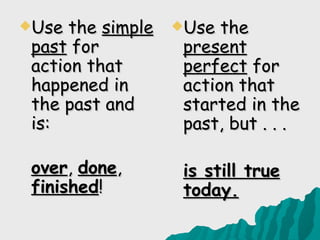
Use  the simple   Use  the
 past for           present
 action that        perfect for
 happened in        action that
 the past and       started in the
 is:                past, but . . .

 over, done,        is still true
 finished!          today.
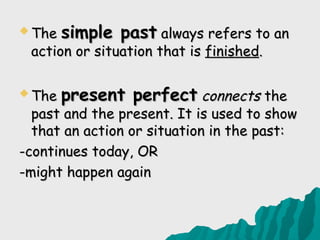
 The   simple past always refers to an
 action or situation that is finished.

 The   present perfect connects the
  past and the present. It is used to show
  that an action or situation in the past:
-continues today, OR
-might happen again
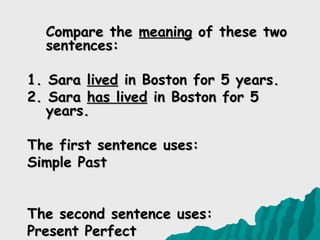
Compare the meaning of these two
  sentences:

1. Sara lived in Boston for 5 years.
2. Sara has lived in Boston for 5
   years.

The first sentence uses:
Simple Past


The second sentence uses:
Present Perfect
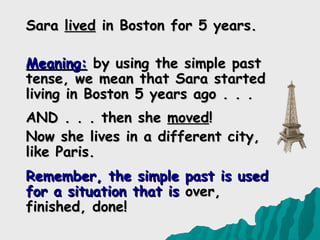
Sara lived in Boston for 5 years.

Meaning: by using the simple past
tense, we mean that Sara started
living in Boston 5 years ago . . .
AND . . . then she moved!
Now she lives in a different city,
like Paris.
Remember, the simple past is used
for a situation that is over,
finished, done!
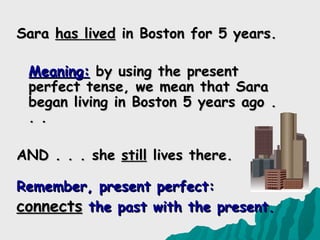
Sara has lived in Boston for 5 years.

 Meaning: by using the present
 perfect tense, we mean that Sara
 began living in Boston 5 years ago .
 . .

AND . . . she still lives there.

Remember, present perfect:
connects the past with the present.
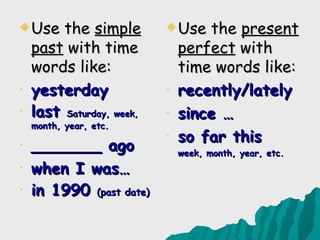
 Use    the simple         Use   the present
    past with time             perfect with
    words like:                time words like:
•   yesterday              •   recently/lately
•   last Saturday, week,   •   since …
    month, year, etc.
                           •   so far this
•   _______ ago                week, month, year, etc.
•   when I was…
•   in 1990 (past date)
Additional notes about
          present perfect:
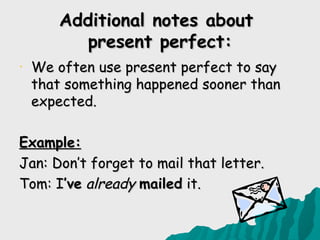
•   We often use present perfect to say
    that something happened sooner than
    expected.

Example:
Jan: Don’t forget to mail that letter.
Tom: I’ve already mailed it.
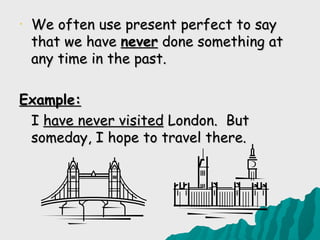
•   We often use present perfect to say
    that we have never done something at
    any time in the past.

Example:
 I have never visited London. But
 someday, I hope to travel there.
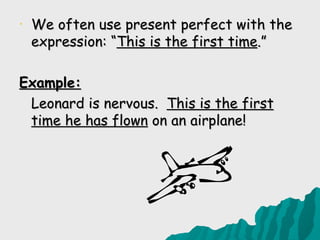
•   We often use present perfect with the
    expression: “This is the first time.”

Example:
 Leonard is nervous. This is the first
 time he has flown on an airplane!
•   We often use present perfect with
    “ever” and “never.”

                   Example:
    Patricia: Have you ever played tennis?
    Linda: No, I’ve never played before, but
    I would like to learn!
Remember!

 If you are talking about a specific
 time in the past (yesterday, last
 month, etc.), you cannot use the
 present perfect.

In these cases, use the simple past.
Practice!
Do these exercises with your partner.
   Choose the simple past or present
   perfect and talk about why each is
   necessary.
1.   When I was a child, I ________ (swim) a lot.
2.   So far this week, we ________ (study) a lot.
3.   Theo __________ (be) very sick recently.
4.   I _________ (have) a terrible headache
      yesterday.
5.   It ________ (rain) a lot lately.
6.   They _______ (get) married ten years ago.
7.   I ________ (go) to Balboa Park many times.
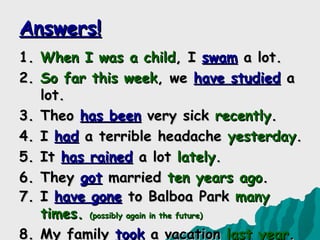
Answers!
1. When I was a child, I swam a lot.
2. So far this week, we have studied a
   lot.
3. Theo has been very sick recently.
4. I had a terrible headache yesterday.
5. It has rained a lot lately.
6. They got married ten years ago.
7. I have gone to Balboa Park many
   times. (possibly again in the future)
8. My family took a vacation last year.

Simple past vs. present perfect

  • 1.
    Simple Past vs. Present Perfect When do we use each tense in English?
  • 2.
    Remember: Grammar hasmeaning! Different grammar tenses are used in different situations or contexts and they carry different meanings. For example . . .
  • 3.
    Use thesimple Use the past for present action that perfect for happened in action that the past and started in the is: past, but . . . over, done, is still true finished! today.
  • 4.
     The simple past always refers to an action or situation that is finished.  The present perfect connects the past and the present. It is used to show that an action or situation in the past: -continues today, OR -might happen again
  • 5.
    Compare the meaningof these two sentences: 1. Sara lived in Boston for 5 years. 2. Sara has lived in Boston for 5 years. The first sentence uses: Simple Past The second sentence uses: Present Perfect
  • 6.
    Sara lived inBoston for 5 years. Meaning: by using the simple past tense, we mean that Sara started living in Boston 5 years ago . . . AND . . . then she moved! Now she lives in a different city, like Paris. Remember, the simple past is used for a situation that is over, finished, done!
  • 7.
    Sara has livedin Boston for 5 years. Meaning: by using the present perfect tense, we mean that Sara began living in Boston 5 years ago . . . AND . . . she still lives there. Remember, present perfect: connects the past with the present.
  • 8.
     Use the simple  Use the present past with time perfect with words like: time words like: • yesterday • recently/lately • last Saturday, week, • since … month, year, etc. • so far this • _______ ago week, month, year, etc. • when I was… • in 1990 (past date)
  • 9.
    Additional notes about present perfect: • We often use present perfect to say that something happened sooner than expected. Example: Jan: Don’t forget to mail that letter. Tom: I’ve already mailed it.
  • 10.
    We often use present perfect to say that we have never done something at any time in the past. Example: I have never visited London. But someday, I hope to travel there.
  • 11.
    We often use present perfect with the expression: “This is the first time.” Example: Leonard is nervous. This is the first time he has flown on an airplane!
  • 12.
    We often use present perfect with “ever” and “never.” Example: Patricia: Have you ever played tennis? Linda: No, I’ve never played before, but I would like to learn!
  • 13.
    Remember! If youare talking about a specific time in the past (yesterday, last month, etc.), you cannot use the present perfect. In these cases, use the simple past.
  • 14.
    Practice! Do these exerciseswith your partner. Choose the simple past or present perfect and talk about why each is necessary. 1. When I was a child, I ________ (swim) a lot. 2. So far this week, we ________ (study) a lot. 3. Theo __________ (be) very sick recently. 4. I _________ (have) a terrible headache yesterday. 5. It ________ (rain) a lot lately. 6. They _______ (get) married ten years ago. 7. I ________ (go) to Balboa Park many times.
  • 15.
    Answers! 1. When Iwas a child, I swam a lot. 2. So far this week, we have studied a lot. 3. Theo has been very sick recently. 4. I had a terrible headache yesterday. 5. It has rained a lot lately. 6. They got married ten years ago. 7. I have gone to Balboa Park many times. (possibly again in the future) 8. My family took a vacation last year.