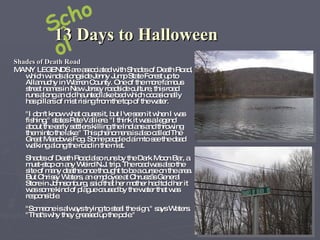
13 Days to Halloween Shades of Death Road MANY LEGENDS are associated with Shades of Death Road, which winds alongside Jenny Jump State Forest up to Allamuchy in Warren County. One of the more famous street names in New Jersey roadside culture, this road runs along an old haunted lake bed which occasionally has pillars of mist rising from the top of the water. "I don't know what causes it, but I've seen it when I was fishing," states Pete Valliere. "I think it was a legend about the early settlers killing the Indians and throwing them into the lake." This phenomena is also called The Great Meadows Fog. Some people claim to see the dead walking along the road in the mist. Shades of Death Road also runs by the Dark Moon Bar, a must-stop on any Weird N.J. trip. The road was also the site of many deaths once thought to be a curse on the area. But Chrissy Waters, an employee at Chruszâs General Store in Johnsonburg, said that her mother had told her it was some kind of plague caused by the water that was responsible. "Someone is always trying to steal the sign," says Waters. "That's why they greased up the pole." School ^
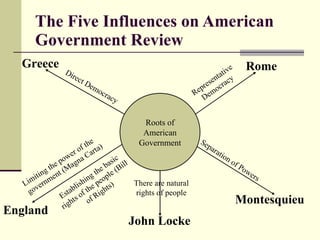
The Five Influences on American Government Review Roots of American Government Greece Rome England John Locke Montesquieu Representative Democracy Direct Democracy Separation of Powers Limiting the power of the government (Magna Carta) Establishing the basic rights of the people (Bill of Rights) There are natural rights of people
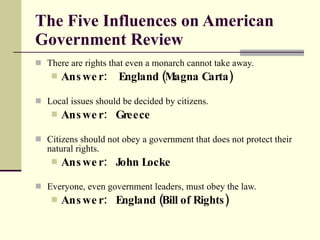
The Five Influences on American Government Review There are rights that even a monarch cannot take away. Answer:   England (Magna Carta) Local issues should be decided by citizens. Answer:   Greece Citizens should not obey a government that does not protect their natural rights. Answer:   John Locke Everyone, even government leaders, must obey the law. Answer:   England (Bill of Rights)
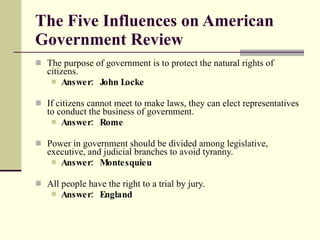
The Five Influences on American Government Review The purpose of government is to protect the natural rights of citizens. Answer:  John Locke If citizens cannot meet to make laws, they can elect representatives to conduct the business of government. Answer:  Rome Power in government should be divided among legislative, executive, and judicial branches to avoid tyranny. Answer:  Montesquieu All people have the right to a trial by jury. Answer:  England
The Road to Independence
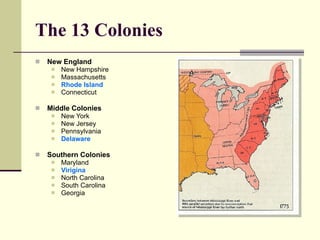
The 13 Colonies New England New Hampshire Massachusetts Rhode Island Connecticut Middle Colonies New York New Jersey Pennsylvania Delaware Southern Colonies Maryland Virigina North Carolina South Carolina Georgia
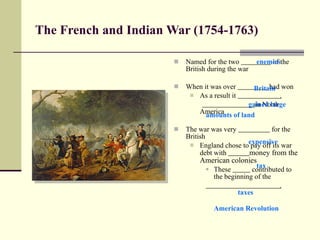
The French and Indian War (1754-1763) Named for the two  of the British during the war When it was over  had won As a result it  . in North America The war was very  for the British England chose to pay off its war debt with  money from the American colonies These  contributed to the beginning of the  . enemies Britain gained large expensive American Revolution tax amounts of land taxes
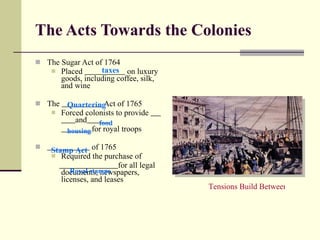
The Acts Towards the Colonies The Sugar Act of 1764 Placed  on luxury goods, including coffee, silk, and wine The  Act of 1765 Forced colonists to provide  and   for royal troops of 1765 Required the purchase of for all legal documents, newspapers, licenses, and leases Tensions Build Between the Colonies and the King taxes Quartering food housing Stamp Act Royal stamps
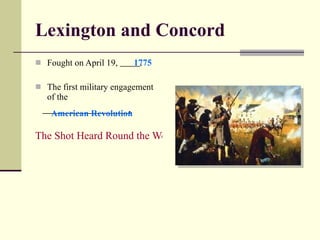
Lexington and Concord Fought on April 19,  . The first military engagement of the  . The Shot Heard Round the World 1775 American Revolution
Thomas Paine He wrote  . It called for  for the American colonies In  , Paine states that sooner or later independence from must come, because America had lost touch with the mother country. Common Sense independence England Common Sense
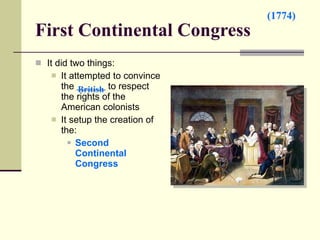
First Continental Congress It did two things: It attempted to convince the  to respect the rights of the American colonists It setup the creation of the: Second Continental Congress British (1774)
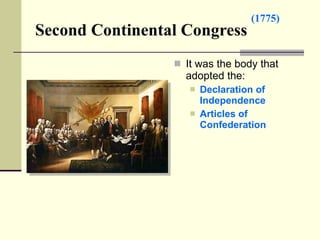
Second Continental Congress It was the body that adopted the: Declaration of Independence Articles of Confederation (1775)
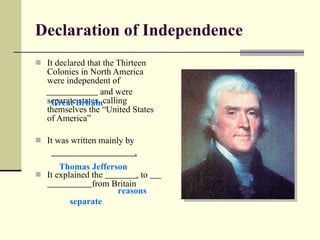
Declaration of Independence It declared that the Thirteen Colonies in North America were independent of  and were separate states, calling themselves the “United States of America” It was written mainly by  . It explained the  .  to  from Britain Thomas Jefferson separate Great Britain reasons
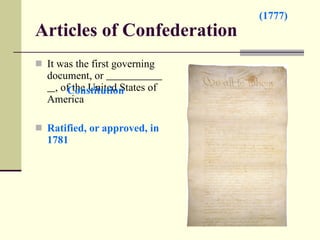
Articles of Confederation  It was the first governing document, or  , of the United States of America Ratified, or approved, in 1781 Constitution (1777)
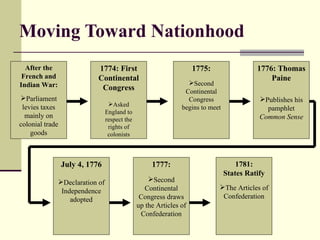
Moving Toward Nationhood After the French and Indian War: Parliament levies taxes mainly on colonial trade goods 1774: First Continental Congress 1775: 1776: Thomas Paine July 4, 1776 1777: 1781: States Ratify Asked England to respect the rights of colonists Second Continental Congress begins to meet Publishes his pamphlet  Common Sense Declaration of Independence adopted Second Continental Congress draws up the Articles of Confederation The Articles of Confederation

The Road To Independence

  • 1.
    13 Days toHalloween Shades of Death Road MANY LEGENDS are associated with Shades of Death Road, which winds alongside Jenny Jump State Forest up to Allamuchy in Warren County. One of the more famous street names in New Jersey roadside culture, this road runs along an old haunted lake bed which occasionally has pillars of mist rising from the top of the water. "I don't know what causes it, but I've seen it when I was fishing," states Pete Valliere. "I think it was a legend about the early settlers killing the Indians and throwing them into the lake." This phenomena is also called The Great Meadows Fog. Some people claim to see the dead walking along the road in the mist. Shades of Death Road also runs by the Dark Moon Bar, a must-stop on any Weird N.J. trip. The road was also the site of many deaths once thought to be a curse on the area. But Chrissy Waters, an employee at Chruszâs General Store in Johnsonburg, said that her mother had told her it was some kind of plague caused by the water that was responsible. "Someone is always trying to steal the sign," says Waters. "That's why they greased up the pole." School ^
  • 2.
    The Five Influenceson American Government Review Roots of American Government Greece Rome England John Locke Montesquieu Representative Democracy Direct Democracy Separation of Powers Limiting the power of the government (Magna Carta) Establishing the basic rights of the people (Bill of Rights) There are natural rights of people
  • 3.
    The Five Influenceson American Government Review There are rights that even a monarch cannot take away. Answer: England (Magna Carta) Local issues should be decided by citizens. Answer: Greece Citizens should not obey a government that does not protect their natural rights. Answer: John Locke Everyone, even government leaders, must obey the law. Answer: England (Bill of Rights)
  • 4.
    The Five Influenceson American Government Review The purpose of government is to protect the natural rights of citizens. Answer: John Locke If citizens cannot meet to make laws, they can elect representatives to conduct the business of government. Answer: Rome Power in government should be divided among legislative, executive, and judicial branches to avoid tyranny. Answer: Montesquieu All people have the right to a trial by jury. Answer: England
  • 5.
    The Road toIndependence
  • 6.
    The 13 ColoniesNew England New Hampshire Massachusetts Rhode Island Connecticut Middle Colonies New York New Jersey Pennsylvania Delaware Southern Colonies Maryland Virigina North Carolina South Carolina Georgia
  • 7.
    The French andIndian War (1754-1763) Named for the two of the British during the war When it was over had won As a result it . in North America The war was very for the British England chose to pay off its war debt with money from the American colonies These contributed to the beginning of the . enemies Britain gained large expensive American Revolution tax amounts of land taxes
  • 8.
    The Acts Towardsthe Colonies The Sugar Act of 1764 Placed on luxury goods, including coffee, silk, and wine The Act of 1765 Forced colonists to provide and for royal troops of 1765 Required the purchase of for all legal documents, newspapers, licenses, and leases Tensions Build Between the Colonies and the King taxes Quartering food housing Stamp Act Royal stamps
  • 9.
    Lexington and ConcordFought on April 19, . The first military engagement of the . The Shot Heard Round the World 1775 American Revolution
  • 10.
    Thomas Paine Hewrote . It called for for the American colonies In , Paine states that sooner or later independence from must come, because America had lost touch with the mother country. Common Sense independence England Common Sense
  • 11.
    First Continental CongressIt did two things: It attempted to convince the to respect the rights of the American colonists It setup the creation of the: Second Continental Congress British (1774)
  • 12.
    Second Continental CongressIt was the body that adopted the: Declaration of Independence Articles of Confederation (1775)
  • 13.
    Declaration of IndependenceIt declared that the Thirteen Colonies in North America were independent of and were separate states, calling themselves the “United States of America” It was written mainly by . It explained the . to from Britain Thomas Jefferson separate Great Britain reasons
  • 14.
    Articles of Confederation It was the first governing document, or , of the United States of America Ratified, or approved, in 1781 Constitution (1777)
  • 15.
    Moving Toward NationhoodAfter the French and Indian War: Parliament levies taxes mainly on colonial trade goods 1774: First Continental Congress 1775: 1776: Thomas Paine July 4, 1776 1777: 1781: States Ratify Asked England to respect the rights of colonists Second Continental Congress begins to meet Publishes his pamphlet Common Sense Declaration of Independence adopted Second Continental Congress draws up the Articles of Confederation The Articles of Confederation