Requirements Management
The Foundation of the Business Analyst’s
               Practice
Do Formal Requirements still matter?
• What does the Agile development world mean to
  Business Analysts?
• Myths concerning “Agile” and requirements
  management
   – “Working code is all that is needed”
   – “All we need are stories?”
   – “Small self organizing team can manage architecture”
   – “Small self organizing team can manage non functional
     requirements”
   – “Agile processes have built-in governance”
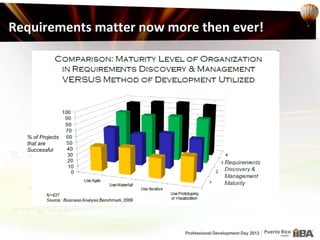
Requirements matter now more then ever!


  % of Projects
  that are
  Successful
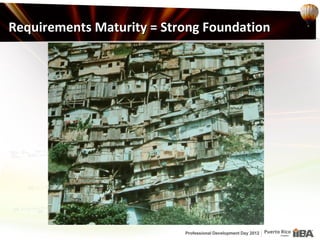
Requirements Maturity = Strong Foundation
Without Requirements we can’t prove completion

• Requirements are the contract between business
  customer and development/IT
• Requirements are only as good as their management
• Requirements management key components:
  –   Requirements definition
  –   Requirements organization and process
  –   Requirements traceability
  –   Requirements change management
  –   Requirement re-use
Requirements Definition Best Practices - Types
• Not all requirements are created equal
• Requirements must have types and attributes
• “FURPS+” is a good guide
  – Functionality - What the customer wants! Note that this includes security-related
    needs.
  – Usability - How effective is the product from the standpoint of the person who must
    use it? Is it aesthetically acceptable? Is the documentation accurate and complete?
  – Reliability - What is the maximum acceptable system downtime? Are failures
    predictable? Can we demonstrate the accuracy of results? How is the system
    recovered?
  – Performance - How fast must it be? What's the maximum response time? What's
    the throughput? What's the memory consumption?
  – Supportability - Is it testable, extensible, serviceable, installable, and configurable?
    Can it be monitored?
  – + - addresses design constraints, physical systems needs, interfaces, design rules
Requirements Definition Abstraction
• Four example requirements for an insurance claims processing
  application:
   – “We must be able to reduce our backlog of claims”
   – “The system must be able to automatically check claim forms for eligibility
     issues”
   – “The system shall determine whether a claimant is already a registered
     user, based on his/her social security number”
   – “The system shall support the simultaneous processing of up to 100 claims ”
• Requirements have type and abstraction level
   –   Business needs
   –   Features
   –   Functional software requirements
   –   Non-functional software requirements
What is Agile Development
• The Manifesto for Agile Software Development
  –   Individuals and interactions over processes and tools
  –   Working software over comprehensive documentation
  –   Customer collaboration over contract negotiation
  –   Responding to change over following a plan
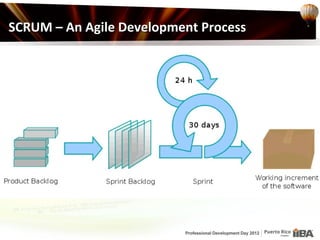
SCRUM – An Agile Development Process
The SCRUM Roles
•   The Product Owner represents the stakeholders, ensuring that the team
    delivers value to the business. The Product Owner writes customer-centric
    items user stories, prioritizes them, and adds them to the product backlog

•   The Development Team is responsible for delivering potentially shippable
    product increments at the end of each Sprint. A Development Team is made up
    of 3–9 people with cross-functional skills who do the actual work (analyse,
    design, develop, test, technical communication, document, etc.)

•   Scrum Master - Scrum is facilitated by a Scrum Master who is accountable for
    removing impediments to the ability of the team to deliver the sprint
    goal/deliverables

•   Stakeholders are the customers, vendors. They are people who enable the
    project and for whom the project produces the agreed-upon benefits that
    justify its production. They are only directly involved in the process during the
    sprint reviews
SCRUM - Business Analysts as Product Owners
 • Product owners are the interface between business
   and technology implementers.
 • User Stories are Agile Requirements
 • (User) Story
    – A feature that is added to the backlog is commonly referred to as a
      story and has a specific suggested structure. The structure of a story
      is: "As a <user type> I want to <do some action> so that <desired
      result>" This is done so that the development team can identify the
      user, action and required result in a request and is a simple way of
      writing requests that anyone can understand
    – Example: “As a mobile banking customer I want to take a
      picture of check from smart phone so I can see deposit
      instantly”
Are stories enough?
• A story - “As a mobile banking customer I want to take
  picture of check from smart phone so I can see deposit
  instantly.”

• Stories often lead to other requirements that need to be typed
  and organized
   – “mobile check deposit” leads to architectural requirements of persistence,
     storage, image support
   – “mobile check deposit” leads to non functional requirements such as image
     throughput bandwidth, response time, security
   – “mobile check deposit” likely needs function requirements decomposition
     for imaging components, for image quality analysis, user verification etc.
Stories Detailed
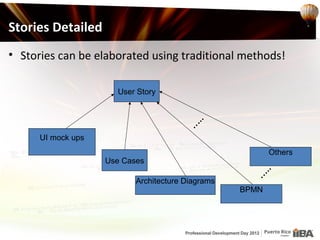
• Stories can be elaborated using traditional methods!

                      User Story


                                         … ..
      UI mock ups
                                                          Others
                    Use Cases


                                                      … ..
                           Architecture Diagrams
                                                   BPMN
Requirements Structure in an Agile world
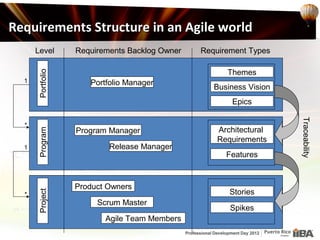
      Level       Requirements Backlog Owner   Requirement Types

                                                     Themes
      Portfolio


  1                  Portfolio Manager
                                                  Business Vision
                                                      Epics


                                                                    Traceability
  *
                  Program Manager                  Architectural
      Program


                                                   Requirements
  1                       Release Manager
                                                     Features


                  Product Owners
                                                      Stories
      Project


  *
                       Scrum Master
                                                      Spikes
                         Agile Team Members
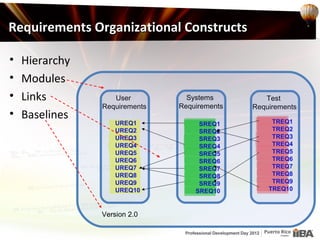
Requirements Organizational Constructs

•   Hierarchy
•   Modules
•   Links          User          Systems         Test
                Requirements   Requirements   Requirements
•   Baselines                                      TREQ1
                    UREQ1           SREQ1
                    UREQ2           SREQ2          TREQ2
                    UREQ3           SREQ3          TREQ3
                    UREQ4           SREQ4          TREQ4
                    UREQ5           SREQ5          TREQ5
                    UREQ6           SREQ6          TREQ6
                    UREQ7           SREQ7          TREQ7
                    UREQ8           SREQ8          TREQ8
                    UREQ9           SREQ9          TREQ9
                    UREQ10         SREQ10         TREQ10


                Version 2.0
Requirements Definition Best Practices - Traceability

• Traceability is a dependency relationship between
  artifacts.
• It is a methodical approach to managing process and
  relationship between artifacts
• Wikipedia:
   – Requirements traceability refers to the ability to describe and
     follow the life of a requirement, in both forwards and
     backwards direction
   – Requirements traceability refers to the ability to define,
     capture and follow the traces left by requirements on other
     elements of the software development environment and the
     trace left by those elements on requirements
Why Traceability is important?
 • Determine the origin of any requirement
 • Ensure quality
    – You can verify that the software fulfills all requirements
    – You can verify that the software does only what was requested
 • Help with requirement change management
 • Analyze impact of a change to a requirement. For example, if
   a feature is modified, traceability enables you to determine:
    – Which use cases need to be modified
    – Which supplementary requirements are affected
 • Auditiblity/Regulatory certification (DO178B, Sarbanes-
   Oxley…)
        • “Every line of code should be directly traceable to a requirement, no
          extraneous code outside of this process should be included in the build” –
          DO178B
Simple link vs. Traceability

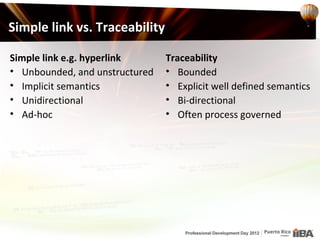
Simple link e.g. hyperlink      Traceability
• Unbounded, and unstructured   • Bounded
• Implicit semantics            • Explicit well defined semantics
• Unidirectional                • Bi-directional
• Ad-hoc                        • Often process governed
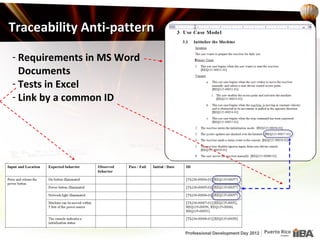
Traceability Anti-pattern

- Requirements in MS Word
  Documents
- Tests in Excel
- Link by a common ID
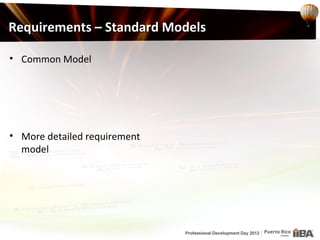
Requirements – Standard Models

• Common Model


• More detailed requirement
  model
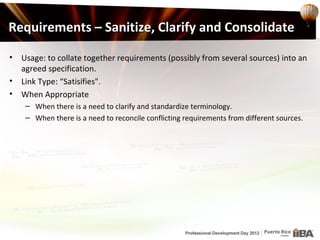
Requirements – Sanitize, Clarify and Consolidate

•   Usage: to collate together requirements (possibly from several sources) into an
    agreed specification.
•   Link Type: “Satisifies".
•   When Appropriate
     – When there is a need to clarify and standardize terminology.
     – When there is a need to reconcile conflicting requirements from different sources.
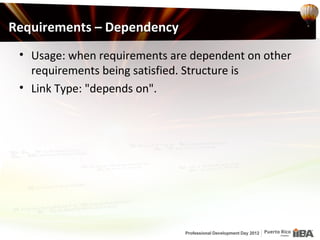
Requirements – Dependency
 • Usage: when requirements are dependent on other
   requirements being satisfied. Structure is
 • Link Type: "depends on".
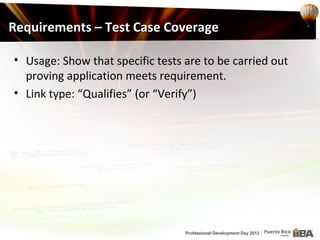
Requirements – Test Case Coverage

• Usage: Show that specific tests are to be carried out
  proving application meets requirement.
• Link type: “Qualifies” (or “Verify”)
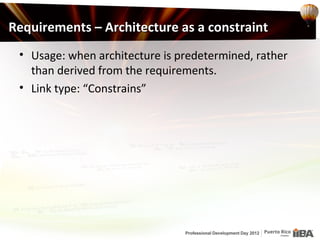
Requirements – Architecture as a constraint
 • Usage: when architecture is predetermined, rather
   than derived from the requirements.
 • Link type: “Constrains”
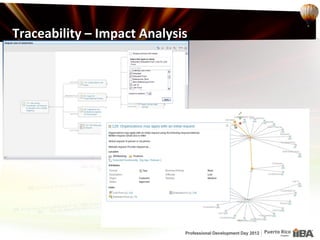
Traceability – Impact Analysis
Traceability and Change
The Consequences of Change
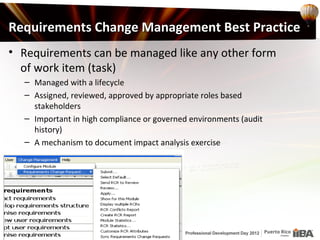
Requirements Change Management Best Practice
• Requirements can be managed like any other form
  of work item (task)
  – Managed with a lifecycle
  – Assigned, reviewed, approved by appropriate roles based
    stakeholders
  – Important in high compliance or governed environments (audit
    history)
  – A mechanism to document impact analysis exercise
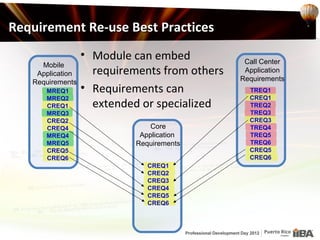
Requirement Re-use Best Practices
                • Module can embed            Call Center
     Mobile
    Application   requirements from others    Application
   Requirements                              Requirements
      MREQ1     • Requirements can             TREQ1
      MREQ2                                    CREQ1
      CREQ1       extended or specialized      TREQ2
      MREQ3                                    TREQ3
      CREQ2                                    CREQ3
      CREQ4                 Core               TREQ4
      MREQ4              Application           TREQ5
      MREQ5             Requirements           TREQ6
      CREQ5                                    CREQ5
      CREQ6                                    CREQ6
                           CREQ1
                           CREQ2
                           CREQ3
                           CREQ4
                           CREQ5
                           CREQ6
Summary - Applications are only as good as
their Requirements
• Requirements are the contract between business
  customer and development/IT
• Requirements are only as good as their management
• Requirements management key components:
  –   Requirements definition
  –   Requirements organization and process
  –   Requirements traceability
  –   Requirements change management
  –   Requirement re-use
Bibliography

• Writing good requirements is a lot like writing good code
  Jim Heumann, IBM, Software Group, 14 Jul 2004
• IIBA BABOK Guide V2.0, 2009
• Six Things Your CIO Needs to Know About Requirements
  Maturity, IAG Consulting, 2012
• Agile Software Requirements, Dean Leffingwell, 2011
• The Benefits of Well Managed Traceability, Ed Genrty,
  Innovate 2012

Business Analyst Requirements Management

  • 1.
    Requirements Management The Foundationof the Business Analyst’s Practice
  • 2.
    Do Formal Requirementsstill matter? • What does the Agile development world mean to Business Analysts? • Myths concerning “Agile” and requirements management – “Working code is all that is needed” – “All we need are stories?” – “Small self organizing team can manage architecture” – “Small self organizing team can manage non functional requirements” – “Agile processes have built-in governance”
  • 3.
    Requirements matter nowmore then ever! % of Projects that are Successful
  • 4.
    Requirements Maturity =Strong Foundation
  • 5.
    Without Requirements wecan’t prove completion • Requirements are the contract between business customer and development/IT • Requirements are only as good as their management • Requirements management key components: – Requirements definition – Requirements organization and process – Requirements traceability – Requirements change management – Requirement re-use
  • 6.
    Requirements Definition BestPractices - Types • Not all requirements are created equal • Requirements must have types and attributes • “FURPS+” is a good guide – Functionality - What the customer wants! Note that this includes security-related needs. – Usability - How effective is the product from the standpoint of the person who must use it? Is it aesthetically acceptable? Is the documentation accurate and complete? – Reliability - What is the maximum acceptable system downtime? Are failures predictable? Can we demonstrate the accuracy of results? How is the system recovered? – Performance - How fast must it be? What's the maximum response time? What's the throughput? What's the memory consumption? – Supportability - Is it testable, extensible, serviceable, installable, and configurable? Can it be monitored? – + - addresses design constraints, physical systems needs, interfaces, design rules
  • 7.
    Requirements Definition Abstraction •Four example requirements for an insurance claims processing application: – “We must be able to reduce our backlog of claims” – “The system must be able to automatically check claim forms for eligibility issues” – “The system shall determine whether a claimant is already a registered user, based on his/her social security number” – “The system shall support the simultaneous processing of up to 100 claims ” • Requirements have type and abstraction level – Business needs – Features – Functional software requirements – Non-functional software requirements
  • 8.
    What is AgileDevelopment • The Manifesto for Agile Software Development – Individuals and interactions over processes and tools – Working software over comprehensive documentation – Customer collaboration over contract negotiation – Responding to change over following a plan
  • 9.
    SCRUM – AnAgile Development Process
  • 10.
    The SCRUM Roles • The Product Owner represents the stakeholders, ensuring that the team delivers value to the business. The Product Owner writes customer-centric items user stories, prioritizes them, and adds them to the product backlog • The Development Team is responsible for delivering potentially shippable product increments at the end of each Sprint. A Development Team is made up of 3–9 people with cross-functional skills who do the actual work (analyse, design, develop, test, technical communication, document, etc.) • Scrum Master - Scrum is facilitated by a Scrum Master who is accountable for removing impediments to the ability of the team to deliver the sprint goal/deliverables • Stakeholders are the customers, vendors. They are people who enable the project and for whom the project produces the agreed-upon benefits that justify its production. They are only directly involved in the process during the sprint reviews
  • 11.
    SCRUM - BusinessAnalysts as Product Owners • Product owners are the interface between business and technology implementers. • User Stories are Agile Requirements • (User) Story – A feature that is added to the backlog is commonly referred to as a story and has a specific suggested structure. The structure of a story is: "As a <user type> I want to <do some action> so that <desired result>" This is done so that the development team can identify the user, action and required result in a request and is a simple way of writing requests that anyone can understand – Example: “As a mobile banking customer I want to take a picture of check from smart phone so I can see deposit instantly”
  • 12.
    Are stories enough? •A story - “As a mobile banking customer I want to take picture of check from smart phone so I can see deposit instantly.” • Stories often lead to other requirements that need to be typed and organized – “mobile check deposit” leads to architectural requirements of persistence, storage, image support – “mobile check deposit” leads to non functional requirements such as image throughput bandwidth, response time, security – “mobile check deposit” likely needs function requirements decomposition for imaging components, for image quality analysis, user verification etc.
  • 13.
    Stories Detailed • Storiescan be elaborated using traditional methods! User Story … .. UI mock ups Others Use Cases … .. Architecture Diagrams BPMN
  • 14.
    Requirements Structure inan Agile world Level Requirements Backlog Owner Requirement Types Themes Portfolio 1 Portfolio Manager Business Vision Epics Traceability * Program Manager Architectural Program Requirements 1 Release Manager Features Product Owners Stories Project * Scrum Master Spikes Agile Team Members
  • 15.
    Requirements Organizational Constructs • Hierarchy • Modules • Links User Systems Test Requirements Requirements Requirements • Baselines TREQ1 UREQ1 SREQ1 UREQ2 SREQ2 TREQ2 UREQ3 SREQ3 TREQ3 UREQ4 SREQ4 TREQ4 UREQ5 SREQ5 TREQ5 UREQ6 SREQ6 TREQ6 UREQ7 SREQ7 TREQ7 UREQ8 SREQ8 TREQ8 UREQ9 SREQ9 TREQ9 UREQ10 SREQ10 TREQ10 Version 2.0
  • 16.
    Requirements Definition BestPractices - Traceability • Traceability is a dependency relationship between artifacts. • It is a methodical approach to managing process and relationship between artifacts • Wikipedia: – Requirements traceability refers to the ability to describe and follow the life of a requirement, in both forwards and backwards direction – Requirements traceability refers to the ability to define, capture and follow the traces left by requirements on other elements of the software development environment and the trace left by those elements on requirements
  • 17.
    Why Traceability isimportant? • Determine the origin of any requirement • Ensure quality – You can verify that the software fulfills all requirements – You can verify that the software does only what was requested • Help with requirement change management • Analyze impact of a change to a requirement. For example, if a feature is modified, traceability enables you to determine: – Which use cases need to be modified – Which supplementary requirements are affected • Auditiblity/Regulatory certification (DO178B, Sarbanes- Oxley…) • “Every line of code should be directly traceable to a requirement, no extraneous code outside of this process should be included in the build” – DO178B
  • 18.
    Simple link vs.Traceability Simple link e.g. hyperlink Traceability • Unbounded, and unstructured • Bounded • Implicit semantics • Explicit well defined semantics • Unidirectional • Bi-directional • Ad-hoc • Often process governed
  • 19.
    Traceability Anti-pattern - Requirementsin MS Word Documents - Tests in Excel - Link by a common ID
  • 20.
    Requirements – StandardModels • Common Model • More detailed requirement model
  • 21.
    Requirements – Sanitize,Clarify and Consolidate • Usage: to collate together requirements (possibly from several sources) into an agreed specification. • Link Type: “Satisifies". • When Appropriate – When there is a need to clarify and standardize terminology. – When there is a need to reconcile conflicting requirements from different sources.
  • 22.
    Requirements – Dependency • Usage: when requirements are dependent on other requirements being satisfied. Structure is • Link Type: "depends on".
  • 23.
    Requirements – TestCase Coverage • Usage: Show that specific tests are to be carried out proving application meets requirement. • Link type: “Qualifies” (or “Verify”)
  • 24.
    Requirements – Architectureas a constraint • Usage: when architecture is predetermined, rather than derived from the requirements. • Link type: “Constrains”
  • 25.
  • 26.
  • 27.
  • 28.
  • 29.
    Requirements Change ManagementBest Practice • Requirements can be managed like any other form of work item (task) – Managed with a lifecycle – Assigned, reviewed, approved by appropriate roles based stakeholders – Important in high compliance or governed environments (audit history) – A mechanism to document impact analysis exercise
  • 30.
    Requirement Re-use BestPractices • Module can embed Call Center Mobile Application requirements from others Application Requirements Requirements MREQ1 • Requirements can TREQ1 MREQ2 CREQ1 CREQ1 extended or specialized TREQ2 MREQ3 TREQ3 CREQ2 CREQ3 CREQ4 Core TREQ4 MREQ4 Application TREQ5 MREQ5 Requirements TREQ6 CREQ5 CREQ5 CREQ6 CREQ6 CREQ1 CREQ2 CREQ3 CREQ4 CREQ5 CREQ6
  • 31.
    Summary - Applicationsare only as good as their Requirements • Requirements are the contract between business customer and development/IT • Requirements are only as good as their management • Requirements management key components: – Requirements definition – Requirements organization and process – Requirements traceability – Requirements change management – Requirement re-use
  • 32.
    Bibliography • Writing goodrequirements is a lot like writing good code Jim Heumann, IBM, Software Group, 14 Jul 2004 • IIBA BABOK Guide V2.0, 2009 • Six Things Your CIO Needs to Know About Requirements Maturity, IAG Consulting, 2012 • Agile Software Requirements, Dean Leffingwell, 2011 • The Benefits of Well Managed Traceability, Ed Genrty, Innovate 2012

Editor's Notes

  • #6 Requirements not defined until coding has started Requirements changing towards the end of development without an impact assessment Difficulty in determining whether or not the released product satisfies the customer needs because the customers needs weren’t specified Time spent coding, writing test cases or documentation to requirements that no longer exist Engineering blamed for “poor quality” when really there is a lack of requirements to build and to test against Requirements Driven Development Requirements not defined until coding has started. Requirements changing towards the end of development without an impact assessment. Difficulty in determining whether or not the released product satisfies the customer needs because the customers needs weren’t specified Time spent coding, writing test cases or documentation to requirements that no longer exist Engineering blamed for “poor quality” when really there is a lack of requirements to build and to test against
  • #16 Requirements not defined until coding has started Requirements changing towards the end of development without an impact assessment Difficulty in determining whether or not the released product satisfies the customer needs because the customers needs weren’t specified Time spent coding, writing test cases or documentation to requirements that no longer exist Engineering blamed for “poor quality” when really there is a lack of requirements to build and to test against Requirements Driven Development Requirements not defined until coding has started. Requirements changing towards the end of development without an impact assessment. Difficulty in determining whether or not the released product satisfies the customer needs because the customers needs weren’t specified Time spent coding, writing test cases or documentation to requirements that no longer exist Engineering blamed for “poor quality” when really there is a lack of requirements to build and to test against
  • #17 Requirements not defined until coding has started Requirements changing towards the end of development without an impact assessment Difficulty in determining whether or not the released product satisfies the customer needs because the customers needs weren’t specified Time spent coding, writing test cases or documentation to requirements that no longer exist Engineering blamed for “poor quality” when really there is a lack of requirements to build and to test against Requirements Driven Development Requirements not defined until coding has started. Requirements changing towards the end of development without an impact assessment. Difficulty in determining whether or not the released product satisfies the customer needs because the customers needs weren’t specified Time spent coding, writing test cases or documentation to requirements that no longer exist Engineering blamed for “poor quality” when really there is a lack of requirements to build and to test against
  • #22 Source Information modules contain information from any relevant sources. Each could contain collected notes from meetings, emails or entire documents. The Stakeholder Requirements module is the module wherein all the information in the source modules is collated. This collation process must include identification and resolution of conflicts, duplications, irrelevance, etc. The intent is that the module contains a well-written, well-structured requirements specification that can be agreed by all the relevant stakeholders.
  • #23 For example, there is no point in being able to bill customers if no records are kept of their expenditure. Two requirements at the same level and A depends on B being met.
  • #24 Although the pattern refers to &apos;Test Cases&quot;, in practice, the same could apply for any test or qualification information Need to add test points to a device. These points are not needed normally. Access coverers for mechanical
  • #25 The major aspects of this information model are as follows: Specification documents are shaded blue, and are related through “satisfies” links. The Architecture is related to the Specification documents through “constrained by” links. In other words, the Architecture is used to hold design constraints from the design philosophy, for example “use polling not interrupts”. This Link Module captures those relationships that demonstrate how a requirement is constrained by an element in the architecture.
  • #32 Requirements not defined until coding has started Requirements changing towards the end of development without an impact assessment Difficulty in determining whether or not the released product satisfies the customer needs because the customers needs weren’t specified Time spent coding, writing test cases or documentation to requirements that no longer exist Engineering blamed for “poor quality” when really there is a lack of requirements to build and to test against Requirements Driven Development Requirements not defined until coding has started. Requirements changing towards the end of development without an impact assessment. Difficulty in determining whether or not the released product satisfies the customer needs because the customers needs weren’t specified Time spent coding, writing test cases or documentation to requirements that no longer exist Engineering blamed for “poor quality” when really there is a lack of requirements to build and to test against
  • #33 Requirements not defined until coding has started Requirements changing towards the end of development without an impact assessment Difficulty in determining whether or not the released product satisfies the customer needs because the customers needs weren’t specified Time spent coding, writing test cases or documentation to requirements that no longer exist Engineering blamed for “poor quality” when really there is a lack of requirements to build and to test against Requirements Driven Development Requirements not defined until coding has started. Requirements changing towards the end of development without an impact assessment. Difficulty in determining whether or not the released product satisfies the customer needs because the customers needs weren’t specified Time spent coding, writing test cases or documentation to requirements that no longer exist Engineering blamed for “poor quality” when really there is a lack of requirements to build and to test against