History of Europe:
Renaissance to 1815
My real glory is not the 40 battles
I won, for Waterloo’s defeat will
destroy the memory of as many
victories. What nothing will
destroy, what will live forever, is
my Civil Code.
∼ Napoleon Bonaparte
Napoleonic Era
Napoleon & the Revolution
Napoleonic
Era
• The Directory
• Coup of 18 Fructidor
• Directory purged all the winners of the
1797 vote
• 57 leaders of Royalists banished to
Guiana, almost certainly to their deaths
• 42 newspapers closed
• Kept current leadership in place
• Essentially, not any better than the
monarchy they’d overthrown
Napoleonic Era
Napoleon Bonaparte
Napoleonic Era
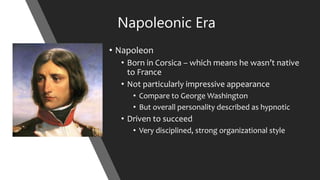
• Napoleon
• Born in Corsica – which means he wasn’t native
to France
• Not particularly impressive appearance
• Compare to George Washington
• But overall personality described as hypnotic
• Driven to succeed
• Very disciplined, strong organizational style
Napoleonic Era
• Napoleon
• Regarded as one of greatest military
commanders ever
• Brigadier-General at age 24, one of
youngest ever
• As leader of France, changed the map
of Europe
• Developed new laws, civil codes,
educational systems that continued to
the present day
Napoleonic Era
• After the French Revolution
• After fall of Robespierre, Napoleon arrested
• Jacobin sympathies
• Released from prison, not restored to his
command
• 1795 – placed second in command of Paris
troops
• Used them to kill thousands of royalists
trying to storm National Convention
• Hailed as “savior of the Republic”
Napoleonic Era
• After the French Revolution
• 1798 Directory sent Napoleon to Egypt
• His suggestion, but Directory agreed
• Glad he’d be far away
• Not posing a threat to rule of the
Directory
• Battles on land and sea
• Mixed results, and a weakened army
From the heights of these pyramids, forty
centuries look down on us.
Napoleonic
Era
• Dissatisfaction with the Directory
• In 1799, Abbé Sieyès became one of the Directors
• Among more conservative members
• Disliked instability of the Directory & its
government
• Including balance of power, tumultuous annual
elections
• Wanted more reliable structure of political power
• Allow new elite to govern securely
• Guarantee of property rights
Napoleonic Era
• Dissatisfaction with the Directory
• Sieyès led plan for parliamentary coup
• Planned to jettison the Constitution
• For military insurance, secured support of
Napoleon
• Returning from the Egyptian Campaign
• The coup was successful, but Sieyès was
not
• His Constitution favored the
aristocracy
• Envisioned limited role for Napoleon,
who had other plans
Napoleonic Era
• The Consulate (1799-1804)
• Lack of reaction in streets
• Proved Revolution was over
• Constitution of 1799 - a “coup within a coup”
• 1st since Revolution to lack a Declaration of Rights
• Kept the appearance of a Republic, but created
dictatorship
• Within 2 months, Sieyès and Ducos were out
• Replaced by Cambacérès & LeBrun, Napoleon’s picks
• Napoleon became “First Consul” – a dictator
Napoleonic Era
• The Consulate
• First Consul – more power than the
other two
• Steps taken as First Consul
• Centralization of power
• Voting remained, but it was controlled
by the State
• Napoleon micromanaged, overseeing
serious reforms
• And though liberties restricted, France
stabilized as a nation
Napoleonic
Era
• First Consul: Reforms
• Worried by democratic forces unleashed by
Revolution
• But unwilling to ignore them completely
• Faced several assassination plots
• By royalist and Jacobin factions
• Used to justify creation of an imperial
system based on Roman model
“… men worn out by the turmoil of the Revolution …
looked for the domination of an able ruler … people
believed quite sincerely that Bonaparte, whether as
consul or emperor, would exert his authority and save
[them] from the perils of anarchy …”
-Madame de Rémusat, 1802-08
Napoleonic Era
• First Consul for Life – 1802
• Napoleon expelled his critics in the government
• Drew on other, talented men
• Charles Maurice de Tallyrand
• Chief Diplomat
• Helped negotiate peace treaties following
military victories by Napoleon’s armies
• Helped consolidate France’s gains
Tallyrand, whose career spanned Ancien
Regime, French Revolution, Age of
Napoleon, & subsequent restorations of
monarchial rule
Napoleonic Era
• From Consul to Emperor
• Coronation of Napoleon I, Emperor of the
French
• December 2, 1804
• Napoleon designed ceremony, unlike Kings
of France
• At Notre Dame, with Pope Pius VII present
• But Napoleon crowned himself, and
Josephine
• Symbolism: becoming Emperor based on
own merit, will of people
• Not an accident of birth or religious
consecration
Napoleonic
Era
• Napoleon’s Achievements: Overview
• Religious Reform – the Concordat of 1801
• Napoleonic Code – reform of French legal
system
• A New Constitution
• Land Reform
• Administrative and fiscal reform
• Continental System
• Educational Reform
• Tax Reform
• Modernized the Army
Napoleonic
Era
• Religious Reform: The Concordat of 1801
• Resolved outstanding problems of religion in
France
• After hostility toward Catholic Church during
Revolution
• Concordat of 1801 restored Catholic worship
• Allowing Church to resume normal operations
• Church lands not restored, but Jesuits
returned
• Tolerance toward Protestants, Jews, atheists
as well
Napoleonic
Era
• Legal Reform: The Napoleonic Code
• Clarified and Simplified laws in France
• Before this, France had no clear laws
governing French society
• Created modern, organized codes
• Governing all French society
• Civil, commercial, criminal, military, penal
codes
• Popular with the French people
• Influential among other European nations
Napoleonic
Era
• The French Constitution
• Constitution of Year VIII
• Established three branches of government
• In an 1800 referendum, public voted in favor of
the Constitution
• Also provided guarantees for personal liberties:
• Human rights
• Freedom of press, worship, association
• But also gave Napoleon powers to rule
absolutely
Napoleonic
Era
• Other Reforms
• Abolished most archaic systems of Ancien
Régime
• Feudalism, system of privileges, provincial
liberties
• Instituted free ownership of land
• Reorganized administrative structure of France
• Financial and tax reforms
Napoleonic
Era
• Military Reforms
• Modernized French army
• Created best infantry in Europe
• Used army to maintain law and order
• And to deal with political opponents
• Made a priority
• Created Légion d’honneur, elite order
• Substitute for old royalist decorations, orders
• To encourage civilian & military achievement
• “Men are led by toys” - Napoleon
Napoleonic
Era
• Military Reforms: Napoleon as Emperor-General
• Coronation not a restoration of monarchy
• Creation of French Empire
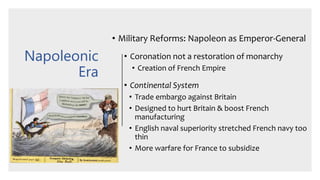
• Continental System
• Trade embargo against Britain
• Designed to hurt Britain & boost French
manufacturing
• English naval superiority stretched French navy too
thin
• More warfare for France to subsidize
Napoleonic
Era
• Napoleon at War
• Over 10-year period, Napoleon led armies
of France
• Against nearly every European power
• By 1807, the “Grand Empire”
• Acquired control of most of continental
Europe
• By conquest or alliance
• Focus on Europe, less on colonial holdings
in the Americas
Napoleonic Era
• France and the New World
• While France fought the Revolution
• Haiti found its own independence under Toussaint Louverture
• Napoleon moved to reclaim Haiti in 1803
• But failed when disease crippled French army
• This led Napoleon to consider selling Louisiana Territory to the US
• Bringing needed funds to Napoleon
• For expanding French Empire
Napoleonic Era
• The Russian Campaign
• Russia’s violations of Continental System
• Napoleon threaten Russia if it allied with Britain
• When invasion came, Russian military avoided
battle
• Used a scorched earth policy to starve out the
French
"The most terrible of all my battles was the one before Moscow. The French showed
themselves to be worthy of victory, but the Russians showed themselves worthy of
being invincible.”
- Napoleon, after the Battle of Borodino

17 Napoleon

  • 1.
  • 2.
    My real gloryis not the 40 battles I won, for Waterloo’s defeat will destroy the memory of as many victories. What nothing will destroy, what will live forever, is my Civil Code. ∼ Napoleon Bonaparte
  • 3.
  • 4.
    Napoleonic Era • The Directory •Coup of 18 Fructidor • Directory purged all the winners of the 1797 vote • 57 leaders of Royalists banished to Guiana, almost certainly to their deaths • 42 newspapers closed • Kept current leadership in place • Essentially, not any better than the monarchy they’d overthrown
  • 5.
  • 6.
    Napoleonic Era • Napoleon •Born in Corsica – which means he wasn’t native to France • Not particularly impressive appearance • Compare to George Washington • But overall personality described as hypnotic • Driven to succeed • Very disciplined, strong organizational style
  • 7.
    Napoleonic Era • Napoleon •Regarded as one of greatest military commanders ever • Brigadier-General at age 24, one of youngest ever • As leader of France, changed the map of Europe • Developed new laws, civil codes, educational systems that continued to the present day
  • 8.
    Napoleonic Era • Afterthe French Revolution • After fall of Robespierre, Napoleon arrested • Jacobin sympathies • Released from prison, not restored to his command • 1795 – placed second in command of Paris troops • Used them to kill thousands of royalists trying to storm National Convention • Hailed as “savior of the Republic”
  • 9.
    Napoleonic Era • Afterthe French Revolution • 1798 Directory sent Napoleon to Egypt • His suggestion, but Directory agreed • Glad he’d be far away • Not posing a threat to rule of the Directory • Battles on land and sea • Mixed results, and a weakened army From the heights of these pyramids, forty centuries look down on us.
  • 10.
    Napoleonic Era • Dissatisfaction withthe Directory • In 1799, Abbé Sieyès became one of the Directors • Among more conservative members • Disliked instability of the Directory & its government • Including balance of power, tumultuous annual elections • Wanted more reliable structure of political power • Allow new elite to govern securely • Guarantee of property rights
  • 11.
    Napoleonic Era • Dissatisfactionwith the Directory • Sieyès led plan for parliamentary coup • Planned to jettison the Constitution • For military insurance, secured support of Napoleon • Returning from the Egyptian Campaign • The coup was successful, but Sieyès was not • His Constitution favored the aristocracy • Envisioned limited role for Napoleon, who had other plans
  • 12.
    Napoleonic Era • TheConsulate (1799-1804) • Lack of reaction in streets • Proved Revolution was over • Constitution of 1799 - a “coup within a coup” • 1st since Revolution to lack a Declaration of Rights • Kept the appearance of a Republic, but created dictatorship • Within 2 months, Sieyès and Ducos were out • Replaced by Cambacérès & LeBrun, Napoleon’s picks • Napoleon became “First Consul” – a dictator
  • 13.
    Napoleonic Era • TheConsulate • First Consul – more power than the other two • Steps taken as First Consul • Centralization of power • Voting remained, but it was controlled by the State • Napoleon micromanaged, overseeing serious reforms • And though liberties restricted, France stabilized as a nation
  • 14.
    Napoleonic Era • First Consul:Reforms • Worried by democratic forces unleashed by Revolution • But unwilling to ignore them completely • Faced several assassination plots • By royalist and Jacobin factions • Used to justify creation of an imperial system based on Roman model “… men worn out by the turmoil of the Revolution … looked for the domination of an able ruler … people believed quite sincerely that Bonaparte, whether as consul or emperor, would exert his authority and save [them] from the perils of anarchy …” -Madame de Rémusat, 1802-08
  • 15.
    Napoleonic Era • FirstConsul for Life – 1802 • Napoleon expelled his critics in the government • Drew on other, talented men • Charles Maurice de Tallyrand • Chief Diplomat • Helped negotiate peace treaties following military victories by Napoleon’s armies • Helped consolidate France’s gains Tallyrand, whose career spanned Ancien Regime, French Revolution, Age of Napoleon, & subsequent restorations of monarchial rule
  • 16.
    Napoleonic Era • FromConsul to Emperor • Coronation of Napoleon I, Emperor of the French • December 2, 1804 • Napoleon designed ceremony, unlike Kings of France • At Notre Dame, with Pope Pius VII present • But Napoleon crowned himself, and Josephine • Symbolism: becoming Emperor based on own merit, will of people • Not an accident of birth or religious consecration
  • 17.
    Napoleonic Era • Napoleon’s Achievements:Overview • Religious Reform – the Concordat of 1801 • Napoleonic Code – reform of French legal system • A New Constitution • Land Reform • Administrative and fiscal reform • Continental System • Educational Reform • Tax Reform • Modernized the Army
  • 18.
    Napoleonic Era • Religious Reform:The Concordat of 1801 • Resolved outstanding problems of religion in France • After hostility toward Catholic Church during Revolution • Concordat of 1801 restored Catholic worship • Allowing Church to resume normal operations • Church lands not restored, but Jesuits returned • Tolerance toward Protestants, Jews, atheists as well
  • 19.
    Napoleonic Era • Legal Reform:The Napoleonic Code • Clarified and Simplified laws in France • Before this, France had no clear laws governing French society • Created modern, organized codes • Governing all French society • Civil, commercial, criminal, military, penal codes • Popular with the French people • Influential among other European nations
  • 20.
    Napoleonic Era • The FrenchConstitution • Constitution of Year VIII • Established three branches of government • In an 1800 referendum, public voted in favor of the Constitution • Also provided guarantees for personal liberties: • Human rights • Freedom of press, worship, association • But also gave Napoleon powers to rule absolutely
  • 21.
    Napoleonic Era • Other Reforms •Abolished most archaic systems of Ancien Régime • Feudalism, system of privileges, provincial liberties • Instituted free ownership of land • Reorganized administrative structure of France • Financial and tax reforms
  • 22.
    Napoleonic Era • Military Reforms •Modernized French army • Created best infantry in Europe • Used army to maintain law and order • And to deal with political opponents • Made a priority • Created Légion d’honneur, elite order • Substitute for old royalist decorations, orders • To encourage civilian & military achievement • “Men are led by toys” - Napoleon
  • 23.
    Napoleonic Era • Military Reforms:Napoleon as Emperor-General • Coronation not a restoration of monarchy • Creation of French Empire • Continental System • Trade embargo against Britain • Designed to hurt Britain & boost French manufacturing • English naval superiority stretched French navy too thin • More warfare for France to subsidize
  • 24.
    Napoleonic Era • Napoleon atWar • Over 10-year period, Napoleon led armies of France • Against nearly every European power • By 1807, the “Grand Empire” • Acquired control of most of continental Europe • By conquest or alliance • Focus on Europe, less on colonial holdings in the Americas
  • 25.
    Napoleonic Era • Franceand the New World • While France fought the Revolution • Haiti found its own independence under Toussaint Louverture • Napoleon moved to reclaim Haiti in 1803 • But failed when disease crippled French army • This led Napoleon to consider selling Louisiana Territory to the US • Bringing needed funds to Napoleon • For expanding French Empire
  • 26.
    Napoleonic Era • TheRussian Campaign • Russia’s violations of Continental System • Napoleon threaten Russia if it allied with Britain • When invasion came, Russian military avoided battle • Used a scorched earth policy to starve out the French "The most terrible of all my battles was the one before Moscow. The French showed themselves to be worthy of victory, but the Russians showed themselves worthy of being invincible.” - Napoleon, after the Battle of Borodino

Editor's Notes

  • #5 Public Discord With the establishment of the Directory, contemporary observers might have assumed that the Revolution was finished. Citizens of the war-weary nation wanted stability, peace, and an end to conditions that at times bordered on chaos. Those on the right who wished to restore the monarchy by putting Louis XVIII on the throne, and those on the left who would have renewed the Reign of Terror tried but failed to overthrow the Directory. The earlier atrocities had made confidence or goodwill between parties impossible. The new régime met opposition from Jacobins on the left and Royalists (secretly subsidized by the British government) on the right. The army suppressed riots and counter-revolutionary activities, but the rebellion and in particular Napoleon gained massive power. In the elections of 1797 for one-third of the seats, the Royalists won the great majority and were poised to take control of the Directory in the next election. The Directory reacted by purging all the winners in the Coup of 18 Fructidor, banishing 57 leaders to certain death in Guiana and closing 42 newspapers. By the same token, it rejected democratic elections and kept its old leaders in power.
  • #7 Napoleon was born in 1769 to Carlo Maria di Buonaparte and Maria Letizia Ramolino, in his family’s ancestral home Casa Buonaparte in Ajaccio, the capital of the island of Corsica. He was their fourth child and third son. This was a year after the island was transferred to France by the Republic of Genoa. The Corsican origins and Corsica’s history would play a very important role in Napoleon’s upbringing and shape his first political fascinations and activism. His first language was Corsican and he always spoke French with a marked Corsican accent.
  • #8 Napoleon was born in 1769 to Carlo Maria di Buonaparte and Maria Letizia Ramolino, in his family’s ancestral home Casa Buonaparte in Ajaccio, the capital of the island of Corsica. He was their fourth child and third son. This was a year after the island was transferred to France by the Republic of Genoa. The Corsican origins and Corsica’s history would play a very important role in Napoleon’s upbringing and shape his first political fascinations and activism. His first language was Corsican and he always spoke French with a marked Corsican accent.
  • #9 After the French Revolution When Maximilien Robespierre fell from power in Paris in July 1794, Bonaparte was arrested on a charge of conspiracy and treason. As a Jacobin, Bonaparte had been seen as a follower of Robespierre, and even though he managed to get his freedom, he was not restored to his command but, instead, in March 1795, he was sent to La Vendée, where he was placed in command of the artillery of the Army of the West. Bonaparte was unhappy at the demotion and sought military preferment and even considered, albeit briefly, leaving France altogether and serving under the sultan of the Ottoman Empire. However, Bonaparte decided to stay, and with a new constitution being introduced, royalists hoped that they would be able to seize power in Paris. The National Convention was worried but felt that they could trust Bonaparte. He was placed second in command of the troops in Paris and used them to shoot hundreds of royalists who were trying to storm the National Convention. This move earned him the gratitude of the politicians, and he was hailed as the savior of the French republic. He was immediately appointed commander of the army of the interior and an adviser to the Directory, as the new government was called. It was during this period that Napoleon met Josephine Tascher de la Pagerie, the widow of General Alexandre de Beauharnais, who had been executed during the Reign of Terror. She was from Martinique in the Caribbean, and Bonaparte fell in love with her. Bonaparte was then involved in cracking down on a protocommunist conspiracy launched by François Babeuf and sought to get command of the Army of Italy, the French army that was about to invade the Italian Peninsula. Filippo Buonarroti, an Italian who had known Bonaparte in Corsica, was appointed commander in chief of the Army of Italy in March 1796. It was a great disappointment for Bonaparte, who married Josephine on March 9 and two days later had to leave home to lead the army on March 11.
  • #10 In March 1798 Bonaparte suggested putting together a military expedition to seize Egypt, then a part of the Ottoman Empire. The Directory were worried about the cost of this expedition but happy that it would take Napoleon a long way from France. On his way to Egypt, the French captured Malta on June 9, 1798, but were unable to find the great treasure they had expected to find. On July 1, the French reached Alexandria, after eluding the British navy. In the Battle of the Pyramids, fought some four miles from the pyramids, a French force of 25,000 held off 100,000 Egyptians. By the end of the battle, the French had lost 300 men, and the Egyptians had lost 6,000. However, although the French were successful on land, the British under Admiral Horatio Nelson attacked the French at sea and destroyed the French navy. Napoleon then moved into Palestine and Syria, where the French captured Gaza, Jaffa, and Haifa. They killed large numbers of people in these attacks, but the French army itself was badly weakened.
  • #11 Rise to Power Bonaparte had his eye on developments at home, and on August 29, 1799, he suddenly left the Middle East for France. In October he returned to Paris, where people were beginning to be dissatisfied with the Directory. Emmanuel-Joseph Sieyès, one of the members of the Directory, asked whether Bonaparte would support a coup d'état. On November 9 (18 Brumaire of the revolutionary calendar), Bonaparte led his soldiers into the Legislative Assembly and ejected the members, and Bonaparte, Sieyès, and Roger Ducos were declared the three provisional consuls. Sieyès hoped to run the new government but Bonaparte who had drafted a new constitution managed to make himself the First Consul, and then the First Consul for life. There was no mention in the new constitution of "liberty, equality, and fraternity." The Consulate was a period when Bonaparte tried to introduce many long-lasting reforms, a number of which continue to the present day. In 1801 he negotiated the Concordat with the Roman Catholic Church, leading to a reconciliation between the church and the state. He also introduced the Napoleonic Code, whereby legal experts reformulated the entire legal system, codifying criminal and civil laws. There was also a meritocratic system by which Bonaparte himself appointed ministers, members of the Council of State, generals, and civil servants. It profoundly changed the nature of France forever.
  • #12 Using mendacious allegations about Neo-Jacobin plots as a cover, the revisionists prepared a parliamentary coup to jettison the constitution. To provide the necessary military insurance, the plotters sought a leading general. Though he was not their first choice, they eventually enlisted Napoleon—recently returned from his Egyptian campaign, about whose disasters the public knew almost nothing. Given a central role in the coup, which occurred on 18 Brumaire, year VIII (November 9, 1799), General Bonaparte addressed the legislature, and, when some deputies balked at his call for scrapping the constitution, his troopers cleared the hall. A rump of each house then convened to draft a new constitution, and during these deliberations Napoleon shouldered aside Sieyès and emerged as the dominant figure in the new regime. The Brumaire event was not really a military coup and did not at first produce a dictatorship. It was a parliamentary coup to create a new constitution and was welcomed by people of differing opinions who saw in it what they wished to see. The image of an energetic military hero impatient with the abuses of the past must have seemed reassuring. Rise to Power Bonaparte had his eye on developments at home, and on August 29, 1799, he suddenly left the Middle East for France. In October he returned to Paris, where people were beginning to be dissatisfied with the Directory. Emmanuel-Joseph Sieyès, one of the members of the Directory, asked whether Bonaparte would support a coup d'état. On November 9 (18 Brumaire of the revolutionary calendar), Bonaparte led his soldiers into the Legislative Assembly and ejected the members, and Bonaparte, Sieyès, and Roger Ducos were declared the three provisional consuls. Sieyès hoped to run the new government but Bonaparte who had drafted a new constitution managed to make himself the First Consul, and then the First Consul for life. There was no mention in the new constitution of "liberty, equality, and fraternity." The Consulate was a period when Bonaparte tried to introduce many long-lasting reforms, a number of which continue to the present day. In 1801 he negotiated the Concordat with the Roman Catholic Church, leading to a reconciliation between the church and the state. He also introduced the Napoleonic Code, whereby legal experts reformulated the entire legal system, codifying criminal and civil laws. There was also a meritocratic system by which Bonaparte himself appointed ministers, members of the Council of State, generals, and civil servants. It profoundly changed the nature of France forever.
  • #13 Consolidation of Power: The Consulate The Directory was crushed, but the coup within the coup was not yet complete. The use of military force had certainly strengthened Napoleon’s hand vis à vis Sieyès and the other plotters. With the Council routed, the plotters convened two commissions, each consisting of 25 deputies from the two Councils. The plotters essentially intimidated the commissions into declaring a provisional government, the first form of the Consulate with Napoleon, Sieyès, and Roger Ducos as Consuls. The lack of reaction from the streets proved that the revolution was indeed over. Resistance by Jacobin officeholders in the provinces was quickly crushed. The commissions then drew up the Constitution of the Year VIII (1799), the first of the constitutions since the Revolution without a Declaration of Rights. Originally devised by Sieyès to give Napoleon a minor role but rewritten by Napoleon and accepted by direct popular vote, the Constitution preserved the appearance of a republic but in reality established a dictatorship.
  • #16 Napoleon was largely able to quell dissent within government by expelling his more vocal critics, such as Benjamin Constant and Madame de Staël. However, he was also able to look beyond partisan and ideological divisions if he recognized exceptional skills and talents that could support his vision of France. The most illustrative example of this approach is his relationship with Charles Maurice de Talleyrand, a laicized bishop, politician, and diplomat whose career spanned the regimes of Louis XVI, the years of the French Revolution, Napoleon, Louis XVIII, and Louis-Philippe. Napoleon found him extremely useful and appointed Talleyrand to be his chief diplomat during the years when French military victories brought one European state after another under French hegemony. Most of the time, Talleyrand worked for peace so as to consolidate France’s gains. He succeeded in obtaining peace with Austria through the 1801 Treaty of Luneville and with Britain in the 1802 Treaty of Amiens. He could not prevent the renewal of war in 1803, but by 1805 opposed his emperor’s renewed wars against Austria, Prussia, and Russia. He resigned as foreign minister in 1807, but retained the trust of Napoleon and conspired to undermine the emperor’s plans through secret dealings with Tsar Alexander of Russia and Austrian minister Metternich. Talleyrand sought a negotiated secure peace so as to perpetuate the gains of the French revolution. Napoleon rejected peace and when he fell in 1814, Talleyrand took charge of the Bourbon restoration based on the principle of legitimacy. image Portrait of Talleyrand, by Pierre-Paul Prud’hon (1809). The name Talleyrand has become a byword for crafty, cynical diplomacy. Talleyrand polarizes scholarly opinion. Some regard him as one of the most versatile, skilled, and influential diplomats in European history, and some believe that he was a traitor, betraying the Ancien Régime, the French Revolution, Napoleon, and the Restoration. The services of talented politicians were so important to Napoleon that he was able to force his collaborators to work above their own political differences and personal animosities. Arguably the second most important person in his government, Joseph Fouché, was Talleyrand’s opponent, yet the two served together under Napoleon. Fouché was careful to temper Napoleon’s more arbitrary actions, which at times won him the gratitude even of the royalists. Fouché was thought to have saved the Jacobins from the vengeance of the Consulate and Bonaparte decided to rid himself of a man who had too much power to be desirable as a subordinate. On the proclamation of Bonaparte as First Consul for life (1802), Fouché was deprived of his office of minister of police. After the proclamation of the First French Empire, Fouché again became head of the re-constituted ministry of police (1804) and later of Internal Affairs, with activities as important as those carried out under the Consulate. His police agents were ubiquitous and the terror that Napoleon and Fouché inspired partly accounts for the absence of conspiracies after 1804. The two remained distrustful of each other and by the end of Napoleon’s rule, Fouché, seeing the fall of the emperor to be imminent, took measures to expedite it and secure his own interests.
  • #20 The Code Napoleon: The most memorable achievement of Napoleon was making of legal laws popularly known as “The Code Napoleon.” Before Napoleon came to power, France had no clear laws governing the French society. Napoleon realized anode for a unified legal system. He appointed committee of lawyers who came out with clear and simplified laws such as a)      The criminal code. b)      The civil code. c)      The commercial code. d)     The military code. e)      The penal code. The Codes made by Napoleon were very popular and were adopted by many countries of Europe, America and Africa. That marked France as a modern state in Europe.
  • #21 The Code Napoleon: The most memorable achievement of Napoleon was making of legal laws popularly known as “The Code Napoleon.” Before Napoleon came to power, France had no clear laws governing the French society. Napoleon realized anode for a unified legal system. He appointed committee of lawyers who came out with clear and simplified laws such as a)      The criminal code. b)      The civil code. c)      The commercial code. d)     The military code. e)      The penal code. The Codes made by Napoleon were very popular and were adopted by many countries of Europe, America and Africa. That marked France as a modern state in Europe.
  • #22 The Code Napoleon: The most memorable achievement of Napoleon was making of legal laws popularly known as “The Code Napoleon.” Before Napoleon came to power, France had no clear laws governing the French society. Napoleon realized anode for a unified legal system. He appointed committee of lawyers who came out with clear and simplified laws such as a)      The criminal code. b)      The civil code. c)      The commercial code. d)     The military code. e)      The penal code. The Codes made by Napoleon were very popular and were adopted by many countries of Europe, America and Africa. That marked France as a modern state in Europe.
  • #23 The Code Napoleon: The most memorable achievement of Napoleon was making of legal laws popularly known as “The Code Napoleon.” Before Napoleon came to power, France had no clear laws governing the French society. Napoleon realized anode for a unified legal system. He appointed committee of lawyers who came out with clear and simplified laws such as a)      The criminal code. b)      The civil code. c)      The commercial code. d)     The military code. e)      The penal code. The Codes made by Napoleon were very popular and were adopted by many countries of Europe, America and Africa. That marked France as a modern state in Europe.
  • #24 The Code Napoleon: The most memorable achievement of Napoleon was making of legal laws popularly known as “The Code Napoleon.” Before Napoleon came to power, France had no clear laws governing the French society. Napoleon realized anode for a unified legal system. He appointed committee of lawyers who came out with clear and simplified laws such as a)      The criminal code. b)      The civil code. c)      The commercial code. d)     The military code. e)      The penal code. The Codes made by Napoleon were very popular and were adopted by many countries of Europe, America and Africa. That marked France as a modern state in Europe.
  • #27 The Russians eventually offered battle outside Moscow on 7 September: the Battle of Borodino resulted in approximately 44,000 Russian and 35,000 French dead, wounded or captured, and may have been the bloodiest day of battle in history up to that point in time.[176] Although the French had won, the Russian army had accepted, and withstood, the major battle Napoleon had hoped would be decisive. Napoleon's own account was: "The most terrible of all my battles was the one before Moscow. The French showed themselves to be worthy of victory, but the Russians showed themselves worthy of being invincible".