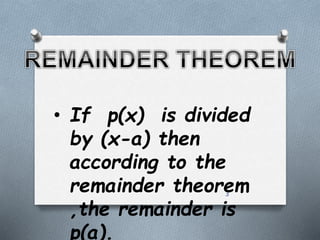
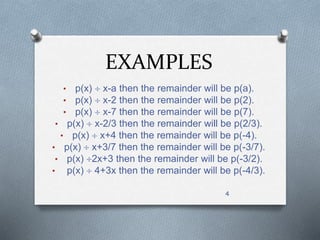
The remainder theorem states that when a polynomial p(x) is divided by (x-a), the remainder is equal to p(a). This is illustrated through several examples of polynomials being divided by expressions of the form (x-a) or (x+a), and calculating the remainder by evaluating p(a). The document also states that if p(a) equals 0 when a polynomial p(x) is divided by (x-a), then (x-a) is a factor of p(x). An example problem demonstrates finding the factor (x+1) of the polynomial p(x)=x^3-3x^2-9x-5 by using the remainder theorem.



![p(x)=x3-3x2-9x-5
g(x) =(x+1)
r(x)=(-1)[remainder]
p(x)=x3-3x2-9x-5
p(-1) = (-1)3-3(-1)2-9(-1)-5
=(-1)-3+9-5
=0
p(-1)=0(x+1) is the factor of p(x).
7
EXAMPLE
• Find if g(x)=(x+1)is the factor of p(x)=x3-3x2-9x-5 or not ?](https://image.slidesharecdn.com/remainderandfactortheorem-231012093950-ce9f5256/85/REMAINDER-AND-FACTOR-THEOREM-pptx-7-320.jpg)


![Grade 10 Remainder Theorem [Autosaved].pptx](https://cdn.slidesharecdn.com/ss_thumbnails/3-250826085837-2b228d20-thumbnail.jpg?width=640&height=640&fit=bounds)


