The Remainder Theorem
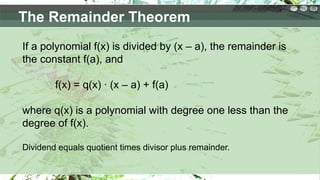
Ifa polynomial f(x) is divided by (x – a), the remainder is
the constant f(a), and
f(x) = q(x) ∙ (x – a) + f(a)
where q(x) is a polynomial with degree one less than the
degree of f(x).
Dividend equals quotient times divisor plus remainder.
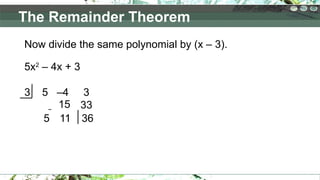
Now divide thesame polynomial by (x – 3).
5x2
– 4x + 3
3 5 –4 3
5 36
11
33
15
The Remainder Theorem
5.
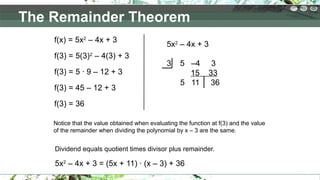
5x2
– 4x +3
3 5 –4 3
15 33
5 11 36
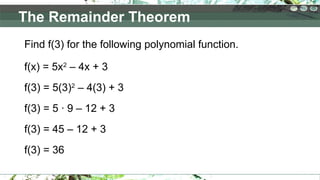
f(x) = 5x2
– 4x + 3
f(3) = 5(3)2
– 4(3) + 3
f(3) = 5 ∙ 9 – 12 + 3
f(3) = 45 – 12 + 3
f(3) = 36
Notice that the value obtained when evaluating the function at f(3) and the value
of the remainder when dividing the polynomial by x – 3 are the same.
Dividend equals quotient times divisor plus remainder.
5x2
– 4x + 3 = (5x + 11) ∙ (x – 3) + 36
The Remainder Theorem
6.
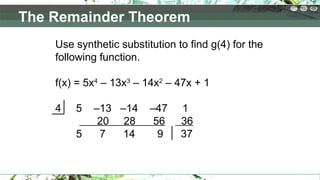
Use synthetic substitutionto find g(4) for the
following function.
f(x) = 5x4
– 13x3
– 14x2
– 47x + 1
4 5 –13 –14 –47 1
20 28 56 36
5 7 14 9 37
The Remainder Theorem
7.
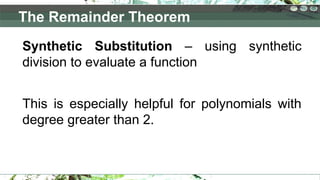
Synthetic Substitution –using synthetic
division to evaluate a function
This is especially helpful for polynomials with
degree greater than 2.
The Remainder Theorem
8.
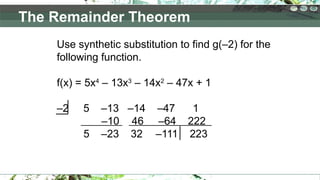
Use synthetic substitutionto find g(–2) for the
following function.
f(x) = 5x4
– 13x3
– 14x2
– 47x + 1
–2 5 –13 –14 –47 1
–10 46 –64 222
5 –23 32 –111 223
The Remainder Theorem
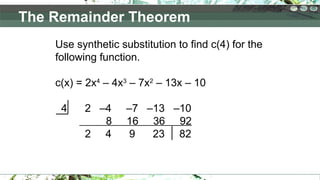
9.
Use synthetic substitutionto find c(4) for the
following function.
c(x) = 2x4
– 4x3
– 7x2
– 13x – 10
4 2 –4 –7 –13 –10
8 16 36 92
2 4 9 23 82
The Remainder Theorem
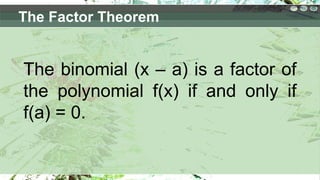
10.
The binomial (x– a) is a factor of
the polynomial f(x) if and only if
f(a) = 0.
The Factor Theorem
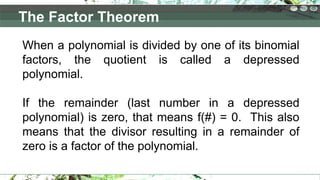
11.
When a polynomialis divided by one of its binomial
factors, the quotient is called a depressed
polynomial.
If the remainder (last number in a depressed
polynomial) is zero, that means f(#) = 0. This also
means that the divisor resulting in a remainder of
zero is a factor of the polynomial.
The Factor Theorem
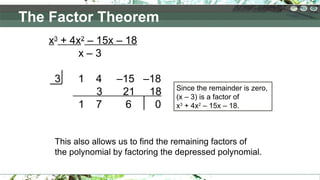
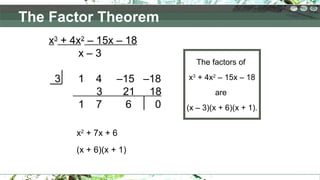
12.
x3
+ 4x2
– 15x– 18
x – 3
3 1 4 –15 –18
3 21 18
1 7 6 0
Since the remainder is zero,
(x – 3) is a factor of
x3
+ 4x2
– 15x – 18.
This also allows us to find the remaining factors of
the polynomial by factoring the depressed polynomial.
The Factor Theorem
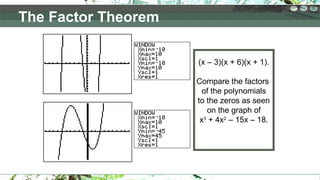
(x – 3)(x+ 6)(x + 1).
Compare the factors
of the polynomials
to the zeros as seen
on the graph of
x3
+ 4x2
– 15x – 18.
The Factor Theorem
15.
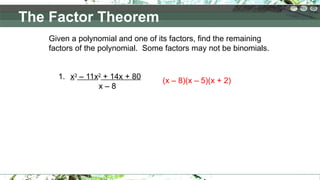
Given a polynomialand one of its factors, find the remaining
factors of the polynomial. Some factors may not be binomials.
1. x3
– 11x2
+ 14x + 80
x – 8
(x – 8)(x – 5)(x + 2)
The Factor Theorem
16.
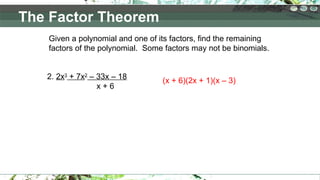
Given a polynomialand one of its factors, find the remaining
factors of the polynomial. Some factors may not be binomials.
2. 2x3
+ 7x2
– 33x – 18
x + 6
(x + 6)(2x + 1)(x – 3)
The Factor Theorem
17.
What is theimportance of the remainder theorem
and factor theorem?
The remainder theorem and factor theorem are
very handy tools. They tell us that we can find
factors of a polynomial without using long division,
synthetic division, or other traditional methods of
factoring. Using these theorems is somewhat of a
trial and error method.



![Grade 10 Remainder Theorem [Autosaved].pptx](https://cdn.slidesharecdn.com/ss_thumbnails/3-250826085837-2b228d20-thumbnail.jpg?width=640&height=640&fit=bounds)


