2013 CharityComms Conference

PEOPLE FOR THE ETHICAL
TREATMENT OF ANIMALS:
The Power of Segmentation


Allan Hulse
In Today’s Session
• What is segmentation?
• What makes a bad piece of communication?
• What makes a good piece of communication?
• Why should we segment?
• Case Study: PETA Online Fundraising Campaign
• Short Group Exercise
• Q and A
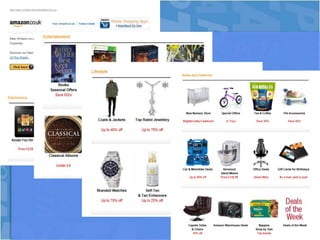
When E-mails Go Bad!!
What Makes Communication Bad?

  • Not personalised
  • Not relevant to me
  • Getting it wrong
  • Bad timing
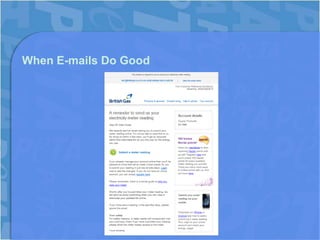
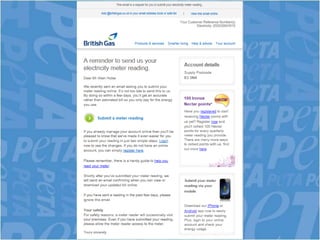
When E-mails Do Good
What Makes Communication Good?

  • Personalised
  • Very relevant to me
  • Very specific reason for sending it
  • Easy to read
  • Easy to act upon
Why Segment?

 • Send messages your supporters want to receive
 • Send more personalised messages
 • Conditionalise your content
 • Get more meaningful results
 • Track the behaviour of different groups within your list
 • Decrease unsubscribes / improve retention


       To Build Engagement
Case Study
People for the Ethical Treatment of Animals (PETA)
• Animals are not ours to:   • Active online community
   • Eat                        • Online petitions
   • Wear                       • Email target campaigns
   • Experiment on              • Pledges (“I pledge to never
   • Use for entertainment        wear fur”)
   • Abuse in any way           • Downloadable material
                                • Social sharing
                                     Data capture
                                     Fundraising
Entry points to PETA’s supporter list
• Online
   • Online petitions
   • Pledges (“I pledge to never wear fur”)
   • Downloadable material
   • Competitions
• Offline
   • Direct Mail
   • Events
   • Phone
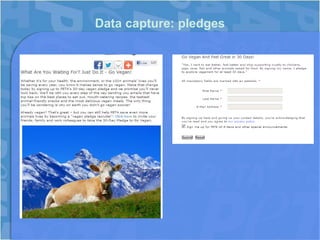
Data capture: pledges
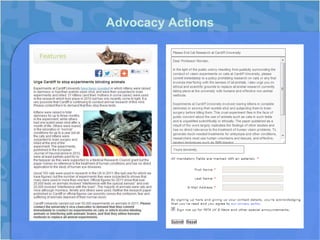
Advocacy Actions
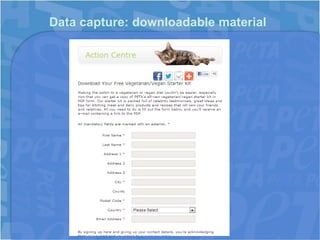
Data capture: downloadable material
‘Interest’ Tracking / Ways to Segment our Data
• Animals are not ours to:
   • Eat
   • Wear
   • Experiment on
   • Use for entertainment
   • Abuse in any way
‘Interest’ Tracking / Ways to Segment our Data
• Animals are not ours to:
   • Eat
      • Petitions
      • Pledges
      • Competitions
      • Donations
‘Interest’ Tracking / Ways to Segment our Data

• Animals are not ours to:
   • Eat
      • Petitions
           • Location
           • Age
           • Gender
‘Interest’ Tracking / Ways to Segment our Data

• Animals are not ours to:
   • Eat
      • Petitions
           • Location
               • Frequency
               • Recentcy
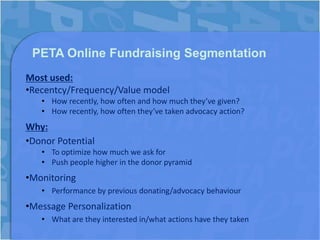
PETA Online Fundraising Segmentation
Most used:
•Recentcy/Frequency/Value model
   • How recently, how often and how much they’ve given?
   • How recently, how often they’ve taken advocacy action?
Why:
•Donor Potential
   • To optimize how much we ask for
   • Push people higher in the donor pyramid
•Monitoring
   • Performance by previous donating/advocacy behaviour
•Message Personalization
   • What are they interested in/what actions have they taken
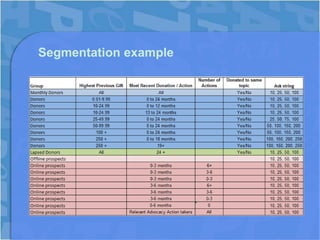
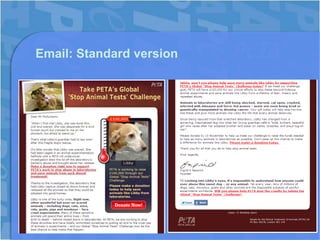
Segmentation example
Email: Standard version
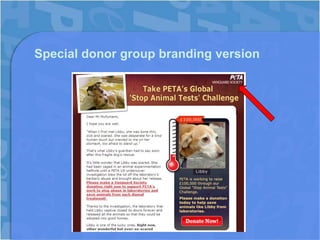
Special donor group branding version
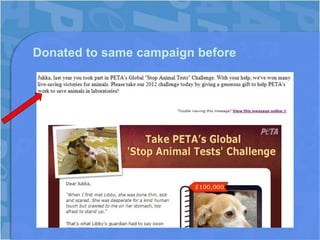
Donated to same campaign before
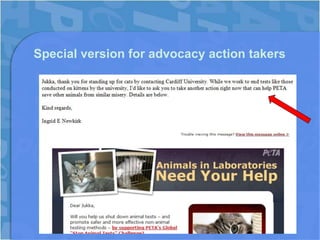
Special version for advocacy action takers
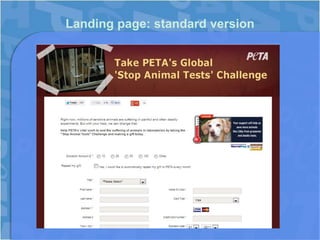
Landing page: standard version
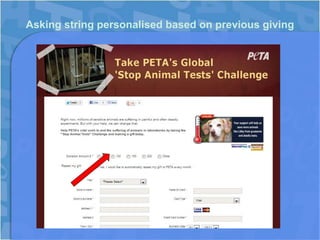
Asking string personalised based on previous giving
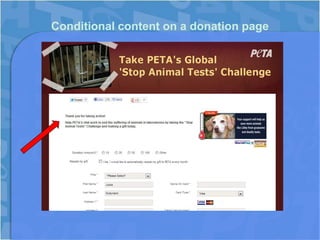
Conditional content on a donation page
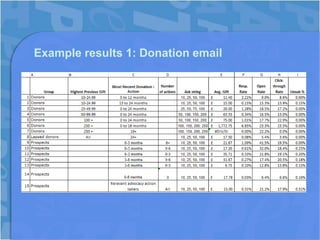
Example results 1: Donation email
Always Have a Reason
• Send messages your supporters want to receive
• Send more personalised messages
• Decrease unsubscribes / improve retention
• Get more meaningful results
• Track the behaviour of subsets within your list
• Conditionalise your content
Practical Application
Exercise
Think about a communication campaign you have or are about to work on
in your organisation. How using segmentation could help you improve
that campaign?


• Indentify what types of data you have in your organisation
• Identify a goal
• Identify how your data will help you achieve that goal
• Identify how you will you measure success
• How will you use those results in the future?
Thank you

       allanh@peta.org.uk

The power of segmentation

  • 1.
    2013 CharityComms Conference PEOPLEFOR THE ETHICAL TREATMENT OF ANIMALS: The Power of Segmentation Allan Hulse
  • 2.
    In Today’s Session •What is segmentation? • What makes a bad piece of communication? • What makes a good piece of communication? • Why should we segment? • Case Study: PETA Online Fundraising Campaign • Short Group Exercise • Q and A
  • 3.
  • 4.
    When E-mails GoBad!! What Makes Communication Bad? • Not personalised • Not relevant to me • Getting it wrong • Bad timing
  • 5.
  • 7.
    When E-mails DoGood What Makes Communication Good? • Personalised • Very relevant to me • Very specific reason for sending it • Easy to read • Easy to act upon
  • 8.
    Why Segment? •Send messages your supporters want to receive • Send more personalised messages • Conditionalise your content • Get more meaningful results • Track the behaviour of different groups within your list • Decrease unsubscribes / improve retention To Build Engagement
  • 9.
  • 10.
    People for theEthical Treatment of Animals (PETA) • Animals are not ours to: • Active online community • Eat • Online petitions • Wear • Email target campaigns • Experiment on • Pledges (“I pledge to never • Use for entertainment wear fur”) • Abuse in any way • Downloadable material • Social sharing  Data capture  Fundraising
  • 11.
    Entry points toPETA’s supporter list • Online • Online petitions • Pledges (“I pledge to never wear fur”) • Downloadable material • Competitions • Offline • Direct Mail • Events • Phone
  • 12.
  • 13.
  • 14.
  • 15.
    ‘Interest’ Tracking /Ways to Segment our Data • Animals are not ours to: • Eat • Wear • Experiment on • Use for entertainment • Abuse in any way
  • 16.
    ‘Interest’ Tracking /Ways to Segment our Data • Animals are not ours to: • Eat • Petitions • Pledges • Competitions • Donations
  • 17.
    ‘Interest’ Tracking /Ways to Segment our Data • Animals are not ours to: • Eat • Petitions • Location • Age • Gender
  • 18.
    ‘Interest’ Tracking /Ways to Segment our Data • Animals are not ours to: • Eat • Petitions • Location • Frequency • Recentcy
  • 19.
    PETA Online FundraisingSegmentation Most used: •Recentcy/Frequency/Value model • How recently, how often and how much they’ve given? • How recently, how often they’ve taken advocacy action? Why: •Donor Potential • To optimize how much we ask for • Push people higher in the donor pyramid •Monitoring • Performance by previous donating/advocacy behaviour •Message Personalization • What are they interested in/what actions have they taken
  • 20.
  • 21.
  • 22.
    Special donor groupbranding version
  • 23.
    Donated to samecampaign before
  • 24.
    Special version foradvocacy action takers
  • 25.
  • 26.
    Asking string personalisedbased on previous giving
  • 27.
    Conditional content ona donation page
  • 28.
    Example results 1:Donation email
  • 29.
    Always Have aReason • Send messages your supporters want to receive • Send more personalised messages • Decrease unsubscribes / improve retention • Get more meaningful results • Track the behaviour of subsets within your list • Conditionalise your content
  • 30.
  • 31.
    Exercise Think about acommunication campaign you have or are about to work on in your organisation. How using segmentation could help you improve that campaign? • Indentify what types of data you have in your organisation • Identify a goal • Identify how your data will help you achieve that goal • Identify how you will you measure success • How will you use those results in the future?
  • 32.
    Thank you allanh@peta.org.uk