The “Peculiar Institution”
Few places in theWestern Hemisphere had slavery by the
mid-19th
century
Isolated the South from American society
Southerners increasingly had to defend it
Varieties of Slavery
Slave Codes
Limited slaves’ rights
Harsh penalties for slaves, limited penalties for slave
owners
Varied from state to state
Anyone with a trace of African ancestry was defined as
black
Varieties of Slavery
Enforcement of slave codes were spotty and uneven
Slave owners often handled punishments
Wide variety of treatment
 From prisonlike to a high degree of autonomy
 Warm & affectionate to tyrannical & cruel
System based on slaves powerlessness; paternalistic
relationships
Varieties of Slavery
Overseers & assistant overseers
“Head drivers” & subdrivers
 Trusted slaves
Methods of assigning slave labor
 Task system
 Gang system
Life Under Slavery
Diet=Cornmeal, salt pork, molasses, & occasionally fresh
meat
 Many slaves had their own gardens
Cheap clothing & shoes
Crude cabins called “slave quarters”
Female slaves acted as “healers” & midwives
Life Under Slavery
Work started as children
Work days longest at harvest time
Women had to carry out work & tradition roles of raising
family, preparing meals, caring for homes
Life Under Slavery
International slave trade ended in 1808
Proportion of blacks to whites decreased
High death rates, life expectancy was much shorter than
that of white southerners
Material conditions better than some northern factory
workers & European peasants
Conditions less severe than slaves in South America &
Caribbean
Slave population actually increased through natural
reproduction
House Slaves
Less grueling work
Butlers, maids, cook, coachmen
Closer relationships w/ slave-owning family
Female house servants were vulnerable to sexual abuse
Slavery in the Cities
Line between slavery & freedom was blurred due to
mobility w/in the city
Mining, lumbering, docks, construction sites, drove
wagons, etc.
Women & children worked in textile mills
Number of slaves in urban areas decreased
Segregation part of southern cities
Free African Americans
250K in slaveholding states by CivilWar
Some were slaves that bought freedom
After NatTurner’s Rebellion (1831), it became increasingly
difficult to set slaves free
 All southern states forbade free African Americans from
entering
Most lived in poverty
They were only quasi-free
The SlaveTrade
Long trips by train or on rivers, short trips on foot
Taken to cities for auctions
Checked like livestock
Strong field hand brought up to $1,700
Split slave families
Foreign slave trade banned in 1808, but smuggling
continued
Amistad
1839—53 slaves in Cuba took charge of ship
Tried to sail back to Africa, ended up in U.S.
Represented in Supreme Court by JQ Adams
Won case & returned to Africa
Slave Resistance
 Response to slavery was mix of adaptation & resistance
 “Sambo”—Acted out role the white world expected him to
 Often a façade by the slaves
 Slave rebel
 Revolts were rare
 Gabriel Prosser, Richmond, 1800—stopped before it started
 DenmarkVesey, Charleston, 1822—suppressed
 NatTurner,Virginia, 1831—Killed 60 whites, stopped by state &
federal troops, 100+ were executed
Slave Resistance
Running away, to the North or Canada
 Difficult to do
 “slave patrols,” bloodhounds, lack of geographic knowledge
Refusal to work hard
Sabotage
 Stealing, breaking tools
Culture of Slavery
Lanugage—”pidgin”—combo of English & African words
Music—spirituals—used to pass time while at work
Religion—Most became Christians
 Mixed elements of religious traditions in Africa
 Often more emotional than white religion
 Emphasized the dream of freedom
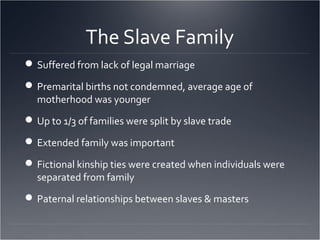
The Slave Family
Suffered from lack of legal marriage
Premarital births not condemned, average age of
motherhood was younger
Up to 1/3 of families were split by slave trade
Extended family was important
Fictional kinship ties were created when individuals were
separated from family
Paternal relationships between slaves & masters

The "Peculiar Institution"

  • 2.
    The “Peculiar Institution” Fewplaces in theWestern Hemisphere had slavery by the mid-19th century Isolated the South from American society Southerners increasingly had to defend it
  • 3.
    Varieties of Slavery SlaveCodes Limited slaves’ rights Harsh penalties for slaves, limited penalties for slave owners Varied from state to state Anyone with a trace of African ancestry was defined as black
  • 4.
    Varieties of Slavery Enforcementof slave codes were spotty and uneven Slave owners often handled punishments Wide variety of treatment  From prisonlike to a high degree of autonomy  Warm & affectionate to tyrannical & cruel System based on slaves powerlessness; paternalistic relationships
  • 5.
    Varieties of Slavery Overseers& assistant overseers “Head drivers” & subdrivers  Trusted slaves Methods of assigning slave labor  Task system  Gang system
  • 6.
    Life Under Slavery Diet=Cornmeal,salt pork, molasses, & occasionally fresh meat  Many slaves had their own gardens Cheap clothing & shoes Crude cabins called “slave quarters” Female slaves acted as “healers” & midwives
  • 7.
    Life Under Slavery Workstarted as children Work days longest at harvest time Women had to carry out work & tradition roles of raising family, preparing meals, caring for homes
  • 8.
    Life Under Slavery Internationalslave trade ended in 1808 Proportion of blacks to whites decreased High death rates, life expectancy was much shorter than that of white southerners Material conditions better than some northern factory workers & European peasants Conditions less severe than slaves in South America & Caribbean Slave population actually increased through natural reproduction
  • 9.
    House Slaves Less gruelingwork Butlers, maids, cook, coachmen Closer relationships w/ slave-owning family Female house servants were vulnerable to sexual abuse
  • 10.
    Slavery in theCities Line between slavery & freedom was blurred due to mobility w/in the city Mining, lumbering, docks, construction sites, drove wagons, etc. Women & children worked in textile mills Number of slaves in urban areas decreased Segregation part of southern cities
  • 11.
    Free African Americans 250Kin slaveholding states by CivilWar Some were slaves that bought freedom After NatTurner’s Rebellion (1831), it became increasingly difficult to set slaves free  All southern states forbade free African Americans from entering Most lived in poverty They were only quasi-free
  • 12.
    The SlaveTrade Long tripsby train or on rivers, short trips on foot Taken to cities for auctions Checked like livestock Strong field hand brought up to $1,700 Split slave families Foreign slave trade banned in 1808, but smuggling continued
  • 13.
    Amistad 1839—53 slaves inCuba took charge of ship Tried to sail back to Africa, ended up in U.S. Represented in Supreme Court by JQ Adams Won case & returned to Africa
  • 14.
    Slave Resistance  Responseto slavery was mix of adaptation & resistance  “Sambo”—Acted out role the white world expected him to  Often a façade by the slaves  Slave rebel  Revolts were rare  Gabriel Prosser, Richmond, 1800—stopped before it started  DenmarkVesey, Charleston, 1822—suppressed  NatTurner,Virginia, 1831—Killed 60 whites, stopped by state & federal troops, 100+ were executed
  • 15.
    Slave Resistance Running away,to the North or Canada  Difficult to do  “slave patrols,” bloodhounds, lack of geographic knowledge Refusal to work hard Sabotage  Stealing, breaking tools
  • 16.
    Culture of Slavery Lanugage—”pidgin”—comboof English & African words Music—spirituals—used to pass time while at work Religion—Most became Christians  Mixed elements of religious traditions in Africa  Often more emotional than white religion  Emphasized the dream of freedom
  • 17.
    The Slave Family Sufferedfrom lack of legal marriage Premarital births not condemned, average age of motherhood was younger Up to 1/3 of families were split by slave trade Extended family was important Fictional kinship ties were created when individuals were separated from family Paternal relationships between slaves & masters