Investigation Interview
Planning: What to Do Before
the Interview
Mark A. Anderson
Director of Training and Development
Anderson Investigative Associates
Presenter bio
Mark A. Anderson
 Director of Training and Development, AIA
 Special Agent, DOJ/OIG, Inspector General Criminal
Investigator Academy
 Detailed to FLETC/DHS, Behavioral Science Division
 Former Senior Special Agent, DOJ, FBI, and NRC
 New York State OIG Deputy Inspector General and Director of
Internal Audit
 Director of Security, Pyramid Corporation
 Forensic Chemist, New York State Police
Anderson Investigative Associates
Let’s Keep In Touch:
 Website
 www.Andersoninvestigative.com
 Facebook
 Anderson Investigative Associates
 LinkedIn
 https://www.linkedin.com/in/mark-a-anderson-a46a1658
 Twitter
 Mark A. Anderson@AIA_training
Anderson Investigative
Associates
What is our Goal in Interviewing?
Our primary purpose is to have an
interaction to elicit the maximum amount
of truthful statements made!
We need to obtain the greatest quality and
quantity of information from this
interaction.
Anderson Investigative
Associates
Planning
“In preparing for battle, I have
always found that plans are
useless, but planning is
indispensable.”
» Dwight Eisenhower, former U.S. President
and supreme Allied commander in
Europe during World War II
Anderson Investigative
Associates
Interview Planning: When to Do?
Planning and Strategizing Must Occur:
•Before
•During
•After the interview.
The direction and focus will change but the planning will
equip you for those eventualities.
Anderson Investigative
Associates
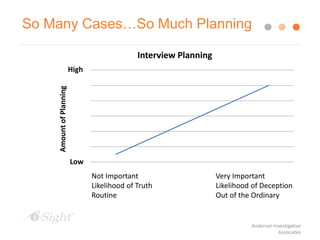
So Many Cases…So Much Planning
AmountofPlanning
Interview Planning
High
Low
Not Important
Likelihood of Truth
Routine
Very Important
Likelihood of Deception
Out of the Ordinary
Anderson Investigative
Associates
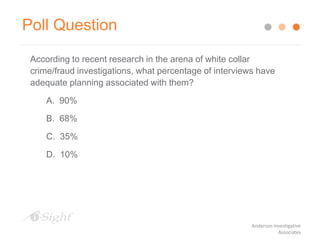
Poll Question
According to recent research in the arena of white collar
crime/fraud investigations, what percentage of interviews have
adequate planning associated with them?
A. 90%
B. 68%
C. 35%
D. 10%
Anderson Investigative
Associates
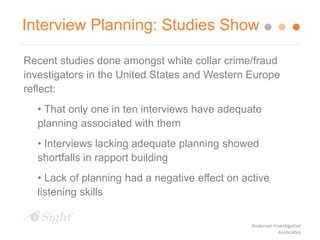
Interview Planning: Studies Show
Recent studies done amongst white collar crime/fraud
investigators in the United States and Western Europe
reflect:
• That only one in ten interviews have adequate
planning associated with them
• Interviews lacking adequate planning showed
shortfalls in rapport building
• Lack of planning had a negative effect on active
listening skills
Anderson Investigative
Associates
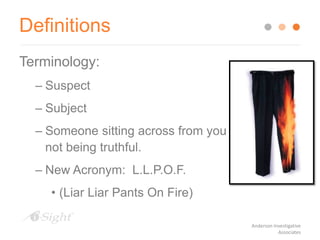
Definitions
Terminology:
– Suspect
– Subject
– Someone sitting across from you
not being truthful.
– New Acronym: L.L.P.O.F.
• (Liar Liar Pants On Fire)
Anderson Investigative
Associates
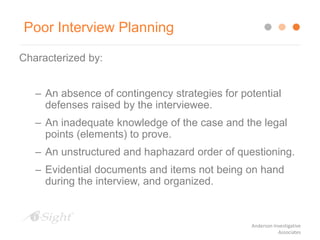
Poor Interview Planning
Characterized by:
– An absence of contingency strategies for potential
defenses raised by the interviewee.
– An inadequate knowledge of the case and the legal
points (elements) to prove.
– An unstructured and haphazard order of questioning.
– Evidential documents and items not being on hand
during the interview, and organized.
Anderson Investigative
Associates
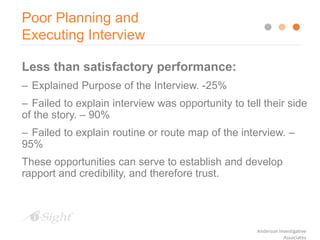
Poor Planning and
Executing Interview
Less than satisfactory performance:
– Explained Purpose of the Interview. -25%
– Failed to explain interview was opportunity to tell their side
of the story. – 90%
– Failed to explain routine or route map of the interview. –
95%
These opportunities can serve to establish and develop
rapport and credibility, and therefore trust.
Anderson Investigative
Associates
Particular Concerns
*Frequent mediocrity displayed by investigators when
developing and, challenging suspects’
answers/accounts.
*Ineffective interviews reflected a rigidity in the
questioning tactics (questioning by number strategy).
• No ability to deviate based on responses.
*Lack of imaginative interviewing strategies, typified by
premature evidence presentation, followed by
investigator seemingly giving up when faced with
denials.
Anderson Investigative
Associates
Particular Concerns
*Perception of guilt negatively effected interview
progression. (investigator bias)
• Why plan if they are guilty?
*Ability to fully explore legal points in interview
(elements of crime).
• Questions as to understanding of elements
• Ability to establish all elements.
*Low level of exploring any motives for what they did,
>25%.
Anderson Investigative
Associates
How about these issues?
Premature evidence presentation
Giving up when confronted with denials.
Rapport building was mediocre
– Results in stunted ability to ask question
– Good rapport, increased correct and more probative
information.
Simple approach to question formulation (evidence
presentation) vs. well-crafted interview presentation.
– Perception of evidence strength is key factor in decision to
confess.
Anderson Investigative
Associates
How about these issues?
Ineffective Summary at end and during interview vs. thorough
summary.
– Demonstrate collective weight of evidence by
summarizing repeatedly.
• Shows common understanding, demonstrates active
listening, results in greater information sharing.
Interviewing too early in investigation.
Failure to interact effectively with partner in two person
interview.
Anderson Investigative
Associates
The Interview and Planning
Objective
Preparation : things to consider
– Safety & Location
– Basic Preparation
– One or two personnel to interview
– Who attends
– Role of the attendees
– Memorializing the results
Anderson Investigative
Associates
Objective
Interviews are conducted to acquire
factual information from a witness
regarding the witness’s knowledge or their
participation in a particular matter.
Your techniques and process should be
planned and consistent.
Anderson Investigative
Associates
“Begin with the End in Mind”
Franklin Covey
Anderson Investigative
Associates
The interview is often the cornerstone of an
investigation. It is frequently the single most
weighed piece of evidence considered in a
hearing/trial.
You should be able to defend your actions
and strategies related to your conduct in all
interviews.
Anderson Investigative
Associates
Preparation
“ To win is important, to prepare is vital.”
--Joe Paterno
Do your homework, know the case and the witness.
Be familiar with the elements of the crime and
administrative policies that may apply. Understand
what you need to prove.
Know when to conduct the interview. Don’t be
premature.
Anderson Investigative
Associates
Preparation
Although each interview is different, we
prepare for them in the same fashion. In
the end, whether at a trial or hearing, your
presentation and consistency will help to
establish your credibility and impartiality
to the subject and later, to a jury or
deciding official.
Anderson Investigative
Associates
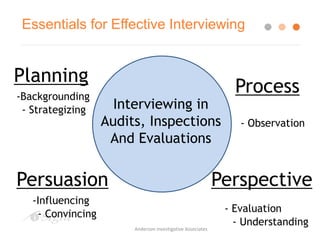
Process
Planning
Perspective
-Backgrounding
- Understanding
Interviewing in
Audits, Inspections
And Evaluations
Persuasion
-Influencing
- Convincing
- Observation
- Evaluation
- Strategizing
Anderson Investigative Associates
Essentials for Effective Interviewing
Planning the Interview
Where will you conduct the interview?
- your office?
- witness’s location?
- neutral site?
EMPLOYEE SAFETY IS #1 PRIORITY.
- consider the eventualities
- weapons in interview room?
Strategize
Anderson Investigative
Associates
Planning the Interview
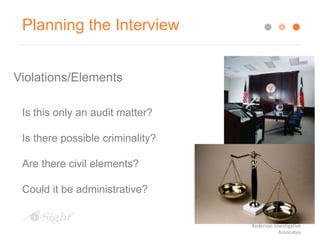
Violations/Elements
Is this only an audit matter?
Is there possible criminality?
Are there civil elements?
Could it be administrative?
Anderson Investigative
Associates
Planning the Interview
Objective of interview
- think general
- what do you already know?
- what do you need or want to know?
- what statement or documents can this interviewee provide?
Violations/Elements
Anderson Investigative
Associates
Planning the Interview
Research your interviewee
- Facebook
- City directory
- Criminal record and reputation
- Employment/educational records
- Other sources?
**The more we know, the better prepared we will be.
Anderson Investigative
Associates
Planning the Interview
Prepare an Outline
- name and identifying data of interviewee
- objectives to cover
- items to request
- date, time, place of interview and persons present
- avoid writing out specific questions, with some exceptions
- We must be prepared to expand out of our checklist, as
needed!
Anderson Investigative
Associates
Planning the Interview
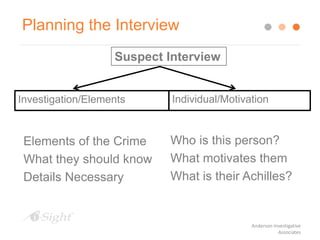
Investigation/Elements
Who is this person?
What motivates them
What is their Achilles?
Individual/Motivation
Suspect Interview
Elements of the Crime
What they should know
Details Necessary
Anderson Investigative
Associates
First Contact
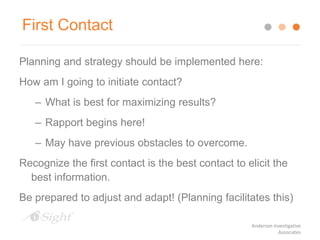
Planning and strategy should be implemented here:
How am I going to initiate contact?
– What is best for maximizing results?
– Rapport begins here!
– May have previous obstacles to overcome.
Recognize the first contact is the best contact to elicit the
best information.
Be prepared to adjust and adapt! (Planning facilitates this)
Anderson Investigative
Associates
Who will be present?
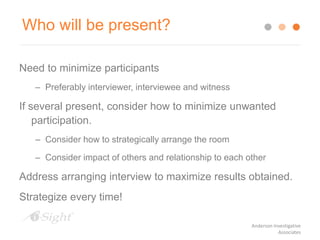
Need to minimize participants
– Preferably interviewer, interviewee and witness
If several present, consider how to minimize unwanted
participation.
– Consider how to strategically arrange the room
– Consider impact of others and relationship to each other
Address arranging interview to maximize results obtained.
Strategize every time!
Anderson Investigative
Associates
Optimal Room Setup
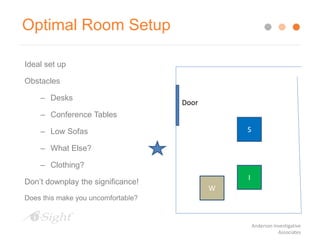
Ideal set up
Obstacles
– Desks
– Conference Tables
– Low Sofas
– What Else?
– Clothing?
Don’t downplay the significance!
Does this make you uncomfortable?
W
I
S
Door
Anderson Investigative
Associates
Safety and Location
The Interview:
It’s not just a conversation
Can be and emotionally charged setting
The more complete the planning the better
we’ll know.
Anderson Investigative
Associates
Safety Considerations
Witness Interviews
Location of the interview
– Somewhere you have control
– Where are we going to maximize information of obtained.
Be alert to your surroundings (back packs, layered clothing,
etc.)
Ask them if they are armed
Positioning inside the room
Anderson Investigative
Associates
Interviewing Subjects/Suspects
Location of the interview can be critical
When scheduling, inform them what they can bring and what not
to bring (weapons)
Select a location with appropriate security
Upon their arrival insure safety
– Need for screening?
– Need to search bags, briefcase, etc.
Safety in numbers: Interview with a second interviewer present
Anderson Investigative
Associates
Several factors influence whether we will have one
or two interviewers present during an interview:
– Location / travel
– Purpose of the witness being interviewed
– Approach or structure of the interview
– Confrontational / non confrontational
– Safety considerations
One or Two Interviewers in the
Interview
Anderson Investigative
Associates
Rapport:
 Alone: you can build rapport, but will often take breaks to
write down key information.
 With a second agent: you build great rapport and rely on the
partner to record the information.
Retention:
 Alone: you need to have a great memory, and able to recall
and store information quickly
 With a second agent: Your themes and theories are more fluid
and the partner is there to keep you focused should the
witness begin to offer an alibi or banter with you.
Advantage - Disadvantage
Anderson Investigative
Associates
Alone: It is easier for a subject to confess to one person, than
to two; however, with a second agent, you have an additional
witness to testify to the events of the interview and be an
extra eyes and ears.
Safety: Two is better than one. Always conduct a subject
interview with another interviewer.
Bottom line is there are pros and cons to either: depending on
the interview, the purpose, and many other factors, weigh
them all before making a decision --- this is planning.
In General
Anderson Investigative
Associates
Be comfortable / capable in asking questions
Questions presented during the interview should
be logical and in support of a foundation.
They should be organized and designed to elicit
dialogue.
Many of these should be prepared in advance
and many times rehearsed.
Ask the Right Questions
Anderson Investigative
Associates
The questions we ask should resolve unanswered
questions raised in the investigation.
The difficult questions must be asked. (And if not
answered, asked again!) We must get the truthful
answers.
Practice good question formulation to minimize the
number of questions asked.
Ask the Right Questions
Anderson Investigative
Associates
Each interview should be conducted in a natural
progression.
Under most circumstances, the subject’s
interview will be the last; however, there may be
situations when it might be advantageous to
interview the subject first. In those cases the
subject may need to re-interviewed later to
address inconsistencies.
Timing
Anderson Investigative
Associates
The interviewer must listen to the witnesses’ answers in order to
further develop their questions. This is a process that is evolving. It
is difficult to achieve this when all your attention is on your prepared
questions. Be focused and flexible. Absorb the information and
process it.
Stay engaged in the interview. Listen to what is being said, and
how does it fit into what was previously said or that is known from
the investigation.
If the witness said it: it’s important: you have to find its relevance.
Learn to Listen
Anderson Investigative
Associates
Script or outline approach
Scripted interview: A structured and methodic
presentation of prepared detailed questions, that are
provided to a witness in a sequential order for
completion.
– Much like an interrogatory sworn statement.
Presenting the Interview Questions
Anderson Investigative
Associates
Advantages:
When formulating the list of questions, this technique
requires the investigator to think about all the issues to
discuss
Almost guarantees your question will be asked
Ensures the interview is structured
– Beginning, middle, and an end
Conditions the witness to answering your questions
Scripted Interviews
Anderson Investigative
Associates
Disadvantages:
Loose the ability to develop rapport
• It’s cold: “Just the facts..”
• Mechanical response
Reduces the likelihood that the witness will expand upon their answer
• They quickly learn that a short answer will suffice. “Got to” get through all
the questions. It is classic conditioning.
Reduces the opportunity for an impromptu comment or alibi
Often generates short or simple answers
Scripted Interviews
Anderson Investigative
Associates
This style relies on a series of topic or theme
questions presented by the interviewer, which
allows the interviewer to develop rapport with
the witness and for the witnesses to provide
more detail in their responses.
Consistent with a narrative sworn statement.
Outline Interviews
Anderson Investigative
Associates
Advantages:
Natural flow in asking questions and obtaining information. More
conversational technique.
Forces the witness to be engaged with the interviewer.
Allows for the opportunity to develop the witnesses response further.
More difficult for the witness to anticipate your “theme” or direction of
where you are going with the questioning techniques.
Outline Interviews
Anderson Investigative
Associates
Disadvantages:
Greater chance of missing information. Occasionally the
conversation rambles on and the interviewer loses track
of salient issues to address.
Good pre-planning of the interview helps to mitigate this
issue by establishing a foundational outline of where you
are going and what you should expect to get.
Outline Interviews
Anderson Investigative
Associates
A telephone interview is not an opportunity not to plan.
Recognize the same need for planning exists in this medium.
Consideration needs to be given to:
Time of Interview?
Who may be present where call is received?
How do I maximize information?
How do I terminate the call if I determine an in-person
interview is necessary?
Telephonic Interviews
Anderson Investigative
Associates
Preliminary inquiries with witness can often be accomplished via the
telephone.
Ensure a means to confirm who you are speaking with.
Useful to determine whether a witness may be a viable source of
information.
Is the first impression opportunity to develop rapport with the
interviewee.
May require a follow up, in person interview.
End interview on good terms.
Not advisable for a suspect/subject interview.
Telephonic Interviews
Anderson Investigative
Associates
Our Gift to You
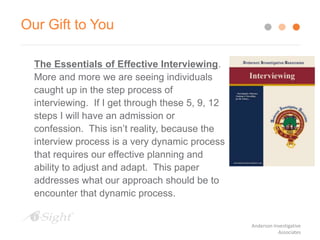
The Essentials of Effective Interviewing.
More and more we are seeing individuals
caught up in the step process of
interviewing. If I get through these 5, 9, 12
steps I will have an admission or
confession. This isn’t reality, because the
interview process is a very dynamic process
that requires our effective planning and
ability to adjust and adapt. This paper
addresses what our approach should be to
encounter that dynamic process.
Anderson Investigative
Associates
Questions?
Anderson Investigative
Associates
Thank-you for participating
If you have any questions, please feel free
to email them to:
Mark A. Anderson, Director of Training and Development
manderson@andersoninvestigative.com
(912) 882-5857
Joe Gerard, CEO, i-Sight Software
j.gerard@i-sight.com

Investigation Interview Planning: What to Do Before the Interview

  • 1.
    Investigation Interview Planning: Whatto Do Before the Interview Mark A. Anderson Director of Training and Development Anderson Investigative Associates
  • 2.
    Presenter bio Mark A.Anderson  Director of Training and Development, AIA  Special Agent, DOJ/OIG, Inspector General Criminal Investigator Academy  Detailed to FLETC/DHS, Behavioral Science Division  Former Senior Special Agent, DOJ, FBI, and NRC  New York State OIG Deputy Inspector General and Director of Internal Audit  Director of Security, Pyramid Corporation  Forensic Chemist, New York State Police
  • 3.
    Anderson Investigative Associates Let’sKeep In Touch:  Website  www.Andersoninvestigative.com  Facebook  Anderson Investigative Associates  LinkedIn  https://www.linkedin.com/in/mark-a-anderson-a46a1658  Twitter  Mark A. Anderson@AIA_training Anderson Investigative Associates
  • 4.
    What is ourGoal in Interviewing? Our primary purpose is to have an interaction to elicit the maximum amount of truthful statements made! We need to obtain the greatest quality and quantity of information from this interaction. Anderson Investigative Associates
  • 5.
    Planning “In preparing forbattle, I have always found that plans are useless, but planning is indispensable.” » Dwight Eisenhower, former U.S. President and supreme Allied commander in Europe during World War II Anderson Investigative Associates
  • 6.
    Interview Planning: Whento Do? Planning and Strategizing Must Occur: •Before •During •After the interview. The direction and focus will change but the planning will equip you for those eventualities. Anderson Investigative Associates
  • 7.
    So Many Cases…SoMuch Planning AmountofPlanning Interview Planning High Low Not Important Likelihood of Truth Routine Very Important Likelihood of Deception Out of the Ordinary Anderson Investigative Associates
  • 8.
    Poll Question According torecent research in the arena of white collar crime/fraud investigations, what percentage of interviews have adequate planning associated with them? A. 90% B. 68% C. 35% D. 10% Anderson Investigative Associates
  • 9.
    Interview Planning: StudiesShow Recent studies done amongst white collar crime/fraud investigators in the United States and Western Europe reflect: • That only one in ten interviews have adequate planning associated with them • Interviews lacking adequate planning showed shortfalls in rapport building • Lack of planning had a negative effect on active listening skills Anderson Investigative Associates
  • 10.
    Definitions Terminology: – Suspect – Subject –Someone sitting across from you not being truthful. – New Acronym: L.L.P.O.F. • (Liar Liar Pants On Fire) Anderson Investigative Associates
  • 11.
    Poor Interview Planning Characterizedby: – An absence of contingency strategies for potential defenses raised by the interviewee. – An inadequate knowledge of the case and the legal points (elements) to prove. – An unstructured and haphazard order of questioning. – Evidential documents and items not being on hand during the interview, and organized. Anderson Investigative Associates
  • 12.
    Poor Planning and ExecutingInterview Less than satisfactory performance: – Explained Purpose of the Interview. -25% – Failed to explain interview was opportunity to tell their side of the story. – 90% – Failed to explain routine or route map of the interview. – 95% These opportunities can serve to establish and develop rapport and credibility, and therefore trust. Anderson Investigative Associates
  • 13.
    Particular Concerns *Frequent mediocritydisplayed by investigators when developing and, challenging suspects’ answers/accounts. *Ineffective interviews reflected a rigidity in the questioning tactics (questioning by number strategy). • No ability to deviate based on responses. *Lack of imaginative interviewing strategies, typified by premature evidence presentation, followed by investigator seemingly giving up when faced with denials. Anderson Investigative Associates
  • 14.
    Particular Concerns *Perception ofguilt negatively effected interview progression. (investigator bias) • Why plan if they are guilty? *Ability to fully explore legal points in interview (elements of crime). • Questions as to understanding of elements • Ability to establish all elements. *Low level of exploring any motives for what they did, >25%. Anderson Investigative Associates
  • 15.
    How about theseissues? Premature evidence presentation Giving up when confronted with denials. Rapport building was mediocre – Results in stunted ability to ask question – Good rapport, increased correct and more probative information. Simple approach to question formulation (evidence presentation) vs. well-crafted interview presentation. – Perception of evidence strength is key factor in decision to confess. Anderson Investigative Associates
  • 16.
    How about theseissues? Ineffective Summary at end and during interview vs. thorough summary. – Demonstrate collective weight of evidence by summarizing repeatedly. • Shows common understanding, demonstrates active listening, results in greater information sharing. Interviewing too early in investigation. Failure to interact effectively with partner in two person interview. Anderson Investigative Associates
  • 17.
    The Interview andPlanning Objective Preparation : things to consider – Safety & Location – Basic Preparation – One or two personnel to interview – Who attends – Role of the attendees – Memorializing the results Anderson Investigative Associates
  • 18.
    Objective Interviews are conductedto acquire factual information from a witness regarding the witness’s knowledge or their participation in a particular matter. Your techniques and process should be planned and consistent. Anderson Investigative Associates
  • 19.
    “Begin with theEnd in Mind” Franklin Covey Anderson Investigative Associates
  • 20.
    The interview isoften the cornerstone of an investigation. It is frequently the single most weighed piece of evidence considered in a hearing/trial. You should be able to defend your actions and strategies related to your conduct in all interviews. Anderson Investigative Associates
  • 21.
    Preparation “ To winis important, to prepare is vital.” --Joe Paterno Do your homework, know the case and the witness. Be familiar with the elements of the crime and administrative policies that may apply. Understand what you need to prove. Know when to conduct the interview. Don’t be premature. Anderson Investigative Associates
  • 22.
    Preparation Although each interviewis different, we prepare for them in the same fashion. In the end, whether at a trial or hearing, your presentation and consistency will help to establish your credibility and impartiality to the subject and later, to a jury or deciding official. Anderson Investigative Associates
  • 23.
    Process Planning Perspective -Backgrounding - Understanding Interviewing in Audits,Inspections And Evaluations Persuasion -Influencing - Convincing - Observation - Evaluation - Strategizing Anderson Investigative Associates Essentials for Effective Interviewing
  • 24.
    Planning the Interview Wherewill you conduct the interview? - your office? - witness’s location? - neutral site? EMPLOYEE SAFETY IS #1 PRIORITY. - consider the eventualities - weapons in interview room? Strategize Anderson Investigative Associates
  • 25.
    Planning the Interview Violations/Elements Isthis only an audit matter? Is there possible criminality? Are there civil elements? Could it be administrative? Anderson Investigative Associates
  • 26.
    Planning the Interview Objectiveof interview - think general - what do you already know? - what do you need or want to know? - what statement or documents can this interviewee provide? Violations/Elements Anderson Investigative Associates
  • 27.
    Planning the Interview Researchyour interviewee - Facebook - City directory - Criminal record and reputation - Employment/educational records - Other sources? **The more we know, the better prepared we will be. Anderson Investigative Associates
  • 28.
    Planning the Interview Preparean Outline - name and identifying data of interviewee - objectives to cover - items to request - date, time, place of interview and persons present - avoid writing out specific questions, with some exceptions - We must be prepared to expand out of our checklist, as needed! Anderson Investigative Associates
  • 29.
    Planning the Interview Investigation/Elements Whois this person? What motivates them What is their Achilles? Individual/Motivation Suspect Interview Elements of the Crime What they should know Details Necessary Anderson Investigative Associates
  • 30.
    First Contact Planning andstrategy should be implemented here: How am I going to initiate contact? – What is best for maximizing results? – Rapport begins here! – May have previous obstacles to overcome. Recognize the first contact is the best contact to elicit the best information. Be prepared to adjust and adapt! (Planning facilitates this) Anderson Investigative Associates
  • 31.
    Who will bepresent? Need to minimize participants – Preferably interviewer, interviewee and witness If several present, consider how to minimize unwanted participation. – Consider how to strategically arrange the room – Consider impact of others and relationship to each other Address arranging interview to maximize results obtained. Strategize every time! Anderson Investigative Associates
  • 32.
    Optimal Room Setup Idealset up Obstacles – Desks – Conference Tables – Low Sofas – What Else? – Clothing? Don’t downplay the significance! Does this make you uncomfortable? W I S Door Anderson Investigative Associates
  • 33.
    Safety and Location TheInterview: It’s not just a conversation Can be and emotionally charged setting The more complete the planning the better we’ll know. Anderson Investigative Associates
  • 34.
    Safety Considerations Witness Interviews Locationof the interview – Somewhere you have control – Where are we going to maximize information of obtained. Be alert to your surroundings (back packs, layered clothing, etc.) Ask them if they are armed Positioning inside the room Anderson Investigative Associates
  • 35.
    Interviewing Subjects/Suspects Location ofthe interview can be critical When scheduling, inform them what they can bring and what not to bring (weapons) Select a location with appropriate security Upon their arrival insure safety – Need for screening? – Need to search bags, briefcase, etc. Safety in numbers: Interview with a second interviewer present Anderson Investigative Associates
  • 36.
    Several factors influencewhether we will have one or two interviewers present during an interview: – Location / travel – Purpose of the witness being interviewed – Approach or structure of the interview – Confrontational / non confrontational – Safety considerations One or Two Interviewers in the Interview Anderson Investigative Associates
  • 37.
    Rapport:  Alone: youcan build rapport, but will often take breaks to write down key information.  With a second agent: you build great rapport and rely on the partner to record the information. Retention:  Alone: you need to have a great memory, and able to recall and store information quickly  With a second agent: Your themes and theories are more fluid and the partner is there to keep you focused should the witness begin to offer an alibi or banter with you. Advantage - Disadvantage Anderson Investigative Associates
  • 38.
    Alone: It iseasier for a subject to confess to one person, than to two; however, with a second agent, you have an additional witness to testify to the events of the interview and be an extra eyes and ears. Safety: Two is better than one. Always conduct a subject interview with another interviewer. Bottom line is there are pros and cons to either: depending on the interview, the purpose, and many other factors, weigh them all before making a decision --- this is planning. In General Anderson Investigative Associates
  • 39.
    Be comfortable /capable in asking questions Questions presented during the interview should be logical and in support of a foundation. They should be organized and designed to elicit dialogue. Many of these should be prepared in advance and many times rehearsed. Ask the Right Questions Anderson Investigative Associates
  • 40.
    The questions weask should resolve unanswered questions raised in the investigation. The difficult questions must be asked. (And if not answered, asked again!) We must get the truthful answers. Practice good question formulation to minimize the number of questions asked. Ask the Right Questions Anderson Investigative Associates
  • 41.
    Each interview shouldbe conducted in a natural progression. Under most circumstances, the subject’s interview will be the last; however, there may be situations when it might be advantageous to interview the subject first. In those cases the subject may need to re-interviewed later to address inconsistencies. Timing Anderson Investigative Associates
  • 42.
    The interviewer mustlisten to the witnesses’ answers in order to further develop their questions. This is a process that is evolving. It is difficult to achieve this when all your attention is on your prepared questions. Be focused and flexible. Absorb the information and process it. Stay engaged in the interview. Listen to what is being said, and how does it fit into what was previously said or that is known from the investigation. If the witness said it: it’s important: you have to find its relevance. Learn to Listen Anderson Investigative Associates
  • 43.
    Script or outlineapproach Scripted interview: A structured and methodic presentation of prepared detailed questions, that are provided to a witness in a sequential order for completion. – Much like an interrogatory sworn statement. Presenting the Interview Questions Anderson Investigative Associates
  • 44.
    Advantages: When formulating thelist of questions, this technique requires the investigator to think about all the issues to discuss Almost guarantees your question will be asked Ensures the interview is structured – Beginning, middle, and an end Conditions the witness to answering your questions Scripted Interviews Anderson Investigative Associates
  • 45.
    Disadvantages: Loose the abilityto develop rapport • It’s cold: “Just the facts..” • Mechanical response Reduces the likelihood that the witness will expand upon their answer • They quickly learn that a short answer will suffice. “Got to” get through all the questions. It is classic conditioning. Reduces the opportunity for an impromptu comment or alibi Often generates short or simple answers Scripted Interviews Anderson Investigative Associates
  • 46.
    This style relieson a series of topic or theme questions presented by the interviewer, which allows the interviewer to develop rapport with the witness and for the witnesses to provide more detail in their responses. Consistent with a narrative sworn statement. Outline Interviews Anderson Investigative Associates
  • 47.
    Advantages: Natural flow inasking questions and obtaining information. More conversational technique. Forces the witness to be engaged with the interviewer. Allows for the opportunity to develop the witnesses response further. More difficult for the witness to anticipate your “theme” or direction of where you are going with the questioning techniques. Outline Interviews Anderson Investigative Associates
  • 48.
    Disadvantages: Greater chance ofmissing information. Occasionally the conversation rambles on and the interviewer loses track of salient issues to address. Good pre-planning of the interview helps to mitigate this issue by establishing a foundational outline of where you are going and what you should expect to get. Outline Interviews Anderson Investigative Associates
  • 49.
    A telephone interviewis not an opportunity not to plan. Recognize the same need for planning exists in this medium. Consideration needs to be given to: Time of Interview? Who may be present where call is received? How do I maximize information? How do I terminate the call if I determine an in-person interview is necessary? Telephonic Interviews Anderson Investigative Associates
  • 50.
    Preliminary inquiries withwitness can often be accomplished via the telephone. Ensure a means to confirm who you are speaking with. Useful to determine whether a witness may be a viable source of information. Is the first impression opportunity to develop rapport with the interviewee. May require a follow up, in person interview. End interview on good terms. Not advisable for a suspect/subject interview. Telephonic Interviews Anderson Investigative Associates
  • 51.
    Our Gift toYou The Essentials of Effective Interviewing. More and more we are seeing individuals caught up in the step process of interviewing. If I get through these 5, 9, 12 steps I will have an admission or confession. This isn’t reality, because the interview process is a very dynamic process that requires our effective planning and ability to adjust and adapt. This paper addresses what our approach should be to encounter that dynamic process. Anderson Investigative Associates
  • 52.
  • 53.
    Thank-you for participating Ifyou have any questions, please feel free to email them to: Mark A. Anderson, Director of Training and Development manderson@andersoninvestigative.com (912) 882-5857 Joe Gerard, CEO, i-Sight Software j.gerard@i-sight.com