The Path to Open Learning is
   Paved with Good Intentions
Patrick McAndrew

                   UK
                           [except
                           where
                           noted]
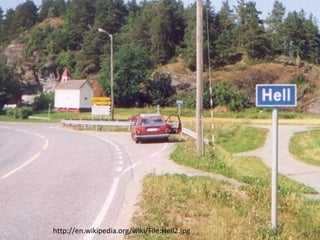
http://en.wikipedia.org/wiki/File:Hell2.jpg
                  olnet.org
yi ng
                  sa
             a re
        e
      tw
Wha


 olnet.org
CC-BY-NC-SA http://www.flickr.com/photos/robpegoraro/7509410278/
          olnet.org
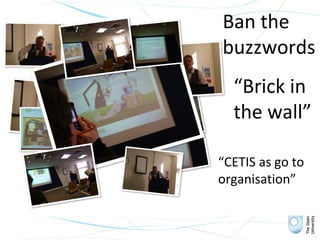
Ban the
            buzzwords
              “Brick in
              the wall”

            “CETIS as go to
            organisation”


olnet.org
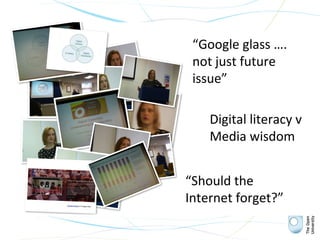
“Google glass ….
             not just future
             issue”

                Digital literacy v
                Media wisdom


            “Should the
            Internet forget?”

olnet.org
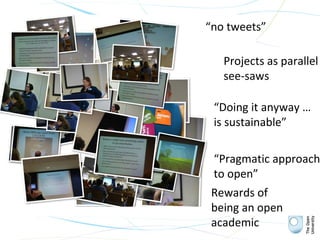
“no tweets”

               Projects as parallel
               see-saws

             “Doing it anyway …
             is sustainable”

             “Pragmatic approach
             to open”
             Rewards of
             being an open
             academic
olnet.org
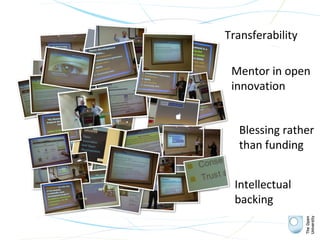
Transferability

             Mentor in open
             innovation


              Blessing rather
              than funding


              Intellectual
              backing

olnet.org
http://www.neoformix.com/Projects/TwitterStreamGraphs/view.php


olnet.org
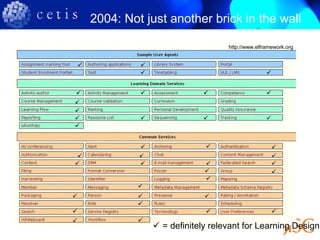
2004: Not just another brick in the wall

                                    http://www.elframework.org


            
                                                  


                                                


                                                



                                                   
                                                   
                                                  
                                                    
                              
             
                            
             
                                                   
            
                  = definitely relevant for Learning Design
olnet.org
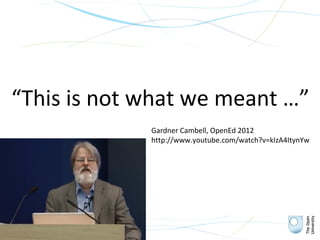
“This is not what we meant …”
                 Gardner Cambell, OpenEd 2012
                 http://www.youtube.com/watch?v=kIzA4ItynYw


         olnet.org
Good Intentions


     olnet.org
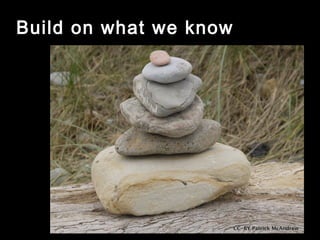
Build on what we know
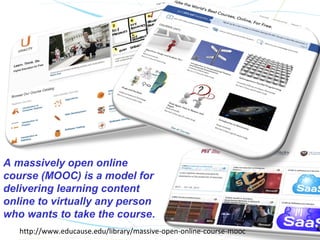
A massively open online
course (MOOC) is a model for
delivering learning content
online to virtually any person
who wants to take the course.
   http://www.educause.edu/library/massive-open-online-course-mooc
The Open University is open to
people, places, methods and
ideas.
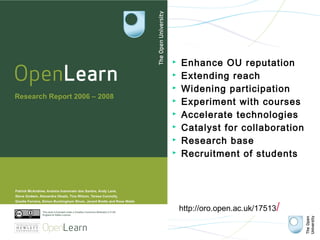
   Enhance OU reputation
   Extending reach
   Widening participation
   Experiment with courses
   Accelerate technologies
   Catalyst for collaboration
   Research base
   Recruitment of students


    http://oro.open.ac.uk/17513/
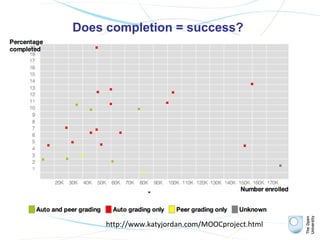
Does completion = success?


     http://www.katyjordan.com/MOOCproject.html
      olnet.org
Innovate


           CC-BY Patrick McAndrew
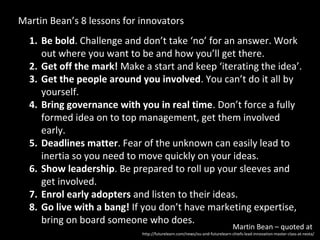
Martin Bean’s 8 lessons for innovators
  1. Be bold. Challenge and don’t take ‘no’ for an answer. Work
     out where you want to be and how you’ll get there.
  2. Get off the mark! Make a start and keep ‘iterating the idea’.
  3. Get the people around you involved. You can’t do it all by
     yourself.
  4. Bring governance with you in real time. Don’t force a fully
     formed idea on to top management, get them involved
     early.
  5. Deadlines matter. Fear of the unknown can easily lead to
     inertia so you need to move quickly on your ideas.
  6. Show leadership. Be prepared to roll up your sleeves and
     get involved.
  7. Enrol early adopters and listen to their ideas.
  8. Go live with a bang! If you don’t have marketing expertise,
     bring on board someone who does.
                                                                            Martin Bean – quoted at
                            http://futurelearn.com/news/ou-and-futurelearn-chiefs-lead-innovation-master-class-at-nesta/
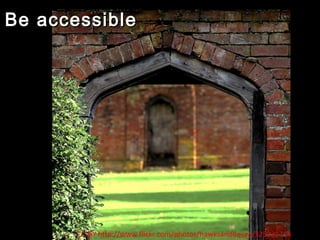
Be accessible


       CC-BY http://www.flickr.com/photos/hawksanddoves/325231714
Viscious circle


   Head brick wall


                 CC-BY-NC www.flickr.com/photos/asten/182910562
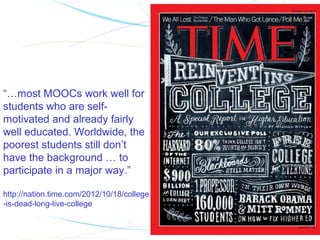
“…most MOOCs work well for
students who are self-
motivated and already fairly
well educated. Worldwide, the
poorest students still don’t
have the background … to
participate in a major way.”

http://nation.time.com/2012/10/18/college
-is-dead-long-live-college
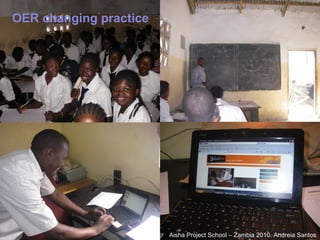
OER changing practice


                        Aisha Project School – Zambia 2010. Andreia Santos
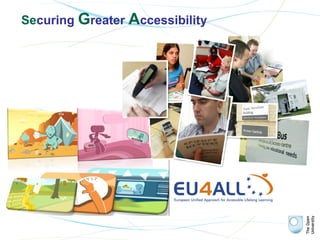
Securing Greater Accessibility
Be interactive


http://www.flickr.com/photos/marcobellucci/3534516458/
Be interactive


                                  What is your next step?


http://www.flickr.com/photos/marcobellucci/3534516458/
Make use of data
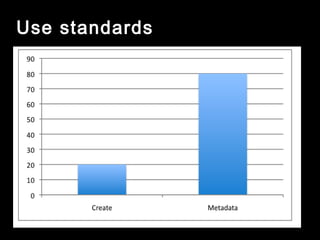
Use standards
UK IMS Centre
olnet.org
olnet.org
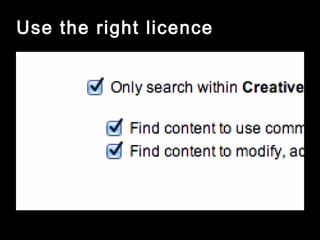
Use the right licence
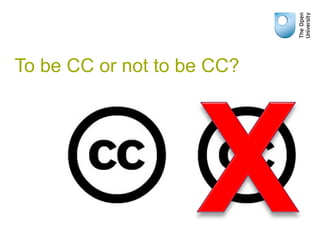
To be CC or not to be CC?
Not be in it for the money


                    CC-BY Patrick McAndrew
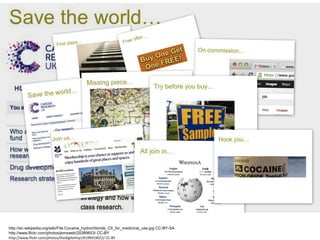
http://en.wikipedia.org/wiki/File:Cocaine_hydrochloride_CII_for_medicinal_use.jpg CC-BY-SA
http://www.flickr.com/photos/jemsweb/20389653/ CC-BY
http://www.flickr.com/photos/thedigitelmyr/6199419022/ CC-BY
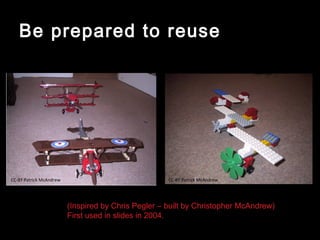
Be prepared to reuse


CC-BY Patrick McAndrew                               CC-BY Patrick McAndrew


                         (Inspired by Chris Pegler – built by Christopher McAndrew)
                         First used in slides in 2004.
Try to answer the questions
Be happy


           CC-BY Patrick McAndrew
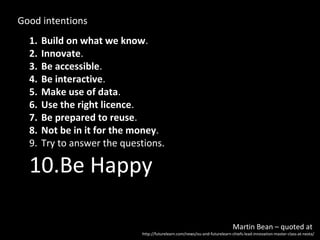
Good intentions
  1.   Build on what we know.
  2.   Innovate.
  3.   Be accessible.
  4.   Be interactive.
  5.   Make use of data.
  6.   Use the right licence.
  7.   Be prepared to reuse.
  8.   Not be in it for the money.
  9.   Try to answer the questions.

  10.Be Happy

                                                                             Martin Bean – quoted at
                             http://futurelearn.com/news/ou-and-futurelearn-chiefs-lead-innovation-master-class-at-nesta/
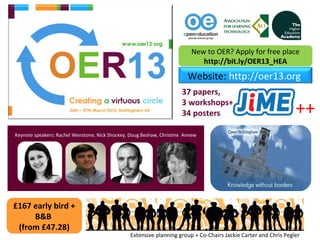
New to OER? Apply for free place
                                                                             http://bit.ly/OER13_HEA
                                                                         Website: http://oer13.org
                                                                      37 papers,
                                                                      3 workshops++
                                                                      34 posters                                 ++
Keynote speakers: Rachel Wenstone, Nick Shockey, Doug Beshaw, Christine Annew


£167 early bird +
     B&B
 (from £47.28)
                                                Extensive planning group + Co-Chairs Jackie Carter and Chris Pegler

The Path to Open Learning is Paved with Good Intentions

  • 1.
    The Path toOpen Learning is Paved with Good Intentions Patrick McAndrew UK [except where noted]
  • 2.
  • 3.
    yi ng sa a re e tw Wha olnet.org
  • 4.
  • 5.
    Ban the buzzwords “Brick in the wall” “CETIS as go to organisation” olnet.org
  • 6.
    “Google glass …. not just future issue” Digital literacy v Media wisdom “Should the Internet forget?” olnet.org
  • 7.
    “no tweets” Projects as parallel see-saws “Doing it anyway … is sustainable” “Pragmatic approach to open” Rewards of being an open academic olnet.org
  • 8.
    Transferability Mentor in open innovation Blessing rather than funding Intellectual backing olnet.org
  • 9.
  • 10.
    2004: Not justanother brick in the wall http://www.elframework.org                                        = definitely relevant for Learning Design
  • 11.
  • 12.
    “This is notwhat we meant …” Gardner Cambell, OpenEd 2012 http://www.youtube.com/watch?v=kIzA4ItynYw olnet.org
  • 13.
  • 14.
  • 15.
    A massively openonline course (MOOC) is a model for delivering learning content online to virtually any person who wants to take the course. http://www.educause.edu/library/massive-open-online-course-mooc
  • 17.
    The Open Universityis open to people, places, methods and ideas.
  • 18.
    Enhance OU reputation  Extending reach  Widening participation  Experiment with courses  Accelerate technologies  Catalyst for collaboration  Research base  Recruitment of students http://oro.open.ac.uk/17513/
  • 19.
    Does completion =success? http://www.katyjordan.com/MOOCproject.html olnet.org
  • 20.
    Innovate CC-BY Patrick McAndrew
  • 23.
    Martin Bean’s 8lessons for innovators 1. Be bold. Challenge and don’t take ‘no’ for an answer. Work out where you want to be and how you’ll get there. 2. Get off the mark! Make a start and keep ‘iterating the idea’. 3. Get the people around you involved. You can’t do it all by yourself. 4. Bring governance with you in real time. Don’t force a fully formed idea on to top management, get them involved early. 5. Deadlines matter. Fear of the unknown can easily lead to inertia so you need to move quickly on your ideas. 6. Show leadership. Be prepared to roll up your sleeves and get involved. 7. Enrol early adopters and listen to their ideas. 8. Go live with a bang! If you don’t have marketing expertise, bring on board someone who does. Martin Bean – quoted at http://futurelearn.com/news/ou-and-futurelearn-chiefs-lead-innovation-master-class-at-nesta/
  • 26.
    Be accessible CC-BY http://www.flickr.com/photos/hawksanddoves/325231714
  • 27.
    Viscious circle  Head brick wall CC-BY-NC www.flickr.com/photos/asten/182910562
  • 28.
    “…most MOOCs workwell for students who are self- motivated and already fairly well educated. Worldwide, the poorest students still don’t have the background … to participate in a major way.” http://nation.time.com/2012/10/18/college -is-dead-long-live-college
  • 29.
    OER changing practice Aisha Project School – Zambia 2010. Andreia Santos
  • 30.
  • 31.
  • 32.
    Be interactive What is your next step? http://www.flickr.com/photos/marcobellucci/3534516458/
  • 33.
  • 35.
  • 36.
  • 37.
  • 38.
  • 39.
  • 40.
    To be CCor not to be CC?
  • 41.
    Not be init for the money CC-BY Patrick McAndrew
  • 42.
  • 43.
    Be prepared toreuse CC-BY Patrick McAndrew CC-BY Patrick McAndrew (Inspired by Chris Pegler – built by Christopher McAndrew) First used in slides in 2004.
  • 44.
    Try to answerthe questions
  • 45.
    Be happy CC-BY Patrick McAndrew
  • 46.
    Good intentions 1. Build on what we know. 2. Innovate. 3. Be accessible. 4. Be interactive. 5. Make use of data. 6. Use the right licence. 7. Be prepared to reuse. 8. Not be in it for the money. 9. Try to answer the questions. 10.Be Happy Martin Bean – quoted at http://futurelearn.com/news/ou-and-futurelearn-chiefs-lead-innovation-master-class-at-nesta/
  • 47.
    New to OER?Apply for free place http://bit.ly/OER13_HEA Website: http://oer13.org 37 papers, 3 workshops++ 34 posters ++ Keynote speakers: Rachel Wenstone, Nick Shockey, Doug Beshaw, Christine Annew £167 early bird + B&B (from £47.28) Extensive planning group + Co-Chairs Jackie Carter and Chris Pegler

Editor's Notes

  • #7 Children in the room 45% of children discriminate Some of you may have children in the room
  • #15 1.
  • #21 2
  • #30 OLnet participated of the conference E-learning Africa 2010 (Lusaka, Zambia), and also paid a visit to Aisha Project School. The goal was to understand how teachers at Aisha have been using OER with the support of UK funded initiatives. There is a mix of ‘ chalk and talk ’ and the use of technologies to enhance learning at the school, given that the learners have no access to text books. However, the teachers at Aisha have been moving away from chalk and talk and using more enquiry-based learning to teach with OER – indicating that OER can encourage new teaching practices.
  • #31 SeGA setup in 2010 to help improve our response as an organisation across university work to improve processes and solve some long-lasting issues. Help address sharing of responsibility.