INTRODUCTION
• The mediastinum is situated between the pleurae covering the medial
aspects of the right and left lungs. Its borders are the thoracic inlet
(superiorly), the diaphragm (inferiorly), the parietal pleurae
(laterally), the vertebral column (posteriorly) and the sternum
(anteriorly).
CLASSIFICATION
• SUTTON
• FELSON
SUTTON CLASSIFICATION
Divisions :
• Anterior - lies in front of anterior
pericardium and trachea
• Middle – with in the pericardial
cavity including trachea
• Posterior – behind the posterior
pericardium and trachea
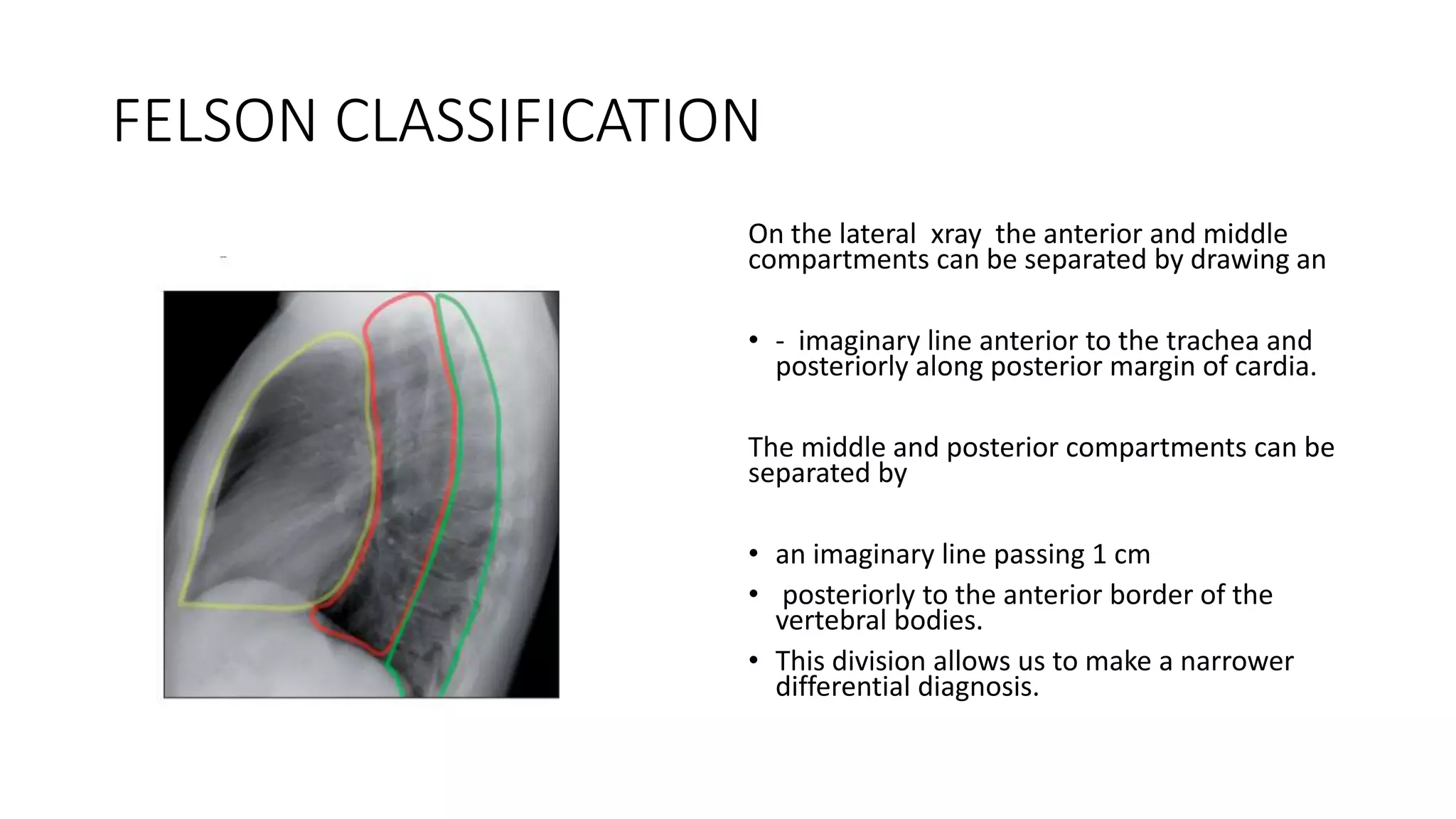
FELSON CLASSIFICATION
On the lateral xray the anterior and middle
compartments can be separated by drawing an
• - imaginary line anterior to the trachea and
posteriorly along posterior margin of cardia.
The middle and posterior compartments can be
separated by
• an imaginary line passing 1 cm
• posteriorly to the anterior border of the
vertebral bodies.
• This division allows us to make a narrower
differential diagnosis.
FRONTAL CHEST XRAY
FAT COLLECTIONS
• Visible pads of fat are present at the right and / or left cardiophrenic
angles in some patients
• If a large fat collection is present it may:
• Cause part of the well-defined margin of the heart to be blurred.
• Mimic a mass lesion.
INTERFACE LINES AND STRIPS
• THE RIGHT PARATRACHEAL STRIPE
• THE PARAVERTEBRAL STRIPES
• AZYGO-OESOPHAGEAL LINE
• ANTERIOR JUNCTION LINE
• POSTERIOR JUNCTION LINE
• AORTO-PULMONARY STRIPE
LINES, STRIPS AND INTERFACE
THE RIGHT PARATRACHEAL STRIPE
• Forms where the right lung
abuts the right side of the
trachea
• The thickness should not
exceed 2.5mm
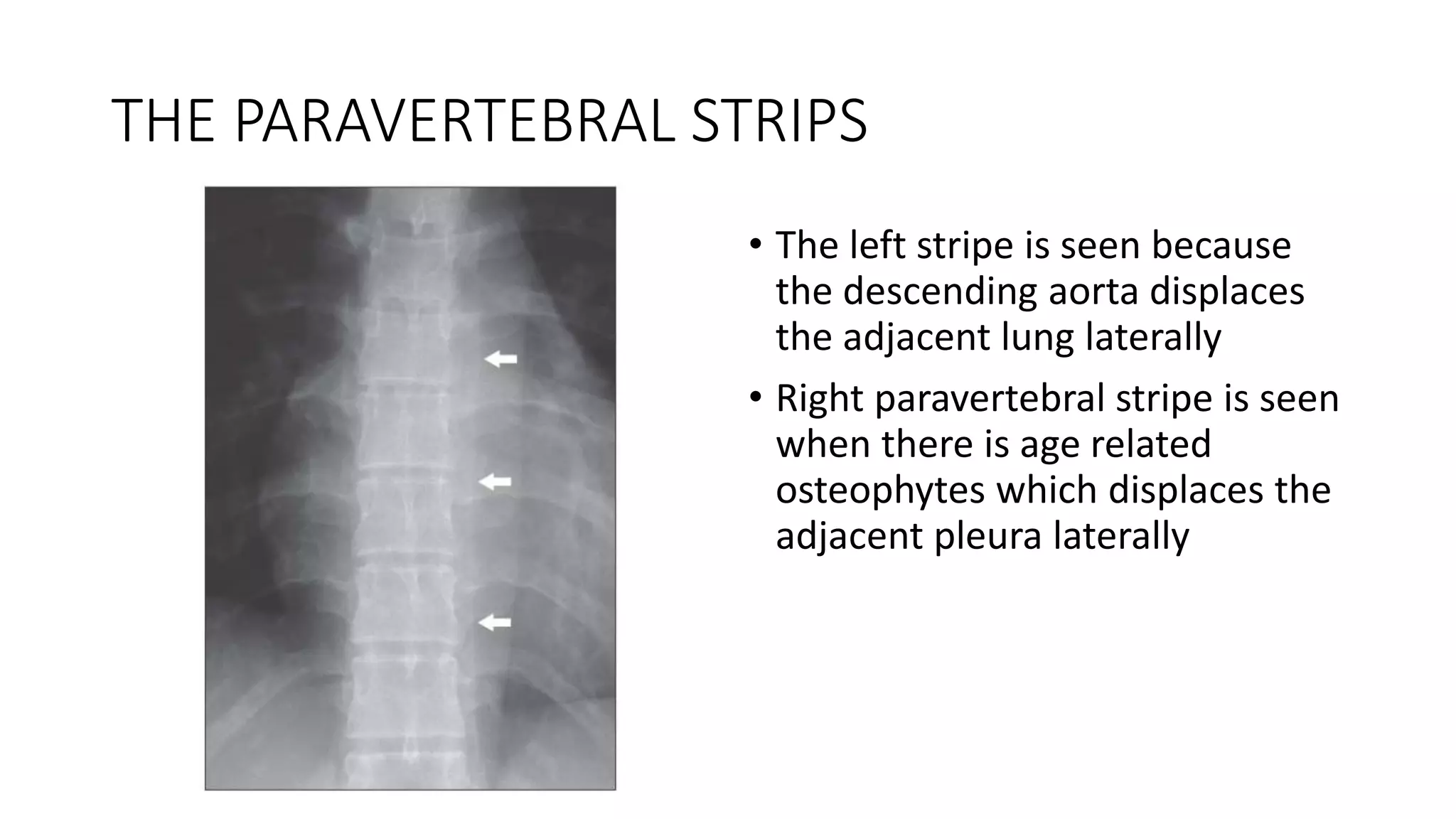
THE PARAVERTEBRAL STRIPS
• The left stripe is seen because
the descending aorta displaces
the adjacent lung laterally
• Right paravertebral stripe is seen
when there is age related
osteophytes which displaces the
adjacent pleura laterally
AZYGO-OESOPHAGEAL LINE
• Formed where the right lung
abuts the right side of the
oesophagus and the azygos vein
• Extends below the aortic arch to
the diaphragm
ANTERIOR JUNCTION LINE
• Formed where the two lungs
abut each other anteriorly below
the level of the manubrium
• The line is made of 4 layers of
pleura
POSTERIOR JUNCTION LINE
• Formed where the two lungs
abut each other posteriorly
• Extends from above the clavicle
to the level of aortic arch
• Made up of 4 layers of pleura
AORTO-PULMONARY STRIPE
• Mediastinal pleura is seen
reflected as a straight line
between the main pulmonary
artery and aortic arch
LATERAL CHEST XRAY
FAT COLLECTIONS
• CARDIAC INCISURA:
The apex of the heart and
adjacent epicardial fat intrudes
into the left hemithorax and
displaces the most infero-medial
and anterior aspect of the left
lung. This often produces a
shadow which can simulate a
mass lesion
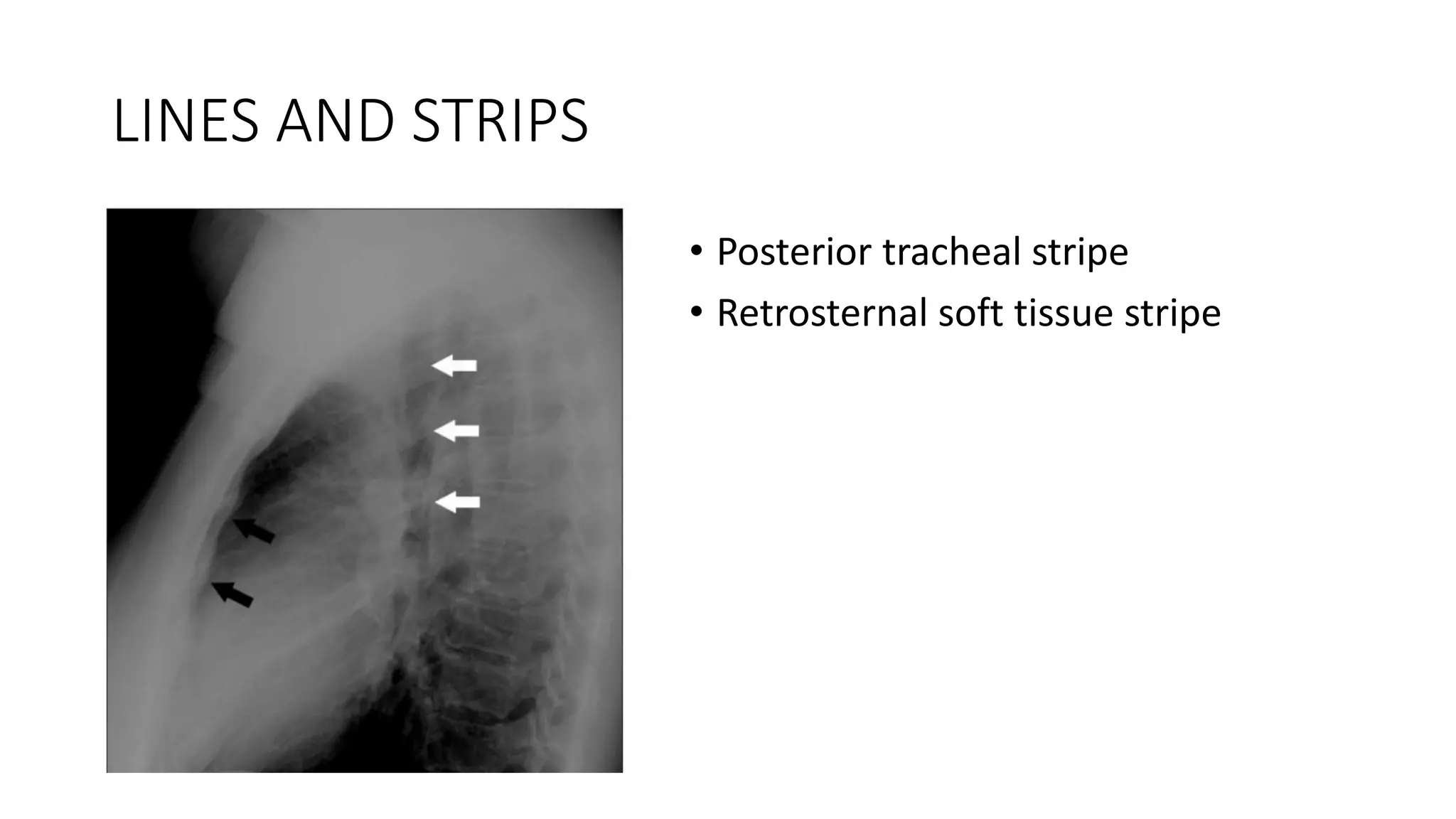
LINES AND STRIPS
• Posterior tracheal stripe
• Retrosternal soft tissue stripe
THANK YOU

MEDIASTINUM.pptx

  • 2.
    INTRODUCTION • The mediastinumis situated between the pleurae covering the medial aspects of the right and left lungs. Its borders are the thoracic inlet (superiorly), the diaphragm (inferiorly), the parietal pleurae (laterally), the vertebral column (posteriorly) and the sternum (anteriorly).
  • 3.
  • 4.
    SUTTON CLASSIFICATION Divisions : •Anterior - lies in front of anterior pericardium and trachea • Middle – with in the pericardial cavity including trachea • Posterior – behind the posterior pericardium and trachea
  • 5.
    FELSON CLASSIFICATION On thelateral xray the anterior and middle compartments can be separated by drawing an • - imaginary line anterior to the trachea and posteriorly along posterior margin of cardia. The middle and posterior compartments can be separated by • an imaginary line passing 1 cm • posteriorly to the anterior border of the vertebral bodies. • This division allows us to make a narrower differential diagnosis.
  • 8.
  • 9.
    FAT COLLECTIONS • Visiblepads of fat are present at the right and / or left cardiophrenic angles in some patients • If a large fat collection is present it may: • Cause part of the well-defined margin of the heart to be blurred. • Mimic a mass lesion.
  • 11.
    INTERFACE LINES ANDSTRIPS • THE RIGHT PARATRACHEAL STRIPE • THE PARAVERTEBRAL STRIPES • AZYGO-OESOPHAGEAL LINE • ANTERIOR JUNCTION LINE • POSTERIOR JUNCTION LINE • AORTO-PULMONARY STRIPE
  • 12.
  • 13.
    THE RIGHT PARATRACHEALSTRIPE • Forms where the right lung abuts the right side of the trachea • The thickness should not exceed 2.5mm
  • 14.
    THE PARAVERTEBRAL STRIPS •The left stripe is seen because the descending aorta displaces the adjacent lung laterally • Right paravertebral stripe is seen when there is age related osteophytes which displaces the adjacent pleura laterally
  • 15.
    AZYGO-OESOPHAGEAL LINE • Formedwhere the right lung abuts the right side of the oesophagus and the azygos vein • Extends below the aortic arch to the diaphragm
  • 16.
    ANTERIOR JUNCTION LINE •Formed where the two lungs abut each other anteriorly below the level of the manubrium • The line is made of 4 layers of pleura
  • 17.
    POSTERIOR JUNCTION LINE •Formed where the two lungs abut each other posteriorly • Extends from above the clavicle to the level of aortic arch • Made up of 4 layers of pleura
  • 18.
    AORTO-PULMONARY STRIPE • Mediastinalpleura is seen reflected as a straight line between the main pulmonary artery and aortic arch
  • 19.
  • 20.
    FAT COLLECTIONS • CARDIACINCISURA: The apex of the heart and adjacent epicardial fat intrudes into the left hemithorax and displaces the most infero-medial and anterior aspect of the left lung. This often produces a shadow which can simulate a mass lesion
  • 21.
    LINES AND STRIPS •Posterior tracheal stripe • Retrosternal soft tissue stripe
  • 22.