The Operating System (OS),
Its Function and Installation
Mr. Melchor S. Castro
Instructor
Technical Terms
•Chip – small, thin piece of semiconductor that can
hold millions of electronic components and circuits
•Configuration – way a system is set up
•Install - To place in position or connect for service or
use
•Utility – piece of computer software designed for a
routine task.
After assembling the computer hardware, the next step is to turn it on
for the first time and you will be needing software to make it
functional. The following are the two main types of software.
• System Software – it is used to manage and control the hardware
components and which interaction between the other types of
software. Example of this are input, output system, device drivers and
operating system
• Application Software. It allows the user of the computer to perform
the specific task. It includes programs such as web browser, office
application, games and photo editors.
Configuring the Basic Input/Output System
• In preparing the installation of OS you need to change
some items in the Basic input/output system (BIOS), a
small program that resides in complementary metal-oxide
semiconductor (CMOS). This chip provides drivers of the
basic peripheral part of motherboard including monitor,
keyboard, mouse, and disk.
• On start up it basically prepares the computer for
operation. Be careful with the configuration, incorrect
setting may prevent your computer from booting.
Steps on how to configure BIOS:
1. Turn on or restart your computer.
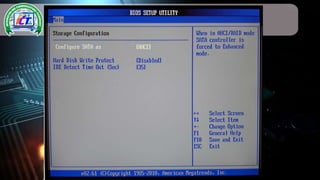
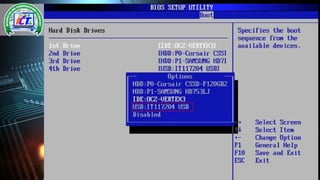
2. Quickly press Esc, Del, F1, F2, Ctrl –Esc, or Ctrl-Alt-Esc as
soon as you see the BIOS type or version on screen to enter
BIOS Setting. There is usually a message that tells you to
“Press F2 to Enter Setup.” You may consult motherboard’s
manual for the specific key.
Steps on how to configure BIOS:
3. Adjust all available features within the standard and advanced
BIOS section. Press down arrow on you keyboard to select items
like the time and date options.
Some common basic options are:
• System time and date.
• Boot Sequence
• Mouse / Keyboard
• Drive Configuration
• Power Management.
• Exit
Steps on how to configure BIOS:
Some Advance features include the following:
• Virus protection/ warning
• Quick POST
• Boot up Floppy seek
• L2 cache size
• Memory timing/DRAM frequency
• On-chip PCI IDE or IDE controller.
• USB Controller
Steps on how to configure BIOS:
Some Advance features include the following:
• USB Keyboard support.
• USB Mouse support
• HDD SMART capability
• Logo/Splash screen show
• PnP OS Installed
• PC Health
• Set to default configuration.
• Passwords.
Steps on how to configure BIOS:
4. Press F10 to save all specified settings or press Escape to
cancel all changes.
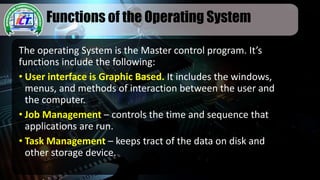
Functions of the Operating System
The operating System is the Master control program. It’s
functions include the following:
• User interface is Graphic Based. It includes the windows,
menus, and methods of interaction between the user and
the computer.
• Job Management – controls the time and sequence that
applications are run.
• Task Management – keeps tract of the data on disk and
other storage device.
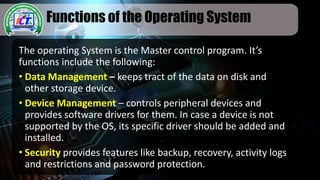
Functions of the Operating System
The operating System is the Master control program. It’s
functions include the following:
• Data Management – keeps tract of the data on disk and
other storage device.
• Device Management – controls peripheral devices and
provides software drivers for them. In case a device is not
supported by the OS, its specific driver should be added and
installed.
• Security provides features like backup, recovery, activity logs
and restrictions and password protection.
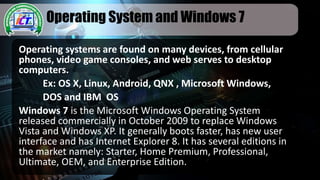
Operating System and Windows 7
Operating systems are found on many devices, from cellular
phones, video game consoles, and web serves to desktop
computers.
Ex: OS X, Linux, Android, QNX , Microsoft Windows,
DOS and IBM OS
Windows 7 is the Microsoft Windows Operating System
released commercially in October 2009 to replace Windows
Vista and Windows XP. It generally boots faster, has new user
interface and has Internet Explorer 8. It has several editions in
the market namely: Starter, Home Premium, Professional,
Ultimate, OEM, and Enterprise Edition.
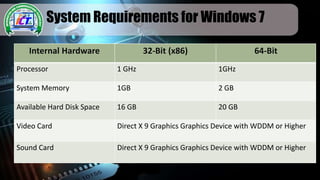
System Requirements for Windows 7
Internal Hardware 32-Bit (x86) 64-Bit
Processor 1 GHz 1GHz
System Memory 1GB 2 GB
Available Hard Disk Space 16 GB 20 GB
Video Card Direct X 9 Graphics Graphics Device with WDDM or Higher
Sound Card Direct X 9 Graphics Graphics Device with WDDM or Higher
Installation
•windows7install1.pdf
Activity
• Install Windows 7 and Applications. Prepare the materials
needed together with the hand tools and workplace. Follow
the procedures accordingly.
Materials
 1 set Compatible desktop computer
 1pc OS Installation CD
 1 pc Motherboard/driver installation CD
 1 set Motherboard’s user manual (for proper BIOS settings)
 1 set working table
Report of Materials Form
The operating system (os),

The operating system (os),

  • 1.
    The Operating System(OS), Its Function and Installation Mr. Melchor S. Castro Instructor
  • 2.
    Technical Terms •Chip –small, thin piece of semiconductor that can hold millions of electronic components and circuits •Configuration – way a system is set up •Install - To place in position or connect for service or use •Utility – piece of computer software designed for a routine task.
  • 3.
    After assembling thecomputer hardware, the next step is to turn it on for the first time and you will be needing software to make it functional. The following are the two main types of software. • System Software – it is used to manage and control the hardware components and which interaction between the other types of software. Example of this are input, output system, device drivers and operating system • Application Software. It allows the user of the computer to perform the specific task. It includes programs such as web browser, office application, games and photo editors.
  • 4.
    Configuring the BasicInput/Output System • In preparing the installation of OS you need to change some items in the Basic input/output system (BIOS), a small program that resides in complementary metal-oxide semiconductor (CMOS). This chip provides drivers of the basic peripheral part of motherboard including monitor, keyboard, mouse, and disk. • On start up it basically prepares the computer for operation. Be careful with the configuration, incorrect setting may prevent your computer from booting.
  • 5.
    Steps on howto configure BIOS: 1. Turn on or restart your computer. 2. Quickly press Esc, Del, F1, F2, Ctrl –Esc, or Ctrl-Alt-Esc as soon as you see the BIOS type or version on screen to enter BIOS Setting. There is usually a message that tells you to “Press F2 to Enter Setup.” You may consult motherboard’s manual for the specific key.
  • 7.
    Steps on howto configure BIOS: 3. Adjust all available features within the standard and advanced BIOS section. Press down arrow on you keyboard to select items like the time and date options. Some common basic options are: • System time and date. • Boot Sequence • Mouse / Keyboard • Drive Configuration • Power Management. • Exit
  • 9.
    Steps on howto configure BIOS: Some Advance features include the following: • Virus protection/ warning • Quick POST • Boot up Floppy seek • L2 cache size • Memory timing/DRAM frequency • On-chip PCI IDE or IDE controller. • USB Controller
  • 10.
    Steps on howto configure BIOS: Some Advance features include the following: • USB Keyboard support. • USB Mouse support • HDD SMART capability • Logo/Splash screen show • PnP OS Installed • PC Health • Set to default configuration. • Passwords.
  • 11.
    Steps on howto configure BIOS: 4. Press F10 to save all specified settings or press Escape to cancel all changes.
  • 12.
    Functions of theOperating System The operating System is the Master control program. It’s functions include the following: • User interface is Graphic Based. It includes the windows, menus, and methods of interaction between the user and the computer. • Job Management – controls the time and sequence that applications are run. • Task Management – keeps tract of the data on disk and other storage device.
  • 13.
    Functions of theOperating System The operating System is the Master control program. It’s functions include the following: • Data Management – keeps tract of the data on disk and other storage device. • Device Management – controls peripheral devices and provides software drivers for them. In case a device is not supported by the OS, its specific driver should be added and installed. • Security provides features like backup, recovery, activity logs and restrictions and password protection.
  • 14.
    Operating System andWindows 7 Operating systems are found on many devices, from cellular phones, video game consoles, and web serves to desktop computers. Ex: OS X, Linux, Android, QNX , Microsoft Windows, DOS and IBM OS Windows 7 is the Microsoft Windows Operating System released commercially in October 2009 to replace Windows Vista and Windows XP. It generally boots faster, has new user interface and has Internet Explorer 8. It has several editions in the market namely: Starter, Home Premium, Professional, Ultimate, OEM, and Enterprise Edition.
  • 15.
    System Requirements forWindows 7 Internal Hardware 32-Bit (x86) 64-Bit Processor 1 GHz 1GHz System Memory 1GB 2 GB Available Hard Disk Space 16 GB 20 GB Video Card Direct X 9 Graphics Graphics Device with WDDM or Higher Sound Card Direct X 9 Graphics Graphics Device with WDDM or Higher
  • 16.
  • 17.
    Activity • Install Windows7 and Applications. Prepare the materials needed together with the hand tools and workplace. Follow the procedures accordingly. Materials  1 set Compatible desktop computer  1pc OS Installation CD  1 pc Motherboard/driver installation CD  1 set Motherboard’s user manual (for proper BIOS settings)  1 set working table
  • 18.