Chapter 7A
Operating System Basics
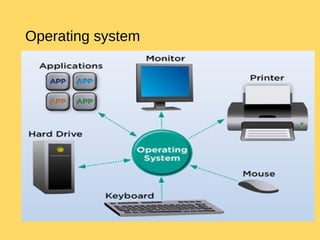
Operating System
• The operating system (OS) is the most important program
that runs on a computer. Every general-purpose computer
must have an operating system to run other programs
and applications.
• Computer operating systems perform basic tasks, such as
recognizing input from the keyboard sending output to the
display screen, keeping track of files and directories on the
disk, and controlling peripheral devices such as printers.
• For large systems, the operating system has even greater
responsibilities and powers. It is like a traffic cop — it makes sure
that different programs and users running at the same time do not
interfere with each other. The operating system is also responsible
for security, ensuring that unauthorized users do not access the
system.
Operating system
Functions of Operating Systems
• Provide a user interface
• Run programs
• Manage hardware devices
• Organized file storage
7A-7A-55
Types of Operating Systems
• Real-time operating system
• Is an application that responds to certain inputs extremely quickly-
thousandths or millionths of a second.
• Very fast small OS
• Built into a device
• Respond quickly to user input
• It can support multiple simultaneous tasks or it may only
support single tasking.
• MP3 players, Medical devices, machinery, life support
system
Types of Operating Systems
• Single user/Single tasking OS
• One user works on the system
• Performs one task at a time
• MS-DOS and Palm OS
• Take up little space on disk
• Run on inexpensive computers
Types of Operating Systems
• Single user/Multitasking OS
• User performs many tasks at once
• Most common form of OS
• Windows XP and OS X
• Require expensive computers
• Tend to be complex
Types of Operating Systems
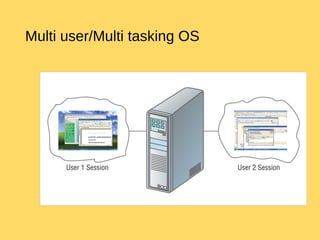
• Multi user/Multitasking OS
• Many users connect to one computer
• Each user has a unique session
• UNIX, Linux, and VMS
• Maintenance can be easy
• Requires a powerful computer
Multi user/Multi tasking OS
Providing a User Interface
• User interface
• How a user interacts with a computer
• Require different skill sets
Providing a User Interface
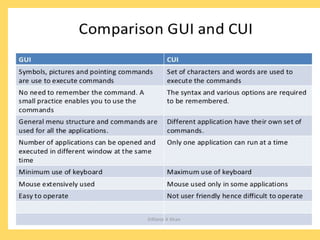
• Graphical user interface (GUI)
• Most common interface
• Windows, OS X, Gnome, KDE
• Uses a mouse to control objects
• Uses a desktop metaphor
• Shortcuts open programs or documents
• Open documents have additional objects
• Task switching
• Dialog boxes allow directed input
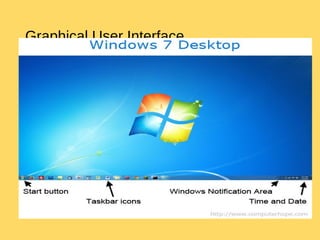
Graphical User Interface
Providing a User Interface
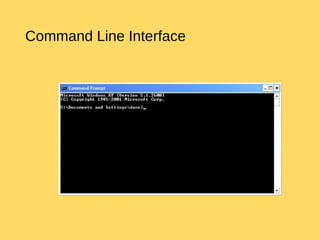
• Command line interfaces
• Older interface
• DOS, Linux, UNIX
• User types commands at a prompt
• User must remember all commands
• Included in all GUIs
Command Line Interface
Running Programs
• Many different applications supported
• System call
• Provides consistent access to OS features
• Share information between programs
• Copy and paste
• Object Linking and Embedding
• The operating system provides a consistent interface between application
programs and the user.
• It is also the interface between those programs and other computer
resources such as memory a printer or another program.
• Programmers write computer programs with built in instructions called
system calls that request services from operating system.
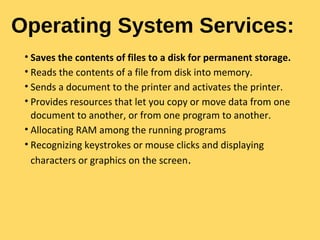
Operating System Services:
• Saves the contents of files to a disk for permanent storage.
• Reads the contents of a file from disk into memory.
• Sends a document to the printer and activates the printer.
• Provides resources that let you copy or move data from one
document to another, or from one program to another.
• Allocating RAM among the running programs
• Recognizing keystrokes or mouse clicks and displaying
characters or graphics on the screen.
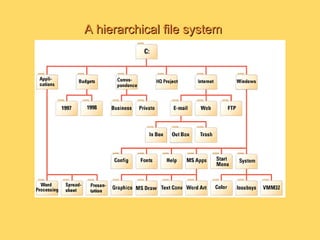
A hierarchical file systemA hierarchical file system
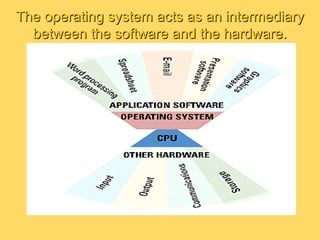
The operating system acts as an intermediaryThe operating system acts as an intermediary
between the software and the hardware.between the software and the hardware.
O.L.E. (Object Linking and
Embedding - data is copied from
one type of document and
embedded into another. The data
that is copied retains a link with
the original document.
Multitasking - means being
able to perform two or more
procedures at the same time--
such as printing a multipage
document, sending e-mail
over the Internet, and typing a
letter--all simultaneously.
Managing Hardware
• Programs need to access hardware
• Interrupts
• CPU is stopped
• Hardware device is accessed
• Figure 6A.14
• Device drivers control the hardware
Interrupt Request (IRQ) -
used by the operating system
to send requests to use
memory and other hardware
devices attached to the
computer system.
Enhancing an OS
• Utilities
• Enhance OS capabilities.
• Provide services not included with OS
• Goes beyond the four functions
• Firewall, anti-virus and compression
• Prices vary
Enhancing an OS
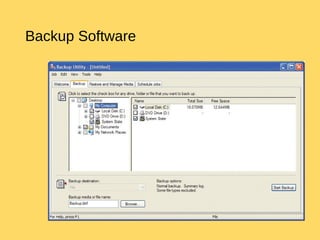
• Backup software
• Archives files onto removable media
• Ensures data integrity
• Most OS include a backup package
• Many third party packages exist
Backup Software
Enhancing an OS
• Anti-virus software
• Crucial utility
• Finds, blocks and removes viruses
• Must be updated regularly
• McAfee and Norton Anti-Virus
Enhancing an OS
• Firewall
• Crucial utility
• Protects your computer from intruders
• Makes computer invisible to hackers
• Zone Labs is a home firewall
• Cisco sells hardware firewalls
Enhancing an OS
• Intrusion detection
• Often part of a firewall package
• Announces attempts to breach security
• Snort is a Linux based package
Enhancing an OS
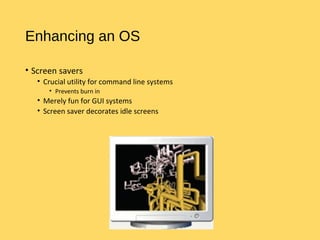
• Screen savers
• Crucial utility for command line systems
• Prevents burn in
• Merely fun for GUI systems
• Screen saver decorates idle screens
Chapter 7A
End of Chapter

Chapter 7A Peter Norton

  • 1.
  • 2.
    Operating System • Theoperating system (OS) is the most important program that runs on a computer. Every general-purpose computer must have an operating system to run other programs and applications. • Computer operating systems perform basic tasks, such as recognizing input from the keyboard sending output to the display screen, keeping track of files and directories on the disk, and controlling peripheral devices such as printers.
  • 3.
    • For largesystems, the operating system has even greater responsibilities and powers. It is like a traffic cop — it makes sure that different programs and users running at the same time do not interfere with each other. The operating system is also responsible for security, ensuring that unauthorized users do not access the system.
  • 4.
  • 5.
    Functions of OperatingSystems • Provide a user interface • Run programs • Manage hardware devices • Organized file storage 7A-7A-55
  • 6.
    Types of OperatingSystems • Real-time operating system • Is an application that responds to certain inputs extremely quickly- thousandths or millionths of a second. • Very fast small OS • Built into a device • Respond quickly to user input • It can support multiple simultaneous tasks or it may only support single tasking. • MP3 players, Medical devices, machinery, life support system
  • 8.
    Types of OperatingSystems • Single user/Single tasking OS • One user works on the system • Performs one task at a time • MS-DOS and Palm OS • Take up little space on disk • Run on inexpensive computers
  • 9.
    Types of OperatingSystems • Single user/Multitasking OS • User performs many tasks at once • Most common form of OS • Windows XP and OS X • Require expensive computers • Tend to be complex
  • 10.
    Types of OperatingSystems • Multi user/Multitasking OS • Many users connect to one computer • Each user has a unique session • UNIX, Linux, and VMS • Maintenance can be easy • Requires a powerful computer
  • 11.
  • 12.
    Providing a UserInterface • User interface • How a user interacts with a computer • Require different skill sets
  • 13.
    Providing a UserInterface • Graphical user interface (GUI) • Most common interface • Windows, OS X, Gnome, KDE • Uses a mouse to control objects • Uses a desktop metaphor • Shortcuts open programs or documents • Open documents have additional objects • Task switching • Dialog boxes allow directed input
  • 14.
  • 15.
    Providing a UserInterface • Command line interfaces • Older interface • DOS, Linux, UNIX • User types commands at a prompt • User must remember all commands • Included in all GUIs
  • 16.
  • 18.
    Running Programs • Manydifferent applications supported • System call • Provides consistent access to OS features • Share information between programs • Copy and paste • Object Linking and Embedding
  • 19.
    • The operatingsystem provides a consistent interface between application programs and the user. • It is also the interface between those programs and other computer resources such as memory a printer or another program. • Programmers write computer programs with built in instructions called system calls that request services from operating system.
  • 20.
    Operating System Services: •Saves the contents of files to a disk for permanent storage. • Reads the contents of a file from disk into memory. • Sends a document to the printer and activates the printer. • Provides resources that let you copy or move data from one document to another, or from one program to another. • Allocating RAM among the running programs • Recognizing keystrokes or mouse clicks and displaying characters or graphics on the screen.
  • 21.
    A hierarchical filesystemA hierarchical file system
  • 22.
    The operating systemacts as an intermediaryThe operating system acts as an intermediary between the software and the hardware.between the software and the hardware.
  • 23.
    O.L.E. (Object Linkingand Embedding - data is copied from one type of document and embedded into another. The data that is copied retains a link with the original document.
  • 24.
    Multitasking - meansbeing able to perform two or more procedures at the same time-- such as printing a multipage document, sending e-mail over the Internet, and typing a letter--all simultaneously.
  • 25.
    Managing Hardware • Programsneed to access hardware • Interrupts • CPU is stopped • Hardware device is accessed • Figure 6A.14 • Device drivers control the hardware
  • 27.
    Interrupt Request (IRQ)- used by the operating system to send requests to use memory and other hardware devices attached to the computer system.
  • 28.
    Enhancing an OS •Utilities • Enhance OS capabilities. • Provide services not included with OS • Goes beyond the four functions • Firewall, anti-virus and compression • Prices vary
  • 29.
    Enhancing an OS •Backup software • Archives files onto removable media • Ensures data integrity • Most OS include a backup package • Many third party packages exist
  • 30.
  • 31.
    Enhancing an OS •Anti-virus software • Crucial utility • Finds, blocks and removes viruses • Must be updated regularly • McAfee and Norton Anti-Virus
  • 32.
    Enhancing an OS •Firewall • Crucial utility • Protects your computer from intruders • Makes computer invisible to hackers • Zone Labs is a home firewall • Cisco sells hardware firewalls
  • 33.
    Enhancing an OS •Intrusion detection • Often part of a firewall package • Announces attempts to breach security • Snort is a Linux based package
  • 34.
    Enhancing an OS •Screen savers • Crucial utility for command line systems • Prevents burn in • Merely fun for GUI systems • Screen saver decorates idle screens
  • 35.

Editor's Notes

  • #6 Teaching Tip File and folder storage is covered in chapter 6.
  • #10 Teaching tip It is true that multi-tasking operating systems are complex. However both XP and OS X make the multitasking process painless for the user.
  • #11 Teaching tip Multi-user Multitasking OS's are found on supercomputers, mainframes and minicomputers. Through Linux, a PC can also support user sessions and terminal connections.
  • #14 Insider information The first commercial GUI was the Xerox Star. Teaching Tip There are several types of dialog boxes. Any errors are displayed in a dialog box. This box is system modal - it requires a response before returning to the OS. Save and print boxes are application modal - The box must be dealt with before returning to the application. However, other OS tasks can be performed.
  • #16 Teaching tip Demonstrate the command line interface in Windows by running cmd. In the command line interface use ping and ipconfig as commands that cannot be run in the GUI.
  • #19 Teaching tip Most students have never encountered a link. I use MS Excel and MS Word to link. Create and save a simple spreadsheet in Excel. Copy the spreadsheet to the clipboard. Open MS Word and paste-link the spreadsheet. Save the MS Word document. Then change and save the spreadsheet in Excel. The word document is automatically updated.
  • #26 Discussion point The mouse uses an interrupt. Many users will move the mouse while waiting for the CPU to finish a task. What does moving the mouse do to the current process? Teaching tip Discuss what can happen when the wrong driver is installed on a computer.
  • #29 Discussion point With Windows XP and SP2, Microsoft has included a firewall and pop-up blocker both typically considered utility software. In the near future, the core services provided by an OS may include security features.
  • #33 Teaching tip Windows XP includes a firewall. Service pack 2 will turn this firewall on by default. To test your computer’s security visit www.grc.com and run the various Shields Up! tests