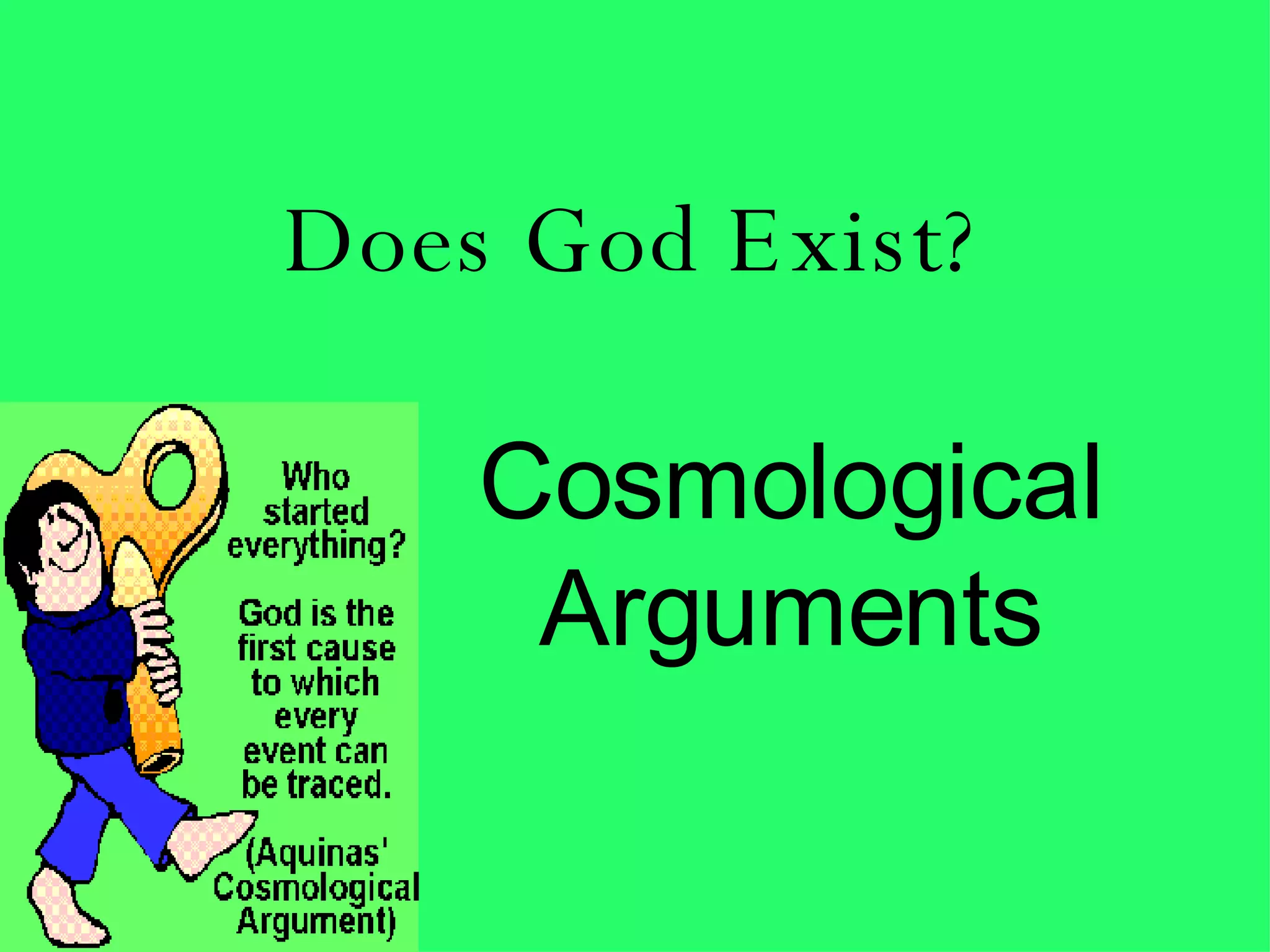
Does God Exist? Cosmological Arguments
What you need to know… Cosmological arguments, including those presented by Aquinas and the Kalam tradition. Ontological arguments as presented by Anselm and Descartes. Analysis of these arguments should include reference to the following: - a posteriori and a priori reasoning; inductive and deductive arguments; - proof and probability; the relationship between reason and faith.
Exam Questions: June 02 1  (a) Outline the cosmological argument as presented by Aquinas and the ontological argument as presented by Descartes.  (20 marks) (b) These arguments have been presented as “proofs” of the existence of God. Examine what is meant by “proof” in this context, and assess how far these arguments may be considered to be proofs of God’s existence.  (30 marks)
Exam Questions: June 03 1  (a) Explain the Cosmological Argument for the existence of God as presented by Aquinas. (20 marks) (b) “The Cosmological Argument can only make the existence of God probable. It cannot prove it.” Explain what this means and discuss how far religious believers would agree.  (30 marks)
Exam Questions: June 04 1  (a) Outline  both  the cosmological argument as presented by the Kalam tradition  and  the ontological argument as presented by Anselm.  (20 marks) (b) “There is  a posteriori  and  a priori  reasoning. There are inductive and deductive arguments.” Explain the type of reasoning and argument used in the ontological argument, and assess how far the argument proves the existence of God.  (30 marks)
Faith v’s Reason Reason – based on examination and consideration of evidence (science) Faith – based on blind belief or instinct (religion) Arguments for Existence of God – attempt to make a matter of faith reasonable PROOF “An argument that starts with unquestioned premises and builds these into a conclusion” Richard Swindburne
Cosmological Arguments Greek “Cosmos” = universe A posteriori, inductive Start with the world, conclude God exists DEPENDENCY or CONTINGENCY ARGUMENTS – these argue for the need for the Universe to depend on something necessary, i.e. something that cannot not-exist Probable conclusion – not necessary Conclude there must be a necessary being = God
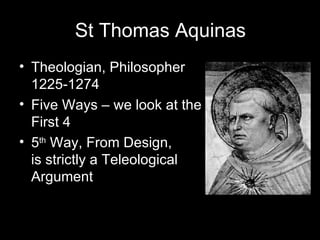
St Thomas Aquinas Theologian, Philosopher  1225-1274 Five Ways – we look at the First 4 5 th  Way, From Design,  is strictly a Teleological Argument
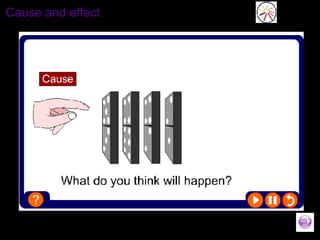
Cause and effect
1. Proving God from Motion P1 Things in this world are moving (changing states from potential to actual) P2 Things cannot move themselves – they  are  moved C There is an unmoved mover who causes  motion in all things. This we call God Examples Analogy Problems
2. Proving God from Cause P1  Every effect (event) has a cause P2 The Universe is an event C Arrive at the First Cause, and  Uncaused Cause that started  everything off. This we call God Examples Analogy Problems
Infinite Regression? William Craig (Evangelical) Infinity is illogical Imagine a library with an infinite number of red and an infinite number of black books. The number of red and black books together would then equal the number of red books. So a subset of the total library would contain half the volumes and yet this would equal all the volumes. We cannot make sense of things without time
3. Proving God from Contingency and Necessity P1. Everything that exists is “contingent” it started existing and will stop existing P2. If EVERYTHING is contingent, there must  have been a time when there was NOTHING P3. Something cannot come from Nothing C there must be a NECESSARY being who  has always existed and always will from  which contingent beings come. This we call  God Examples / Analogy Problems
4. Proving God From Grades of Perfection P1 Within any genus we observe grades of  perfection. P2 There cannot be an infinite scale of  perfection C God is Perfection Examples Analogy
Kalam - ISLAMIC PHILOSOPHY The Holy Qu’ran called Muslims to reasoning and to seek learning.  This led to philosophy being taken seriously and ancient Greek philosophic texts being made available in Arabic. Islamic philosophy had an identity separate from Theology and was referred to as  kalam -  but it also depended on religion. Kalam Cosmological Argument orignates 9thC
The Kalam Cosmological Argument This argument is not concerned with the contingency off  all  things… P1. Things that  begin  to exist  have a cause P2. The Universe began to exist C The universe has a cause – God Timelines? Steady State
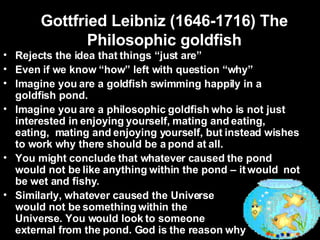
Gottfried Leibniz (1646-1716) The Philosophic goldfish Rejects the idea that things “just are” Even if we know “how” left with question “why” Imagine you are a goldfish swimming happily in a goldfish pond. Imagine you are a philosophic goldfish who is not just interested in enjoying yourself, mating and eating, eating,  mating and enjoying yourself, but instead wishes to work why there should be a pond at all. You might conclude that whatever caused the pond would not be like anything within the pond – it would  not be wet and fishy. Similarly, whatever caused the Universe  would not be something within the  Universe. You would look to someone  external from the pond. God is the reason why
“ ... However far you go back to earlier states,  you will never find in those states a full reason why there should be any world rather than none , and why it should be as it is. Therefore, even if you suppose the world eternal, as you will still be supposing nothing but a succession of states and will not in any of them find a sufficient reason...  it is evident that the reason must be sought elsewhere .”
Problems: Inductive – conclusion only probable Universe is uncaused/unmoved? Steady State Theory Why not infinite regression? Matter is Eternal Why ask Why? John Hick “there is no ultimate explanation to the universe” Bertrand Russell (1872-1970)  “Brute fact” Just is. Can’t be checkmated is you refuse to play a move! David Hume, “Which God?”  This man has a mother, therefore the universe has a mother? This effect has a cause, therefore… Nonsense Too big a leap in logic

A2 Cosmological

  • 1.
    Does God Exist?Cosmological Arguments
  • 2.
    What you needto know… Cosmological arguments, including those presented by Aquinas and the Kalam tradition. Ontological arguments as presented by Anselm and Descartes. Analysis of these arguments should include reference to the following: - a posteriori and a priori reasoning; inductive and deductive arguments; - proof and probability; the relationship between reason and faith.
  • 3.
    Exam Questions: June02 1 (a) Outline the cosmological argument as presented by Aquinas and the ontological argument as presented by Descartes. (20 marks) (b) These arguments have been presented as “proofs” of the existence of God. Examine what is meant by “proof” in this context, and assess how far these arguments may be considered to be proofs of God’s existence. (30 marks)
  • 4.
    Exam Questions: June03 1 (a) Explain the Cosmological Argument for the existence of God as presented by Aquinas. (20 marks) (b) “The Cosmological Argument can only make the existence of God probable. It cannot prove it.” Explain what this means and discuss how far religious believers would agree. (30 marks)
  • 5.
    Exam Questions: June04 1 (a) Outline both the cosmological argument as presented by the Kalam tradition and the ontological argument as presented by Anselm. (20 marks) (b) “There is a posteriori and a priori reasoning. There are inductive and deductive arguments.” Explain the type of reasoning and argument used in the ontological argument, and assess how far the argument proves the existence of God. (30 marks)
  • 6.
    Faith v’s ReasonReason – based on examination and consideration of evidence (science) Faith – based on blind belief or instinct (religion) Arguments for Existence of God – attempt to make a matter of faith reasonable PROOF “An argument that starts with unquestioned premises and builds these into a conclusion” Richard Swindburne
  • 7.
    Cosmological Arguments Greek“Cosmos” = universe A posteriori, inductive Start with the world, conclude God exists DEPENDENCY or CONTINGENCY ARGUMENTS – these argue for the need for the Universe to depend on something necessary, i.e. something that cannot not-exist Probable conclusion – not necessary Conclude there must be a necessary being = God
  • 8.
    St Thomas AquinasTheologian, Philosopher 1225-1274 Five Ways – we look at the First 4 5 th Way, From Design, is strictly a Teleological Argument
  • 9.
  • 10.
    1. Proving Godfrom Motion P1 Things in this world are moving (changing states from potential to actual) P2 Things cannot move themselves – they are moved C There is an unmoved mover who causes motion in all things. This we call God Examples Analogy Problems
  • 11.
    2. Proving Godfrom Cause P1 Every effect (event) has a cause P2 The Universe is an event C Arrive at the First Cause, and Uncaused Cause that started everything off. This we call God Examples Analogy Problems
  • 12.
    Infinite Regression? WilliamCraig (Evangelical) Infinity is illogical Imagine a library with an infinite number of red and an infinite number of black books. The number of red and black books together would then equal the number of red books. So a subset of the total library would contain half the volumes and yet this would equal all the volumes. We cannot make sense of things without time
  • 13.
    3. Proving Godfrom Contingency and Necessity P1. Everything that exists is “contingent” it started existing and will stop existing P2. If EVERYTHING is contingent, there must have been a time when there was NOTHING P3. Something cannot come from Nothing C there must be a NECESSARY being who has always existed and always will from which contingent beings come. This we call God Examples / Analogy Problems
  • 14.
    4. Proving GodFrom Grades of Perfection P1 Within any genus we observe grades of perfection. P2 There cannot be an infinite scale of perfection C God is Perfection Examples Analogy
  • 15.
    Kalam - ISLAMICPHILOSOPHY The Holy Qu’ran called Muslims to reasoning and to seek learning. This led to philosophy being taken seriously and ancient Greek philosophic texts being made available in Arabic. Islamic philosophy had an identity separate from Theology and was referred to as kalam - but it also depended on religion. Kalam Cosmological Argument orignates 9thC
  • 16.
    The Kalam CosmologicalArgument This argument is not concerned with the contingency off all things… P1. Things that begin to exist have a cause P2. The Universe began to exist C The universe has a cause – God Timelines? Steady State
  • 17.
    Gottfried Leibniz (1646-1716)The Philosophic goldfish Rejects the idea that things “just are” Even if we know “how” left with question “why” Imagine you are a goldfish swimming happily in a goldfish pond. Imagine you are a philosophic goldfish who is not just interested in enjoying yourself, mating and eating, eating, mating and enjoying yourself, but instead wishes to work why there should be a pond at all. You might conclude that whatever caused the pond would not be like anything within the pond – it would not be wet and fishy. Similarly, whatever caused the Universe would not be something within the Universe. You would look to someone external from the pond. God is the reason why
  • 18.
    “ ... Howeverfar you go back to earlier states, you will never find in those states a full reason why there should be any world rather than none , and why it should be as it is. Therefore, even if you suppose the world eternal, as you will still be supposing nothing but a succession of states and will not in any of them find a sufficient reason... it is evident that the reason must be sought elsewhere .”
  • 19.
    Problems: Inductive –conclusion only probable Universe is uncaused/unmoved? Steady State Theory Why not infinite regression? Matter is Eternal Why ask Why? John Hick “there is no ultimate explanation to the universe” Bertrand Russell (1872-1970) “Brute fact” Just is. Can’t be checkmated is you refuse to play a move! David Hume, “Which God?” This man has a mother, therefore the universe has a mother? This effect has a cause, therefore… Nonsense Too big a leap in logic