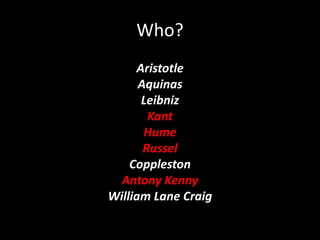
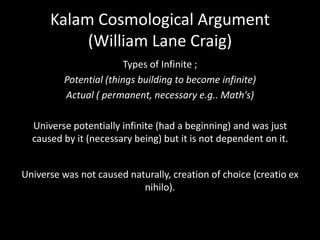
The cosmological argument tries to prove God's existence based on the origins of the universe. Major philosophers who developed or critiqued the cosmological argument include Aristotle, Aquinas, Leibniz, Kant, Hume, Russell, and Coppleston. Aquinas developed five ways, including the idea of an unmoved mover. Leibniz proposed sufficient reason. Kant and Hume challenged the argument. Russell argued key concepts had no meaning, while Coppleston defended the argument using Aquinas and Leibniz. Craig's kalam cosmological argument distinguishes potential and actual infinites, proposing the universe had a beginning caused by a necessary being.