The PDB An Exemplar for Data Science To
Date, But What About the Future?
Philip E. Bourne Ph.D.
Associate Director for Data Science
National Institutes of Health
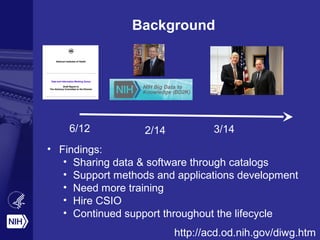
Background
6/12 2/14 3/14
• Findings:
• Sharing data & software through catalogs
• Support methods and applications development
• Need more training
• Hire CSIO
• Continued support throughout the lifecycle
http://acd.od.nih.gov/diwg.htm
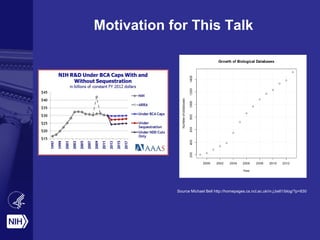
Motivation for This Talk
Source Michael Bell http://homepages.cs.ncl.ac.uk/m.j.bell1/blog/?p=830
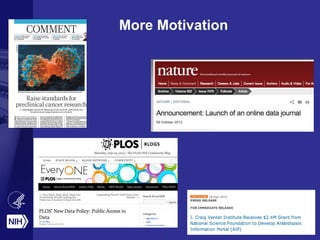
More Motivation
The way we fund and operate
biomedical databases will not scale.
How do we keep the best features of
todays resources but also respond to
shrinking budgets and changes in the
way we do science?
Lets address this question using the
PDB as an example
Disclaimer: This is NOT a talk about
the PDB per se, but a talk about data
resources in general, but using the
PDB as an example since we are all
familiar with it and it is considered an
exemplar by most stakeholders
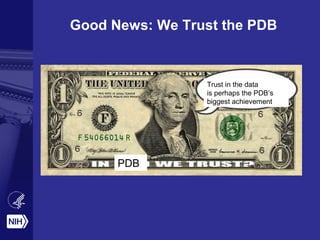
Good News: We Trust the PDB
PDB
Trust in the data
is perhaps the PDB’s
biggest achievement
Good News: Trust
 Trust is like compound interest
 Comes from listening
 Comes from engaging the community in every aspect
of the process
 Comes from data consistency and level of annotation
 Comes from responsiveness
 Comes from the quality of the delivery service
Good News/Bad News Re Data Quality
 Good News:
– If done right in the
beginning 25% of the
PDB’s budget could have
been saved
– Ontologies can work
– Automation has reduced
cost even as the amount
of data has increased
– Reproducibility is
improved
 Bad News:
– Complex ontologies slow
adoption
– All data are created
equal
– Annotation is limited
Good News/Bad News Re Community
 Good News:
– The community is
engaged
– The community has
driven data sharing
 Bad News:
– The community does not
reduce costs through
active participation
– There is insufficient
reward for being part of
the community e.g. as an
annotator
How we do science is changing. Do
data resources including the PDB best
serve the needs of the user at this
point?
How is Science Changing?
 More interdisciplinary
 More translational
 More access to diverse data types
 More computational
 More collaborative
Good News/Bad News for the PDB in
this Changing Landscape
 Bad News:
– Interface complex and
uni-data oriented
– Data accessible;
methods accessible (sort
of); but not together
– Significant redundancy in
services offered
 Good News:
– Annotation!
– Demand is increasing
– Integrated with other
data types
– Restful services
General Problem Statement:
How to insure a high quality
annotated data source that provides
the optimal environment for
accessibility and analysis by a broad
community of diverse users?
Okay so what can the funders do to
address a situation where really the
PDB is currently a best case
scenario?
1. Encourage more
understanding for how
existing data are used
* http://www.cdc.gov/h1n1flu/estimates/April_March_13.htm
Jan. 2008 Jan. 2009 Jan. 2010Jul. 2009Jul. 2008 Jul. 2010
1RUZ: 1918 H1 Hemagglutinin
Structure Summary page activity for
H1N1 Influenza related structures
3B7E: Neuraminidase of A/Brevig Mission/1/1918
H1N1 strain in complex with zanamivir
[Andreas Prlic]
We Need to Learn from Industries Whose
Livelihood Addresses the Question of Use
2. Address the Issue that
Scholarship is Broken
 I have a paper with 17,500 citations that no one has
ever read
 I have papers in PLOS ONE that have more citations
than ones in PNAS
 I have data sets I am proud of few places to put
them
 I edited a journal but it did not count for much
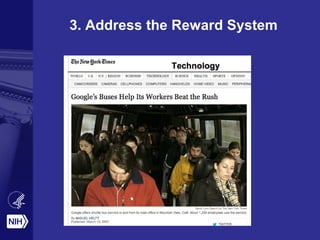
3. Address the Reward System
4. Enable Reproducibility
 Much of the research life cycle is now digital -
encourage the reliability, accessibility, findability,
usability of data, methods, narrative, publications etc.
 How?
 Data sharing plans
 Standards frameworks
 Data and software catalogs
 PubMedCentral
? The Commons – PMC for the complete lifecycle
? Machine readable data sharing plans
? Small funding to communities
? Support for training and best practices in eScholarship
5. Establish The Commons
 Public/private partnership
 Work with IC’s, NCBI and CIT to identify and run
pilots – cloud, HPC centers
 Port DbGAP to the cloud
? Experiment with new funding strategies
 Evaluate
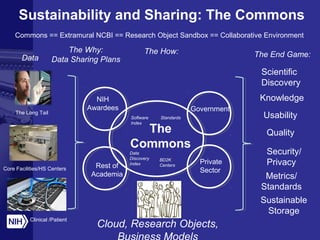
Sustainability and Sharing: The Commons
Data
The Long Tail
Core Facilities/HS Centers
Clinical /Patient
The Why:
Data Sharing Plans
The
Commons
Government
The How:
Data
Discovery
Index
Sustainable
Storage
Quality
Scientific
Discovery
Usability
Security/
Privacy
Commons == Extramural NCBI == Research Object Sandbox == Collaborative Environment
The End Game:
KnowledgeNIH
Awardees
Private
Sector
Metrics/
Standards
Rest of
Academia
Software Standards
Index
BD2K
Centers
Cloud, Research Objects,
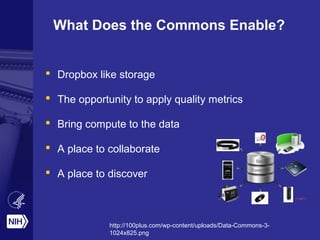
What Does the Commons Enable?
 Dropbox like storage
 The opportunity to apply quality metrics
 Bring compute to the data
 A place to collaborate
 A place to discover
http://100plus.com/wp-content/uploads/Data-Commons-3-
1024x825.png
The PDB in the Commons
 Components:
– Annotated collection of data files
– API’s to access these data files
– Example methods using these APIs
 Potential outcomes
– Nothing happens?
– A new breed of developer starts to use PDB data in new
ways ?
– The casual user has a broader set of services that
previously?
– Quality declines?
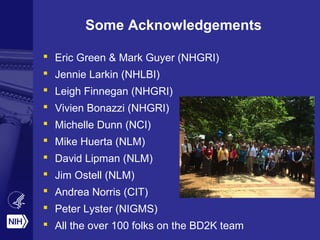
Some Acknowledgements
 Eric Green & Mark Guyer (NHGRI)
 Jennie Larkin (NHLBI)
 Leigh Finnegan (NHGRI)
 Vivien Bonazzi (NHGRI)
 Michelle Dunn (NCI)
 Mike Huerta (NLM)
 David Lipman (NLM)
 Jim Ostell (NLM)
 Andrea Norris (CIT)
 Peter Lyster (NIGMS)
 All the over 100 folks on the BD2K team
NIHNIH……
Turning Discovery Into HealthTurning Discovery Into Health
philip.bourne@nih.gov

The PDB An Exemplar for Data Science To Date, But What About the Future?

  • 1.
    The PDB AnExemplar for Data Science To Date, But What About the Future? Philip E. Bourne Ph.D. Associate Director for Data Science National Institutes of Health
  • 2.
    Background 6/12 2/14 3/14 •Findings: • Sharing data & software through catalogs • Support methods and applications development • Need more training • Hire CSIO • Continued support throughout the lifecycle http://acd.od.nih.gov/diwg.htm
  • 3.
    Motivation for ThisTalk Source Michael Bell http://homepages.cs.ncl.ac.uk/m.j.bell1/blog/?p=830
  • 4.
  • 5.
    The way wefund and operate biomedical databases will not scale. How do we keep the best features of todays resources but also respond to shrinking budgets and changes in the way we do science? Lets address this question using the PDB as an example
  • 6.
    Disclaimer: This isNOT a talk about the PDB per se, but a talk about data resources in general, but using the PDB as an example since we are all familiar with it and it is considered an exemplar by most stakeholders
  • 7.
    Good News: WeTrust the PDB PDB Trust in the data is perhaps the PDB’s biggest achievement
  • 8.
    Good News: Trust Trust is like compound interest  Comes from listening  Comes from engaging the community in every aspect of the process  Comes from data consistency and level of annotation  Comes from responsiveness  Comes from the quality of the delivery service
  • 9.
    Good News/Bad NewsRe Data Quality  Good News: – If done right in the beginning 25% of the PDB’s budget could have been saved – Ontologies can work – Automation has reduced cost even as the amount of data has increased – Reproducibility is improved  Bad News: – Complex ontologies slow adoption – All data are created equal – Annotation is limited
  • 10.
    Good News/Bad NewsRe Community  Good News: – The community is engaged – The community has driven data sharing  Bad News: – The community does not reduce costs through active participation – There is insufficient reward for being part of the community e.g. as an annotator
  • 11.
    How we doscience is changing. Do data resources including the PDB best serve the needs of the user at this point?
  • 12.
    How is ScienceChanging?  More interdisciplinary  More translational  More access to diverse data types  More computational  More collaborative
  • 13.
    Good News/Bad Newsfor the PDB in this Changing Landscape  Bad News: – Interface complex and uni-data oriented – Data accessible; methods accessible (sort of); but not together – Significant redundancy in services offered  Good News: – Annotation! – Demand is increasing – Integrated with other data types – Restful services
  • 14.
    General Problem Statement: Howto insure a high quality annotated data source that provides the optimal environment for accessibility and analysis by a broad community of diverse users?
  • 15.
    Okay so whatcan the funders do to address a situation where really the PDB is currently a best case scenario?
  • 16.
    1. Encourage more understandingfor how existing data are used * http://www.cdc.gov/h1n1flu/estimates/April_March_13.htm Jan. 2008 Jan. 2009 Jan. 2010Jul. 2009Jul. 2008 Jul. 2010 1RUZ: 1918 H1 Hemagglutinin Structure Summary page activity for H1N1 Influenza related structures 3B7E: Neuraminidase of A/Brevig Mission/1/1918 H1N1 strain in complex with zanamivir [Andreas Prlic]
  • 17.
    We Need toLearn from Industries Whose Livelihood Addresses the Question of Use
  • 18.
    2. Address theIssue that Scholarship is Broken  I have a paper with 17,500 citations that no one has ever read  I have papers in PLOS ONE that have more citations than ones in PNAS  I have data sets I am proud of few places to put them  I edited a journal but it did not count for much
  • 19.
    3. Address theReward System
  • 20.
    4. Enable Reproducibility Much of the research life cycle is now digital - encourage the reliability, accessibility, findability, usability of data, methods, narrative, publications etc.  How?  Data sharing plans  Standards frameworks  Data and software catalogs  PubMedCentral ? The Commons – PMC for the complete lifecycle ? Machine readable data sharing plans ? Small funding to communities ? Support for training and best practices in eScholarship
  • 21.
    5. Establish TheCommons  Public/private partnership  Work with IC’s, NCBI and CIT to identify and run pilots – cloud, HPC centers  Port DbGAP to the cloud ? Experiment with new funding strategies  Evaluate
  • 22.
    Sustainability and Sharing:The Commons Data The Long Tail Core Facilities/HS Centers Clinical /Patient The Why: Data Sharing Plans The Commons Government The How: Data Discovery Index Sustainable Storage Quality Scientific Discovery Usability Security/ Privacy Commons == Extramural NCBI == Research Object Sandbox == Collaborative Environment The End Game: KnowledgeNIH Awardees Private Sector Metrics/ Standards Rest of Academia Software Standards Index BD2K Centers Cloud, Research Objects,
  • 23.
    What Does theCommons Enable?  Dropbox like storage  The opportunity to apply quality metrics  Bring compute to the data  A place to collaborate  A place to discover http://100plus.com/wp-content/uploads/Data-Commons-3- 1024x825.png
  • 24.
    The PDB inthe Commons  Components: – Annotated collection of data files – API’s to access these data files – Example methods using these APIs  Potential outcomes – Nothing happens? – A new breed of developer starts to use PDB data in new ways ? – The casual user has a broader set of services that previously? – Quality declines?
  • 25.
    Some Acknowledgements  EricGreen & Mark Guyer (NHGRI)  Jennie Larkin (NHLBI)  Leigh Finnegan (NHGRI)  Vivien Bonazzi (NHGRI)  Michelle Dunn (NCI)  Mike Huerta (NLM)  David Lipman (NLM)  Jim Ostell (NLM)  Andrea Norris (CIT)  Peter Lyster (NIGMS)  All the over 100 folks on the BD2K team
  • 26.
    NIHNIH…… Turning Discovery IntoHealthTurning Discovery Into Health philip.bourne@nih.gov