Libraries
Bridging the
Digital Divide
   Library of Michigan
Opening Keynote, Beginning
        Workshop

      Bobbi Newman
 http://librarianbyday.net
     @librarianbyday
 bobbi@librarianbyday.net
What is the digital divide?
 Why does it matter?
  The role of Libraries
What is the digital divide?
What will close it?
Access to the technology
           AND
   Skills to use it well
Technology
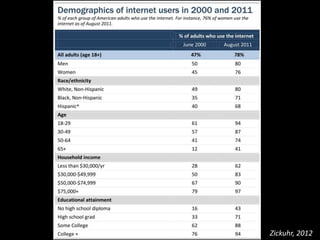
Who Doesn’t Have Access?

one third of all Americans
            or
 100 million Americans
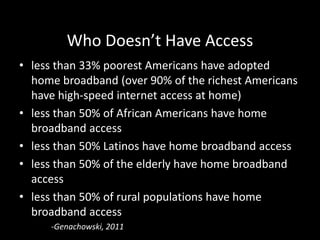
Who Doesn’t Have Access
• less than 33% poorest Americans have adopted
  home broadband (over 90% of the richest Americans
  have high-speed internet access at home)
• less than 50% of African Americans have home
  broadband access
• less than 50% Latinos have home broadband access
• less than 50% of the elderly have home broadband
  access
• less than 50% of rural populations have home
  broadband access
     -Genachowski, 2011
Zickuhr, 2012
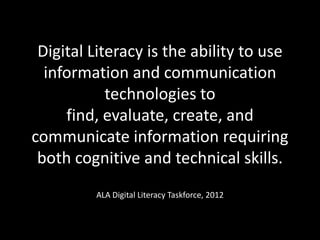
Digital Literacy
Digital Literacy is the ability to use
  information and communication
            technologies to
     find, evaluate, create, and
communicate information requiring
 both cognitive and technical skills.
         ALA Digital Literacy Taskforce, 2012
Why Does It Matter?
Some Stats
• Over 80% of Fortune 500 companies require online
  job applications (including major employers such as
  Wal-Mart, Target, Costco, and ExxonMobil)
• students with a computer and broadband at home
  have 6 to 8 percentage higher GPA than similar
  student who don’t have home access to the Internet
• Consumers with broadband at home have the
  potential to save more than $7,000 a year.

- Genachowski, 2011
Connection
  Opportunity
   Education
  Employment
Civic Engagement
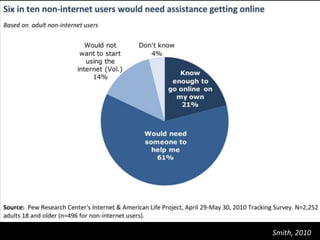
Smith, 2010
Libraries provide a bridge across the
            digital divide
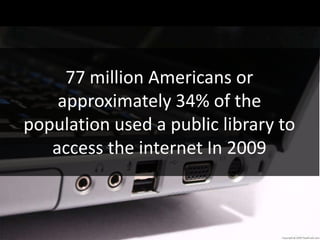
77 million Americans or
    approximately 34% of the
population used a public library to
   access the internet In 2009
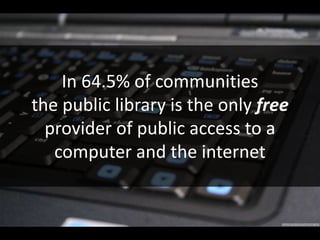
In 64.5% of communities
the public library is the only free
  provider of public access to a
   computer and the internet
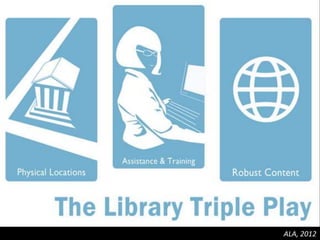
ALA, 2012
Resources

• Digitalliteracy.gov
• Connect to Compete
• Digital Literacy Project - Atwater
  Library
• Digital Literacy: Learning
  Resources | Idaho Commission for
  Libraries
References
•   ALA supports FCC proposal to fund digital literacy training through public libraries. (2012, April
    3).District Dispatch. Retrieved from http://www.districtdispatch.org/2012/04/ala-supports-fcc-
    proposal-to-fund-digital-literacy-training-through-public-libraries/
•   Becker, S., Crandall, M. D., Fisher, K. E., Kinney, B., Landry, C., & Rocha, A. (2010). Opportunity for
    American Library Association. (2011). The state of America's libraries: A report from the American
    Library Association. Chicago, IL: American Library Association. Retrieved from
    http://ala.org/ala/newspresscenter/mediapresscenter/americaslibraries2011/state_of_americas_li
    braries_report_2011.pdf
•   All: How the American Public Benefits from Internet Access at U.S. Libraries (IMLS-2010-RES-01).
    Washington, DC: Institute of Museum and Library Services.
•   DiMaggio, P., & Hargittai, E. (2001). From the ‘digital divide’ to ‘digital inequality’: Studying internet
    use as penetration increases. Woodrow Wilson School, Princeton University: Center for the Arts and
    Cultural Policy Studies.
•   Federal Communications Commission. (2010). Connecting America: The National Broadband Plan.
    Washington, D.C: Federal Communications Commission.
•   Genachowski, J. (2011, November). FCC & “Connect to Compete” tackle barriers to broadband
    adoption, Face Sheet for Chairman Genachowski Remarks on Broadband Adoption, Speech
    presented in Washington, D.C. Retrieved from
    http://hraunfoss.fcc.gov/edocs_public/attachmatch/DOC-310924A1.pdf
•   Smith, A. (2010). Home broadband 2010. Washington, D.C: Pew Research Center’s Internet &
    American Life Project.
•   Zickuhr, K. (2010). Generations 2010. Washington, D.C: Pew Research Center’s Internet and
    American Life Project.
•   Zickuhr, K., & Smith, A. (2012). Digital differences. Washington, D.C: Pew Research Center’s Internet
    and American Life Project.
Questions?

     Bobbi Newman
http://librarianbyday.net
    @librarianbyday
bobbi@librarianbyday.net

Libraries Bridging the Digital Divide

  • 1.
    Libraries Bridging the Digital Divide Library of Michigan Opening Keynote, Beginning Workshop Bobbi Newman http://librarianbyday.net @librarianbyday bobbi@librarianbyday.net
  • 2.
    What is thedigital divide? Why does it matter? The role of Libraries
  • 3.
    What is thedigital divide?
  • 4.
    What will closeit? Access to the technology AND Skills to use it well
  • 5.
  • 6.
    Who Doesn’t HaveAccess? one third of all Americans or 100 million Americans
  • 7.
    Who Doesn’t HaveAccess • less than 33% poorest Americans have adopted home broadband (over 90% of the richest Americans have high-speed internet access at home) • less than 50% of African Americans have home broadband access • less than 50% Latinos have home broadband access • less than 50% of the elderly have home broadband access • less than 50% of rural populations have home broadband access -Genachowski, 2011
  • 8.
  • 9.
  • 10.
    Digital Literacy isthe ability to use information and communication technologies to find, evaluate, create, and communicate information requiring both cognitive and technical skills. ALA Digital Literacy Taskforce, 2012
  • 11.
    Why Does ItMatter?
  • 12.
    Some Stats • Over80% of Fortune 500 companies require online job applications (including major employers such as Wal-Mart, Target, Costco, and ExxonMobil) • students with a computer and broadband at home have 6 to 8 percentage higher GPA than similar student who don’t have home access to the Internet • Consumers with broadband at home have the potential to save more than $7,000 a year. - Genachowski, 2011
  • 13.
    Connection Opportunity Education Employment Civic Engagement
  • 14.
  • 15.
    Libraries provide abridge across the digital divide
  • 16.
    77 million Americansor approximately 34% of the population used a public library to access the internet In 2009
  • 17.
    In 64.5% ofcommunities the public library is the only free provider of public access to a computer and the internet
  • 18.
  • 19.
    Resources • Digitalliteracy.gov • Connectto Compete • Digital Literacy Project - Atwater Library • Digital Literacy: Learning Resources | Idaho Commission for Libraries
  • 20.
    References • ALA supports FCC proposal to fund digital literacy training through public libraries. (2012, April 3).District Dispatch. Retrieved from http://www.districtdispatch.org/2012/04/ala-supports-fcc- proposal-to-fund-digital-literacy-training-through-public-libraries/ • Becker, S., Crandall, M. D., Fisher, K. E., Kinney, B., Landry, C., & Rocha, A. (2010). Opportunity for American Library Association. (2011). The state of America's libraries: A report from the American Library Association. Chicago, IL: American Library Association. Retrieved from http://ala.org/ala/newspresscenter/mediapresscenter/americaslibraries2011/state_of_americas_li braries_report_2011.pdf • All: How the American Public Benefits from Internet Access at U.S. Libraries (IMLS-2010-RES-01). Washington, DC: Institute of Museum and Library Services. • DiMaggio, P., & Hargittai, E. (2001). From the ‘digital divide’ to ‘digital inequality’: Studying internet use as penetration increases. Woodrow Wilson School, Princeton University: Center for the Arts and Cultural Policy Studies. • Federal Communications Commission. (2010). Connecting America: The National Broadband Plan. Washington, D.C: Federal Communications Commission. • Genachowski, J. (2011, November). FCC & “Connect to Compete” tackle barriers to broadband adoption, Face Sheet for Chairman Genachowski Remarks on Broadband Adoption, Speech presented in Washington, D.C. Retrieved from http://hraunfoss.fcc.gov/edocs_public/attachmatch/DOC-310924A1.pdf • Smith, A. (2010). Home broadband 2010. Washington, D.C: Pew Research Center’s Internet & American Life Project. • Zickuhr, K. (2010). Generations 2010. Washington, D.C: Pew Research Center’s Internet and American Life Project. • Zickuhr, K., & Smith, A. (2012). Digital differences. Washington, D.C: Pew Research Center’s Internet and American Life Project.
  • 21.
    Questions? Bobbi Newman http://librarianbyday.net @librarianbyday bobbi@librarianbyday.net

Editor's Notes

  • #12 When citizens gain access to the internet they gain access to a multitude of new possibilities. Research by Pew shows that broadband users of all ages utilize the internet for a wide range of activities including: email, using search engines, seeking health information, following the news, buying products, making travel reservations or purchases, online banking, looking for religious information, rating products, services, or people, making charitable donations and downloading and listening to podcasts Government agencies are no longer issuing print forms. Banks are sending alerts and account balance information via text messages. Email notification of package deliveryHomeworkSearch for and Apply for jobsEducation Health and wellness, diet and nutrition informationFind a doctor Laws & regulationsGovernment formsContact information for a specific government official or agencyCommunity and civic engagement NewsPersonal financesPay billsWe are exposed to more mediated messages in one day than our great-grandparents were exposed to in a year-Center for Media LiteracyA respected Swiss scientist, Conrad Gessner, might have been the first to raise the alarm about the effects of information overload. In a landmark book, he described how the modern world overwhelmed people with data and that this overabundance was both "confusing and harmful" to the mind. The media now echo his concerns with reports on the unprecedented risks of living in an "always on" digital environment. It's worth noting that Gessner, for his part, never once used e-mail and was completely ignorant about computers. That's not because he was a technophobe but because he died in 1565. His warnings referred to the seemingly unmanageable flood of information unleashed by the printing press