Privacy in the Digital Age
Lee Rainie (@lrainie)
Director, Internet, Science, and Technology Research
Pew Research Center
6.3.15
WAN-IFRA – World Media Policy Forum
Background
• Surveys of U.S. adults – post-
Snowden
• Privacy issues are jumbled together
in people’s heads and don’t unpack
easily:
–Sur-veillance
–Sous-veillance
–Co-veillance
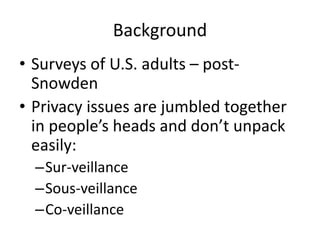
1. The balance of
forces has shifted in
the networked
age. People are
now “public by
default and
private by effort.”
-- danah boyd
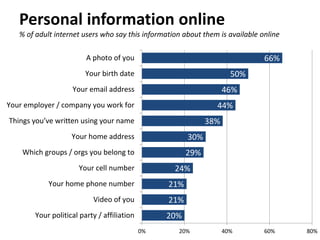
Personal information online
% of adult internet users who say this information about them is available online
20%
21%
21%
24%
29%
30%
38%
44%
46%
50%
66%
0% 20% 40% 60% 80%
Your political party / affiliation
Video of you
Your home phone number
Your cell number
Which groups / orgs you belong to
Your home address
Things you’ve written using your name
Your employer / company you work for
Your email address
Your birth date
A photo of you
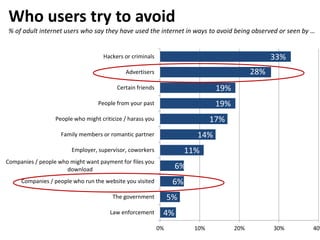
Who users try to avoid
% of adult internet users who say they have used the internet in ways to avoid being observed or seen by …
4%
5%
6%
6%
11%
14%
17%
19%
19%
28%
33%
0% 10% 20% 30% 40%
Law enforcement
The government
Companies / people who run the website you visited
Companies / people who might want payment for files you
download
Employer, supervisor, coworkers
Family members or romantic partner
People who might criticize / harass you
People from your past
Certain friends
Advertisers
Hackers or criminals
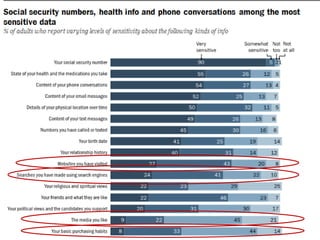
2. Privacy is not binary / context matters
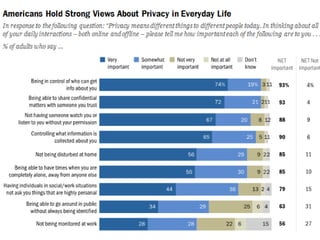
3. Personal control / agency matters
4. Most accept that certain trade-offs are
part of the bargain
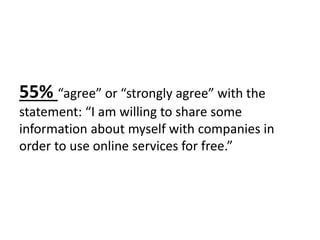
55% “agree” or “strongly agree” with the
statement: “I am willing to share some
information about myself with companies in
order to use online services for free.”
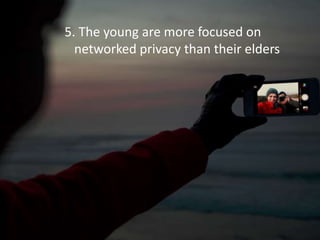
5. The young are more focused on
networked privacy than their elders
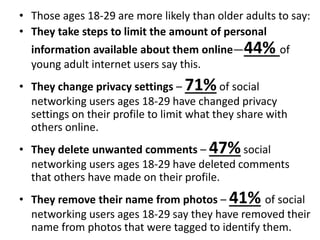
• Those ages 18-29 are more likely than older adults to say:
• They take steps to limit the amount of personal
information available about them online—44% of
young adult internet users say this.
• They change privacy settings – 71%of social
networking users ages 18-29 have changed privacy
settings on their profile to limit what they share with
others online.
• They delete unwanted comments – 47%social
networking users ages 18-29 have deleted comments
that others have made on their profile.
• They remove their name from photos – 41% of social
networking users ages 18-29 say they have removed their
name from photos that were tagged to identify them.
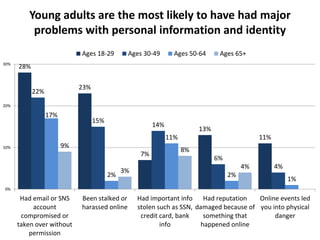
Young adults are the most likely to have had major
problems with personal information and identity
28%
23%
7%
13%
11%
22%
15%
14%
6%
4%
17%
2%
11%
2%
1%
9%
3%
8%
4%
0%
10%
20%
30%
Had email or SNS
account
compromised or
taken over without
permission
Been stalked or
harassed online
Had important info
stolen such as SSN,
credit card, bank
info
Had reputation
damaged because of
something that
happened online
Online events led
you into physical
danger
Ages 18-29 Ages 30-49 Ages 50-64 Ages 65+
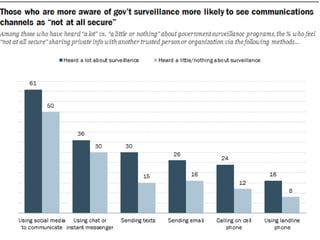
6. Many know they do not
know what is going on ….
Those who know the most
are more worried
and wary
7. Many are resigned – some are even hopeless –
and their trust is fading
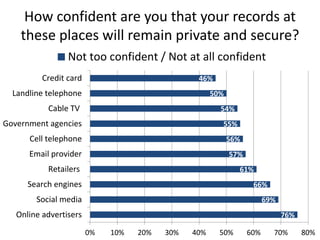
How confident are you that your records at
these places will remain private and secure?
76%
69%
66%
61%
57%
56%
55%
54%
50%
46%
0% 10% 20% 30% 40% 50% 60% 70% 80%
Online advertisers
Social media
Search engines
Retailers
Email provider
Cell telephone
Government agencies
Cable TV
Landline telephone
Credit card
Not too confident / Not at all confident
Changes in laws would help
8. Changes in law could make a difference
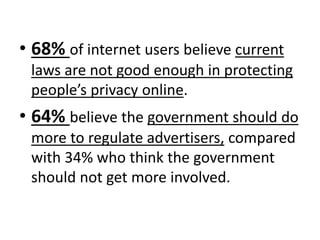
• 68% of internet users believe current
laws are not good enough in protecting
people’s privacy online.
• 64% believe the government should do
more to regulate advertisers, compared
with 34% who think the government
should not get more involved.
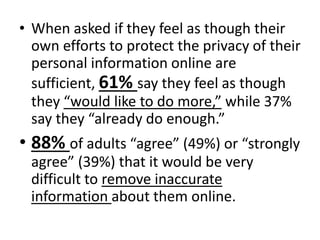
• When asked if they feel as though their
own efforts to protect the privacy of their
personal information online are
sufficient, 61% say they feel as though
they “would like to do more,” while 37%
say they “already do enough.”
• 88% of adults “agree” (49%) or “strongly
agree” (39%) that it would be very
difficult to remove inaccurate
information about them online.
Thank you!
Lee Rainie
lrainie@pewresearch.org
@lrainie
@pewinternet
@pewresearch

Privacy in the Digital Age

  • 1.
    Privacy in theDigital Age Lee Rainie (@lrainie) Director, Internet, Science, and Technology Research Pew Research Center 6.3.15 WAN-IFRA – World Media Policy Forum
  • 3.
    Background • Surveys ofU.S. adults – post- Snowden • Privacy issues are jumbled together in people’s heads and don’t unpack easily: –Sur-veillance –Sous-veillance –Co-veillance
  • 4.
    1. The balanceof forces has shifted in the networked age. People are now “public by default and private by effort.” -- danah boyd
  • 5.
    Personal information online %of adult internet users who say this information about them is available online 20% 21% 21% 24% 29% 30% 38% 44% 46% 50% 66% 0% 20% 40% 60% 80% Your political party / affiliation Video of you Your home phone number Your cell number Which groups / orgs you belong to Your home address Things you’ve written using your name Your employer / company you work for Your email address Your birth date A photo of you
  • 6.
    Who users tryto avoid % of adult internet users who say they have used the internet in ways to avoid being observed or seen by … 4% 5% 6% 6% 11% 14% 17% 19% 19% 28% 33% 0% 10% 20% 30% 40% Law enforcement The government Companies / people who run the website you visited Companies / people who might want payment for files you download Employer, supervisor, coworkers Family members or romantic partner People who might criticize / harass you People from your past Certain friends Advertisers Hackers or criminals
  • 7.
    2. Privacy isnot binary / context matters
  • 11.
    3. Personal control/ agency matters
  • 14.
    4. Most acceptthat certain trade-offs are part of the bargain
  • 15.
    55% “agree” or“strongly agree” with the statement: “I am willing to share some information about myself with companies in order to use online services for free.”
  • 17.
    5. The youngare more focused on networked privacy than their elders
  • 18.
    • Those ages18-29 are more likely than older adults to say: • They take steps to limit the amount of personal information available about them online—44% of young adult internet users say this. • They change privacy settings – 71%of social networking users ages 18-29 have changed privacy settings on their profile to limit what they share with others online. • They delete unwanted comments – 47%social networking users ages 18-29 have deleted comments that others have made on their profile. • They remove their name from photos – 41% of social networking users ages 18-29 say they have removed their name from photos that were tagged to identify them.
  • 19.
    Young adults arethe most likely to have had major problems with personal information and identity 28% 23% 7% 13% 11% 22% 15% 14% 6% 4% 17% 2% 11% 2% 1% 9% 3% 8% 4% 0% 10% 20% 30% Had email or SNS account compromised or taken over without permission Been stalked or harassed online Had important info stolen such as SSN, credit card, bank info Had reputation damaged because of something that happened online Online events led you into physical danger Ages 18-29 Ages 30-49 Ages 50-64 Ages 65+
  • 20.
    6. Many knowthey do not know what is going on …. Those who know the most are more worried and wary
  • 22.
    7. Many areresigned – some are even hopeless – and their trust is fading
  • 24.
    How confident areyou that your records at these places will remain private and secure? 76% 69% 66% 61% 57% 56% 55% 54% 50% 46% 0% 10% 20% 30% 40% 50% 60% 70% 80% Online advertisers Social media Search engines Retailers Email provider Cell telephone Government agencies Cable TV Landline telephone Credit card Not too confident / Not at all confident
  • 25.
    Changes in lawswould help 8. Changes in law could make a difference
  • 26.
    • 68% ofinternet users believe current laws are not good enough in protecting people’s privacy online. • 64% believe the government should do more to regulate advertisers, compared with 34% who think the government should not get more involved.
  • 27.
    • When askedif they feel as though their own efforts to protect the privacy of their personal information online are sufficient, 61% say they feel as though they “would like to do more,” while 37% say they “already do enough.” • 88% of adults “agree” (49%) or “strongly agree” (39%) that it would be very difficult to remove inaccurate information about them online.
  • 29.

Editor's Notes

  • #2 World Association of Newspapers and News Publishers – WAN-IFRA http://www.wan-ifra.org/ Wednesday June 3, 2015 Washington Hilton, Washington DC   14:00 – 16:30 World Media Policy Forum: dissecting the big challenges facing publishers, policy makers and civil society Focus on internet governance and right to be forgotten     The social changes and consequences of the networked society are still being measured. Nonetheless publishers must evaluate and respond now to rapid technology change with policies that will not only protect the ideals that underpin independent and ethical journalism and press freedom but also business sustainability.   As a consequence, it seems that in 2015 publishers, Internet giants and private citizens find themselves engaging more and more passionately in debates around media policy, with alliances changing dramatically depending on the topic.   To help consider appropriate policy responses, we have decided to organize WAN-IFRA’s first World Media Policy Forum, where legal experts, international institutions and practitioners will contribute to clarify where we stand, and where we are headed.    We have invited Lee Rainie, Director, Internet, Science and Technology from the Pew Research Center to deliver a keynote address. Rainie is one of the world’s top academic researchers on the internet and the social changes triggered by information and communication technologies (ICT.) He will talk about what research is showing us about privacy strategies and statistics. Title: Sur-veillance, Sous-veillace and Co-veillance Abstract: Personal privacy in the networked age is limited by three dimensions of “veillance.” They shape people’s behavior and their anxieties about the future of privacy. Lee Rainie will present the latest survey findings from the Pew Research Center about how people try to navigate this new environment in their relationship with government, commercial enterprises, and each other. He will also discuss how some technologists are trying to respond.