@Physiocouk #manchesterphysio facebook.com/physiocouk
Welcome
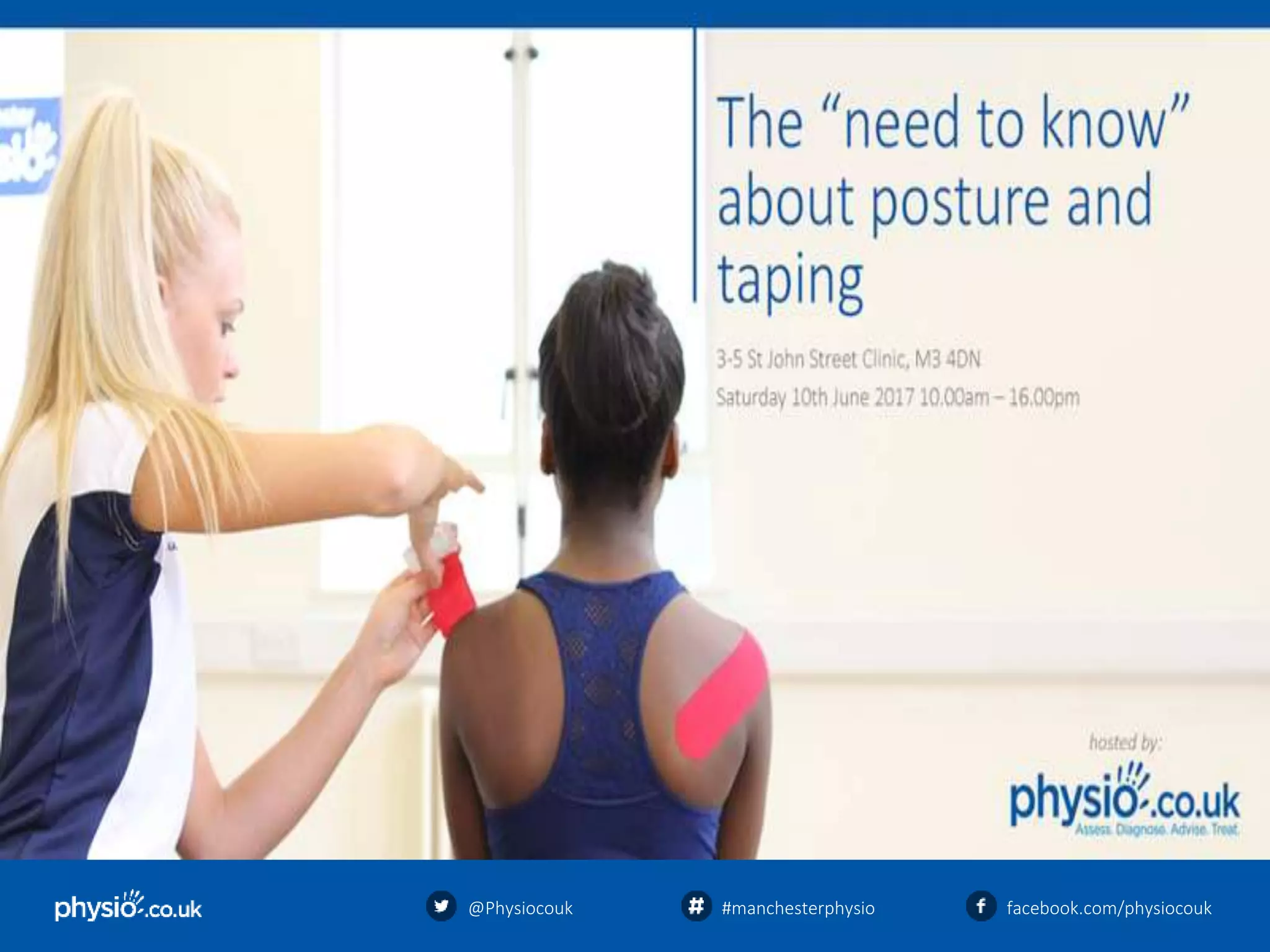
The “need to know” about posture and taping
with Katie Emmett & John Krol
@Physiocouk #manchesterphysio facebook.com/physiocouk
3@Physiocouk #manchesterphysio facebook.com/physiocouk
Let’s connect
Website: www.physio.co.uk
Twitter: @physiocouk
Facebook: www.facebook.com/physiocouk
4
Aims of today
@Physiocouk #manchesterphysio facebook.com/physiocouk
To learn about posture
To learn different types of posture
How k-tape works
How to apply k-tape for posture
5
Itinerary
10.00 - 10.15 Arrival /Induction
10.15 - 11.00 Theory: Posture
11.00 - 11.15 Posture workshop
11.15 - 12.00 Theory: Taping
12.00 - 12.30 Lunch
12.30 - 14.45 Practical
14.45 - 15.00 Evidence/ Q & A
@Physiocouk #manchesterphysio facebook.com/physiocouk
6
Please note
@Physiocouk #manchesterphysio facebook.com/physiocouk
• This is a CPD event
• Check with your insurance provider
@Physiocouk #manchesterphysio facebook.com/physiocouk
Theory: Posture
8
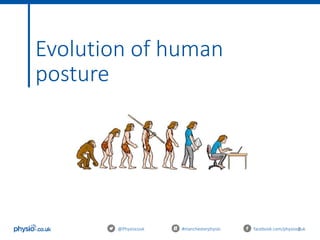
Evolution of human
posture
@Physiocouk #manchesterphysio facebook.com/physiocouk
9@Physiocouk #manchesterphysio facebook.com/physiocouk
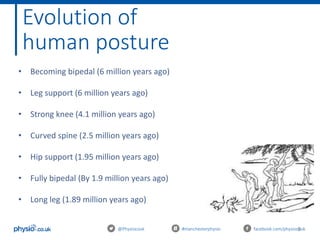
Evolution of
human posture
• Becoming bipedal (6 million years ago)
• Leg support (6 million years ago)
• Strong knee (4.1 million years ago)
• Curved spine (2.5 million years ago)
• Hip support (1.95 million years ago)
• Fully bipedal (By 1.9 million years ago)
• Long leg (1.89 million years ago)
10@Physiocouk #manchesterphysio facebook.com/physiocouk
Benefits and Costs
Benefits of walking & upright posture
As environments changed, walking on two legs helped early
humans survive by:
• Making it easier to pick fruits and other food from low-lying
branches
• Freeing hands for carrying food, tools or babies
• Enabling early humans to appear larger and more intimidating
• Helping early humans cover wide, open landscapes quickly
and efficiently
11@Physiocouk #manchesterphysio facebook.com/physiocouk
Costs of walking & upright posture
Back pain and other skeletal problems are relatively common in
modern humans, an unfortunate side effect of walking upright.
Distributing all our weight on just two limbs can have painful
consequences:
• Lower back pain
• Slipped disks
• Arthritis in hips and knees
• Collapsed foot arches.
Benefits and Costs
12
What is posture?
@Physiocouk #manchesterphysio facebook.com/physiocouk
13@Physiocouk #manchesterphysio facebook.com/physiocouk
Definition
Good posture
• Standing with the head balanced effortlessly above the spine
• Straight and vertical except for the slight natural curves in the
lower back and neck
• Slight S-shape
• Recognised as being associated with good appearance, good
health, strength, athleticism, and stamina.
14@Physiocouk #manchesterphysio facebook.com/physiocouk
Definition
Bad posture
• Commonly described position in which the head and
shoulders are placed forward of the spine
• Excessive S-shape or a C-shape
• Referred to as a slouched, or hunchback posture
• Regarded as a poor appearance, associated with backaches of
all types, poor health, poor breathing and tiredness
15@Physiocouk #manchesterphysio facebook.com/physiocouk
Life style
Occupation
Sedentary living
Technology
Why has our
posture changed?
And what does it mean for us?
16@Physiocouk #manchesterphysio facebook.com/physiocouk
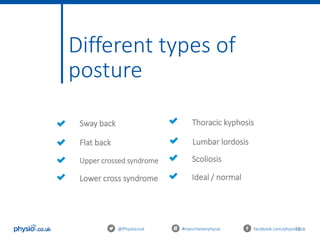
Scoliosis
Sway back
Flat back
Upper crossed syndrome
Lumbar lordosis
Thoracic kyphosis
Lower cross syndrome Ideal / normal
Different types of
posture
17@Physiocouk #manchesterphysio facebook.com/physiocouk
Posture
Examples
18
Sway Back
@Physiocouk #manchesterphysio facebook.com/physiocouk
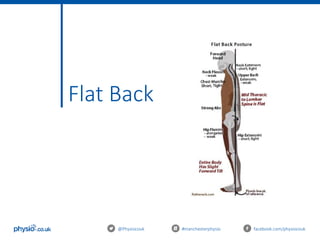
Flat Back
@Physiocouk #manchesterphysio facebook.com/physiocouk
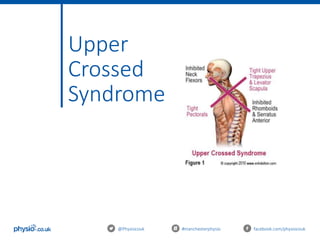
Upper
Crossed
Syndrome
@Physiocouk #manchesterphysio facebook.com/physiocouk
Lower
Crossed
Syndrome
@Physiocouk #manchesterphysio facebook.com/physiocouk
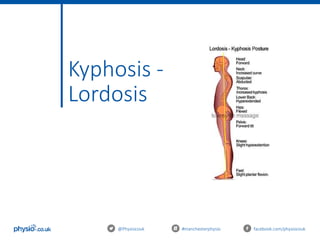
Kyphosis -
Lordosis
@Physiocouk #manchesterphysio facebook.com/physiocouk
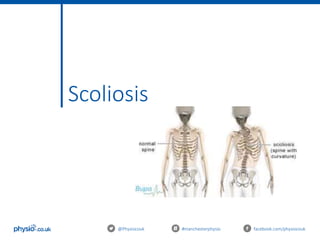
Scoliosis
@Physiocouk #manchesterphysio facebook.com/physiocouk
The ideal
posture
@Physiocouk #manchesterphysio facebook.com/physiocouk
25
Posture Workshop
@Physiocouk #manchesterphysio facebook.com/physiocouk
26@Physiocouk #manchesterphysio facebook.com/physiocouk
How can we help
your posture?
Assessments
Observation
Palpation
Ax movement
Ax strength
27@Physiocouk #manchesterphysio facebook.com/physiocouk
How can we help
your posture?
Treatments
Massage
Mobilisations
Passive stretching
Muscle energy techniques
Taping
Posture education
Exercise programmes/pilates
28
Evidence of
posture and
treatment
@Physiocouk #manchesterphysio facebook.com/physiocouk
Exercise programmes
Pilates
Taping
29@Physiocouk #manchesterphysio facebook.com/physiocouk
Pilates
Emery et al (2009) looked at nineteen subjects (9 controls, 10
experimental) that were assessed twice, 12 weeks apart,
during which the experimental group was submitted to a
Pilates training program (two 1-h sessions per week). The
Pilates training program was effective in improving
abdominal strength and upper spine posture as well as in
stabilising core posture as shoulder flexion movements were
performed.
30@Physiocouk #manchesterphysio facebook.com/physiocouk
Pilates
Kuo, Tully and Galea (2009) found that Immediately after a
Pilates based exercise program (twice weekly for 10 weeks) for
older adults (over 60) stood with slightly decreased thoracic
flexion and sat with slight increased lumbar extension, however,
No differences were found during a follow up period.
31@Physiocouk #manchesterphysio facebook.com/physiocouk
Exercise
programmes
Lynch (2009) recruited 28 elite level collegiate swimmers who presented with
a forward head round shoulder posture. The experimental group were given
postural exercises designed to correct the posture for an 8 week period.
These involved strengthening of the lower and middle fibres of trapezius and
serratus anterior and stretching of pectoralis minor and cervical extensors.
Prior to starting the exercises, both groups were assessed for postural
position, shoulder pain and function, and maximal strength of muscles
around the shoulder blade.
The results revealed that the experimental group had decreased forward
head and shoulder position, suggesting that posture did improve after the
exercise programme. The authors also reported that pain did improve in the
experimental group.
32@Physiocouk #manchesterphysio facebook.com/physiocouk
Theory: Taping
33@Physiocouk #manchesterphysio facebook.com/physiocouk
Taping is an adjunct to our services that can offer support,
immobilisation or proprioceptive feedback depending upon
what is required for the individual
2 main types:
K-tape = elasticated tape with acrylic glue
Zinc Oxide = non stretch cotton with a zinc oxide adhesive
What is taping?
34@Physiocouk #manchesterphysio facebook.com/physiocouk
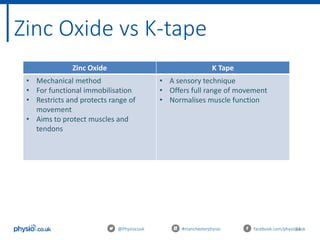
Zinc Oxide K Tape
• Mechanical method
• For functional immobilisation
• Restricts and protects range of
movement
• Aims to protect muscles and
tendons
• A sensory technique
• Offers full range of movement
• Normalises muscle function
Zinc Oxide vs K-tape
35
The Benefits
@Physiocouk #manchesterphysio facebook.com/physiocouk
Pain relieving
Increases circulation
Decreases swelling
Increases or restricts movement
Decreases muscle tension
Improves posture
Provides support
Aids proprioception
Enhances performance
Early return to sport / activity
It looks good!
36@Physiocouk #manchesterphysio facebook.com/physiocouk
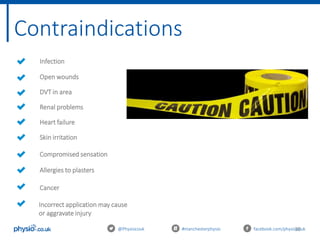
Infection
Open wounds
DVT in area
Renal problems
Heart failure
Skin irritation
Compromised sensation
Allergies to plasters
Cancer
Incorrect application may cause
or aggravate injury
Contraindications
37
PLACEBO OR NOT?!
@Physiocouk #manchesterphysio facebook.com/physiocouk
38
How does K-Tape work?
The Decompression Effect
@Physiocouk #manchesterphysio facebook.com/physiocouk
WRINKLES!
39
How it works
@Physiocouk #manchesterphysio facebook.com/physiocouk
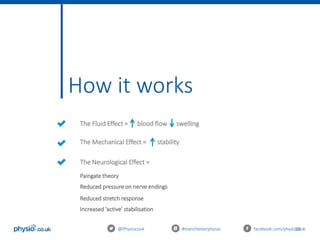
The Fluid Effect = blood flow swelling
The Mechanical Effect = stability
The Neurological Effect =
Paingate theory
Reduced pressure on nerve endings
Reduced stretch response
Increased ‘active’ stabilisation
40
Pre application
@Physiocouk #manchesterphysio facebook.com/physiocouk
Ensure the skin is dry and clean
No hair
Wait 1-2 hours after swimming/ exercise/showering
Ensure K-tape has rounded edges and ‘anchors’ ready
41
Application
@Physiocouk #manchesterphysio facebook.com/physiocouk
For Pain Relief – stretch the muscle before applying tape. Apply tape
with no additional stretch.
For Structural Support – keep the muscle in a shortened position and
stretch the centre of the tape from 30-80%. The final 2-3″ at either end of
each strip must be applied with absolutely no stretch. Applying stretch to
the ends of the tape can quickly lead to skin irritation and abrasions.
To Reduce Swelling – lightly stretch both the muscle and the tape as the
tape is applied. As noted above, the final 2-3″ of each strip must be
applied with no additional stretch.
42@Physiocouk #manchesterphysio facebook.com/physiocouk
Should be able to move
Fine to shower
No rubbing
If any rash/irritation remove tape
After Care
Taping is not the solution – exercises must still be completed!
Remove after 3 days (Max!)
43
Practical
@Physiocouk #manchesterphysio facebook.com/physiocouk
44
Scenario
Neck Pain
@Physiocouk #manchesterphysio facebook.com/physiocouk
The office worker with forward head posture:
28 year old Natalie is an office worker. She has been suffering with
bilateral neck and upper trapezius pain for 3 months since another
member of staff left the company, leading to a heavy workload and
overtime. She feels her symptoms get worse as the working
day/week goes on.
45
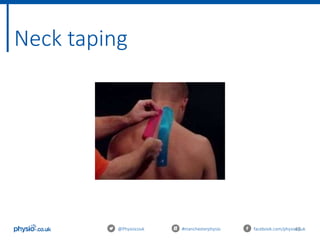
Neck taping
@Physiocouk #manchesterphysio facebook.com/physiocouk
46
Scenario
Shoulder
@Physiocouk #manchesterphysio facebook.com/physiocouk
The builder with shoulder impingement
Bob is a 52 year old builder. Over the past 3 weeks he has felt a
gradual onset of sharp anterior shoulder pain, especially when
lifting and reaching at work. He describes the pain as a ‘severe
pinching feeling’ which seems to be getting worse.
47
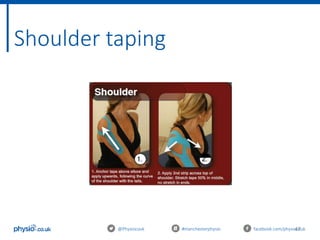
Shoulder taping
@Physiocouk #manchesterphysio facebook.com/physiocouk
48
Scenario
Lumbar spine
@Physiocouk #manchesterphysio facebook.com/physiocouk
A new mum with a disc prolapse
35 year old Lisa is a new mum with an 8 week old baby. She
had some back pain during pregnancy, and then when her
baby was born she went to pick her up from her cot in a
rotated position resulting in sudden sharp lumbar and right
leg pain. She is struggling as she finds herself bending down a
lot to care for her baby.
49
Lumbar spine
taping
@Physiocouk #manchesterphysio facebook.com/physiocouk
50
Scenario
@Physiocouk #manchesterphysio facebook.com/physiocouk
The shop assistant with whiplash
Adam is 26 years old, and was recently involved in a car accident.
He was stationary when he was hit from behind, leading to neck
and back pain the next day. His symptoms are slowly improving but
work is aggravating his pain when he is on his feet for long periods
or stacking shelves.
51
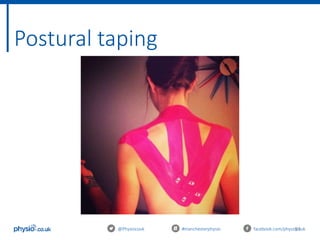
Postural taping
@Physiocouk #manchesterphysio facebook.com/physiocouk
52
Evidence:
Taping and Posture
@Physiocouk #manchesterphysio facebook.com/physiocouk
53
Evidence
Evidence is conflicting however the following benefits have been found:
@Physiocouk #manchesterphysio facebook.com/physiocouk
Improves power & strength in uninjured muscle
Reduces pain & improves function in PFJ pain and Plantar fasciitis
Improves pain, increases ROM and function for impingement
Increases muscle activity
Doesn’t decrease performance
54
Cervical Spine
@Physiocouk #manchesterphysio facebook.com/physiocouk
Gonzalez-Iglasias (2009) completed a study on patients with acute
whiplash symptoms receiving KT. The results demonstrated
statistically significant improvements in pain levels and ROM
immediately following application and 24 hours later.
55
Lumbar Spine
@Physiocouk #manchesterphysio facebook.com/physiocouk
Castro-Sanchez et al (2012) found in there study (albeit minimal
participants) that K- tape reduced disability and pain in
participants with non-specific LBP
Paoloni et al (2011) looked at 39 subjects and 3 groups: KT,
exercise, and KT and exercise. All 3 groups had a significant
reduction in pain and KT was found to help normalize lumbar
muscle function
56
Shoulder
@Physiocouk #manchesterphysio facebook.com/physiocouk
Murray (2010) found that KT can enhance scapula retraction. This was found to

significantly reduce pain, however the study was only carried out on 10 people.
Shoulder impingement:
Thelen et al (2008) concluded that KT may assist in immediate improvements
in pain free shoulder abduction (but overtime it seems to be no more effective
than sham in decreasing pain intensity or disability)
Lewis et al (2005) reported a statistically significant increased pain free
shoulder AROM with taping and increased pain free abduction
57
Thanks for coming!
Don’t forget to follow us on Twitter: @physiocouk
@Physiocouk #manchesterphysio facebook.com/physiocouk
58@Physiocouk #manchesterphysio facebook.com/physiocouk
Title
Text…

The "need to know" about posture and taping

Editor's Notes

  • #3 Introduction of company: Manchester Physio has been established for * years Its expanded over the years, offering a wide range of services including neurological physiotherapy, podiatry, pilates, sports massage, a specialized CIMT service. We have 12 clinic locations currently based in Manchester and Liverpool and we continue to expand Reminder Filming Refreshments Introduction to us Katie: I’m Katie I graduated in sport and exercise therapy at Leeds Metropolitan University in 2013. I started working for this company in the beginning of 2014. My current role is to oversee our massage and personal training service Day to day and I treat a large massage caseload. The most common issues I see is posture problems. I’m constantly assessing and treating posture and with that found using kineso tape along side massage and exercise is really beneficial *John Introduction to attendees
  • #4 Make all people aware of our social media names/ advertise to tweet us/facebook us throughout the day or after.
  • #5 Aims for today: To learn about posture To learn different types of posture How K-tape works How to apply K-tape for posture
  • #6 10.00 - 10.30 Arrival /Induction 10.30 - 12.00 Theory: Posture 12.00 – 12.30 Lunch 12.30 - 13.30 Theory: Taping 13.30 - 14.00 Taping Application 14.00 - 14.15 Break 14.15 - 16.00 Case studies / Practical workshops
  • #7 CPD event and check with your insurance provider that you are covered to use taping techniques to patients or clients Aim of holding these workshops is to give an insight topics we like to cover within therapy practice, also what we see in private clinic, a good chance to meet other therapists and share opinions and experiences
  • #8 Katie
  • #10 Katie  Fossil bones have been found which show a gradual transition of human development to go climbing trees to walking upright on a regular basis.   Becoming bipedal By 6 million years ago The oldest evidence for walking on two legs comes from one of the earliest humans Walking upright may have helped this species survive in the diverse habitats near where it lived—including forests and grasslands.   Leg support 6 million years ago upper part of this thigh bone is similar in size to those of other large apes. But the angled part more closely resembles that of modern humans. It formed a strong bridge with the hip to support the body’s weight, suggesting walking upright.   Strong knee 4.1 million years ago Every time you take a step, you briefly stand on one leg—putting stress on your leg bones. The wide area of bone just below this the knee joint in Australopithecus anamensis is a result of that stress. It provides strong evidence that this individual walked upright.   Mostly bipedal By 4 million years ago from around this time period come from early human species that lived near open areas and dense woods. Their bodies had evolved in ways that enabled them to walk upright most of the time, but still climb trees. As a result, they could take advantage of both habitats.   Curved spine 2.5 million years ago The curve of your lower back absorbs shock when you walk. It is uniquely human. You can see a similar curve in the spine of this early human, Australopithecus africanus, who walked upright in a way very similar to modern humans.   Hip support 1.95 million years ago           The size and broad shape of the hip bones of Homo erectus are similar to a modern human’s, showing that this early human species had given up climbing for walking.   Fully bipedal By 1.9 million years ago Silhouette of Homo erectus pelvis. Image courtesy of Karen Carr StudiosThe pelvis and thigh bones (outline to right) of Homo erectus are similar to modern humans, and show that this early human was able to walk long distances. That ability was a big advantage during this time period. East Africa’s environments were fluctuating widely between moist and dry, and open grasslands were beginning to spread.   Long leg 1.89 million years ago The long thigh bones of Homo erectus enabled its owner to take long strides and therefore to walk farther and faster than earlier humans.     
  • #11  Katie Benefits of walking & upright posture As environments changed, walking on two legs helped early humans survive by: Making it easier to pick fruits and other food from low-lying branches Freeing hands for carrying food, tools or babies Enabling early humans to appear larger and more intimidating Helping early humans cover wide, open landscapes quickly and efficiently
  • #12 Katie Costs of walking & upright posture Back pain and other skeletal problems are relatively common in modern humans, an unfortunate side effect of walking upright. Distributing all our weight on just two limbs can have painful consequences: Lower back pain Slipped disks Arthritis in hips and knees Collapsed foot arches
  • #13 John
  • #14 John Good posture standing with the head balanced effortlessly above the spine straight and vertical except for the slight natural curves in the lower back and neck slight S-shape recognised as being associated with good appearance, good health, strength, athleticism, and stamina.
  • #15 John Bad posture commonly described position in which the head and shoulders are placed forward of the spine excessive S-shape or a C-shape referred to as a slouched, or hunchback posture regarded as a poor appearance, associated with backaches of all types, poor health, poor breathing and tiredness
  • #16 John Lifestyle Occupations Desk based Sedentary Technology
  • #17 John Different types of posture Sway back Flat back Upper crossed syndrome Lower cross syndrome Thoracic kyphosis Lumbar lordosis Scoliosis Ideal/ normal
  • #18 John
  • #19 Sway Back Forward head upper trunk shifted backwards Pelvis shifted forwards knees hyper- extended
  • #20 Flat back Forward head Weak neck flexors short and tight neck extensors short and tight chest muscles weak upper back extensors strong abs flat mid thoracic spine Weak and elonglated hip flexors short and tight hip extensors entire body has slight tilt forward
  • #21 Upper crossed syndrome – most common postural position to see in clinic Inhibited/weak neck flexors tight upper traps and lev scap Tight pectorals inhibited and weak rhomboids and serratus anterior
  • #22 Lower crossed syndrome tight lumbar erector spinae Weak inhibited abdominal muscles Weak and inhibited glutes tight hip flexors
  • #23 Kyphosis - lordosis Forward head increased neck curve abdcuted scapula increased thoracic kyphosis hyperextended lower back flexed hips forward pelvis tilt slight knee hyper extension slight plantar flexed feet
  • #24 Spinal rotation Ribs and shoulder blade bulge on one side One shoulder hangs lower than the other One shoulder blade sits higher than the other The pelvis sits slightly forward and to one side One leg may appear shorter than the other
  • #25 Ideal/ normal posture The Posture Committee of American Academy of Orthopedic Surgeons, 1947 Definition of good posture: “the state of muscular and skeletal balance which protects the supporting structures of the body against injury or progressive deformity irrespective of the attitude in which these structures are working or resting” Kendall et al, 1952 Definition of ideal posture: “an alignment of maximum physiological and biomechanical efficiency, which requires a minimum of stress and strain” Known as “standing up straight” Looking for points of alignment plumb line falls through the ear lobe, the tip of the shoulder centre of the hip anterior to the knee and ankle joints
  • #26 Posture Workshop Examples of postures: get into pairs Assess each other’s postural alignment What type of posture does your partner have? Demonstrate other types of posture to each other Practice the ‘ideal’ posture – how does it feel?
  • #27  Katie observations Ax movement Palpate Soft tissues/ spine
  • #28 Treatment Mobilisations Massage Passive stretching MET taping Posture education Exercise programme / pilates
  • #29 Lacking evidence treating posture, hard to measure No Reliable outcomes Generalised to population However there is evidence and we’ll share them with you now, coming back to taping evidence later
  • #31 (
  • #33  John
  • #34 Taping is an adjunct to our services that can offer support, immobilisation or proprioceptive feedback depending upon what is required for the individual 2 main types: K-tape = elasticated tape with acrylic glue Zinc Oxide = non stretch cotton with a zinc oxide adhesive
  • #35 Zinc oxide: Mechanical method For functional immobilisation Restricts and protects range of movement Aims to protect muscles and tendons K Tape: A sensory technique Offers full range of movement Normalises muscle function
  • #36 The benefits: Pain relieving Increases circulation Decreases swelling Increases or restricts movement Decreases muscle tension Improves posture Provides support Aids proprioception Enhances performance Early return to sport/ activity It looks good!
  • #37 Contraindications Infection Open wounds DVT in areas Renal problems Heart failure Skin irritation Comprised sensation Allergies to plasters Cancer Incorrect application may cause or aggravate injury
  • #38 Placebo or not?
  • #39 How does k tape work? The decompression effect
  • #40 The fluid effect= increases blood flow. Decreases swelling The mechanical effect= increases stability The neurological effect = Pain gate theory, reduced pressure on nerve endings, reduced strength response, increased active stabilisation
  • #41 Pre application Ensure the skin is dry and clean No hair Wait 1-2 hours after swimming/exercise/ showering Ensure k tape has rounded edges and anchors ready
  • #42 Application For pain relief -stretch the muscle before applying tape. Apply tape with no additional stretch. For structural support - keep the muscle in a shortened position and stretch the centre of the tape from 30-80%. The final 2-3″ at either end of each strip must be applied with absolutely no stretch. Applying stretch to the ends of the tape can quickly lead to skin irritation and abrasions. To reduce swelling - lightly stretch both the muscle and the tape as the tape is applied. As noted above, the final 2-3″ of each strip must be applied with no additional stretch
  • #43 After Care: Taping is not a solution – exercises must still be completed Should be able to move Fine to shower No rubbing If any rash/irritation remove tape Remove after 3 days (max)
  • #44 Practical Hand out tape/ scissors Demonstrations followed by case study Practice technique in groups of two/three
  • #45 Katie Lengthen muscle – pain relief Chin tuck for structural response
  • #47 Katie
  • #48 Structual response Many ways – focus on that upper cross syndromes the seems to be the most common of poor postures *lengthen pec muscle *anterior shoulder position
  • #49 John
  • #50 John
  • #51 John
  • #54 Katie Evidence Evidence is conflicting however the following benefits have been found Improves power and strength in uninjured muscle Reduces pain and improves function in PFL and plantar fasciitis Improves pain, increases rom and function for impingement Increases muscle activity Doesn’t decrease performance
  • #55 Katie
  • #56 John
  • #57 Katie