Agricultural Pathways to Improved Nutrition 
Prabhu Pingali, Katie Ricketts, David Sahn 
PREPARATORY TECHNICAL MEETING 
FAO Headquarters, Rome, Italy 
13-15 November 2013
Agricultural Pathways to Improved 
Nutrition 
Prabhu Pingali 
Professor of Applied 
Economics 
& Director, Tata-Cornell 
Initiative for Agriculture 
& Nutrition, Cornell 
University 
Katie Ricketts 
Research Associate, Tata- 
Cornell Initiative for 
Agriculture and Nutrition, 
Cornell University 
David Sahn 
International Professor of 
Economics in the Division of 
Nutritional Sciences & 
Department of Economics, 
Cornell University
Nutrition-Agriculture Pathways 
Household food access (quality, quantity and diversity) 
• Raising incomes 
• Ensuring market availability of low-cost nutritious food 
• Dietary diversity 
Meeting individual dietary needs and ensuring nutrient 
absorption/utilization 
• Food choice and intra-household allocation 
• Good health and prevent infection 
Also, look at reverse causality, between health and 
nutrition, and agricultural productivity.
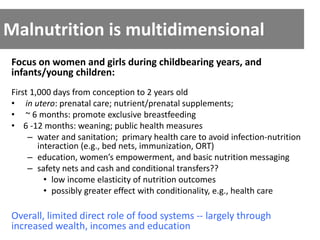
Malnutrition is multidimensional 
Focus on women and girls during childbearing years, and 
infants/young children: 
First 1,000 days from conception to 2 years old 
• in utero: prenatal care; nutrient/prenatal supplements; 
• ~ 6 months: promote exclusive breastfeeding 
• 6 -12 months: weaning; public health measures 
– water and sanitation; primary health care to avoid infection-nutrition 
interaction (e.g., bed nets, immunization, ORT) 
– education, women’s empowerment, and basic nutrition messaging 
– safety nets and cash and conditional transfers?? 
• low income elasticity of nutrition outcomes 
• possibly greater effect with conditionality, e.g., health care 
Overall, limited direct role of food systems -- largely through 
increased wealth, incomes and education
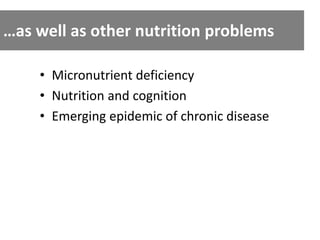
…as well as other nutrition problems 
• Micronutrient deficiency 
• Nutrition and cognition 
• Emerging epidemic of chronic disease
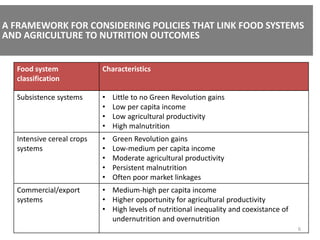
A FRAMEWORK FOR CONSIDERING POLICIES THAT LINK FOOD SYSTEMS 
AND AGRICULTURE TO NUTRITION OUTCOMES 
Food system 
classification 
Characteristics 
Subsistence systems • Little to no Green Revolution gains 
• Low per capita income 
• Low agricultural productivity 
• High malnutrition 
Intensive cereal crops 
systems 
• Green Revolution gains 
• Low-medium per capita income 
• Moderate agricultural productivity 
• Persistent malnutrition 
• Often poor market linkages 
Commercial/export 
systems 
• Medium-high per capita income 
• Higher opportunity for agricultural productivity 
• High levels of nutritional inequality and coexistance of 
undernutrition and overnutrition 
6
7 
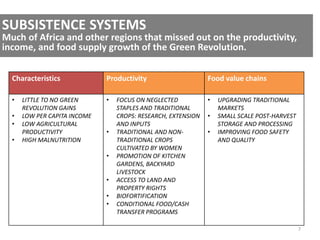
SUBSISTENCE SYSTEMS 
Much of Africa and other regions that missed out on the productivity, 
income, and food supply growth of the Green Revolution. 
Characteristics Productivity Food value chains 
• LITTLE TO NO GREEN 
REVOLUTION GAINS 
• LOW PER CAPITA INCOME 
• LOW AGRICULTURAL 
PRODUCTIVITY 
• HIGH MALNUTRITION 
• FOCUS ON NEGLECTED 
STAPLES AND TRADITIONAL 
CROPS: RESEARCH, EXTENSION 
AND INPUTS 
• TRADITIONAL AND NON-TRADITIONAL 
CROPS 
CULTIVATED BY WOMEN 
• PROMOTION OF KITCHEN 
GARDENS, BACKYARD 
LIVESTOCK 
• ACCESS TO LAND AND 
PROPERTY RIGHTS 
• BIOFORTIFICATION 
• CONDITIONAL FOOD/CASH 
TRANSFER PROGRAMS 
• UPGRADING TRADITIONAL 
MARKETS 
• SMALL SCALE POST-HARVEST 
STORAGE AND PROCESSING 
• IMPROVING FOOD SAFETY 
AND QUALITY
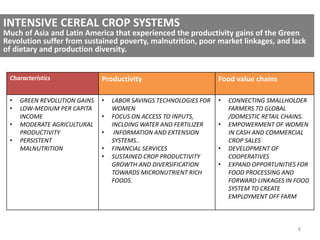
INTENSIVE CEREAL CROP SYSTEMS 
Much of Asia and Latin America that experienced the productivity gains of the Green 
Revolution suffer from sustained poverty, malnutrition, poor market linkages, and lack 
of dietary and production diversity. 
8 
Characteristics Productivity Food value chains 
• GREEN REVOLUTION GAINS 
• LOW-MEDIUM PER CAPITA 
INCOME 
• MODERATE AGRICULTURAL 
PRODUCTIVITY 
• PERSISTENT 
MALNUTRITION 
• LABOR SAVINGS TECHNOLOGIES FOR 
WOMEN 
• FOCUS ON ACCESS TO INPUTS, 
INCLDING WATER AND FERTILIZER 
• INFORMATION AND EXTENSION 
SYSTEMS.. 
• FINANCIAL SERVICES 
• SUSTAINED CROP PRODUCTIVITY 
GROWTH AND DIVERSIFICATION 
TOWARDS MICRONUTRIENT RICH 
FOODS. 
• CONNECTING SMALLHOLDER 
FARMERS TO GLOBAL 
/DOMESTIC RETAIL CHAINS. 
• EMPOWERMENT OF WOMEN 
IN CASH AND COMMERCIAL 
CROP SALES 
• DEVELOPMENT OF 
COOPERATIVES 
• EXPAND OPPORTUNITIES FOR 
FOOD PROCESSING AND 
FORWARD LINKAGES IN FOOD 
SYSTEM TO CREATE 
EMPLOYMENT OFF FARM
9 
COMMERCIAL/EXPORT-ORIENTED 
SYSTEMS 
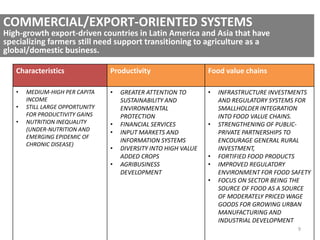
COMMERCIAL/EXPORT-ORIENTED SYSTEMS 
High-growth export-driven countries in Latin America and Asia that have 
specializing farmers still need support transitioning to agriculture as a 
global/domestic business. 
Characteristics Productivity Food value chains 
• MEDIUM-HIGH PER CAPITA 
INCOME 
• STILL LARGE OPPORTUNITY 
FOR PRODUCTIVITY GAINS 
• NUTRITION INEQUALITY 
(UNDER-NUTRITION AND 
EMERGING EPIDEMIC OF 
CHRONIC DISEASE) 
• GREATER ATTENTION TO 
SUSTAINABILITY AND 
ENVIRONMENTAL 
PROTECTION 
• FINANCIAL SERVICES 
• INPUT MARKETS AND 
INFORMATION SYSTEMS 
• DIVERSITY INTO HIGH VALUE 
ADDED CROPS 
• AGRIBUSINESS 
DEVELOPMENT 
• INFRASTRUCTURE INVESTMENTS 
AND REGULATORY SYSTEMS FOR 
SMALLHOLDER INTEGRATION 
INTO FOOD VALUE CHAINS. 
• STRENGTHENING OF PUBLIC-PRIVATE 
PARTNERSHIPS TO 
ENCOURAGE GENERAL RURAL 
INVESTMENT, 
• FORTIFIED FOOD PRODUCTS 
• IMPROVED REGULATORY 
ENVIRONMENT FOR FOOD SAFETY 
• FOCUS ON SECTOR BEING THE 
SOURCE OF FOOD AS A SOURCE 
OF MODERATELY PRICED WAGE 
GOODS FOR GROWING URBAN 
MANUFACTURING AND 
INDUSTRIAL DEVELOPMENT
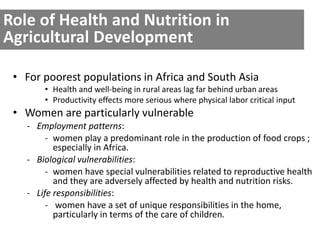
Role of Health and Nutrition in 
Agricultural Development 
• For poorest populations in Africa and South Asia 
• Health and well-being in rural areas lag far behind urban areas 
• Productivity effects more serious where physical labor critical input 
• Women are particularly vulnerable 
- Employment patterns: 
- women play a predominant role in the production of food crops ; 
especially in Africa. 
- Biological vulnerabilities: 
- women have special vulnerabilities related to reproductive health 
and they are adversely affected by health and nutrition risks. 
- Life responsibilities: 
- women have a set of unique responsibilities in the home, 
particularly in terms of the care of children.

ICN2-Agricultural Pathways to Improved Nutrition

  • 1.
    Agricultural Pathways toImproved Nutrition Prabhu Pingali, Katie Ricketts, David Sahn PREPARATORY TECHNICAL MEETING FAO Headquarters, Rome, Italy 13-15 November 2013
  • 2.
    Agricultural Pathways toImproved Nutrition Prabhu Pingali Professor of Applied Economics & Director, Tata-Cornell Initiative for Agriculture & Nutrition, Cornell University Katie Ricketts Research Associate, Tata- Cornell Initiative for Agriculture and Nutrition, Cornell University David Sahn International Professor of Economics in the Division of Nutritional Sciences & Department of Economics, Cornell University
  • 3.
    Nutrition-Agriculture Pathways Householdfood access (quality, quantity and diversity) • Raising incomes • Ensuring market availability of low-cost nutritious food • Dietary diversity Meeting individual dietary needs and ensuring nutrient absorption/utilization • Food choice and intra-household allocation • Good health and prevent infection Also, look at reverse causality, between health and nutrition, and agricultural productivity.
  • 4.
    Malnutrition is multidimensional Focus on women and girls during childbearing years, and infants/young children: First 1,000 days from conception to 2 years old • in utero: prenatal care; nutrient/prenatal supplements; • ~ 6 months: promote exclusive breastfeeding • 6 -12 months: weaning; public health measures – water and sanitation; primary health care to avoid infection-nutrition interaction (e.g., bed nets, immunization, ORT) – education, women’s empowerment, and basic nutrition messaging – safety nets and cash and conditional transfers?? • low income elasticity of nutrition outcomes • possibly greater effect with conditionality, e.g., health care Overall, limited direct role of food systems -- largely through increased wealth, incomes and education
  • 5.
    …as well asother nutrition problems • Micronutrient deficiency • Nutrition and cognition • Emerging epidemic of chronic disease
  • 6.
    A FRAMEWORK FORCONSIDERING POLICIES THAT LINK FOOD SYSTEMS AND AGRICULTURE TO NUTRITION OUTCOMES Food system classification Characteristics Subsistence systems • Little to no Green Revolution gains • Low per capita income • Low agricultural productivity • High malnutrition Intensive cereal crops systems • Green Revolution gains • Low-medium per capita income • Moderate agricultural productivity • Persistent malnutrition • Often poor market linkages Commercial/export systems • Medium-high per capita income • Higher opportunity for agricultural productivity • High levels of nutritional inequality and coexistance of undernutrition and overnutrition 6
  • 7.
    7 SUBSISTENCE SYSTEMS Much of Africa and other regions that missed out on the productivity, income, and food supply growth of the Green Revolution. Characteristics Productivity Food value chains • LITTLE TO NO GREEN REVOLUTION GAINS • LOW PER CAPITA INCOME • LOW AGRICULTURAL PRODUCTIVITY • HIGH MALNUTRITION • FOCUS ON NEGLECTED STAPLES AND TRADITIONAL CROPS: RESEARCH, EXTENSION AND INPUTS • TRADITIONAL AND NON-TRADITIONAL CROPS CULTIVATED BY WOMEN • PROMOTION OF KITCHEN GARDENS, BACKYARD LIVESTOCK • ACCESS TO LAND AND PROPERTY RIGHTS • BIOFORTIFICATION • CONDITIONAL FOOD/CASH TRANSFER PROGRAMS • UPGRADING TRADITIONAL MARKETS • SMALL SCALE POST-HARVEST STORAGE AND PROCESSING • IMPROVING FOOD SAFETY AND QUALITY
  • 8.
    INTENSIVE CEREAL CROPSYSTEMS Much of Asia and Latin America that experienced the productivity gains of the Green Revolution suffer from sustained poverty, malnutrition, poor market linkages, and lack of dietary and production diversity. 8 Characteristics Productivity Food value chains • GREEN REVOLUTION GAINS • LOW-MEDIUM PER CAPITA INCOME • MODERATE AGRICULTURAL PRODUCTIVITY • PERSISTENT MALNUTRITION • LABOR SAVINGS TECHNOLOGIES FOR WOMEN • FOCUS ON ACCESS TO INPUTS, INCLDING WATER AND FERTILIZER • INFORMATION AND EXTENSION SYSTEMS.. • FINANCIAL SERVICES • SUSTAINED CROP PRODUCTIVITY GROWTH AND DIVERSIFICATION TOWARDS MICRONUTRIENT RICH FOODS. • CONNECTING SMALLHOLDER FARMERS TO GLOBAL /DOMESTIC RETAIL CHAINS. • EMPOWERMENT OF WOMEN IN CASH AND COMMERCIAL CROP SALES • DEVELOPMENT OF COOPERATIVES • EXPAND OPPORTUNITIES FOR FOOD PROCESSING AND FORWARD LINKAGES IN FOOD SYSTEM TO CREATE EMPLOYMENT OFF FARM
  • 9.
    9 COMMERCIAL/EXPORT-ORIENTED SYSTEMS COMMERCIAL/EXPORT-ORIENTED SYSTEMS High-growth export-driven countries in Latin America and Asia that have specializing farmers still need support transitioning to agriculture as a global/domestic business. Characteristics Productivity Food value chains • MEDIUM-HIGH PER CAPITA INCOME • STILL LARGE OPPORTUNITY FOR PRODUCTIVITY GAINS • NUTRITION INEQUALITY (UNDER-NUTRITION AND EMERGING EPIDEMIC OF CHRONIC DISEASE) • GREATER ATTENTION TO SUSTAINABILITY AND ENVIRONMENTAL PROTECTION • FINANCIAL SERVICES • INPUT MARKETS AND INFORMATION SYSTEMS • DIVERSITY INTO HIGH VALUE ADDED CROPS • AGRIBUSINESS DEVELOPMENT • INFRASTRUCTURE INVESTMENTS AND REGULATORY SYSTEMS FOR SMALLHOLDER INTEGRATION INTO FOOD VALUE CHAINS. • STRENGTHENING OF PUBLIC-PRIVATE PARTNERSHIPS TO ENCOURAGE GENERAL RURAL INVESTMENT, • FORTIFIED FOOD PRODUCTS • IMPROVED REGULATORY ENVIRONMENT FOR FOOD SAFETY • FOCUS ON SECTOR BEING THE SOURCE OF FOOD AS A SOURCE OF MODERATELY PRICED WAGE GOODS FOR GROWING URBAN MANUFACTURING AND INDUSTRIAL DEVELOPMENT
  • 10.
    Role of Healthand Nutrition in Agricultural Development • For poorest populations in Africa and South Asia • Health and well-being in rural areas lag far behind urban areas • Productivity effects more serious where physical labor critical input • Women are particularly vulnerable - Employment patterns: - women play a predominant role in the production of food crops ; especially in Africa. - Biological vulnerabilities: - women have special vulnerabilities related to reproductive health and they are adversely affected by health and nutrition risks. - Life responsibilities: - women have a set of unique responsibilities in the home, particularly in terms of the care of children.

Editor's Notes

  • #6 David : Anything to add here? Another slide?
  • #8 Subsistence systems are of special importance for African agriculture   - Productivity effects of health and nutrition greatest in populations with more serious health problems - health and well-being in rural areas lag far behind that in urban areas - productivity consequences of poor health are likely to be worse in areas where hard physical labor is the critical input.   Again, this characterizes rural Africa where there is virtually no formal wage labor, and most work is directly or indirectly related to agriculture and is reliant on strength and stamina.   - adverse events, such as weather and pests, jointly have an adverse affect on income and prices of food, as well as directly on health