Activity 1; Shine a
LIGHT on ME!!!
DIRECTION:
UNSCRAMBLE THE LETTERS TO BE FLASH
ON THE SCREEN TO FORM THE CORRECT
WORD, WRITE YOUR ANSWER ON THE
GIVEN ILLUSTRATION BOARD GIVEN. YOU
WILL HAVE 30 SECONDS TO ANSWER.
T H G I L
L I G H T
The only EM wave that is visible to
our human eye.
F L R E C N I E T O
R E F L E C T I O N
The bouncing of light when it
when it hits the surface.
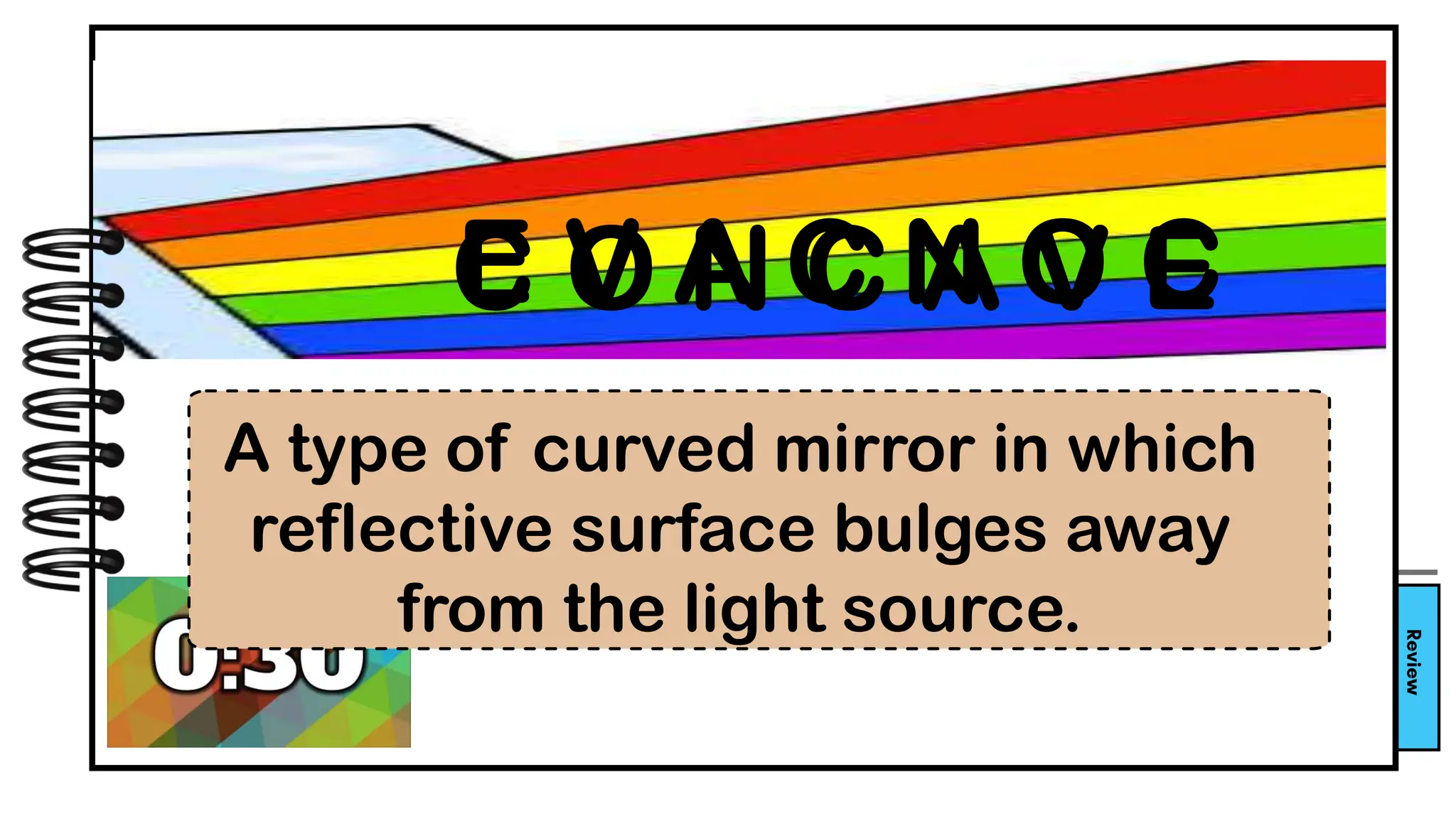
E V A C N O C
C O N C A V E
A type of curved mirror in which
reflective surface bulges away
from the light source.
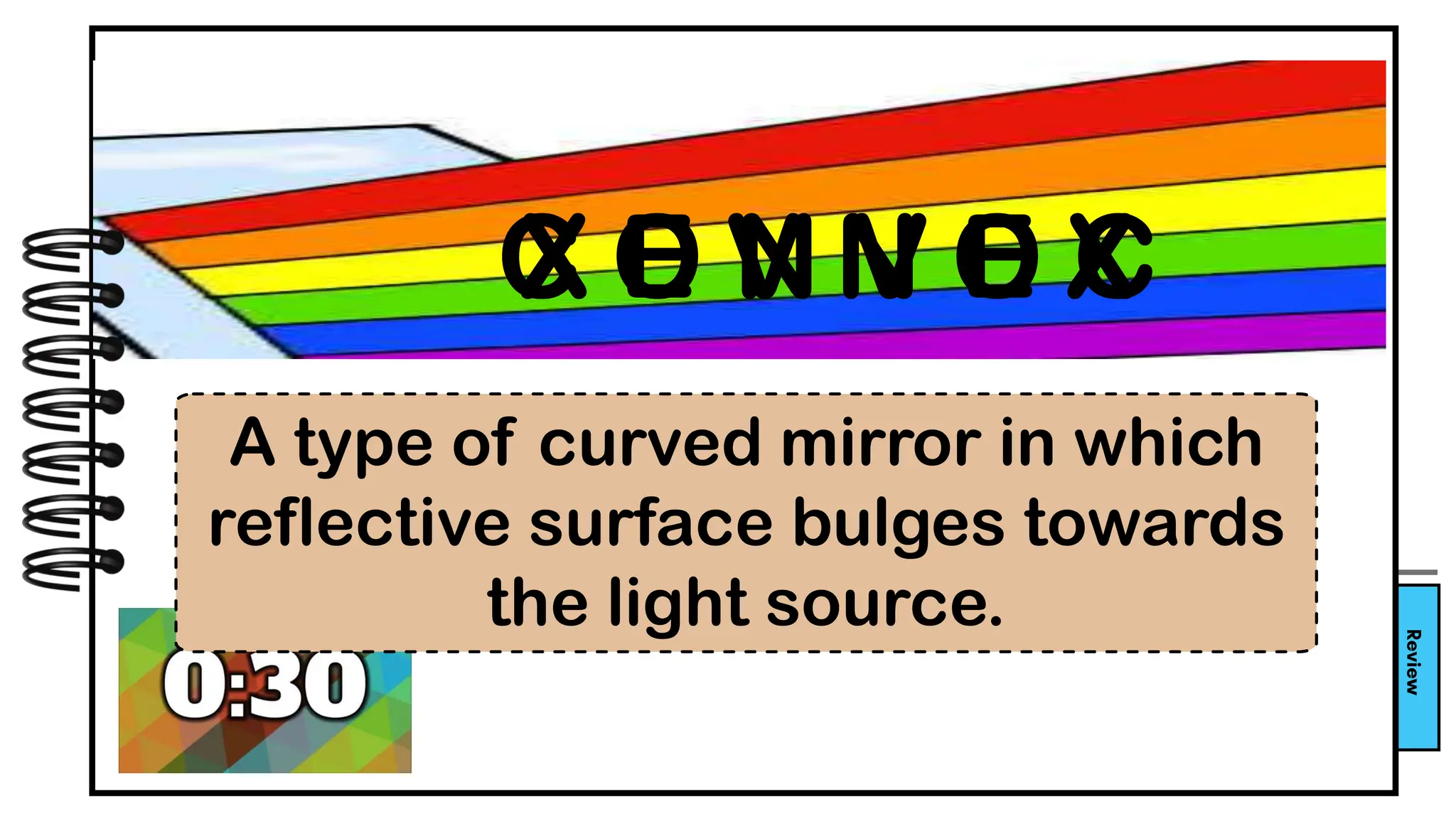
X E V N O C
C O N V E X
A type of curved mirror in which
reflective surface bulges towards
the light source.
Activity 2: WHO SAYS I’M L-O-S-T?
DIRECTION:
Each terminology used to describe an image of a
spherical mirror will be assigned with a corresponding
hand gesture/action. Students will act – out the hand
gesture to describe the image formed in the different
location of an object shown on the ray diagram. You will
be given 30 seconds to act your answer. If you are done
with your answer you can raise your flag.
Inverted / upright
reduce / enlarge
equal
virtual real
Answer:
Answer:
Answer:
Answer:
At the end of the session, the students should be able to:
• Relate the focal length, f, of a convex mirror to the
positions of and object and image using the mirror
equation.
• Describe the quantitative characteristics of image
formed in a curved mirror using the mirror formula.
• Cite real – world applications of curved/spherical mirror
A 5 cm tall light bulb is placed
at a distance of 45 cm from a
concave mirror having a focal
length of 10.5 cm. Determine
the image distance and the
image size.
Sample Problem
Group 1 & 3: Draw It!
Student will make a visual representation of
the object described in the problem.
Group 2 & 4: Take a Guess!
Using the learned concept of ray
diagramming, analyze and make an
educated guess on the image location,
orientation, size and type.
The position and size of the image formed by mirrors may be
determined using ray diagrams. However, the position of the
image be quickly determined using the mirror equation:
1
f
1
p
1
q
= +
where:
f = focal length or distant of the focal length from the mirror
p = distance of the object from the mirror
q = distance of the image from the mirror
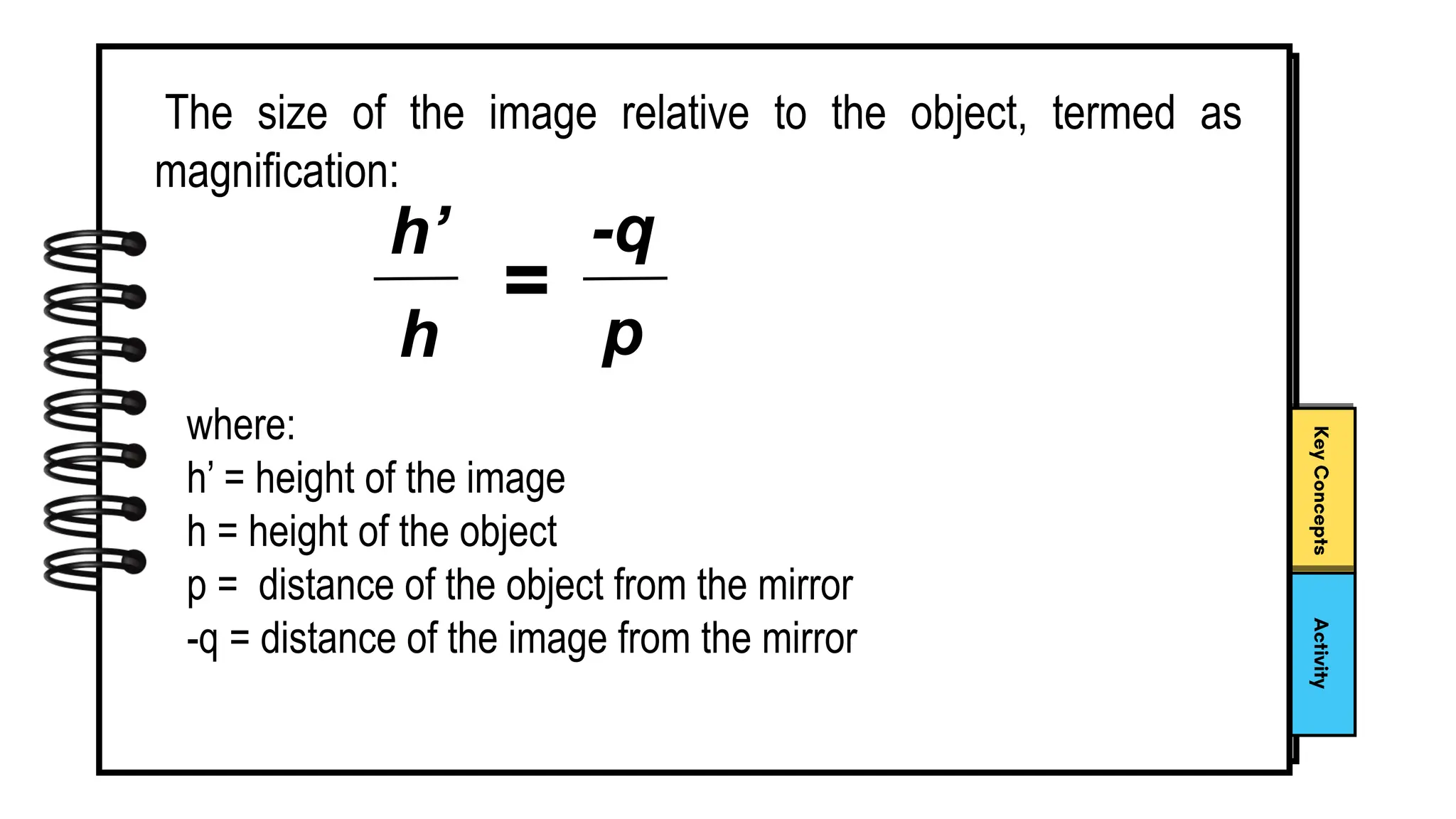
The size of the image relative to the object, termed as
magnification:
h’
h
-q
p
=
where:
h’ = height of the image
h = height of the object
p = distance of the object from the mirror
-q = distance of the image from the mirror
Sample # 1
An object is placed 36 cm in front
of a concave mirror of focal length
of 22.5 cm. What is the image
distance?
Sample # 2
A 5.0 cm tall light bulb is placed at
a distance of 45 cm from a concave
mirror having a focal length of 10.5
cm. Determine the image distance
and the image size.
The Sign of Conventions for Mirrors.
• f is positive (+) if the mirror is a concave mirror
• f is negative (-) if the mirror is a convex mirror
• q is (+) if the image is a real image and located on
the object ‘s side of the mirror
• q is (-) if the image is a virtual image and located
behind the mirror
• h’ is (+) if the image is an upright image
• h’ is (-) if the image is an inverted image.
Direction:
Each group will be given 5 minutes to analyze and solve the
problems to be given. After that, representative each group will
present their output.
Presentation
of Outputs.
GROUP ACTIVITY
• What skills do we develop in making a ray
diagram? How will you relate the
importance of ray diagramming in
understanding the concept of Mirror
Equation?
• Cite real – world applications of
curved/spherical mirror
•Convex Mirror in stores is used to watch the activities of
customers.
•Convex mirror is used as side view mirrors in a car to see the traffic
behind.
•Concave mirror in headlights of a car allows the light to spread out
longer distance.
A mirror with a focal length of 12 cm creates
an image that is 35 cm away from its principal
axis. How far is the corresponding object from
the mirror? (10 pts)
a. What is the distance of the object?
b. What type of curved mirror is used in the
problem?
c. Determine the orientation and type of image?
In a ½ crosswise explain how this quotation
resonate/relate with you?

THE MIRROR EQUATION.pptx

  • 5.
    Activity 1; Shinea LIGHT on ME!!!
  • 6.
    DIRECTION: UNSCRAMBLE THE LETTERSTO BE FLASH ON THE SCREEN TO FORM THE CORRECT WORD, WRITE YOUR ANSWER ON THE GIVEN ILLUSTRATION BOARD GIVEN. YOU WILL HAVE 30 SECONDS TO ANSWER.
  • 7.
    T H GI L L I G H T The only EM wave that is visible to our human eye.
  • 8.
    F L RE C N I E T O R E F L E C T I O N The bouncing of light when it when it hits the surface.
  • 9.
    E V AC N O C C O N C A V E A type of curved mirror in which reflective surface bulges away from the light source.
  • 10.
    X E VN O C C O N V E X A type of curved mirror in which reflective surface bulges towards the light source.
  • 11.
    Activity 2: WHOSAYS I’M L-O-S-T?
  • 12.
    DIRECTION: Each terminology usedto describe an image of a spherical mirror will be assigned with a corresponding hand gesture/action. Students will act – out the hand gesture to describe the image formed in the different location of an object shown on the ray diagram. You will be given 30 seconds to act your answer. If you are done with your answer you can raise your flag. Inverted / upright reduce / enlarge equal virtual real
  • 13.
  • 14.
  • 15.
  • 16.
  • 18.
    At the endof the session, the students should be able to: • Relate the focal length, f, of a convex mirror to the positions of and object and image using the mirror equation. • Describe the quantitative characteristics of image formed in a curved mirror using the mirror formula. • Cite real – world applications of curved/spherical mirror
  • 19.
    A 5 cmtall light bulb is placed at a distance of 45 cm from a concave mirror having a focal length of 10.5 cm. Determine the image distance and the image size. Sample Problem
  • 20.
    Group 1 &3: Draw It! Student will make a visual representation of the object described in the problem. Group 2 & 4: Take a Guess! Using the learned concept of ray diagramming, analyze and make an educated guess on the image location, orientation, size and type.
  • 22.
    The position andsize of the image formed by mirrors may be determined using ray diagrams. However, the position of the image be quickly determined using the mirror equation: 1 f 1 p 1 q = + where: f = focal length or distant of the focal length from the mirror p = distance of the object from the mirror q = distance of the image from the mirror
  • 23.
    The size ofthe image relative to the object, termed as magnification: h’ h -q p = where: h’ = height of the image h = height of the object p = distance of the object from the mirror -q = distance of the image from the mirror
  • 24.
    Sample # 1 Anobject is placed 36 cm in front of a concave mirror of focal length of 22.5 cm. What is the image distance?
  • 25.
    Sample # 2 A5.0 cm tall light bulb is placed at a distance of 45 cm from a concave mirror having a focal length of 10.5 cm. Determine the image distance and the image size.
  • 26.
    The Sign ofConventions for Mirrors. • f is positive (+) if the mirror is a concave mirror • f is negative (-) if the mirror is a convex mirror • q is (+) if the image is a real image and located on the object ‘s side of the mirror • q is (-) if the image is a virtual image and located behind the mirror • h’ is (+) if the image is an upright image • h’ is (-) if the image is an inverted image.
  • 27.
    Direction: Each group willbe given 5 minutes to analyze and solve the problems to be given. After that, representative each group will present their output.
  • 29.
  • 30.
    • What skillsdo we develop in making a ray diagram? How will you relate the importance of ray diagramming in understanding the concept of Mirror Equation? • Cite real – world applications of curved/spherical mirror
  • 31.
    •Convex Mirror instores is used to watch the activities of customers. •Convex mirror is used as side view mirrors in a car to see the traffic behind. •Concave mirror in headlights of a car allows the light to spread out longer distance.
  • 32.
    A mirror witha focal length of 12 cm creates an image that is 35 cm away from its principal axis. How far is the corresponding object from the mirror? (10 pts) a. What is the distance of the object? b. What type of curved mirror is used in the problem? c. Determine the orientation and type of image?
  • 33.
    In a ½crosswise explain how this quotation resonate/relate with you?