Convex Mirror
Ray Diagrams and Image Formation
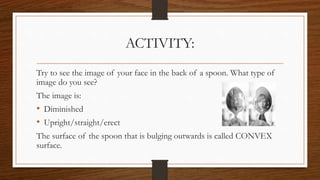
ACTIVITY:
Try to see the image of your face in the back of a spoon. What type of
image do you see?
The image is:
• Diminished
• Upright/straight/erect
The surface of the spoon that is bulging outwards is called CONVEX
surface.
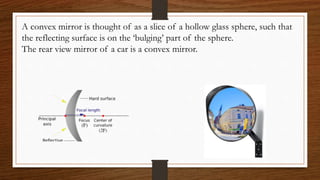
A convex mirror is thought of as a slice of a hollow glass sphere, such that
the reflecting surface is on the ‘bulging’ part of the sphere.
The rear view mirror of a car is a convex mirror.
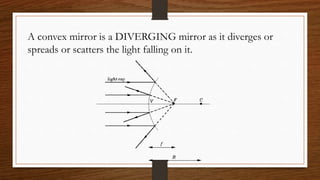
A convex mirror is a DIVERGING mirror as it diverges or
spreads or scatters the light falling on it.
Terms for spherical mirrors(convex)
• Focus: behind the mirror
• Centre of curvature: Behind the mirror at the center of the
imaginary sphere
• Principal Axis
• Pole
• Radius of curvature
• Focal length
Characteristics of image formed by convex
mirror:
• Always erect
• Always virtual
• Always diminished
• Always behind the mirror between Pole and focus
Ray diagram for an image
formed by a convex mirror
Only two cases:
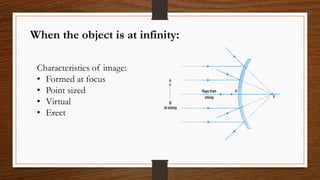
When the object is at infinity:
Characteristics of image:
• Formed at focus
• Point sized
• Virtual
• Erect
Object anywhere on the Principal Axis:
Characteristics of image:
• Virtual
• Erect
• Between pole and focus
• Diminished
Uses of convex mirror:
Point to ponder: We have studied images formed by plane, concave and
convex mirror. Which out of these could give a full image of a larger object?
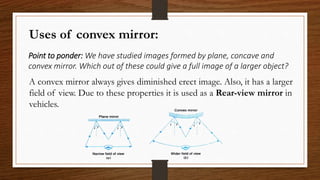
A convex mirror always gives diminished erect image. Also, it has a larger
field of view. Due to these properties it is used as a Rear-view mirror in
vehicles.
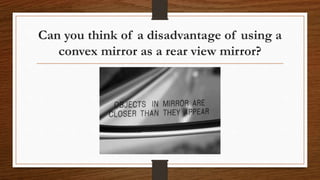
Can you think of a disadvantage of using a
convex mirror as a rear view mirror?
Uses of concave mirror:
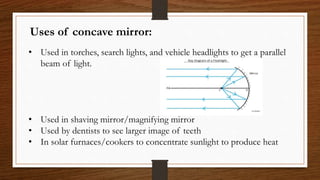
• Used in torches, search lights, and vehicle headlights to get a parallel
beam of light.
• Used in shaving mirror/magnifying mirror
• Used by dentists to see larger image of teeth
• In solar furnaces/cookers to concentrate sunlight to produce heat
Sign convention for reflection by spherical
mirrors:
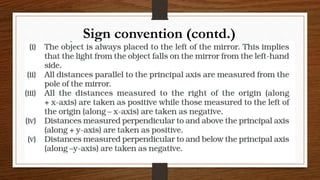
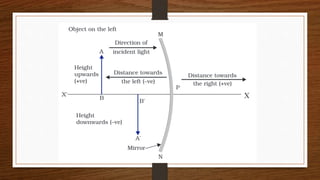
For studying reflection and solving problems, we use
a set of sign convention called New Cartesian sign
convention.
The main points of this convention are:
Sign convention (contd.)
Recap Questions:
1. The mirror that always forms image of the same size as the object is
(a) Plane Mirror (b) Concave Mirror (c) Convex mirror
Answer: (a)
2. The mirror which always forms virtual, erect and diminished image is:
(a) Concave mirror (b) Convex mirror (c) Plane Mirror
Answer: (b)
3. A mirror which acts as a converging mirror is .
Answer: concave mirror
4. A mirror which acts as a diverging mirror is .
Answer: convex mirror
5. Focus of a convex mirror lies
(a) in front of it (b) behind it (c) can be on any side
Answer: (b)
6. A mirror that can give enlarged, erect image is:
(a) Convex mirror (b) Plane mirror (c) Concave mirror
Answer: (c)
7. Mirror which is used by dentists to see enlarged tooth is:
(a) Plane mirror (b) Concave mirror (c) Convex mirror
Answer: (b)
8. Acc. to New Cartesian sign convention, all distances are measured from
(a) Focus(F) (b) Centre of curvature(C) (c) Pole(P)
Answer: (c)
9. Acc. to New Cartesian sign convention, focal length of concave mirror will be:
(a) Positive (b) Negative
Answer: (b)
10. Object is always kept on:
(a) Left of mirror (b) Right of mirror (c) can be kept anywhere
Answer: (a)
Mirror Formula
• We know that the distance between P and F is called focal length. It is
denoted by ‘f’.
• Distance between pole and object on principal axis is called object distance.
It is denoted by ‘u’.
• Distance between the pole and the image is called image distance and is
denoted by ‘v’.
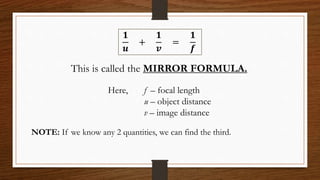
These three quantities are mathematically related by the formula:
𝟏
𝒖
+
𝟏
𝒗
=
𝟏
𝒇
This is called the MIRROR FORMULA.
Here, f – focal length
u – object distance
v – image distance
NOTE: If we know any 2 quantities, we can find the third.
Using sign convention in mirror formula:
When using this formula, New Cartesian sign convention has to be applied to get the
correct signs for u, v and f.
Some points to be kept in mind are:
1. As a convention, as we have read before, the object is always kept to the left of the
mirror. Thus, object distance u is always negative.
2. Focus of a concave mirror is on the left. So its focal length ‘f’ will be taken with
negative sign. On the other hand, focus of a convex mirror lies on the right, so its
focal length ‘f’ is taken with negative sign.
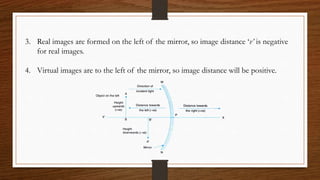
3. Real images are formed on the left of the mirror, so image distance ‘v’ is negative
for real images.
4. Virtual images are to the left of the mirror, so image distance will be positive.
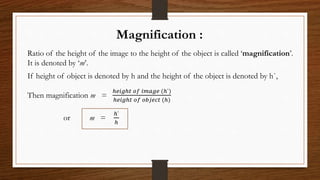
Magnification :
Ratio of the height of the image to the height of the object is called ‘magnification’.
It is denoted by ‘m’.
If height of object is denoted by h and the height of the object is denoted by h`,
Then magnification m =
ℎ𝑒𝑖𝑔ℎ𝑡 𝑜𝑓 𝑖𝑚𝑎𝑔𝑒 (ℎ`)
ℎ𝑒𝑖𝑔ℎ𝑡 𝑜𝑓 𝑜𝑏𝑗𝑒𝑐𝑡 (ℎ)
or m =
ℎ`
ℎ
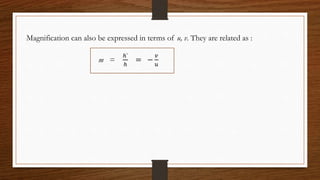
Magnification can also be expressed in terms of u, v. They are related as :
m =
ℎ`
ℎ
= −
𝑣
𝑢
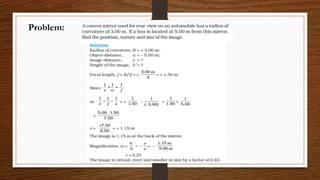
Problem:

Class 10 light - convex mirror

  • 1.
    Convex Mirror Ray Diagramsand Image Formation
  • 2.
    ACTIVITY: Try to seethe image of your face in the back of a spoon. What type of image do you see? The image is: • Diminished • Upright/straight/erect The surface of the spoon that is bulging outwards is called CONVEX surface.
  • 3.
    A convex mirroris thought of as a slice of a hollow glass sphere, such that the reflecting surface is on the ‘bulging’ part of the sphere. The rear view mirror of a car is a convex mirror.
  • 4.
    A convex mirroris a DIVERGING mirror as it diverges or spreads or scatters the light falling on it.
  • 5.
    Terms for sphericalmirrors(convex) • Focus: behind the mirror • Centre of curvature: Behind the mirror at the center of the imaginary sphere • Principal Axis • Pole • Radius of curvature • Focal length
  • 6.
    Characteristics of imageformed by convex mirror: • Always erect • Always virtual • Always diminished • Always behind the mirror between Pole and focus
  • 7.
    Ray diagram foran image formed by a convex mirror Only two cases:
  • 8.
    When the objectis at infinity: Characteristics of image: • Formed at focus • Point sized • Virtual • Erect
  • 9.
    Object anywhere onthe Principal Axis: Characteristics of image: • Virtual • Erect • Between pole and focus • Diminished
  • 10.
    Uses of convexmirror: Point to ponder: We have studied images formed by plane, concave and convex mirror. Which out of these could give a full image of a larger object? A convex mirror always gives diminished erect image. Also, it has a larger field of view. Due to these properties it is used as a Rear-view mirror in vehicles.
  • 11.
    Can you thinkof a disadvantage of using a convex mirror as a rear view mirror?
  • 12.
    Uses of concavemirror: • Used in torches, search lights, and vehicle headlights to get a parallel beam of light. • Used in shaving mirror/magnifying mirror • Used by dentists to see larger image of teeth • In solar furnaces/cookers to concentrate sunlight to produce heat
  • 13.
    Sign convention forreflection by spherical mirrors: For studying reflection and solving problems, we use a set of sign convention called New Cartesian sign convention. The main points of this convention are:
  • 14.
  • 16.
    Recap Questions: 1. Themirror that always forms image of the same size as the object is (a) Plane Mirror (b) Concave Mirror (c) Convex mirror Answer: (a) 2. The mirror which always forms virtual, erect and diminished image is: (a) Concave mirror (b) Convex mirror (c) Plane Mirror Answer: (b)
  • 17.
    3. A mirrorwhich acts as a converging mirror is . Answer: concave mirror 4. A mirror which acts as a diverging mirror is . Answer: convex mirror 5. Focus of a convex mirror lies (a) in front of it (b) behind it (c) can be on any side Answer: (b)
  • 18.
    6. A mirrorthat can give enlarged, erect image is: (a) Convex mirror (b) Plane mirror (c) Concave mirror Answer: (c) 7. Mirror which is used by dentists to see enlarged tooth is: (a) Plane mirror (b) Concave mirror (c) Convex mirror Answer: (b) 8. Acc. to New Cartesian sign convention, all distances are measured from (a) Focus(F) (b) Centre of curvature(C) (c) Pole(P) Answer: (c)
  • 19.
    9. Acc. toNew Cartesian sign convention, focal length of concave mirror will be: (a) Positive (b) Negative Answer: (b) 10. Object is always kept on: (a) Left of mirror (b) Right of mirror (c) can be kept anywhere Answer: (a)
  • 20.
    Mirror Formula • Weknow that the distance between P and F is called focal length. It is denoted by ‘f’. • Distance between pole and object on principal axis is called object distance. It is denoted by ‘u’. • Distance between the pole and the image is called image distance and is denoted by ‘v’. These three quantities are mathematically related by the formula:
  • 21.
    𝟏 𝒖 + 𝟏 𝒗 = 𝟏 𝒇 This is calledthe MIRROR FORMULA. Here, f – focal length u – object distance v – image distance NOTE: If we know any 2 quantities, we can find the third.
  • 22.
    Using sign conventionin mirror formula: When using this formula, New Cartesian sign convention has to be applied to get the correct signs for u, v and f. Some points to be kept in mind are: 1. As a convention, as we have read before, the object is always kept to the left of the mirror. Thus, object distance u is always negative. 2. Focus of a concave mirror is on the left. So its focal length ‘f’ will be taken with negative sign. On the other hand, focus of a convex mirror lies on the right, so its focal length ‘f’ is taken with negative sign.
  • 23.
    3. Real imagesare formed on the left of the mirror, so image distance ‘v’ is negative for real images. 4. Virtual images are to the left of the mirror, so image distance will be positive.
  • 24.
    Magnification : Ratio ofthe height of the image to the height of the object is called ‘magnification’. It is denoted by ‘m’. If height of object is denoted by h and the height of the object is denoted by h`, Then magnification m = ℎ𝑒𝑖𝑔ℎ𝑡 𝑜𝑓 𝑖𝑚𝑎𝑔𝑒 (ℎ`) ℎ𝑒𝑖𝑔ℎ𝑡 𝑜𝑓 𝑜𝑏𝑗𝑒𝑐𝑡 (ℎ) or m = ℎ` ℎ
  • 25.
    Magnification can alsobe expressed in terms of u, v. They are related as : m = ℎ` ℎ = − 𝑣 𝑢
  • 26.