What is MUSCLE?
Musclesare pieces of soft
tissue throughout your
body. They help you do
everything from holding
your body still to running
a marathon
3.
muscles muscles
Muscles playa crucial role in
physical fitness, as they are
responsible for movement,
stability, and overall strength.
Engaging in regular exercise
helps build and maintain
muscle mass, which improves
endurance, flexibility, and
coordination.
Strong and well-conditioned
muscles not only improve
athletic performance but
also prevent injuries and
support daily activities,
making them essential for
overall physical fitness.
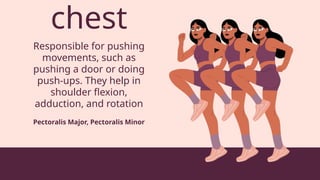
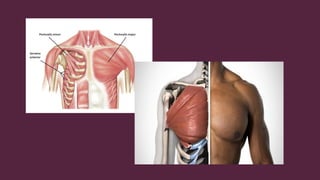
chest
Responsible for pushing
movements,such as
pushing a door or doing
push-ups. They help in
shoulder flexion,
adduction, and rotation
Pectoralis Major, Pectoralis Minor
7.
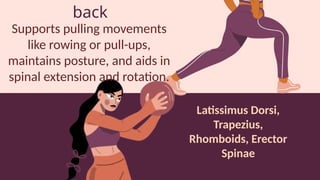
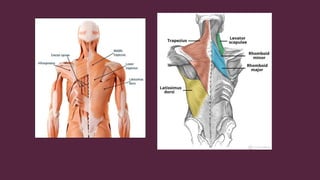
back
Supports pulling movements
likerowing or pull-ups,
maintains posture, and aids in
spinal extension and rotation.
Latissimus Dorsi,
Trapezius,
Rhomboids, Erector
Spinae
9.
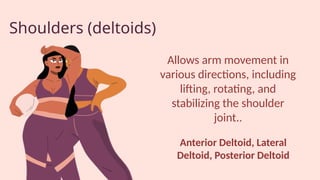
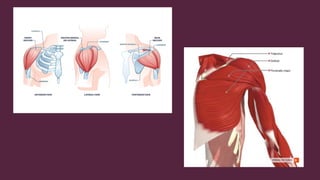
Shoulders (deltoids)
Allows armmovement in
various directions, including
lifting, rotating, and
stabilizing the shoulder
joint..
Anterior Deltoid, Lateral
Deltoid, Posterior Deltoid
11.
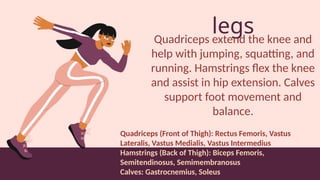
legs
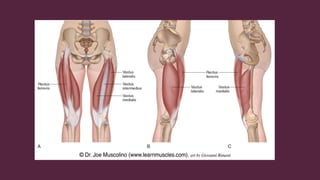
Quadriceps extend theknee and
help with jumping, squatting, and
running. Hamstrings flex the knee
and assist in hip extension. Calves
support foot movement and
balance.
Quadriceps (Front of Thigh): Rectus Femoris, Vastus
Lateralis, Vastus Medialis, Vastus Intermedius
Hamstrings (Back of Thigh): Biceps Femoris,
Semitendinosus, Semimembranosus
Calves: Gastrocnemius, Soleus
13.
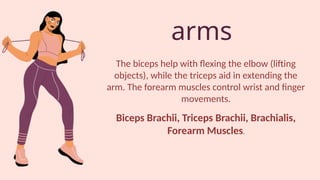
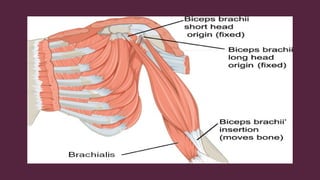
arms
The biceps helpwith flexing the elbow (lifting
objects), while the triceps aid in extending the
arm. The forearm muscles control wrist and finger
movements.
Biceps Brachii, Triceps Brachii, Brachialis,
Forearm Muscles.
15.
Think
Think of thetasks
that you do every
day, from the
moment you
wake up to the
moment you
sleep.
Observe List Plan
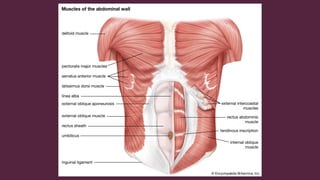
Abdominals and core
Observe the
people around
you, your friends
or your family.
What health-
related fitness do
they do?
When you are
done reflecting
and observing,
list down all the
activities you
think are health-
related fitness.
From the list,
create a weekly
plan and adapt
some of the
activities on your
list that you can
do during the
week.
Provides trunk stability,
supports posture, and aids
in bending, twisting, and
core stabilization. Y
,
Rectus Abdominis, Obliques (Internal &
External), Transverse Abdominisr
body is made up of fat, bone, and muscle.
Body composition is a way for health professionals to
17.
To care forone's body and
keep it healthy is to love
oneself.



![Ppt38 a.pptm [autosaved]](https://cdn.slidesharecdn.com/ss_thumbnails/ppt38a-pptmautosaved-130116100801-phpapp01-thumbnail.jpg?width=640&height=640&fit=bounds)


