Chapter 5 Lecture
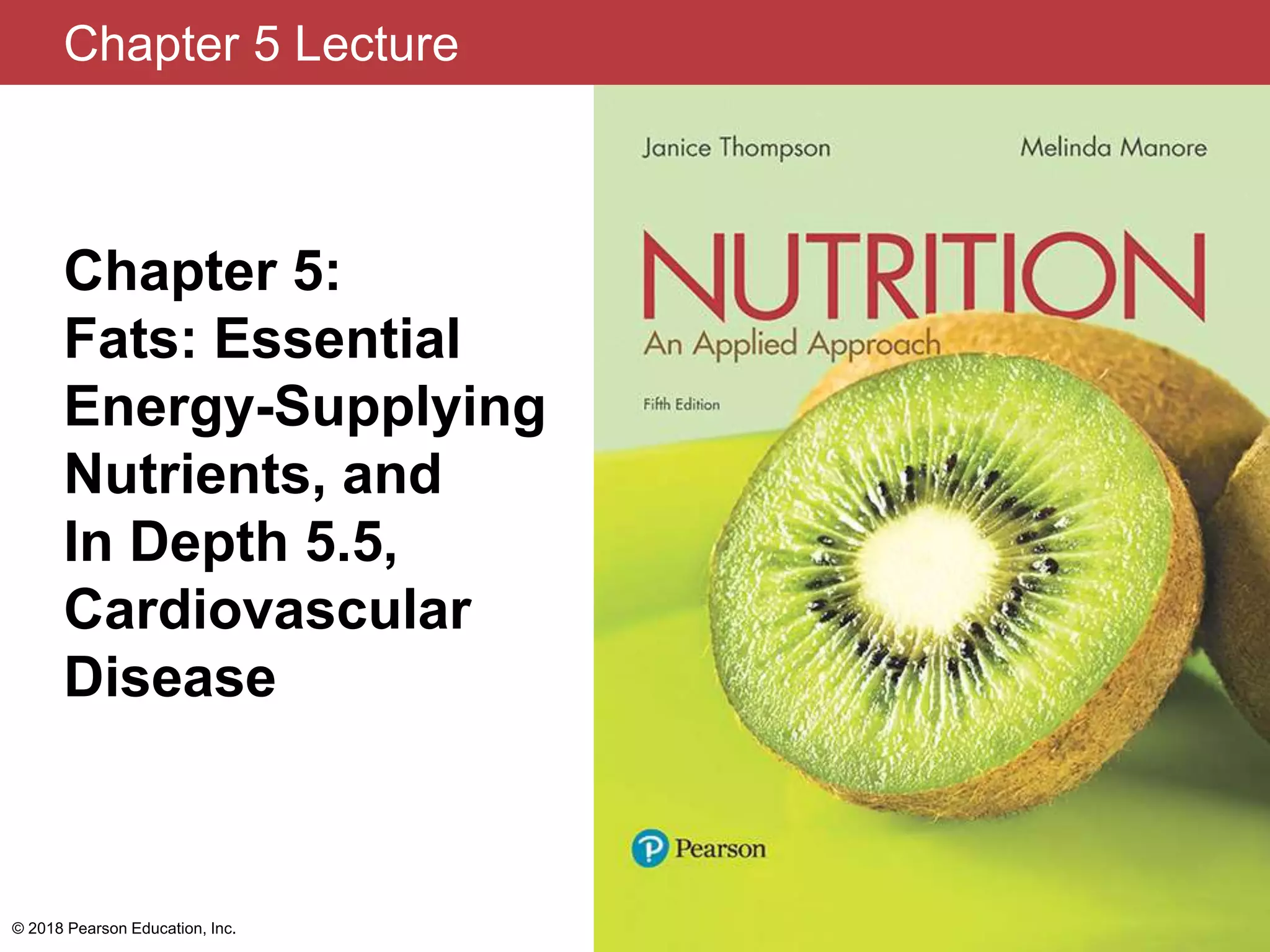
Chapter 5:
Fats: Essential
Energy-Supplying
Nutrients, and
In Depth 5.5,
Cardiovascular
Disease
© 2018 Pearson Education, Inc.
What Are Fats?
• Fats are one type of lipid
• Lipids: diverse class of organic substances that
are insoluble in water
• Lipids (fats) do not dissolve in water
© 2018 Pearson Education, Inc.
Triglycerides
• Most of the fat we eat is in the form of
triglycerides
• About 95% of the fats we consume
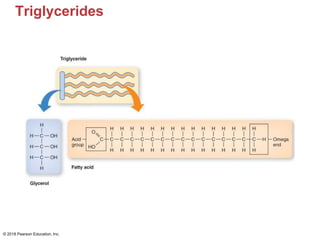
• Triglycerides are composed of
• Three fatty acid molecules
• Fatty acids: long chains of carbon atoms
surrounded by hydrogen atoms
• One glycerol molecule
• Glycerol: a three-carbon alcohol that is the
backbone of a triglyceride
© 2018 Pearson Education, Inc.
Triglycerides
© 2018 Pearson Education, Inc.
Phospholipids
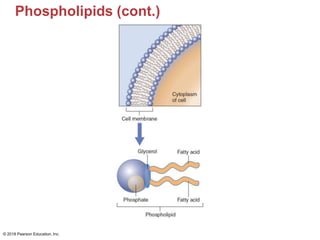
Phospholipids
• Composed of
• Glycerol backbone
• Two fatty acids
• Phosphate
• Soluble in water
• Manufactured in our bodies so they are not
required in our diet
• Important components of cell membranes
© 2018 Pearson Education, Inc.
Phospholipids (cont.)
© 2018 Pearson Education, Inc.
Sterols
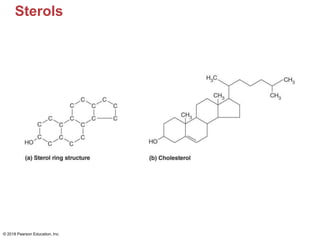
Sterols: lipids containing multiple rings of carbon
atoms
• Essential components of cell membranes and
many hormones
• Manufactured in our bodies and therefore not
an essential component of our diet
• Cholesterol is the major sterol found in the
body
© 2018 Pearson Education, Inc.
Sterols
© 2018 Pearson Education, Inc.
Triglycerides
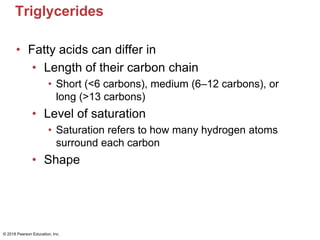
• Fatty acids can differ in
• Length of their carbon chain
• Short (<6 carbons), medium (6–12 carbons), or
long (>13 carbons)
• Level of saturation
• Saturation refers to how many hydrogen atoms
surround each carbon
• Shape
© 2018 Pearson Education, Inc.
Triglycerides (cont.)
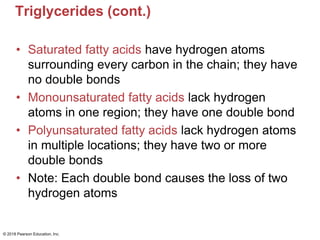
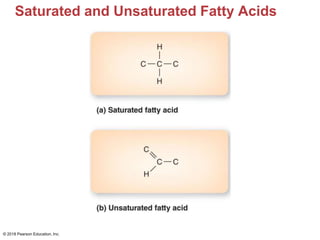
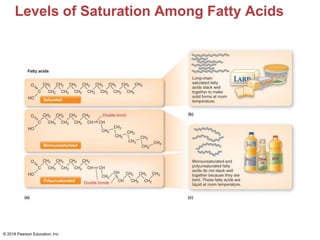
• Saturated fatty acids have hydrogen atoms
surrounding every carbon in the chain; they have
no double bonds
• Monounsaturated fatty acids lack hydrogen
atoms in one region; they have one double bond
• Polyunsaturated fatty acids lack hydrogen atoms
in multiple locations; they have two or more
double bonds
• Note: Each double bond causes the loss of two
hydrogen atoms
© 2018 Pearson Education, Inc.
Saturated and Unsaturated Fatty Acids
© 2018 Pearson Education, Inc.
Levels of Saturation Among Fatty Acids
© 2018 Pearson Education, Inc.
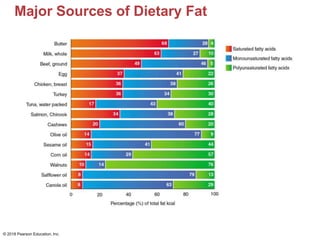
Major Sources of Dietary Fat
© 2018 Pearson Education, Inc.
Triglycerides
• The shape of a triglyceride is determined by the
saturation of the carbon chains
• Saturated fatty acids can pack tightly together
and are solid at room temperature
• For example, coconut oil, animal fats, butter,
and lard are high in saturated fatty acids
© 2018 Pearson Education, Inc.
Triglycerides (cont.)
• Unsaturated fatty acids do not stack together well
and are liquid at room temperature
• Unsaturated fatty acids are the predominant
type in plants
• Two exceptions are coconut and palm
kernel oil
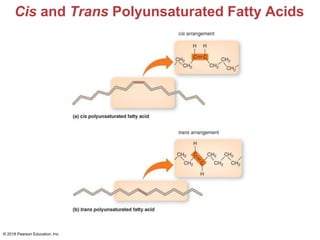
• The hydrogen atoms at the unsaturated region
can be arranged in different positions
• Cis: same side of the carbon chain
• Trans: opposite sides of the carbon chain
© 2018 Pearson Education, Inc.
Cis and Trans Polyunsaturated Fatty Acids
© 2018 Pearson Education, Inc.
Triglycerides (cont.)
Hydrogenation: the addition of hydrogen atoms to
unsaturated fatty acids
• Converts liquid fats (oils) into a semisolid
(spreadable) or solid form
• Used to create margarine from plant oil
• Often creates trans fatty acids
• Listed on food labels as partially
hydrogenated oil
© 2018 Pearson Education, Inc.
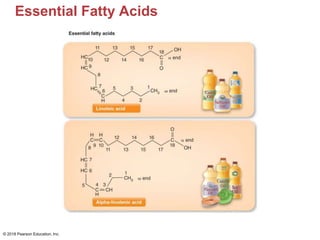
Essential Fatty Acids
Essential fatty acids cannot be synthesized in the
body and must be obtained in the diet
• Omega-6 and omega-3 fatty acids
• They are precursors to biological compounds
called eicosanoids, which regulate cellular
function
© 2018 Pearson Education, Inc.
Essential Fatty Acids (cont.)
• Linoleic acid is found in vegetable and nut oils
• Alpha-linolenic acid (ALA) is derived from
dark-green leafy vegetables, flaxseeds and
flaxseed oil, soybeans and soybean oil, walnuts
and walnut oil, and canola oil
• Eicosapentaenoic acid (EPA) and
docosahexaenoic acid (DHA) have important
health benefits and are found in fish, shellfish,
and fish oils
© 2018 Pearson Education, Inc.
Essential Fatty Acids
© 2018 Pearson Education, Inc.
Why Do We Need Fats?
Energy
• Fat is very energy dense, providing
9 kcal/gram
• Much of the energy used during rest comes
from fat
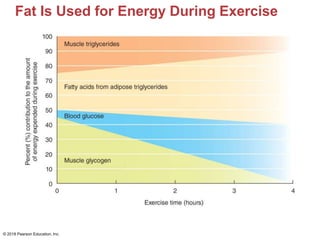
• Fat is used for energy during exercise,
especially after glycogen is depleted
• Fat is also used for energy storage
© 2018 Pearson Education, Inc.
Fat Is Used for Energy During Exercise
© 2018 Pearson Education, Inc.
Why Do We Need Fats?
• Fat-soluble vitamins
• Vitamins A, D, E, and K are soluble in fat; fat
is required for their transport
• Fat is essential to many body functions
• Cell membrane structure
• Nerve cell transmissions
• Protection of internal organs
• Insulation to retain body heat
© 2018 Pearson Education, Inc.
Why Do We Need Fats? (cont.)
• Fat provides flavor and texture to foods
• Fat contributes to making us feel satiated
• Fats are more energy dense than
carbohydrates or protein
• Fats take longer to digest
© 2018 Pearson Education, Inc.
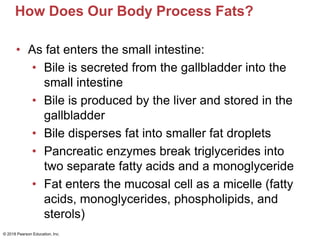
How Does Our Body Process Fats?
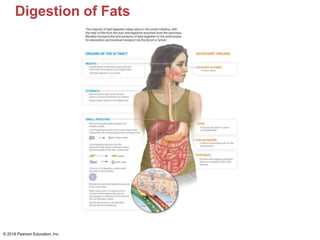
• As fat enters the small intestine:
• Bile is secreted from the gallbladder into the
small intestine
• Bile is produced by the liver and stored in the
gallbladder
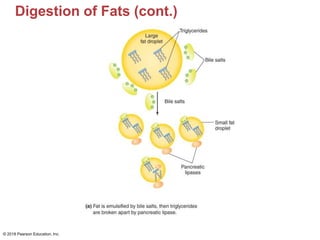
• Bile disperses fat into smaller fat droplets
• Pancreatic enzymes break triglycerides into
two separate fatty acids and a monoglyceride
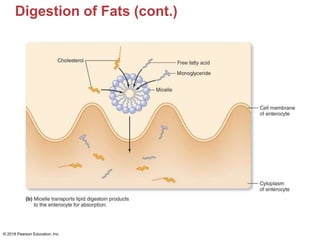
• Fat enters the mucosal cell as a micelle (fatty
acids, monoglycerides, phospholipids, and
sterols)
© 2018 Pearson Education, Inc.
Digestion of Fats
© 2018 Pearson Education, Inc.
Digestion of Fats (cont.)
© 2018 Pearson Education, Inc.
Digestion of Fats (cont.)
© 2018 Pearson Education, Inc.
How Does Our Body Process Fats?
• In the intestinal mucosal cell:
• Fatty acids are reattached to the
monoglyceride to re-form triglycerides
• A small amount of protein is added to the
lipids, forming a chylomicron
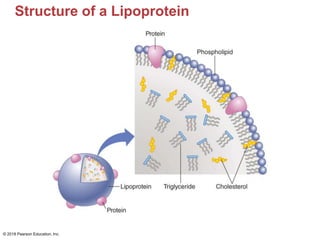
• Chylomicron: a lipoprotein produced by cells
lining the small intestine
• Composed of triglycerides surrounded by
phospholipids and proteins
• Soluble in water
© 2018 Pearson Education, Inc.
Structure of a Lipoprotein
© 2018 Pearson Education, Inc.
How Does Our Body Process Fats?
• Chylomicrons are the transport vehicles that
remove absorbed fats from the small intestine
• Travel through the lymphatic system
• Are transferred to the bloodstream
• Short- and medium-chain fatty acids are
absorbed more quickly because they are not
arranged into chylomicrons
© 2018 Pearson Education, Inc.
How Does Our Body Process Fats? (cont.)
• Once the chylomicron gets to a cell in the body,
the triglycerides in the chylomicrons must be
disassembled by lipoprotein lipase into two fatty
acids and a monoglyceride before they can pass
through the cell membrane
• After entering the cell, the two fatty acids and
monoglyceride re-form a triglyceride
• The triglyceride can be
• Used immediately for energy
• Used to make lipid-containing compounds
• Stored in liver and muscle cells
© 2018 Pearson Education, Inc.
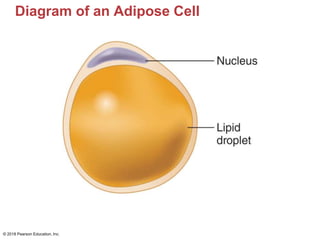
Diagram of an Adipose Cell
© 2018 Pearson Education, Inc.
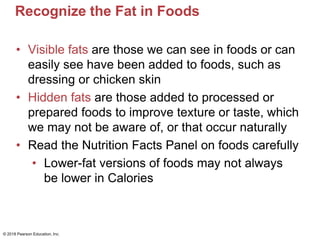
Recognize the Fat in Foods
• Visible fats are those we can see in foods or can
easily see have been added to foods, such as
dressing or chicken skin
• Hidden fats are those added to processed or
prepared foods to improve texture or taste, which
we may not be aware of, or that occur naturally
• Read the Nutrition Facts Panel on foods carefully
• Lower-fat versions of foods may not always
be lower in Calories
© 2018 Pearson Education, Inc.
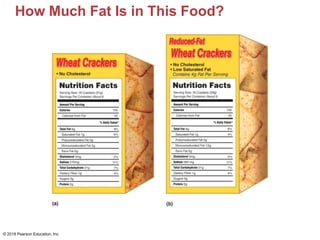
How Much Fat Is in This Food?
© 2018 Pearson Education, Inc.
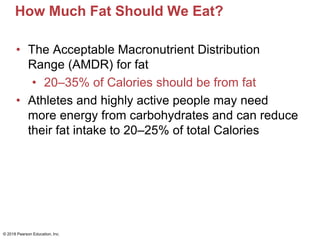
How Much Fat Should We Eat?
• The Acceptable Macronutrient Distribution
Range (AMDR) for fat
• 20–35% of Calories should be from fat
• Athletes and highly active people may need
more energy from carbohydrates and can reduce
their fat intake to 20–25% of total Calories
© 2018 Pearson Education, Inc.
How Much Fat Should We Eat?
• The type of fat consumed is important
• Intake of saturated and trans fatty acids
should be minimized as much as possible
• We typically get enough linoleic acid in our
diets from salad dressings, vegetable oils,
margarines, and mayonnaise
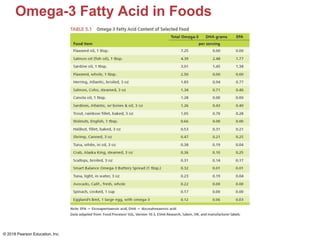
• To ensure an adequate amount of omega-3
fatty acids, we need to consume more
dark-green leafy vegetables, walnuts,
flaxseeds, and fish or fish oils
© 2018 Pearson Education, Inc.
Essential Fatty Acids
• Linoleic Acid (omega-6)
• AI is 14–17 g per day for men and 11–12 g
per day for women
• Alpha-linolenic acid (omega-3)
• AI is 1.6 g per day for men and 1.1 g per day
for women
© 2018 Pearson Education, Inc.
Omega-3 Fatty Acid in Foods
© 2018 Pearson Education, Inc.
Limit Saturated and Trans Fats
• Reduce your intake of saturated fats
• Be conscious of the saturated fat content of
meats, baked goods and snack goods, and
foods including vegetables that are fried,
breaded, or drenched in sauce
• Avoid trans fatty acids
• Limit your intake of dietary cholesterol, which will
also help limit your intake of saturated fats
© 2018 Pearson Education, Inc.
Select Beneficial Fats
• Consume and cook with leafy green vegetables,
avocados, soybeans, soybean oil, and flaxseed
oil
• Add walnuts, almonds, flaxseeds, and chia
seeds to your diet, and try almond milk in your
cereal
• Consider including fish in your diet at least twice
a week or consider taking a fish oil supplement
• Fish can contain mercury, PCBs, and other
environmental contaminants, so be selective
© 2018 Pearson Education, Inc.
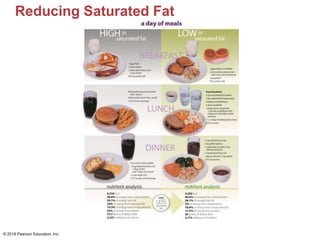
Reducing Saturated Fat
© 2018 Pearson Education, Inc.
Fat Replacers
• Snack foods are frequent targets for fat
replacers, substances that can reduce the fat
content
• Fat replacers such as olestra have not proved
very popular or effective because of potential
gastrointestinal side effects
• Our growing obesity problems indicate that fat
replacers do not help Americans lose weight
© 2018 Pearson Education, Inc.
Role of Fats in Chronic Disease
• The chronic disease most closely associated
with diets high in saturated fat is cardiovascular
disease
• The role of dietary fat in the development of
cancer has been extensively researched, but the
relationship between some cancer types and
dietary fats is controversial (e.g., breast cancer)
• The strongest association between dietary fat
and cancer is for prostate cancer
© 2018 Pearson Education, Inc.
In Depth: Cardiovascular Disease
Cardiovascular disease (CVD)
• Dysfunction of the heart or blood vessels
• The most common forms:
• Coronary heart disease, or coronary artery disease
• Stroke
• Hypertension, or high blood pressure
• Peripheral vascular disease
© 2018 Pearson Education, Inc.
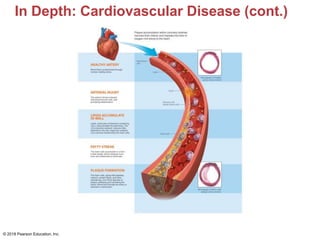
In Depth: Cardiovascular Disease (cont.)
Atherosclerosis is a disease in which artery walls
build up lipid deposits and scar tissue, impairing
blood flow
• The stiffness that results is commonly called
“hardening of the arteries”
• The result is that the heart must work harder to
push blood through the vessels
© 2018 Pearson Education, Inc.
In Depth: Cardiovascular Disease (cont.)
© 2018 Pearson Education, Inc.
In Depth: Cardiovascular Disease (cont.)
Hypertension is a major chronic disease in the
United States
• It functions as a warning sign for a person’s risk
for developing heart disease or stroke
• For many people, hypertension is hereditary; for
others, it can be induced through poor nutrition
and exercise habits or a combination of poor
habits and heredity
© 2018 Pearson Education, Inc.
In Depth: Cardiovascular Disease (cont.)
• Modifiable risk factors for cardiovascular disease
include
• Being overweight
• Physical inactivity
• Smoking
• Type 2 diabetes mellitus
• Inflammation in the body
• Abnormal blood lipids
© 2018 Pearson Education, Inc.
In Depth: Cardiovascular Disease (cont.)
• The intake of certain types of fats can protect
against heart disease
• Diets high in omega-3 fatty acids (along with
moderate exercise) can reduce inflammation
and increase HDL (“good”) cholesterol levels
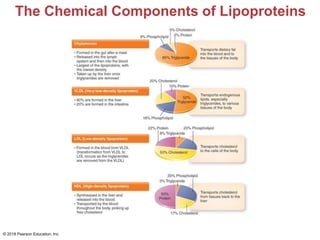
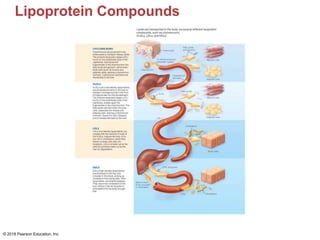
• Low-density lipoproteins (LDLs) are often called
“bad” cholesterol because of their role in
transporting cholesterol throughout the body
© 2018 Pearson Education, Inc.
In Depth: Cardiovascular Disease (cont.)
• Diets high in saturated fats
• Decrease the removal of LDLs from the blood
• Contribute to the formation of plaques that
can block arteries
• Increase triglyceride levels (chylomicrons and
very-low-density lipoproteins, or VLDLs)
© 2018 Pearson Education, Inc.
The Chemical Components of Lipoproteins
© 2018 Pearson Education, Inc.
Lipoprotein Compounds
© 2018 Pearson Education, Inc.
In Depth: Cardiovascular Disease
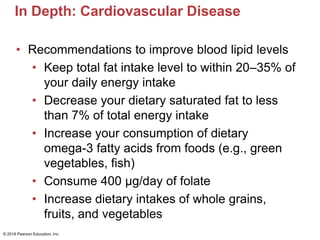
• Recommendations to improve blood lipid levels
• Keep total fat intake level to within 20–35% of
your daily energy intake
• Decrease your dietary saturated fat to less
than 7% of total energy intake
• Increase your consumption of dietary
omega-3 fatty acids from foods (e.g., green
vegetables, fish)
• Consume 400 μg/day of folate
• Increase dietary intakes of whole grains,
fruits, and vegetables
© 2018 Pearson Education, Inc.
In Depth: Cardiovascular Disease (cont.)
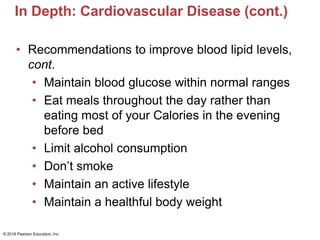
• Recommendations to improve blood lipid levels,
cont.
• Maintain blood glucose within normal ranges
• Eat meals throughout the day rather than
eating most of your Calories in the evening
before bed
• Limit alcohol consumption
• Don’t smoke
• Maintain an active lifestyle
• Maintain a healthful body weight
© 2018 Pearson Education, Inc.
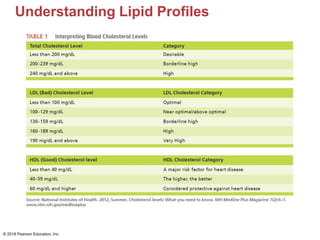
Understanding Lipid Profiles
© 2018 Pearson Education, Inc.
In Depth: Cardiovascular Disease
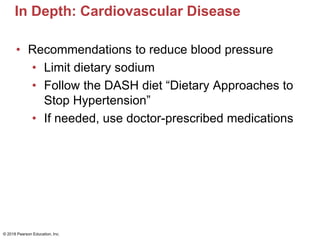
• Recommendations to reduce blood pressure
• Limit dietary sodium
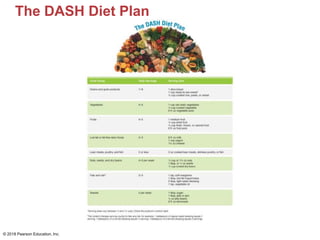
• Follow the DASH diet “Dietary Approaches to
Stop Hypertension”
• If needed, use doctor-prescribed medications
© 2018 Pearson Education, Inc.
The DASH Diet Plan
© 2018 Pearson Education, Inc.

Chapter 5 FATS

  • 1.
    Chapter 5 Lecture Chapter5: Fats: Essential Energy-Supplying Nutrients, and In Depth 5.5, Cardiovascular Disease © 2018 Pearson Education, Inc.
  • 2.
    What Are Fats? •Fats are one type of lipid • Lipids: diverse class of organic substances that are insoluble in water • Lipids (fats) do not dissolve in water © 2018 Pearson Education, Inc.
  • 3.
    Triglycerides • Most ofthe fat we eat is in the form of triglycerides • About 95% of the fats we consume • Triglycerides are composed of • Three fatty acid molecules • Fatty acids: long chains of carbon atoms surrounded by hydrogen atoms • One glycerol molecule • Glycerol: a three-carbon alcohol that is the backbone of a triglyceride © 2018 Pearson Education, Inc.
  • 4.
  • 5.
    Phospholipids Phospholipids • Composed of •Glycerol backbone • Two fatty acids • Phosphate • Soluble in water • Manufactured in our bodies so they are not required in our diet • Important components of cell membranes © 2018 Pearson Education, Inc.
  • 6.
    Phospholipids (cont.) © 2018Pearson Education, Inc.
  • 7.
    Sterols Sterols: lipids containingmultiple rings of carbon atoms • Essential components of cell membranes and many hormones • Manufactured in our bodies and therefore not an essential component of our diet • Cholesterol is the major sterol found in the body © 2018 Pearson Education, Inc.
  • 8.
    Sterols © 2018 PearsonEducation, Inc.
  • 9.
    Triglycerides • Fatty acidscan differ in • Length of their carbon chain • Short (<6 carbons), medium (6–12 carbons), or long (>13 carbons) • Level of saturation • Saturation refers to how many hydrogen atoms surround each carbon • Shape © 2018 Pearson Education, Inc.
  • 10.
    Triglycerides (cont.) • Saturatedfatty acids have hydrogen atoms surrounding every carbon in the chain; they have no double bonds • Monounsaturated fatty acids lack hydrogen atoms in one region; they have one double bond • Polyunsaturated fatty acids lack hydrogen atoms in multiple locations; they have two or more double bonds • Note: Each double bond causes the loss of two hydrogen atoms © 2018 Pearson Education, Inc.
  • 11.
    Saturated and UnsaturatedFatty Acids © 2018 Pearson Education, Inc.
  • 12.
    Levels of SaturationAmong Fatty Acids © 2018 Pearson Education, Inc.
  • 13.
    Major Sources ofDietary Fat © 2018 Pearson Education, Inc.
  • 14.
    Triglycerides • The shapeof a triglyceride is determined by the saturation of the carbon chains • Saturated fatty acids can pack tightly together and are solid at room temperature • For example, coconut oil, animal fats, butter, and lard are high in saturated fatty acids © 2018 Pearson Education, Inc.
  • 15.
    Triglycerides (cont.) • Unsaturatedfatty acids do not stack together well and are liquid at room temperature • Unsaturated fatty acids are the predominant type in plants • Two exceptions are coconut and palm kernel oil • The hydrogen atoms at the unsaturated region can be arranged in different positions • Cis: same side of the carbon chain • Trans: opposite sides of the carbon chain © 2018 Pearson Education, Inc.
  • 16.
    Cis and TransPolyunsaturated Fatty Acids © 2018 Pearson Education, Inc.
  • 17.
    Triglycerides (cont.) Hydrogenation: theaddition of hydrogen atoms to unsaturated fatty acids • Converts liquid fats (oils) into a semisolid (spreadable) or solid form • Used to create margarine from plant oil • Often creates trans fatty acids • Listed on food labels as partially hydrogenated oil © 2018 Pearson Education, Inc.
  • 18.
    Essential Fatty Acids Essentialfatty acids cannot be synthesized in the body and must be obtained in the diet • Omega-6 and omega-3 fatty acids • They are precursors to biological compounds called eicosanoids, which regulate cellular function © 2018 Pearson Education, Inc.
  • 19.
    Essential Fatty Acids(cont.) • Linoleic acid is found in vegetable and nut oils • Alpha-linolenic acid (ALA) is derived from dark-green leafy vegetables, flaxseeds and flaxseed oil, soybeans and soybean oil, walnuts and walnut oil, and canola oil • Eicosapentaenoic acid (EPA) and docosahexaenoic acid (DHA) have important health benefits and are found in fish, shellfish, and fish oils © 2018 Pearson Education, Inc.
  • 20.
    Essential Fatty Acids ©2018 Pearson Education, Inc.
  • 21.
    Why Do WeNeed Fats? Energy • Fat is very energy dense, providing 9 kcal/gram • Much of the energy used during rest comes from fat • Fat is used for energy during exercise, especially after glycogen is depleted • Fat is also used for energy storage © 2018 Pearson Education, Inc.
  • 22.
    Fat Is Usedfor Energy During Exercise © 2018 Pearson Education, Inc.
  • 23.
    Why Do WeNeed Fats? • Fat-soluble vitamins • Vitamins A, D, E, and K are soluble in fat; fat is required for their transport • Fat is essential to many body functions • Cell membrane structure • Nerve cell transmissions • Protection of internal organs • Insulation to retain body heat © 2018 Pearson Education, Inc.
  • 24.
    Why Do WeNeed Fats? (cont.) • Fat provides flavor and texture to foods • Fat contributes to making us feel satiated • Fats are more energy dense than carbohydrates or protein • Fats take longer to digest © 2018 Pearson Education, Inc.
  • 25.
    How Does OurBody Process Fats? • As fat enters the small intestine: • Bile is secreted from the gallbladder into the small intestine • Bile is produced by the liver and stored in the gallbladder • Bile disperses fat into smaller fat droplets • Pancreatic enzymes break triglycerides into two separate fatty acids and a monoglyceride • Fat enters the mucosal cell as a micelle (fatty acids, monoglycerides, phospholipids, and sterols) © 2018 Pearson Education, Inc.
  • 26.
    Digestion of Fats ©2018 Pearson Education, Inc.
  • 27.
    Digestion of Fats(cont.) © 2018 Pearson Education, Inc.
  • 28.
    Digestion of Fats(cont.) © 2018 Pearson Education, Inc.
  • 29.
    How Does OurBody Process Fats? • In the intestinal mucosal cell: • Fatty acids are reattached to the monoglyceride to re-form triglycerides • A small amount of protein is added to the lipids, forming a chylomicron • Chylomicron: a lipoprotein produced by cells lining the small intestine • Composed of triglycerides surrounded by phospholipids and proteins • Soluble in water © 2018 Pearson Education, Inc.
  • 30.
    Structure of aLipoprotein © 2018 Pearson Education, Inc.
  • 31.
    How Does OurBody Process Fats? • Chylomicrons are the transport vehicles that remove absorbed fats from the small intestine • Travel through the lymphatic system • Are transferred to the bloodstream • Short- and medium-chain fatty acids are absorbed more quickly because they are not arranged into chylomicrons © 2018 Pearson Education, Inc.
  • 32.
    How Does OurBody Process Fats? (cont.) • Once the chylomicron gets to a cell in the body, the triglycerides in the chylomicrons must be disassembled by lipoprotein lipase into two fatty acids and a monoglyceride before they can pass through the cell membrane • After entering the cell, the two fatty acids and monoglyceride re-form a triglyceride • The triglyceride can be • Used immediately for energy • Used to make lipid-containing compounds • Stored in liver and muscle cells © 2018 Pearson Education, Inc.
  • 33.
    Diagram of anAdipose Cell © 2018 Pearson Education, Inc.
  • 34.
    Recognize the Fatin Foods • Visible fats are those we can see in foods or can easily see have been added to foods, such as dressing or chicken skin • Hidden fats are those added to processed or prepared foods to improve texture or taste, which we may not be aware of, or that occur naturally • Read the Nutrition Facts Panel on foods carefully • Lower-fat versions of foods may not always be lower in Calories © 2018 Pearson Education, Inc.
  • 35.
    How Much FatIs in This Food? © 2018 Pearson Education, Inc.
  • 36.
    How Much FatShould We Eat? • The Acceptable Macronutrient Distribution Range (AMDR) for fat • 20–35% of Calories should be from fat • Athletes and highly active people may need more energy from carbohydrates and can reduce their fat intake to 20–25% of total Calories © 2018 Pearson Education, Inc.
  • 37.
    How Much FatShould We Eat? • The type of fat consumed is important • Intake of saturated and trans fatty acids should be minimized as much as possible • We typically get enough linoleic acid in our diets from salad dressings, vegetable oils, margarines, and mayonnaise • To ensure an adequate amount of omega-3 fatty acids, we need to consume more dark-green leafy vegetables, walnuts, flaxseeds, and fish or fish oils © 2018 Pearson Education, Inc.
  • 38.
    Essential Fatty Acids •Linoleic Acid (omega-6) • AI is 14–17 g per day for men and 11–12 g per day for women • Alpha-linolenic acid (omega-3) • AI is 1.6 g per day for men and 1.1 g per day for women © 2018 Pearson Education, Inc.
  • 39.
    Omega-3 Fatty Acidin Foods © 2018 Pearson Education, Inc.
  • 40.
    Limit Saturated andTrans Fats • Reduce your intake of saturated fats • Be conscious of the saturated fat content of meats, baked goods and snack goods, and foods including vegetables that are fried, breaded, or drenched in sauce • Avoid trans fatty acids • Limit your intake of dietary cholesterol, which will also help limit your intake of saturated fats © 2018 Pearson Education, Inc.
  • 41.
    Select Beneficial Fats •Consume and cook with leafy green vegetables, avocados, soybeans, soybean oil, and flaxseed oil • Add walnuts, almonds, flaxseeds, and chia seeds to your diet, and try almond milk in your cereal • Consider including fish in your diet at least twice a week or consider taking a fish oil supplement • Fish can contain mercury, PCBs, and other environmental contaminants, so be selective © 2018 Pearson Education, Inc.
  • 42.
    Reducing Saturated Fat ©2018 Pearson Education, Inc.
  • 43.
    Fat Replacers • Snackfoods are frequent targets for fat replacers, substances that can reduce the fat content • Fat replacers such as olestra have not proved very popular or effective because of potential gastrointestinal side effects • Our growing obesity problems indicate that fat replacers do not help Americans lose weight © 2018 Pearson Education, Inc.
  • 44.
    Role of Fatsin Chronic Disease • The chronic disease most closely associated with diets high in saturated fat is cardiovascular disease • The role of dietary fat in the development of cancer has been extensively researched, but the relationship between some cancer types and dietary fats is controversial (e.g., breast cancer) • The strongest association between dietary fat and cancer is for prostate cancer © 2018 Pearson Education, Inc.
  • 45.
    In Depth: CardiovascularDisease Cardiovascular disease (CVD) • Dysfunction of the heart or blood vessels • The most common forms: • Coronary heart disease, or coronary artery disease • Stroke • Hypertension, or high blood pressure • Peripheral vascular disease © 2018 Pearson Education, Inc.
  • 46.
    In Depth: CardiovascularDisease (cont.) Atherosclerosis is a disease in which artery walls build up lipid deposits and scar tissue, impairing blood flow • The stiffness that results is commonly called “hardening of the arteries” • The result is that the heart must work harder to push blood through the vessels © 2018 Pearson Education, Inc.
  • 47.
    In Depth: CardiovascularDisease (cont.) © 2018 Pearson Education, Inc.
  • 48.
    In Depth: CardiovascularDisease (cont.) Hypertension is a major chronic disease in the United States • It functions as a warning sign for a person’s risk for developing heart disease or stroke • For many people, hypertension is hereditary; for others, it can be induced through poor nutrition and exercise habits or a combination of poor habits and heredity © 2018 Pearson Education, Inc.
  • 49.
    In Depth: CardiovascularDisease (cont.) • Modifiable risk factors for cardiovascular disease include • Being overweight • Physical inactivity • Smoking • Type 2 diabetes mellitus • Inflammation in the body • Abnormal blood lipids © 2018 Pearson Education, Inc.
  • 50.
    In Depth: CardiovascularDisease (cont.) • The intake of certain types of fats can protect against heart disease • Diets high in omega-3 fatty acids (along with moderate exercise) can reduce inflammation and increase HDL (“good”) cholesterol levels • Low-density lipoproteins (LDLs) are often called “bad” cholesterol because of their role in transporting cholesterol throughout the body © 2018 Pearson Education, Inc.
  • 51.
    In Depth: CardiovascularDisease (cont.) • Diets high in saturated fats • Decrease the removal of LDLs from the blood • Contribute to the formation of plaques that can block arteries • Increase triglyceride levels (chylomicrons and very-low-density lipoproteins, or VLDLs) © 2018 Pearson Education, Inc.
  • 52.
    The Chemical Componentsof Lipoproteins © 2018 Pearson Education, Inc.
  • 53.
    Lipoprotein Compounds © 2018Pearson Education, Inc.
  • 54.
    In Depth: CardiovascularDisease • Recommendations to improve blood lipid levels • Keep total fat intake level to within 20–35% of your daily energy intake • Decrease your dietary saturated fat to less than 7% of total energy intake • Increase your consumption of dietary omega-3 fatty acids from foods (e.g., green vegetables, fish) • Consume 400 μg/day of folate • Increase dietary intakes of whole grains, fruits, and vegetables © 2018 Pearson Education, Inc.
  • 55.
    In Depth: CardiovascularDisease (cont.) • Recommendations to improve blood lipid levels, cont. • Maintain blood glucose within normal ranges • Eat meals throughout the day rather than eating most of your Calories in the evening before bed • Limit alcohol consumption • Don’t smoke • Maintain an active lifestyle • Maintain a healthful body weight © 2018 Pearson Education, Inc.
  • 56.
    Understanding Lipid Profiles ©2018 Pearson Education, Inc.
  • 57.
    In Depth: CardiovascularDisease • Recommendations to reduce blood pressure • Limit dietary sodium • Follow the DASH diet “Dietary Approaches to Stop Hypertension” • If needed, use doctor-prescribed medications © 2018 Pearson Education, Inc.
  • 58.
    The DASH DietPlan © 2018 Pearson Education, Inc.