The Story of “the Lion and the ANT”
a story that all management need
to comprehend and learn from
Training Material | March 2015
and the concept of management quad
Every day,
an Ant arrived
at work early
and started
work
immediately ..
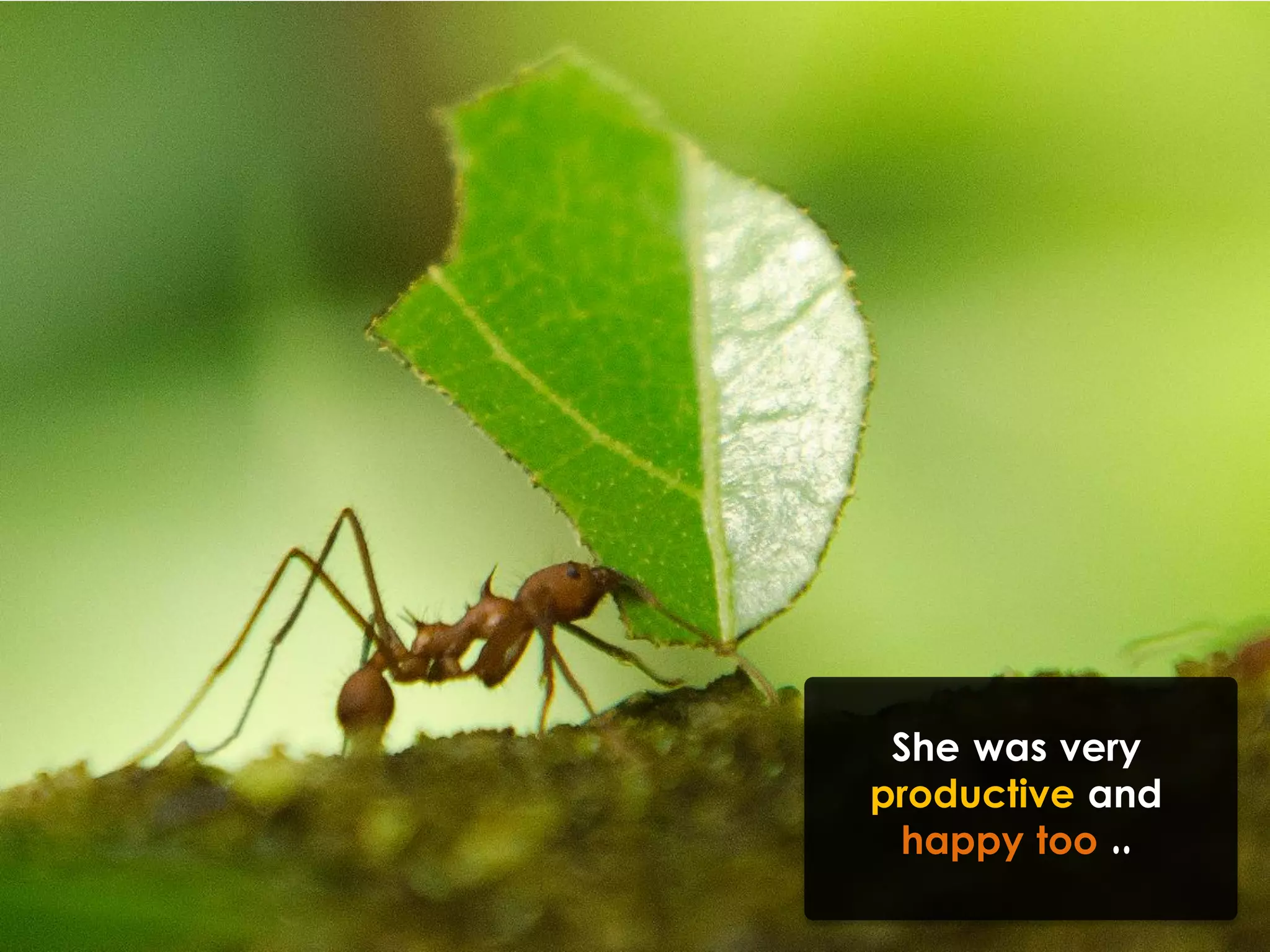
She was very
productive and
happy too ..
Observing this,
the Chief,
a Lion, was
surprised to
see that the
ant was
working
without
supervision !
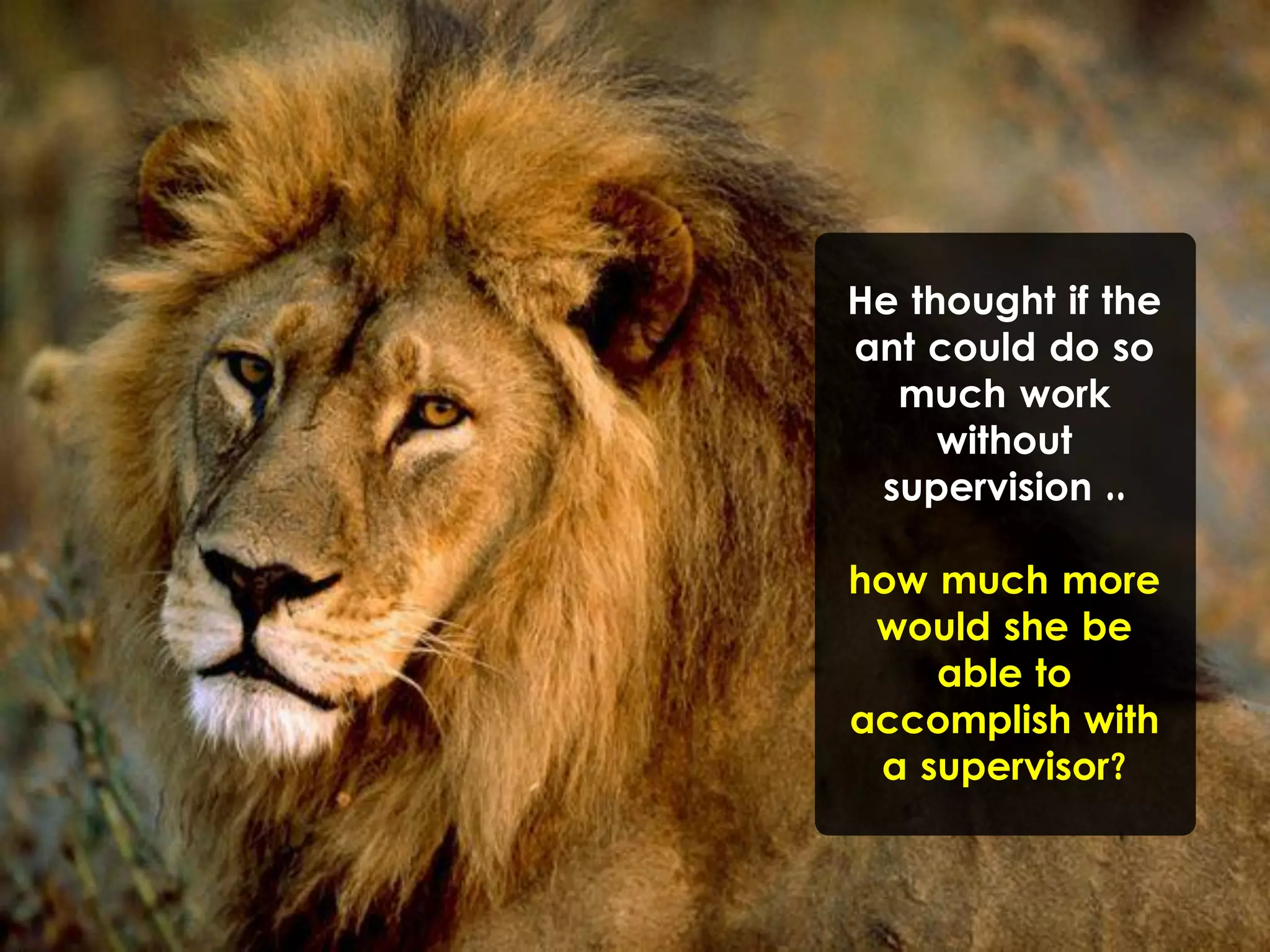
He thought if the
ant could do so
much work
without
supervision ..
how much more
would she be
able to
accomplish with
a supervisor?
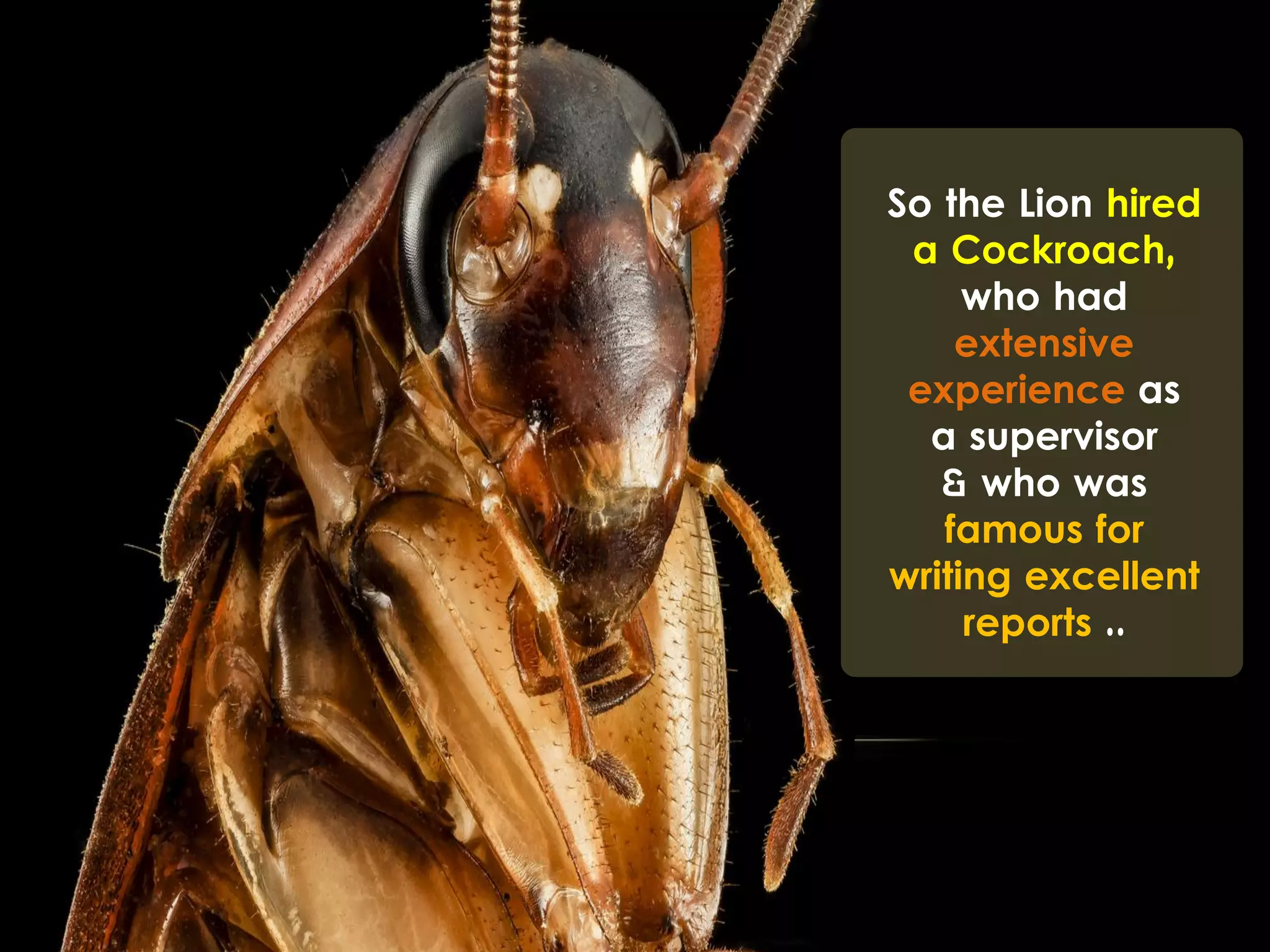
So the Lion hired
a Cockroach,
who had
extensive
experience as
a supervisor
& who was
famous for
writing excellent
reports ..
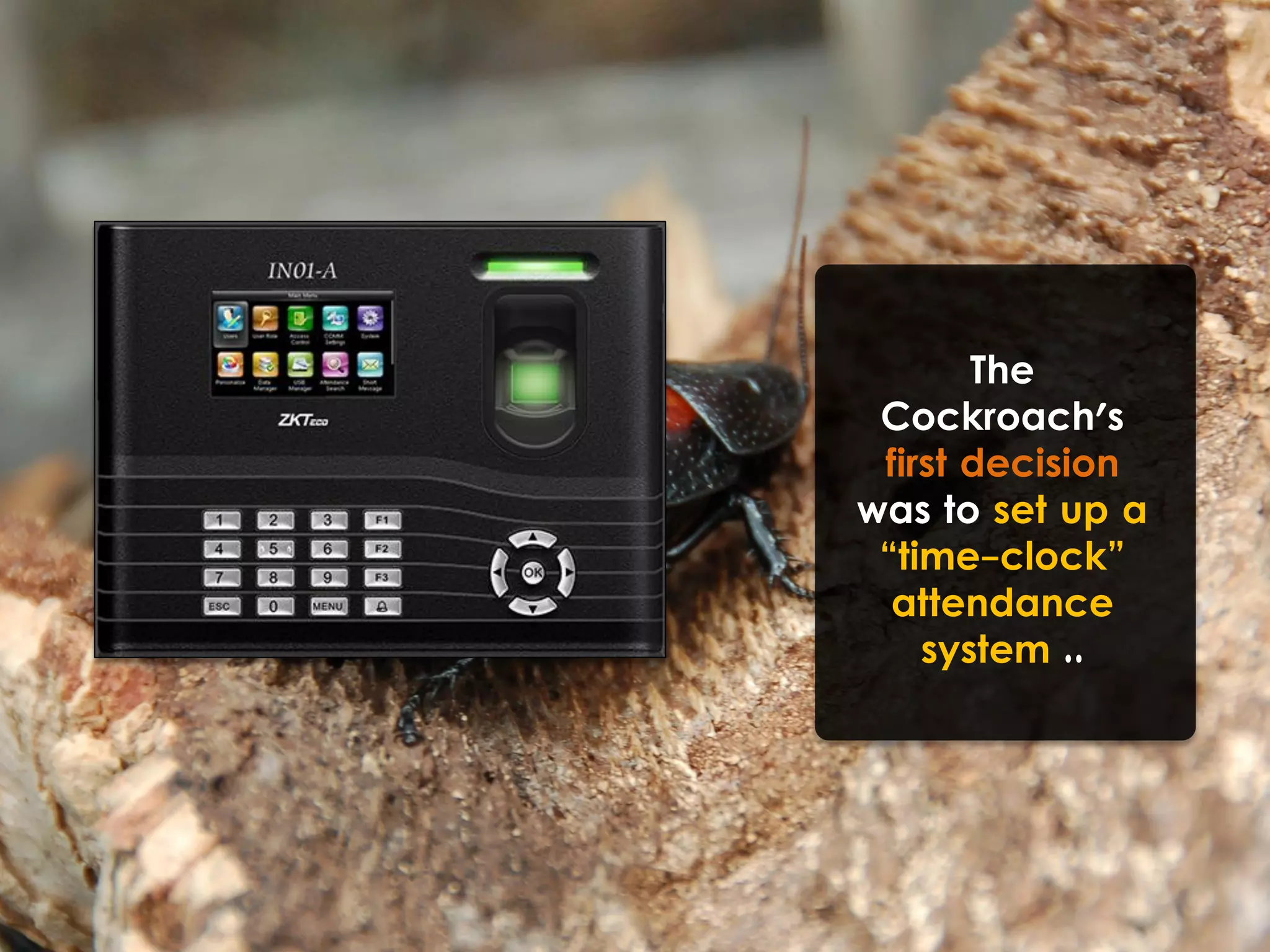
The
Cockroach's
first decision
was to set up a
“time-clock”
attendance
system ..
The Cockroach
needed a
secretary
(a bee)
to help him
write and type
his reports
and ...
... he recruited
a Spider, to
manage the
achieves and
monitor all
phone calls ..
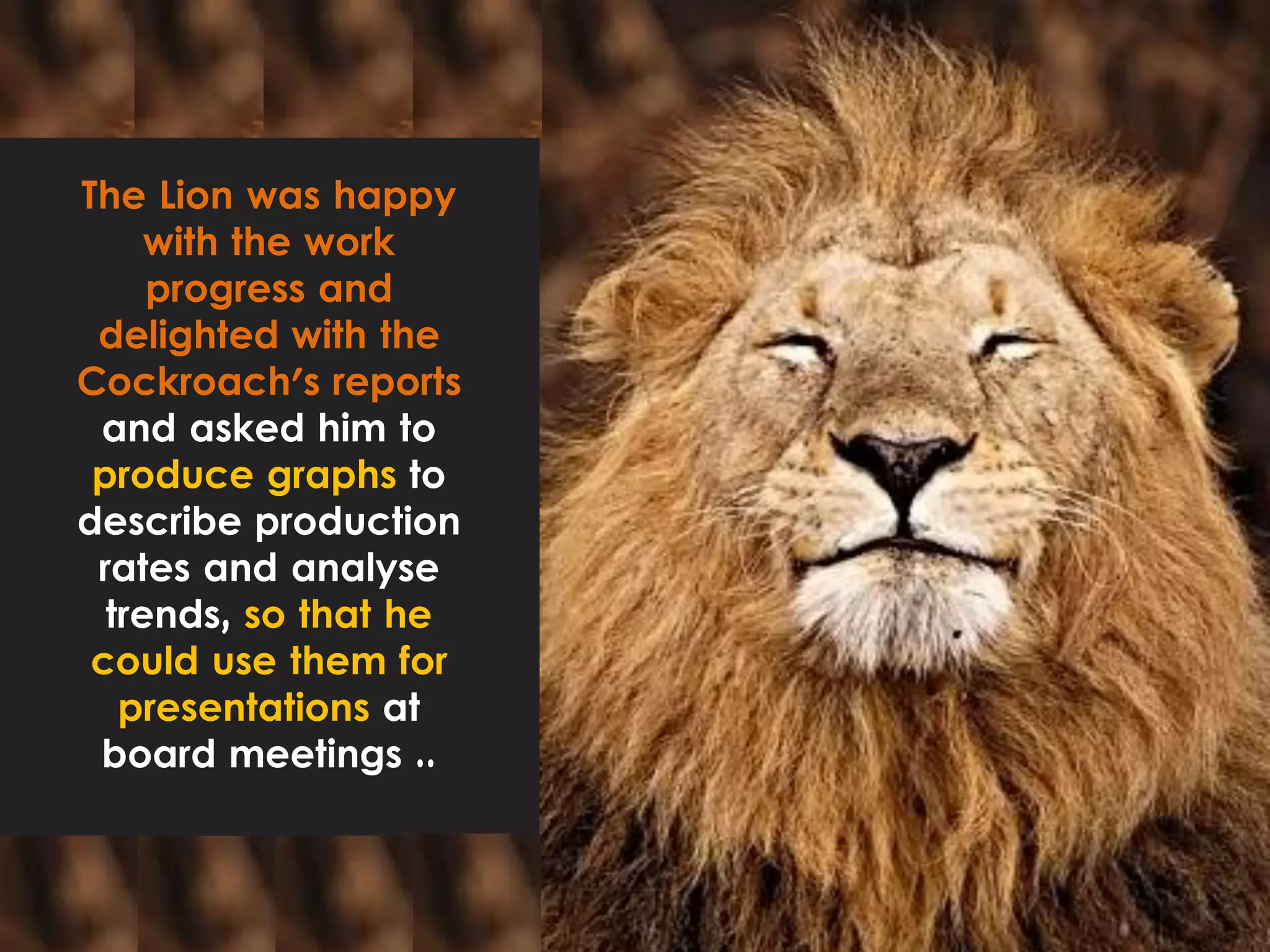
The Lion was happy
with the work
progress and
delighted with the
Cockroach's reports
and asked him to
produce graphs to
describe production
rates and analyse
trends, so that he
could use them for
presentations at
board meetings ..
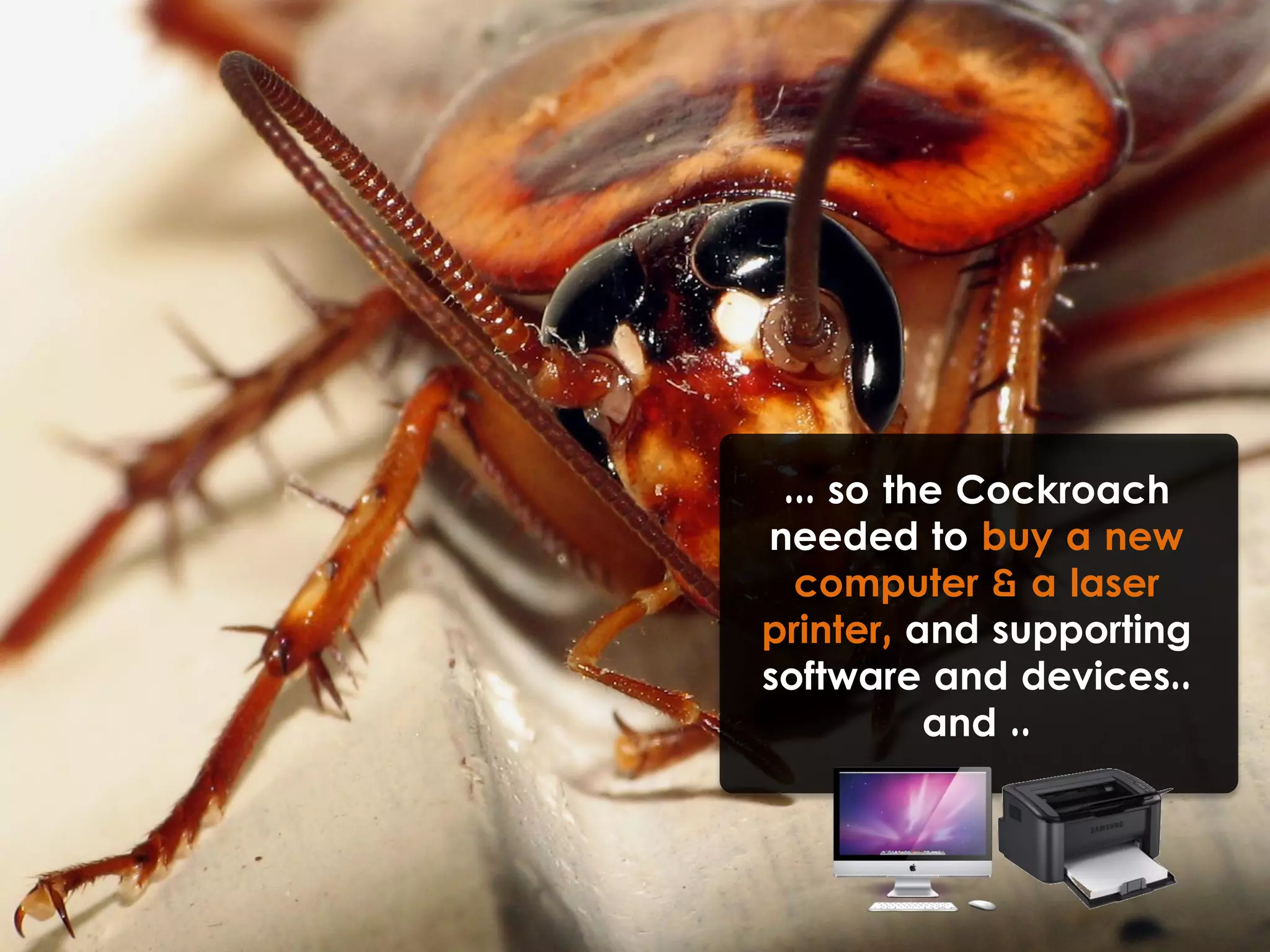
... so the Cockroach
needed to buy a new
computer & a laser
printer, and supporting
software and devices..
and ..
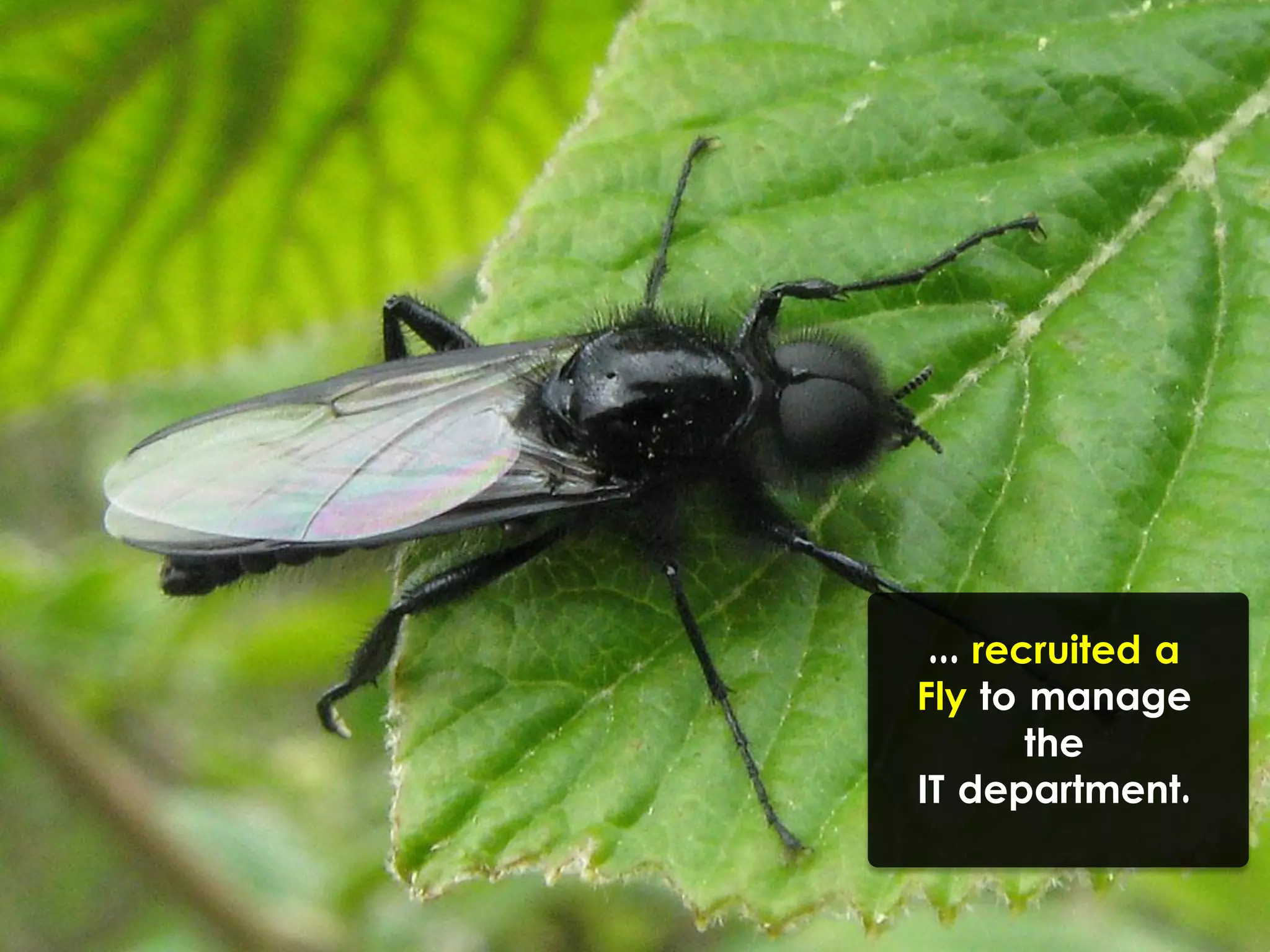
... recruited a
Fly to manage
the
IT department.
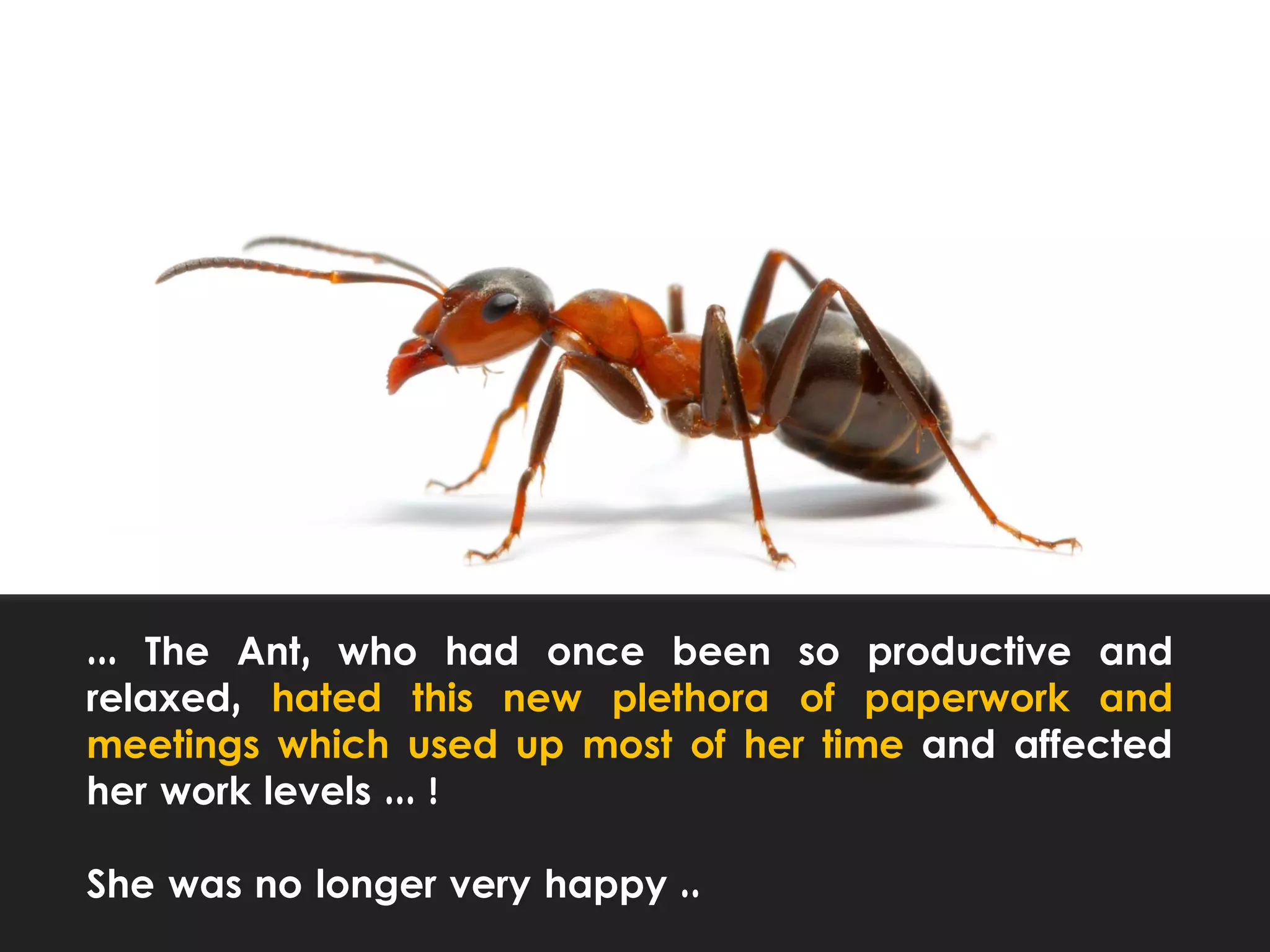
... The Ant, who had once been so productive and
relaxed, hated this new plethora of paperwork and
meetings which used up most of her time and affected
her work levels ... !
She was no longer very happy ..
The Lion felt
that it was
high time to
nominate a
person in
charge of the
department
where the Ant
worked.
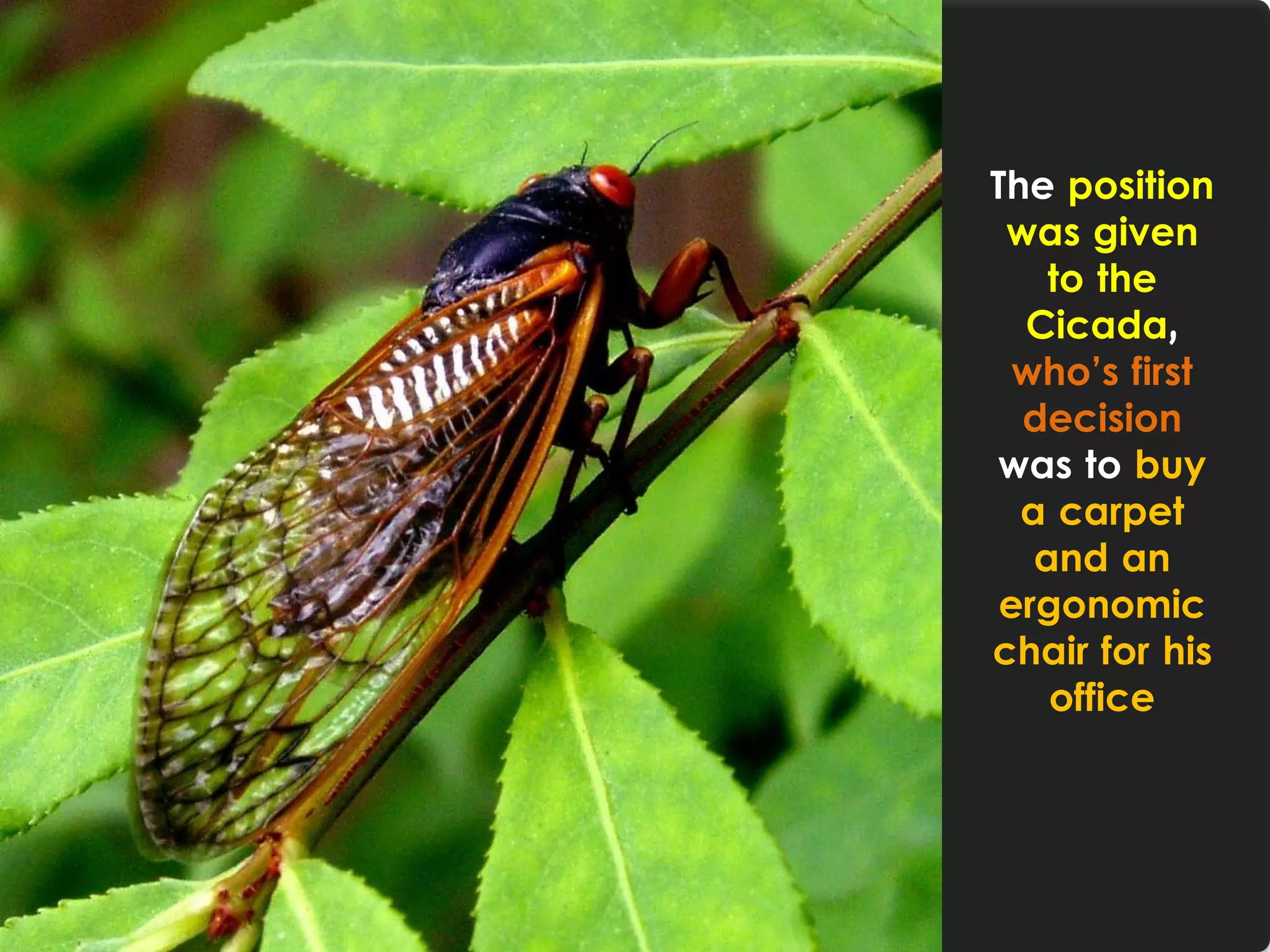
The position
was given
to the
Cicada,
who’s first
decision
was to buy
a carpet
and an
ergonomic
chair for his
office
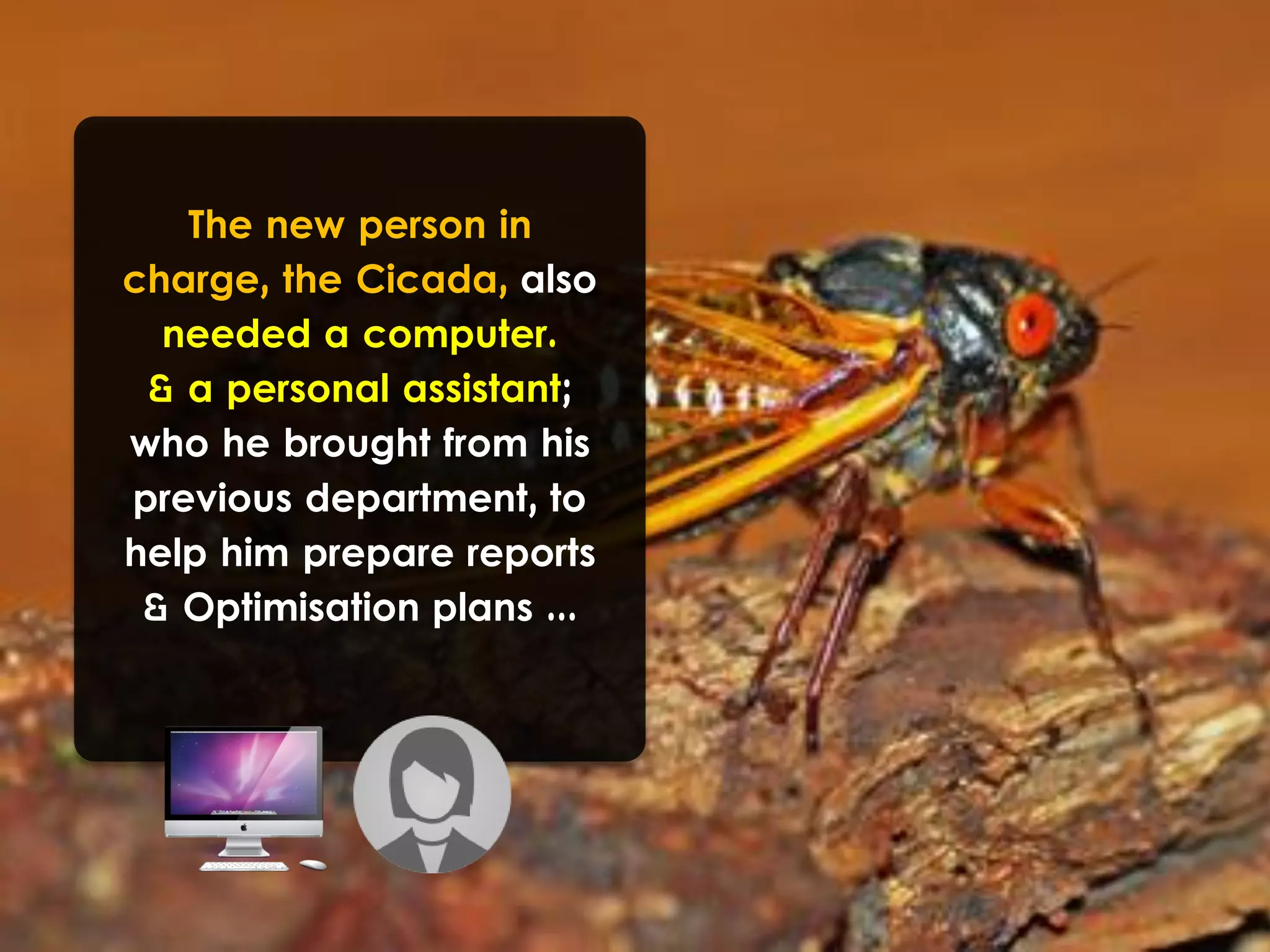
The new person in
charge, the Cicada, also
needed a computer.
& a personal assistant;
who he brought from his
previous department, to
help him prepare reports
& Optimisation plans ...
The department
where the Ant
worked became
a sad place,
where nobody
laughed
anymore and
everybody had
become upset ..
It was at that
time the Cicada
convinced the
chief (Lion)
to start a study
of the working
environment.
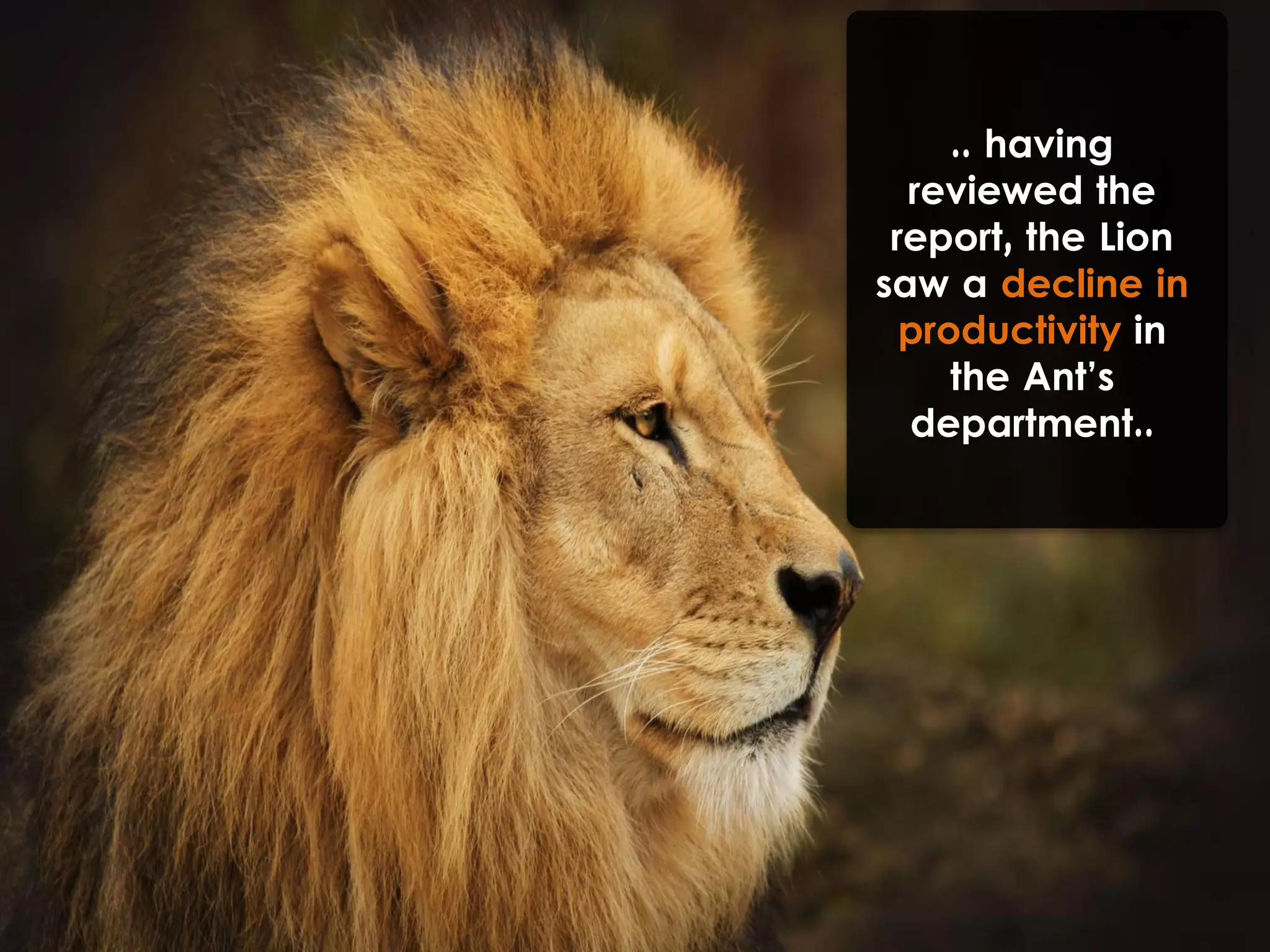
.. having
reviewed the
report, the Lion
saw a decline in
productivity in
the Ant’s
department..
So he recruited
the Owl, a
prestigious and
renowned
consultant to
carry out a
comprehensive
audit and
suggest
solutions ..
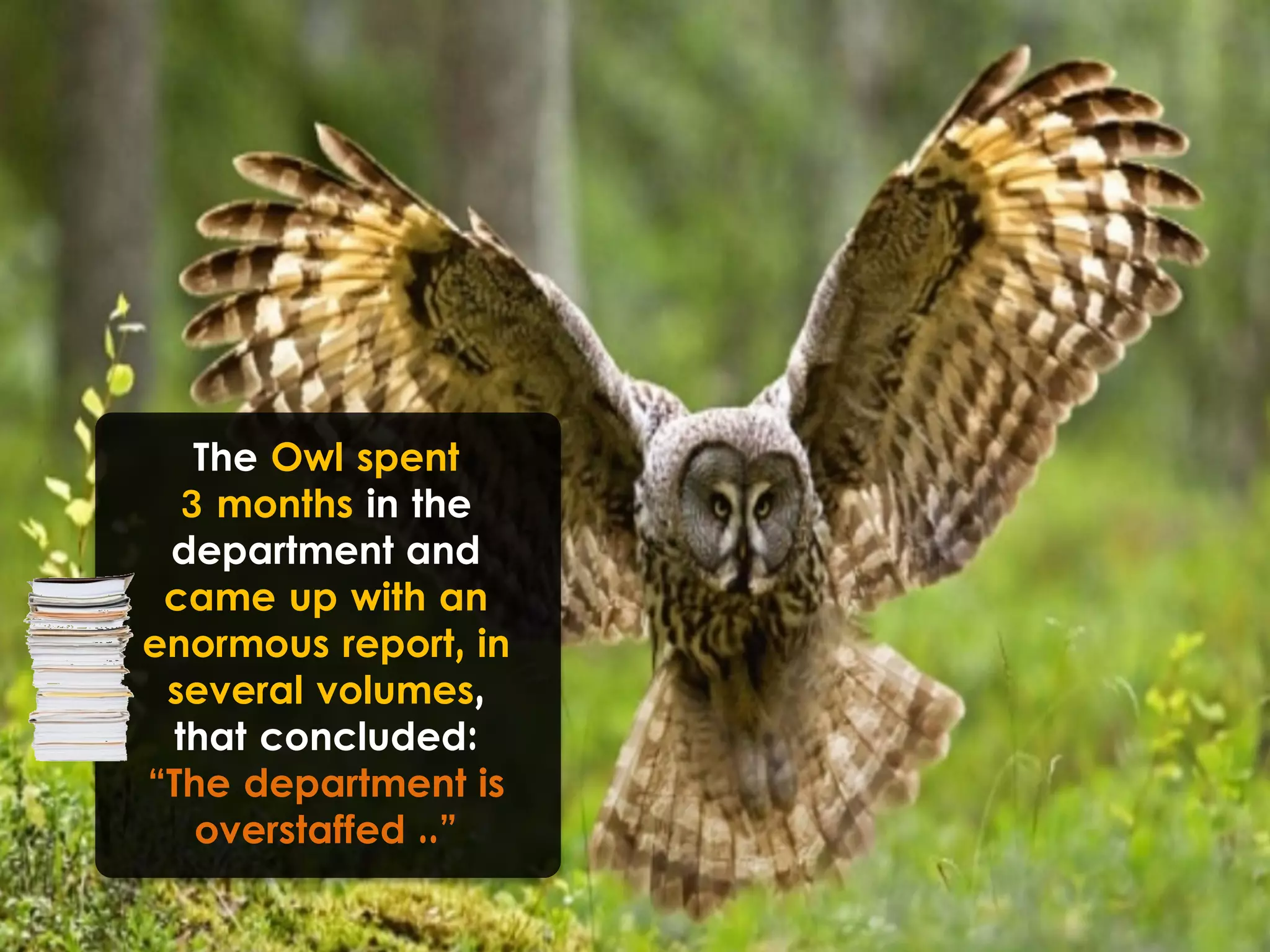
The Owl spent
3 months in the
department and
came up with an
enormous report, in
several volumes,
that concluded:
“The department is
overstaffed ..”
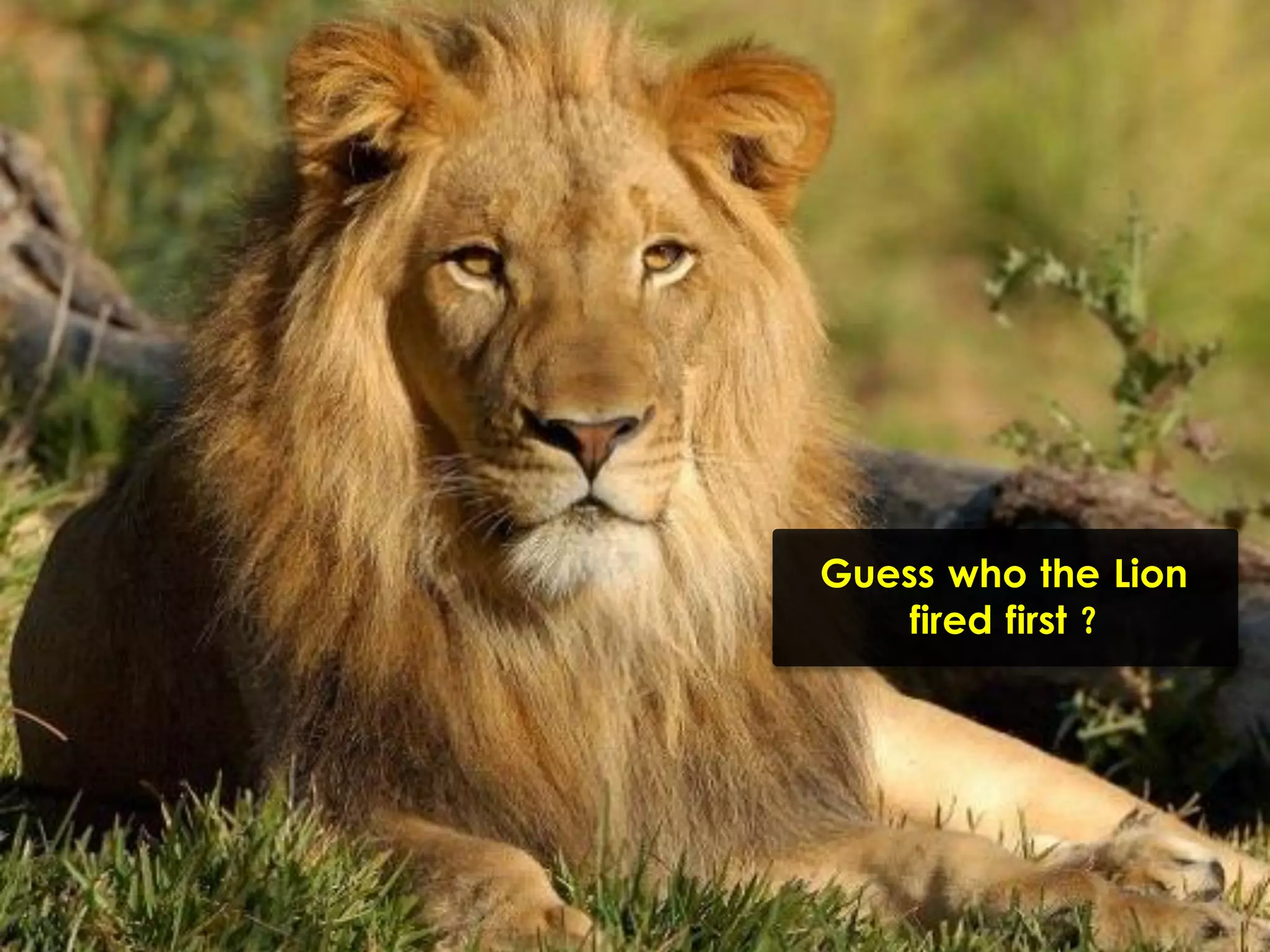
Guess who the Lion
fired first ?
The Ant, of course!
… because it was reported
that she “showed lack of
motivation and had a
negative attitude towards
organisation processes.”
.. that was the end of
“the Lion and the Ant” story ..
but similar stories continue
under different themes and
excuses in work environments
and organisations !!
The story reflects the reality
of many management
practices and cultures in
organisations today ..
But let’s
analyse
the “Lion’s”
objectives
and what
he was
trying to
achieve ..
The objective
from the Lion’s
perspective
aimed to improve
the level,
efficiency and
effectiveness of
the Ant’s
performance
(at least from our
perception!)
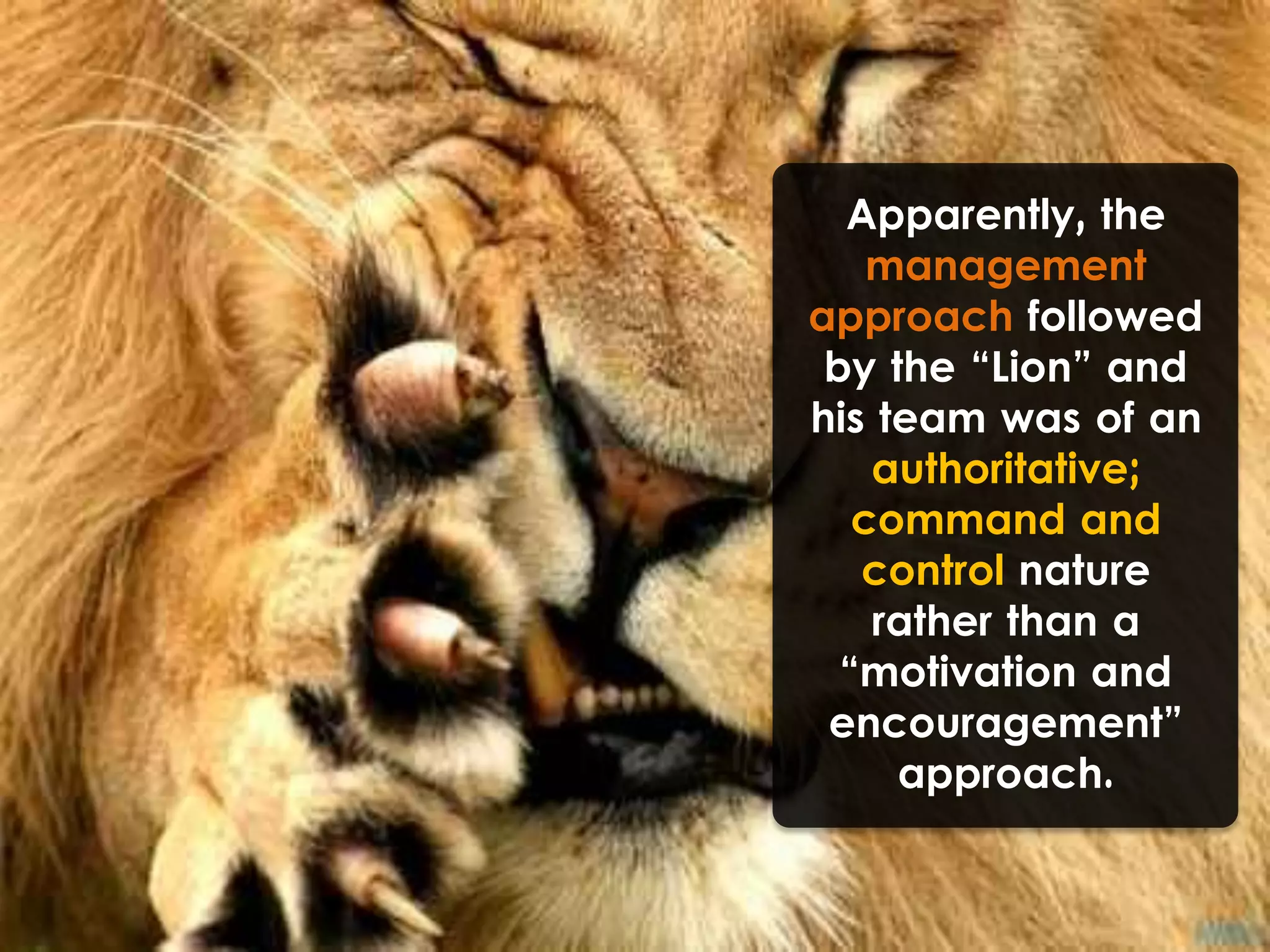
Apparently, the
management
approach followed
by the “Lion” and
his team was of an
authoritative;
command and
control nature
rather than a
“motivation and
encouragement”
approach.
The Lion and his team
demonstrated great interest
in employing management
concepts of governance,
organisation structure,
performance management,
audit and control, etc…
but they have fallen into
the trap of bureaucratic
management and
administrative red tape..
and they ended up paying
attention to consecutive
tasks resulting from
decisions that were not
linked to written and
defined objectives!
Can this explain the
frustration and negative
behavior that appeared
in the “Ant” ??
It may be that the «Ant» was suspicious about the new
systems and procedures and thought that it might have
been questioning her work abilities or even a lack of
confidence in her capabilities?
Or that because she was not informed and aware
enough of what was going on around her, it contributed
to her isolation from work and a reason for her passivity!!
Can we get some clearer
excuses for the Ant at least?!
But! .. wasn’t there any
other option for the “Lion”
prior to his decision?
Among the many
questions that arise if
we attempt to analyse
the story, is the fact
that the Lion could
have achieved the
same set of goals
through:
(1) Increasing the
number of Ants for
example, or ..
(2) by consulting the
Ant itself in what can
be done .. as she
had the cognitive
knowledge about
her own work ..
We still wonder
though about:
whether the “Lion”
was aware of
what made the
Ant energetic and
effective, prior to
his first decision?
Or was it a pure
guesstimate-
based decision?
What leadership &
management teams
need to understand
is that:
“the decision-
making process in
organisations can
not be based on
guesswork ..”
There is no such
thing called the
logic of guessing in
management!!
The story in its entirety, refers
to the importance of
focusing on the final desired
results at all times ..
And that in the absence of
such focus, the organisation
may get itself strategically
deviated and start
implementing and getting
engaged in activities that
were created from none!
Add to this the efforts, time,
and budgets that run along
such activities!
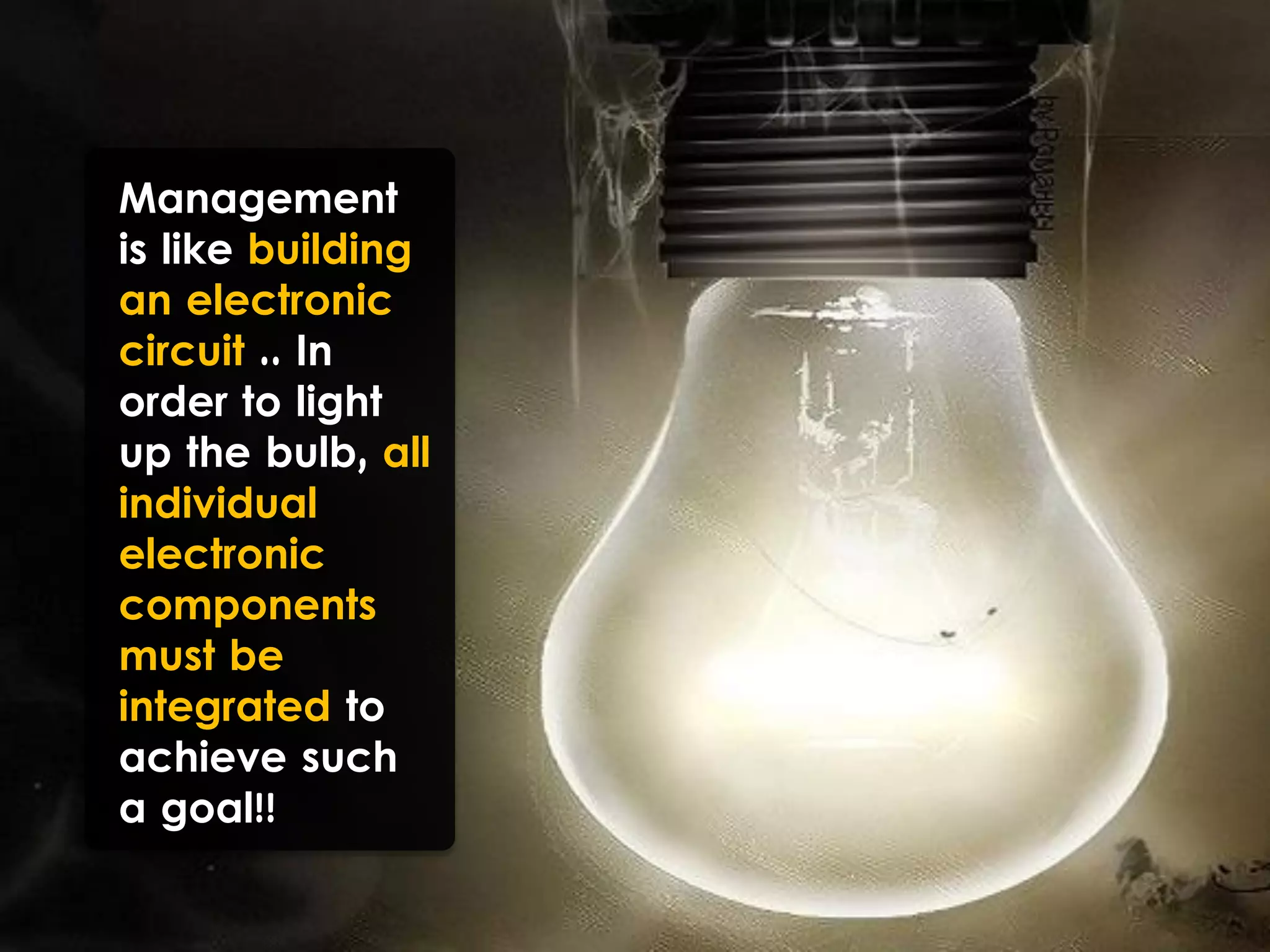
Management
is like building
an electronic
circuit .. In
order to light
up the bulb, all
individual
electronic
components
must be
integrated to
achieve such
a goal!!
The management circuit similar to an electric
circuit, can’t achieve its organisational objectives
without the incorporation of the four management
dimensions: [management quad]!
Management Quad: where management need
to pay attention ..
Copyright: Dr. Ali M. Al-Khouri
Remember:
Leadership & management
roles can not be imagined
to be about the “level of
authority” or the “extent of
monitoring and control”
they impose in their work
environments !!
The strength of institutional pillars
depends on the awareness levels of the
leadership and management teams of
their primary roles of developing and
supporting a performance driven work
culture and continuously seek to help
workers overcome obstacles that may
hinder them from doing their jobs ..
Remember:
“There is no one recipe for success
.. but the lessons we can draw from
experiences remain an important
source of building and developing
our practices ..”
Note: “all the characters in the story
are fictitious.. and any resemblance
between them and reality is purely
coincidental.”
Dr. Ali M. Al-Khouri
Professor and Fellow, British Institute of Technology
and E-commerce – London, United Kingdom
@DrAliAlKhouri
Email: alkhouriali@gmail.com
Slide Share: Slideshare.netdralkhouri
Academia: academia.orgdralkhouri
References:
Noone, J. (2010) The Lion ad Ant: Some Lessons
for Managers and HR. http://goo.gl/TbTzJi

The lion and the ant

  • 1.
    The Story of“the Lion and the ANT” a story that all management need to comprehend and learn from Training Material | March 2015 and the concept of management quad
  • 2.
    Every day, an Antarrived at work early and started work immediately ..
  • 3.
    She was very productiveand happy too ..
  • 4.
    Observing this, the Chief, aLion, was surprised to see that the ant was working without supervision !
  • 5.
    He thought ifthe ant could do so much work without supervision .. how much more would she be able to accomplish with a supervisor?
  • 6.
    So the Lionhired a Cockroach, who had extensive experience as a supervisor & who was famous for writing excellent reports ..
  • 7.
    The Cockroach's first decision was toset up a “time-clock” attendance system ..
  • 8.
    The Cockroach needed a secretary (abee) to help him write and type his reports and ...
  • 9.
    ... he recruited aSpider, to manage the achieves and monitor all phone calls ..
  • 10.
    The Lion washappy with the work progress and delighted with the Cockroach's reports and asked him to produce graphs to describe production rates and analyse trends, so that he could use them for presentations at board meetings ..
  • 11.
    ... so theCockroach needed to buy a new computer & a laser printer, and supporting software and devices.. and ..
  • 12.
    ... recruited a Flyto manage the IT department.
  • 13.
    ... The Ant,who had once been so productive and relaxed, hated this new plethora of paperwork and meetings which used up most of her time and affected her work levels ... ! She was no longer very happy ..
  • 14.
    The Lion felt thatit was high time to nominate a person in charge of the department where the Ant worked.
  • 15.
    The position was given tothe Cicada, who’s first decision was to buy a carpet and an ergonomic chair for his office
  • 16.
    The new personin charge, the Cicada, also needed a computer. & a personal assistant; who he brought from his previous department, to help him prepare reports & Optimisation plans ...
  • 17.
    The department where theAnt worked became a sad place, where nobody laughed anymore and everybody had become upset ..
  • 18.
    It was atthat time the Cicada convinced the chief (Lion) to start a study of the working environment.
  • 19.
    .. having reviewed the report,the Lion saw a decline in productivity in the Ant’s department..
  • 20.
    So he recruited theOwl, a prestigious and renowned consultant to carry out a comprehensive audit and suggest solutions ..
  • 21.
    The Owl spent 3months in the department and came up with an enormous report, in several volumes, that concluded: “The department is overstaffed ..”
  • 22.
    Guess who theLion fired first ?
  • 23.
    The Ant, ofcourse! … because it was reported that she “showed lack of motivation and had a negative attitude towards organisation processes.”
  • 24.
    .. that wasthe end of “the Lion and the Ant” story .. but similar stories continue under different themes and excuses in work environments and organisations !!
  • 25.
    The story reflectsthe reality of many management practices and cultures in organisations today ..
  • 26.
  • 27.
    The objective from theLion’s perspective aimed to improve the level, efficiency and effectiveness of the Ant’s performance (at least from our perception!)
  • 28.
    Apparently, the management approach followed bythe “Lion” and his team was of an authoritative; command and control nature rather than a “motivation and encouragement” approach.
  • 29.
    The Lion andhis team demonstrated great interest in employing management concepts of governance, organisation structure, performance management, audit and control, etc… but they have fallen into the trap of bureaucratic management and administrative red tape.. and they ended up paying attention to consecutive tasks resulting from decisions that were not linked to written and defined objectives!
  • 30.
    Can this explainthe frustration and negative behavior that appeared in the “Ant” ??
  • 31.
    It may bethat the «Ant» was suspicious about the new systems and procedures and thought that it might have been questioning her work abilities or even a lack of confidence in her capabilities? Or that because she was not informed and aware enough of what was going on around her, it contributed to her isolation from work and a reason for her passivity!! Can we get some clearer excuses for the Ant at least?!
  • 32.
    But! .. wasn’tthere any other option for the “Lion” prior to his decision?
  • 33.
    Among the many questionsthat arise if we attempt to analyse the story, is the fact that the Lion could have achieved the same set of goals through: (1) Increasing the number of Ants for example, or .. (2) by consulting the Ant itself in what can be done .. as she had the cognitive knowledge about her own work ..
  • 34.
    We still wonder thoughabout: whether the “Lion” was aware of what made the Ant energetic and effective, prior to his first decision? Or was it a pure guesstimate- based decision?
  • 35.
    What leadership & managementteams need to understand is that: “the decision- making process in organisations can not be based on guesswork ..” There is no such thing called the logic of guessing in management!!
  • 36.
    The story inits entirety, refers to the importance of focusing on the final desired results at all times .. And that in the absence of such focus, the organisation may get itself strategically deviated and start implementing and getting engaged in activities that were created from none! Add to this the efforts, time, and budgets that run along such activities!
  • 37.
    Management is like building anelectronic circuit .. In order to light up the bulb, all individual electronic components must be integrated to achieve such a goal!!
  • 38.
    The management circuitsimilar to an electric circuit, can’t achieve its organisational objectives without the incorporation of the four management dimensions: [management quad]!
  • 39.
    Management Quad: wheremanagement need to pay attention .. Copyright: Dr. Ali M. Al-Khouri
  • 40.
    Remember: Leadership & management rolescan not be imagined to be about the “level of authority” or the “extent of monitoring and control” they impose in their work environments !!
  • 41.
    The strength ofinstitutional pillars depends on the awareness levels of the leadership and management teams of their primary roles of developing and supporting a performance driven work culture and continuously seek to help workers overcome obstacles that may hinder them from doing their jobs ..
  • 42.
    Remember: “There is noone recipe for success .. but the lessons we can draw from experiences remain an important source of building and developing our practices ..”
  • 43.
    Note: “all thecharacters in the story are fictitious.. and any resemblance between them and reality is purely coincidental.”
  • 44.
    Dr. Ali M.Al-Khouri Professor and Fellow, British Institute of Technology and E-commerce – London, United Kingdom @DrAliAlKhouri Email: alkhouriali@gmail.com Slide Share: Slideshare.netdralkhouri Academia: academia.orgdralkhouri References: Noone, J. (2010) The Lion ad Ant: Some Lessons for Managers and HR. http://goo.gl/TbTzJi