Effectiveness of Blumea balsamifera (sambong)
As tea against Escherichia coli
A science investigatory project
In partial fulfillment for Science
Investigatory project
From the class of
Mr. Denis Dyvee Errabo
Submitted by:
Llido, Danice Y.
Diaz, Xena Nicole P.
Del Carmen, Denice
Ordoveza, Geneva Mae
Espinosa, Marielen
Fedelis, Jay Paul
Cantangco, Jesrick
October 7, 2014
ACKNOWLEDGEMENT
The researchers acknowledge the person who give importance for this
investigation and also a person whose valuable experience and for those people who
help to make this investigatory project together:
First of all the researchers give thanks for our JESUS CHRIST SON OF GOD
For those wisdom and knowledge that He gave to make this project perfectly by the
God’s purpose, by the strength and blessings to be part of this project and by proving
that all things are possible by His name and also for His generous personality. PRAISE
THE LORD that the researchers receive it all from Him;
And for the researcher’s PARENTS who totally support in some activities of the
school also for this kind of experimentation and who has been there along their journey
also giving encouragement and inspiration.
And for the TEACHERS of researcher who also understand when the researcher
came to school lately, and also giving inspiration and giving strength and when each of
them strive for the researchers happiness at the back of stressful projects.
To their loving FRIENDS who cheer up along the journey and also proposing
hope when the things seemed to be impossible.
THE RESEARCHERS
DEDICATION
The RESEARCHERS dedicate it for those people who have been there in times
of needs and also along their journey.
And for the researcher’s supportive PARENTS who help when no one is around
to make this project together with other researchers.
And Mr. Denis Dyvee Errabo who persists to make this project and give
authority to study about this given priority.
Lastly our FATHER GOD holy in His purpose and proving that the researchers
can do this before the submission, who also guides the researchers to make possible
the impossible.
ABSTRACT
The researchers want to conduct an investigatory project that is all about
concentration that can kill microorganisms. The researchers want to create a product
that can kill the E. coli that cause diarrhea. The researchers want to prove that the
Blumea balsamifera (Sambong) is effective in curing diarrhea or killing E. coli. The
importance of this study is to help the people needed medicine for healing, maintenance
of health, activity, body comfortable and conditioning. The researchers use the Blumea
balsamifera (Sambong) as the main ingredient of the product. Blumea balsamifera
(Sambong) is the one of the common anti-microbial herbal medicine to prevent
Escherichia coli. The researchers start doing this investigatory project on August 5,
2014 during the rainy season where the diarrhea is prone.
The researchers hypothesized that Blumea balsamifera (sambong) is effective in
killing the Escherichia coli. In 1997, the Traditional and Alternative Medicine Acts
(TAMA) was passed and it became legal to sell these plants for medicinal purposes in
the Philippines. Sambong tea is also used for herbal treatment of diarrhea and stomach
spasms. A Photochemical study indicates that sambong leaves contains the chemicals
icthyothereol acetate, cyptomeridiol, lutein and ß-carotene that has been found to have
positive activity against microbes such as a Niger, T mentagrophytes and C albicans.
Results also showed activity against P aeruginosa, S aureus, B subtilis and E coli.
The researchers tested their extract in Natural Science Research Institute (NSRI)
in University of the Philippines, to test the effectiveness of the Blumea balsamifera to
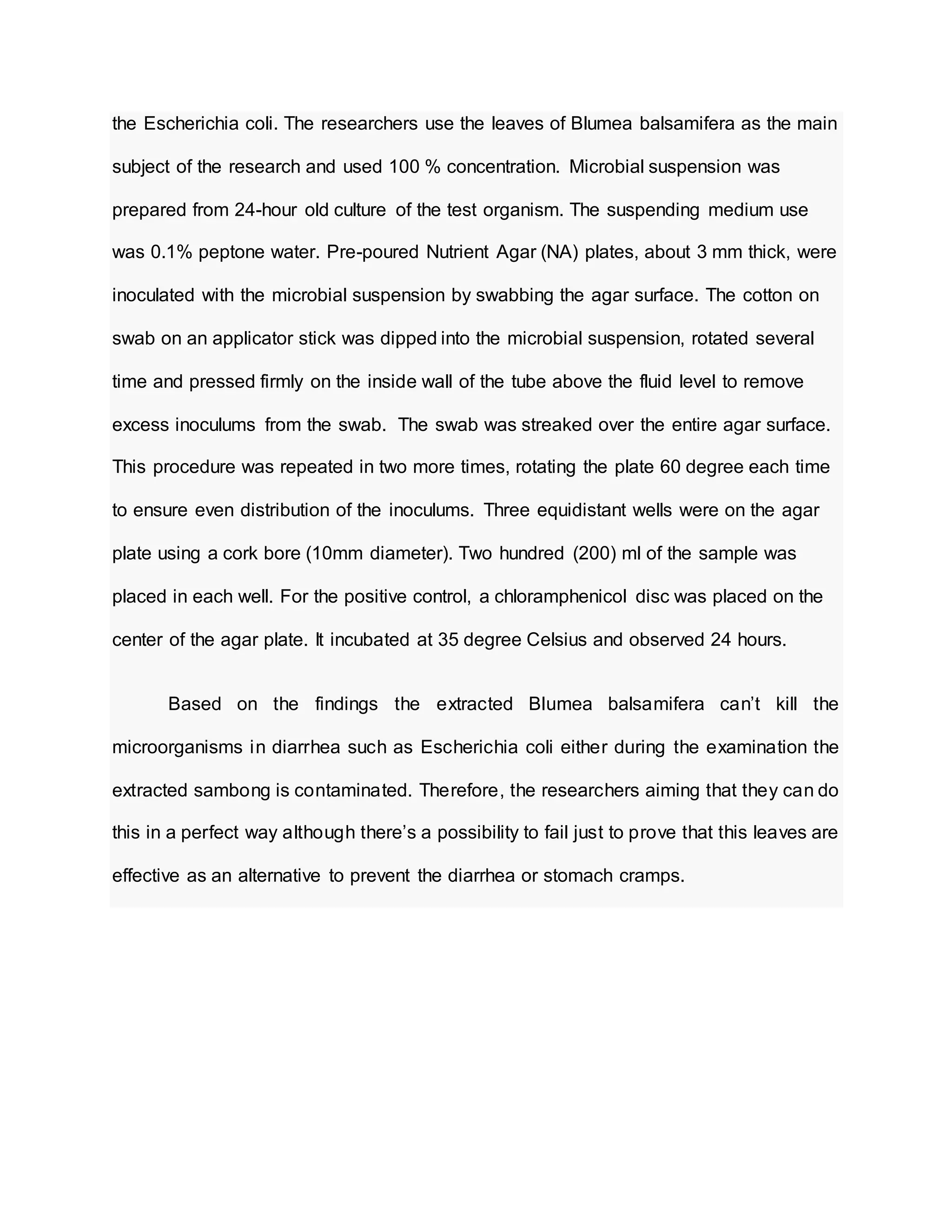
the Escherichia coli. The researchers use the leaves of Blumea balsamifera as the main
subject of the research and used 100 % concentration. Microbial suspension was
prepared from 24-hour old culture of the test organism. The suspending medium use
was 0.1% peptone water. Pre-poured Nutrient Agar (NA) plates, about 3 mm thick, were
inoculated with the microbial suspension by swabbing the agar surface. The cotton on
swab on an applicator stick was dipped into the microbial suspension, rotated several
time and pressed firmly on the inside wall of the tube above the fluid level to remove
excess inoculums from the swab. The swab was streaked over the entire agar surface.
This procedure was repeated in two more times, rotating the plate 60 degree each time
to ensure even distribution of the inoculums. Three equidistant wells were on the agar
plate using a cork bore (10mm diameter). Two hundred (200) ml of the sample was
placed in each well. For the positive control, a chloramphenicol disc was placed on the
center of the agar plate. It incubated at 35 degree Celsius and observed 24 hours.
Based on the findings the extracted Blumea balsamifera can’t kill the
microorganisms in diarrhea such as Escherichia coli either during the examination the
extracted sambong is contaminated. Therefore, the researchers aiming that they can do
this in a perfect way although there’s a possibility to fail just to prove that this leaves are
effective as an alternative to prevent the diarrhea or stomach cramps.
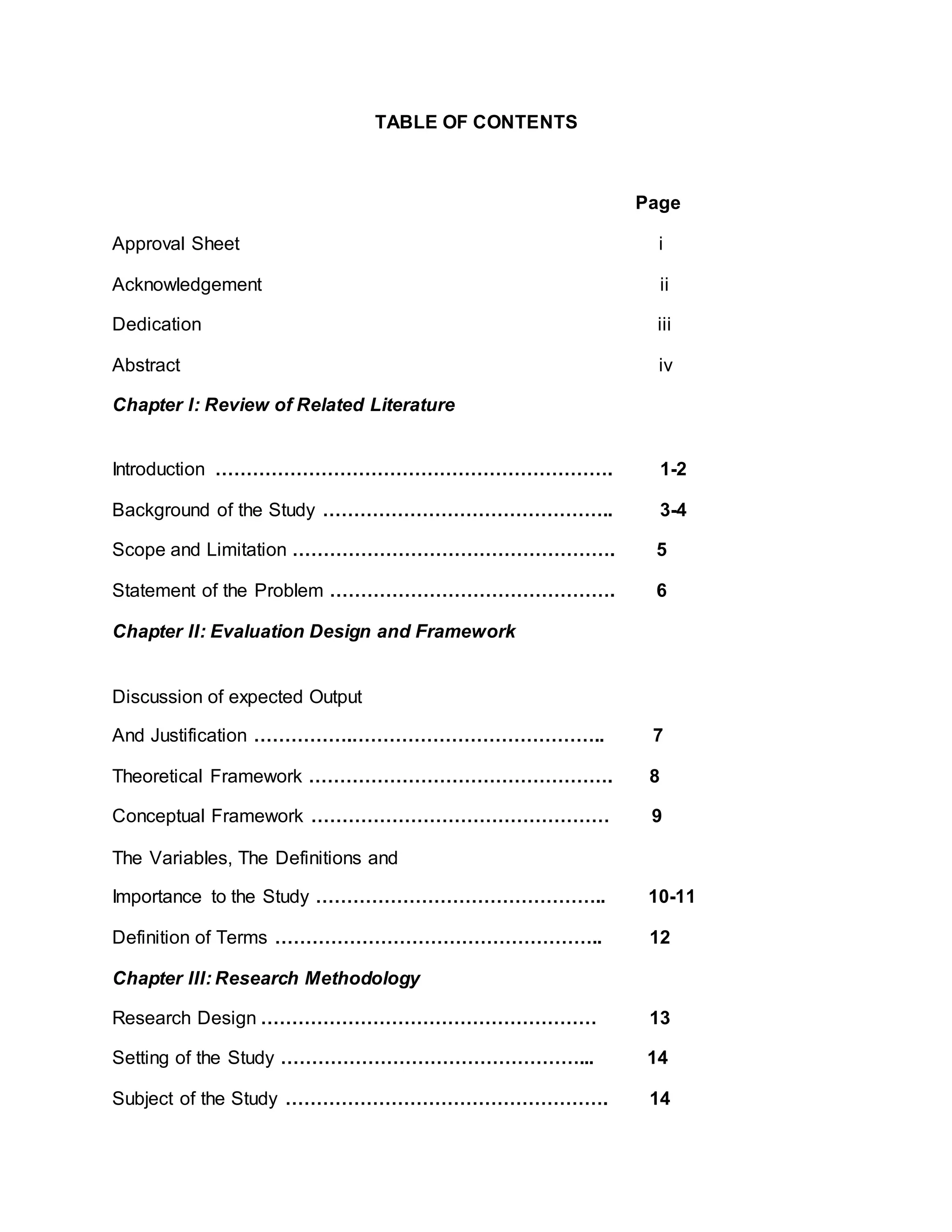
TABLE OF CONTENTS
Page
Approval Sheet i
Acknowledgement ii
Dedication iii
Abstract iv
Chapter I: Review of Related Literature
Introduction ………………………………………………………. 1-2
Background of the Study ……………………………………….. 3-4
Scope and Limitation ……………………………………………. 5
Statement of the Problem ………………………………………. 6
Chapter II: Evaluation Design and Framework
Discussion of expected Output
And Justification …………….………………………………….. 7
Theoretical Framework …………………………………………. 8
Conceptual Framework ………………………………………… 9
The Variables, The Definitions and
Importance to the Study ……………………………………….. 10-11
Definition of Terms …………………………………………….. 12
Chapter III: Research Methodology
Research Design ……………………………………………… 13
Setting of the Study …………………………………………... 14
Subject of the Study ……………………………………………. 14
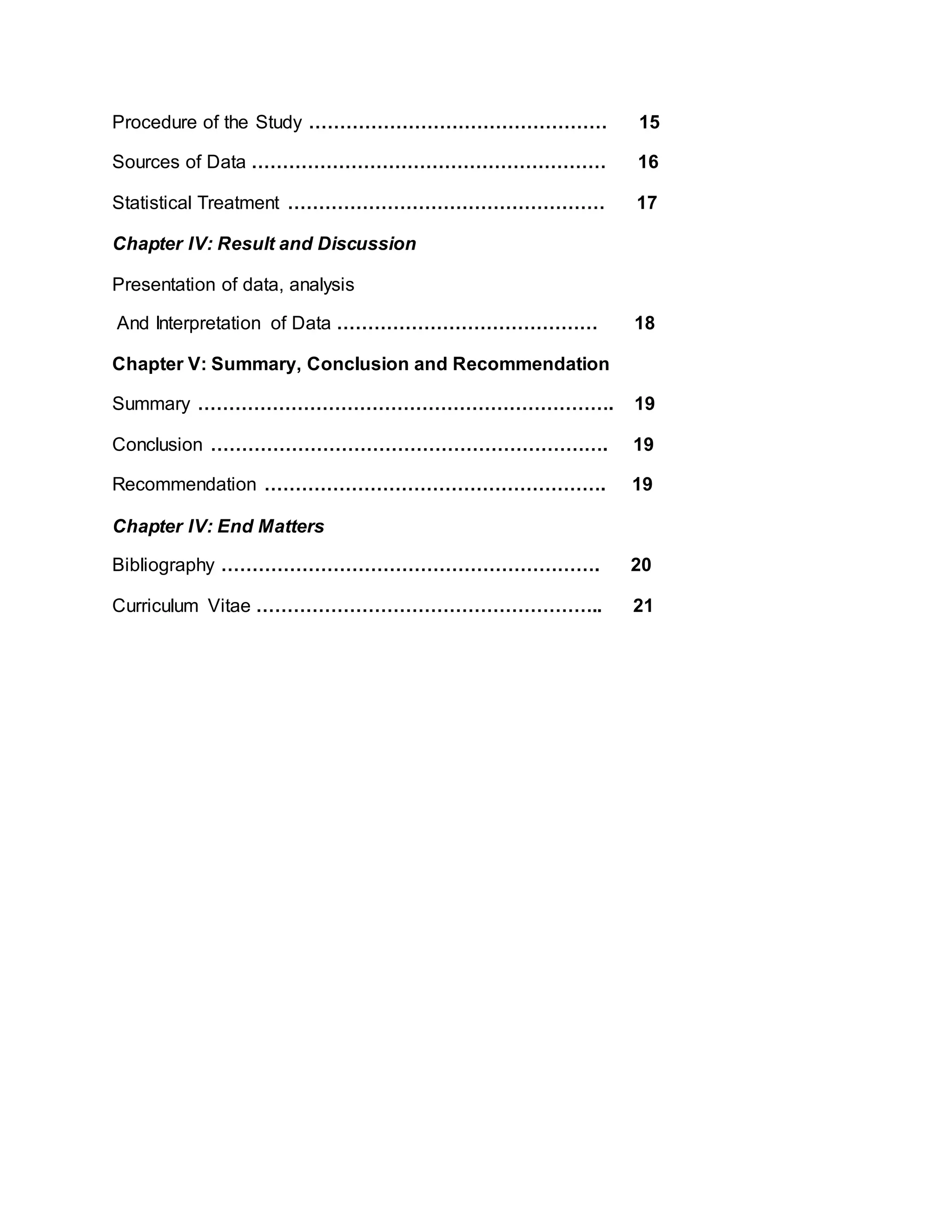
Procedure of the Study ………………………………………… 15
Sources of Data ………………………………………………… 16
Statistical Treatment …………………………………………… 17
Chapter IV: Result and Discussion
Presentation of data, analysis
And Interpretation of Data …………………………………… 18
Chapter V: Summary, Conclusion and Recommendation
Summary …………………………………………………………. 19
Conclusion ………………………………………………………. 19
Recommendation ………………………………………………. 19
Chapter IV: End Matters
Bibliography ……………………………………………………. 20
Curriculum Vitae ……………………………………………….. 21
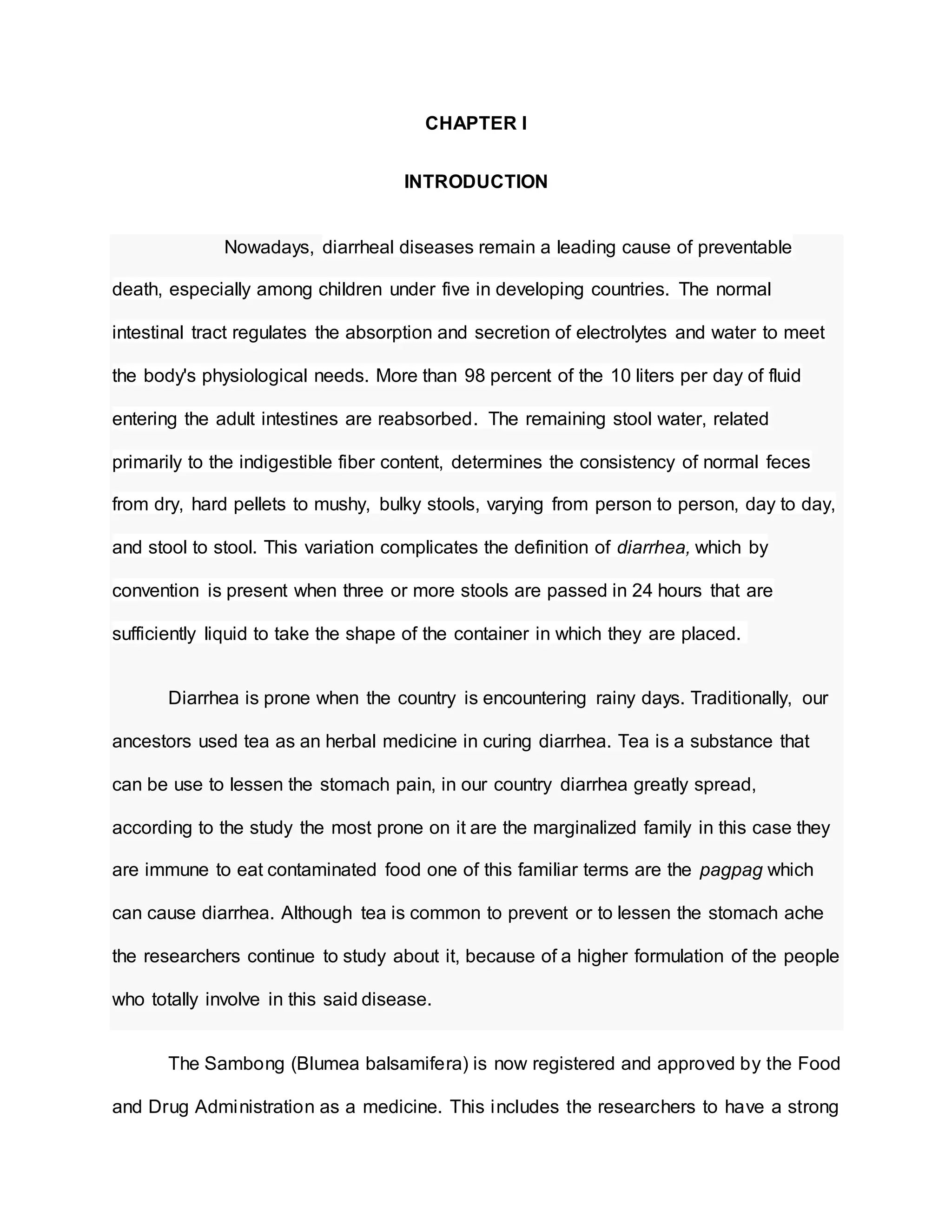
CHAPTER I
INTRODUCTION
Nowadays, diarrheal diseases remain a leading cause of preventable
death, especially among children under five in developing countries. The normal
intestinal tract regulates the absorption and secretion of electrolytes and water to meet
the body's physiological needs. More than 98 percent of the 10 liters per day of fluid
entering the adult intestines are reabsorbed. The remaining stool water, related
primarily to the indigestible fiber content, determines the consistency of normal feces
from dry, hard pellets to mushy, bulky stools, varying from person to person, day to day,
and stool to stool. This variation complicates the definition of diarrhea, which by
convention is present when three or more stools are passed in 24 hours that are
sufficiently liquid to take the shape of the container in which they are placed.
Diarrhea is prone when the country is encountering rainy days. Traditionally, our
ancestors used tea as an herbal medicine in curing diarrhea. Tea is a substance that
can be use to lessen the stomach pain, in our country diarrhea greatly spread,
according to the study the most prone on it are the marginalized family in this case they
are immune to eat contaminated food one of this familiar terms are the pagpag which
can cause diarrhea. Although tea is common to prevent or to lessen the stomach ache
the researchers continue to study about it, because of a higher formulation of the people
who totally involve in this said disease.
The Sambong (Blumea balsamifera) is now registered and approved by the Food
and Drug Administration as a medicine. This includes the researchers to have a strong
determination to kill the microorganism Escherichia coli (E.coli) that actively cause of
diarrhea. The researchers want to conduct a product that can prevent the diarrhea
cause by Escherichia coli (E.coli) and the main ingredient of this product is Blumea
Balsamifera. The researchers may prove it using Blumea Balsamifera tea but therefore
the researchers also expect that there’s a possibility to fail.
BACKGROUND OF THE STUDY
Based on the research the most affected of diarrhea is among children under five
years old in a country. Also marginalized people can encounter this kind of disease
because sometimes the food that they prepare for their daily meal is contaminated or
also known as “pagpag”. In this case the most prone to diarrhea are the families that are
marginalized so the researchers want to end those problems by using Blumea
balsamifera in killing Escherichia coli.
The researchers use Blumea balsamifera (sambong) in killing Escherichia coli
(E.coli). Sambong is an herbal plant that grows wild in tropical countries including the
Philippines. It has a long history in traditional medicine as a diuretic and analgesic.
Modern technology has made it possible to study sambong and its active ingredients.
Blumea balsamifera is used as an herbal treatment for the common cold and as a
diuretic in Philippine medicine, where it is most commonly known as sambong. It is used
to treat infected wounds, respiratory infections, and stomach pains in Thai
and Chinese folk medicine. Sambong is known for treating kidney stones, rheumatism,
coughs and colds, hypertension, heart disease and anti-diarrhea.
While Escherichia coli is a gram-negative, facultative anaerobic, rod shaped
bacterium of the genus Escherichia that is commonly found in the lower intestine of
warm-blooded organisms (endotherms). Most Escherichia coli strains are harmless, but
some serotypes can cause serious food poisoning in their hosts, and are occasionally
responsible for product recalls due to food contamination. The harmless strains are part
of the normal flora of the gut, and can benefit their hosts by producing vitamin K2, and
preventing colonization of the intestine pathogenic bacteria.
Diarrhea is abnormally frequent and watery bowel movements caused by E. coli
and the researchers want to prevent the said disease.
SCOPE AND LIMITATION
The research is about concentration that can kill microorganism. The researchers
want to kill Escherichia coli (E.coli) by using Blumea Balsamifera (sambong). The
researchers make this investigation to make a product with the main ingredient Blumea
balsamifera (sambong) that can cure diarrhea. The researchers bring their extract in
Natural Sciences Research Institute (NSRI) in University of the Philippines. The main
objective of the researchers in this investigation is to prove an alternative medicine
against the Escherichia coli (E.coli) in an affordable and easier way. Also the other
objective is to provide an herbal tea using Blumea Balsamifera (sambong). The
researchers get the result of the tested extract in Natural Sciences Research Institute
(NSRI) in University of the Philippines and if it is positive, they will test it in to the subject
(person) and observe what will happen after using it. The researchers do not use any
chemical substances in making the tea.
STATEMENT OF THE PROBLEM
The problem in this investigation is, the side effect of the product is not
constant and predictable. Also the researchers have not don’t know the specific
temperature to preserve the product. The researchers want to know if product can’t
affect the condition of the subject (person).
1. What is the effect of the Blumea balsamifera in treating diarrhea?
2. Is there any significant effect on the zone of inhibition in the concentration of
the Blumea balsamifera against Escherichia coli (E.coli)?
a. 100 %
b.75 %
c.50 %
3. How did the Blumea Balsamifera kill Escherichia coli (E.coli)?
HYPOTHESES
There is no significant effect on the gram-negative bacteria.
CHAPTER II:
EVALUATION, DESIGN AND FRAMEWORK
In this chapter, the resarchers will explain what product is all about. The
researchers will evaluate the process of making the herbal tea using Blumea
balsamifera (Sambong). The reseasrchers give an appropiate design of the product
want to conduct. Also the variables that the reserachers used. Using methodologies,
dependent, independent and other article the researchers may prove that this herbal
medicine is effectively to kill the said microorganisms.
Discussion of expected Output and Justification
This experiment is about the extracted Blumea balsamifera (Sambong) use a
main ingredient to make an herbal tea. The researchers conduct this output (herbal tea)
because tea can prevent diarrhea. It is affordable and easy to make. The researchers
want to prove that herbal tea with main ingredient Blumea balsamifera (Sambong) is
effective in killing Escherichia coli (E.coli). The researchers expect that the possible
result is perfect.
DEFINITION OF TERMS
Blumea balsamifera
- An herbal medicine usually grows in the Philippines in open grasslands, and a
widely used herbal treatment country. Known for remarkable treatment for kidney
stones, rheumatism, coughs and colds, hypertension, heart disease and anti-
diarrhea.
Diarrhea
- Abnormally frequent and watery bowel movements caused by E. coli
Escherichia coli (E.coli)
- Bacteria normally live in the intestines of healthy people and animals.
Marginalize
- Poor than a poor.
Agar Plate
- Is a Petri dish that contains a growth medium (typically agar plus nutrients) used
to culture microorganismsor small plants like the moss Physcomitrella patens.
Pathogenic bacteria
- Are bacteria that cause bacterial infection.
THEORITICAL FRAMEWORK
Based on the research, Blumea balsamifera is a source of the flavonoids
blumeatin, flavone and quercetin. Flavonoids or bioflavonoids are plant pigments which
act like antioxidants, protecting our cells and DNA from being damaged by free radicals.
Initial findings show that the blumeatin extracted from sambong leaves may protect our
liver from damage. Still other studies show that extracts from sambong tend to inhibit
the growth of cancer cells, whether the cells be from mice or people. Investigations
further opened up the possibility that the quercetin from sambong may be a strong
antioxidant and inflammatory, and have other anti-aging health benefits such as keeping
skin supple and looking young and healthy. Lastly, the actions of the antioxidant
flavones may prevent the development of cancer and heart disease. Sambong extracts
also display antifungal, antibacterial and antihistamine activities.
It is an astringent that can be used for the faster healing of cuts and wounds, for
post-partum baths and for bathing sensitive and painful areas affected by rheumatism. It
is an expectorant and sambong leaves can be prepared as a herbal tea that helps
relieve the symptoms of a cold by expelling mucus and phlegm from the respiratory
system.Like coffee and tea, sambong is a diuretic that facilitates the removal of excess
salt and water from our bodies and helps to dissolve kidney stones Findings from
clinical studies conducted by the Philippine Department of Health support the potential
of sambong as a safe and effective way to treat kidney stones. The Philippine National
Kidney and Transplant Institute has already approved the use of the herb for patients
with kidney problems in preventing or delaying dialysis and kidney transplants. Health.
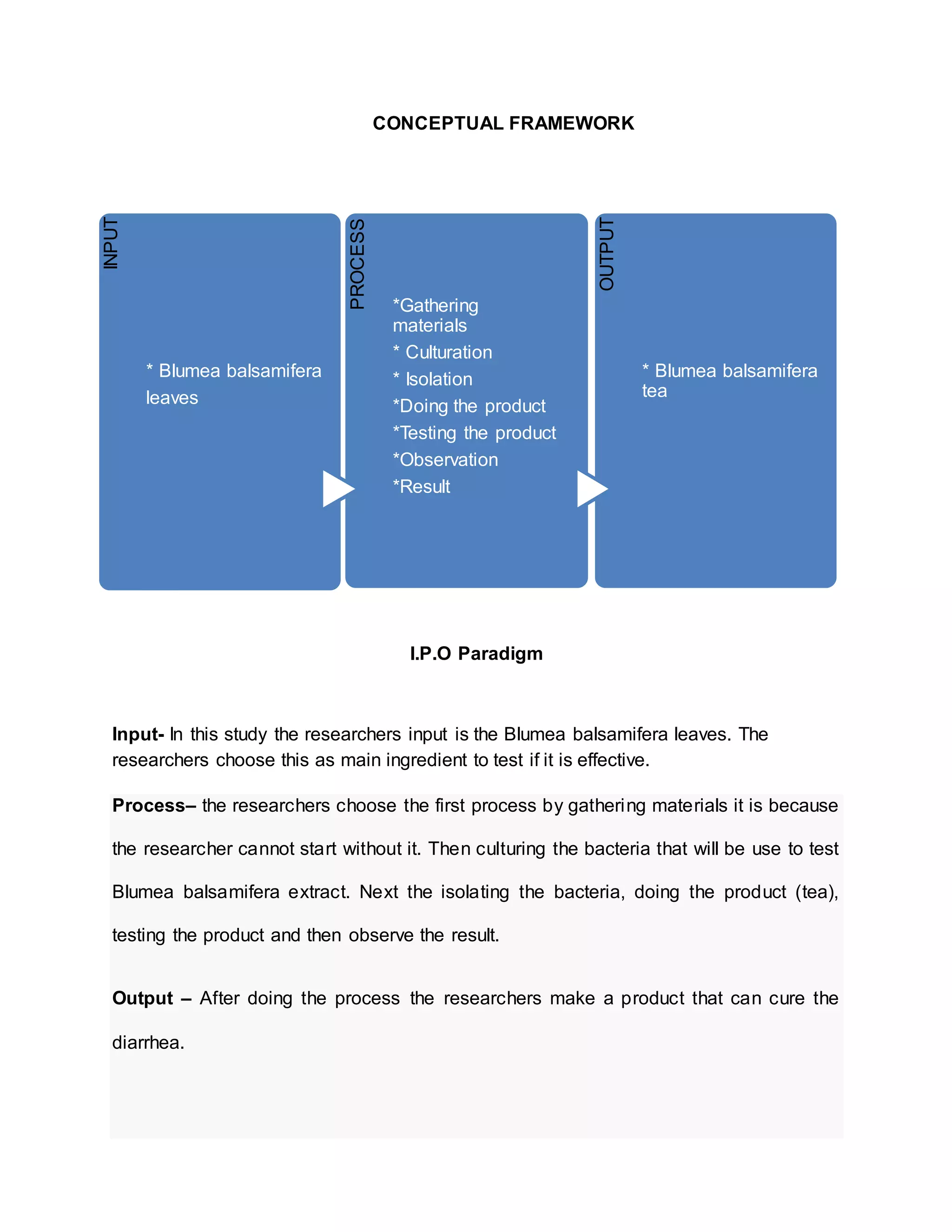
CONCEPTUAL FRAMEWORK
I.P.O Paradigm
Input- In this study the researchers input is the Blumea balsamifera leaves. The
researchers choose this as main ingredient to test if it is effective.
Process– the researchers choose the first process by gathering materials it is because
the researcher cannot start without it. Then culturing the bacteria that will be use to test
Blumea balsamifera extract. Next the isolating the bacteria, doing the product (tea),
testing the product and then observe the result.
Output – After doing the process the researchers make a product that can cure the
diarrhea.
INPUT
* Blumea balsamifera
leaves
PROCESS
*Gathering
materials
* Culturation
* Isolation
*Doing the product
*Testing the product
*Observation
*Result
OUTPUT
* Blumea balsamifera
tea
The Variables, Their definitions and importance of the study
Independent variable:
Blumea balsamifera – Blumea balsamifera (sambong) is an herbal medicine usually
grows in the Philippines in open grassland, and a widely used herbal treatment in the
country. It is known for its remarkable treatment for anti-diarrhea and use from stomach
problems indigestion and diarrhea spasm.
Dependent variable:
Blumea balsamifera Tea- in our culture tea is very effective alternative to lessen the
stomach cramp, taken as tea, the leaves of sambong help control the diarrhea and
relieve stomach pains. Some people also use the plant as a drug for its hallugenic
effect. The researchers use this for its tested and recommended herbal medicine.
Controlled variable:
Chloramphenicol- is the controlled variable because it is has the standard of
significance. The researchers can say it is significance if it passed the standard of the
measure of the zone of inhibition of the controlled variable.
Importance of the study:
Is to control the number of people who involve in this case which is diarrhea according
to study the most prone on it are the people who actively to eat an food which is
contaminated or some water that is not totally filtered neither raw .
CHAPTER 3: RESEARCH METHODOLOGY
The researchers tested their extract in Natural Science Research Institute (NSRI)
in University of the Philippines, to test the effectiveness of the Blumea balsamifera to
the Escherichia coli. The researchers use the leaves of Blumea balsamifera as the main
subject of the research and used 100 % concentration. Microbial suspension was
prepared from 24-hour old culture of the test organism. The suspending medium use
was 0.1% peptone water. Pre-poured Nutrient Agar (NA) plates, about 3 mm thick, were
inoculated with the microbial suspension by swabbing the agar surface. The cotton on
swab on an applicator stick was dipped into the microbial suspension, rotated several
time and pressed firmly on the inside wall of the tube above the fluid level to remove
excess inoculums from the swab. The swab was streaked over the entire agar surface.
This procedure was repeated in two more times, rotating the plate 60 degree each time
to ensure even distribution of the inoculums. Three equidistant wells were on the agar
plate using a cork bore (10mm diameter). Two hundred (200) µl of the sample was
placed in each well. For the positive control, a chloramphenicol disc was placed on the
center of the agar plate. The NA plates were incubated at 35ºC and observed after 24
hours. The clearing zone was measured in millimeters and the average diameter of the
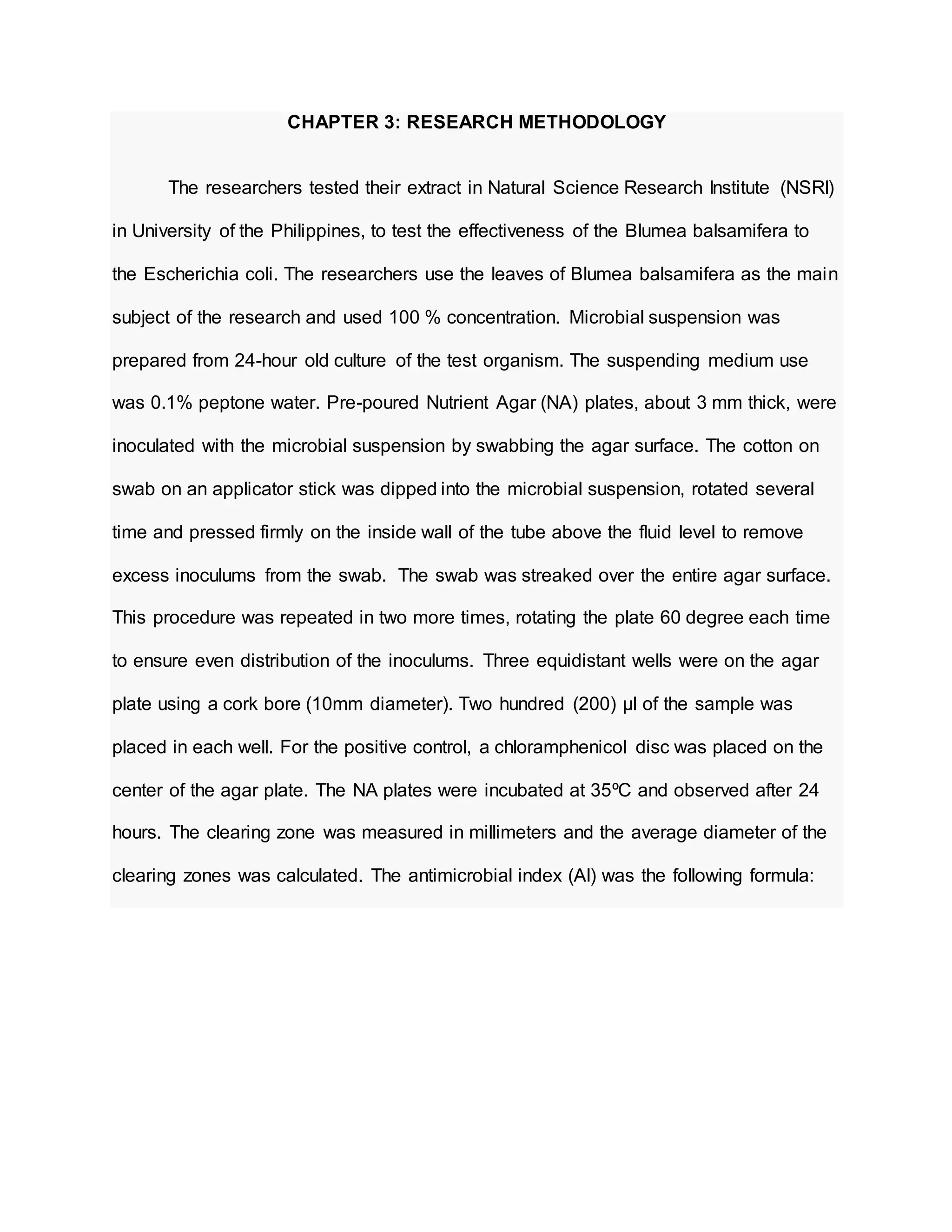
clearing zones was calculated. The antimicrobial index (Al) was the following formula:
RESEARCH DESIGN
The researchers know that there are many ways to conduct this experiment
that’s why the researchers think the best way to introduce the product that the
researchers made. The researchers manipulate one variable, and control/randomizes
the rest of the variables the researchers used. The researchers has a gatherings thow
to done this investigatory project. The researchers assigned in different task or chapters
to done it to have an easy way to finish the experiment. If every researchers done with
their task it is the time they gather and start planing about the said investigatory project.
The researchers got some info in books and internet to have an acceptable reseacrh.
SETTING OF THE STUDY
This study was conducted at the researchers house where located in Block2 Lot8
Bistekville 1 brgy. Payatas B Quezon City. The researchers used this place because
they are comfortable and it’s because it has a big enough space, this place is also near
in some store where the researchers can find some of the ingredients that will be use in
the study, also in Kaimito st. Payatas B Quezon city where the researchers used this
place to make a documents about their studies.
The testing was held in Natural Science Research Institute (NSRI), where in
University of the Philippines, Diliman.
SUBJECT OF THE STUDY
Escherichia coli is a gram-negative, facultative anaerobic, rod shaped bacterium
of the genus Escherichia that is commonly found in the lower intestine of warm-blooded
organisms (endotherms). Most Escherichia coli strains are harmless, but some
serotypes can cause serious food poisoning in their hosts, and are occasionally
responsible for product recalls due to food contamination. The harmless strains are part
of the normal flora of the gut, and can benefit their hosts by producing vitamin K2, and
preventing colonization of the intestine pathogenic bacteria. The researchers want to kill
this kind of bacteria.
PROCEDURE OF THE STUDY
Materials:
Dried sambong leaves (1-2 days)
Tea Filter
Bowl
Teaspoon
Plastic bags
Procedure
First, gently crushed the dried sambong until it loosen and get a tea filter. Next
put 1-2 tsp.of loose leaves in tea filter, then seal with staple lastly packed in
appropriate plastic bag.
SOURCES OF DATA
The researchers tested their extract in Natural Science Research Institute (NSRI)
in University of the Philippines, to test the effectiveness of the Blumea balsamifera to
the Escherichia coli. Natural Science Research Institute (NSRI) is the one who tested
the extract and they use Agar Plate, Microbal suspension and Chorampinecol.
STATISTICAL TREATMENT
Frequency
Is the number of occurrences of a repeating event per unit time. It is also referred to
as temporal frequency, which emphasizes the contrast tospatial frequency and angular
frequency. The period is the duration of one cyclein a repeating event, so the period is
the reciprocal of the frequency.
Percentage
Is a number or ratio expressed as a fraction of 100. It is often denoted using
the percent sign, "%", or the abbreviation "pct."
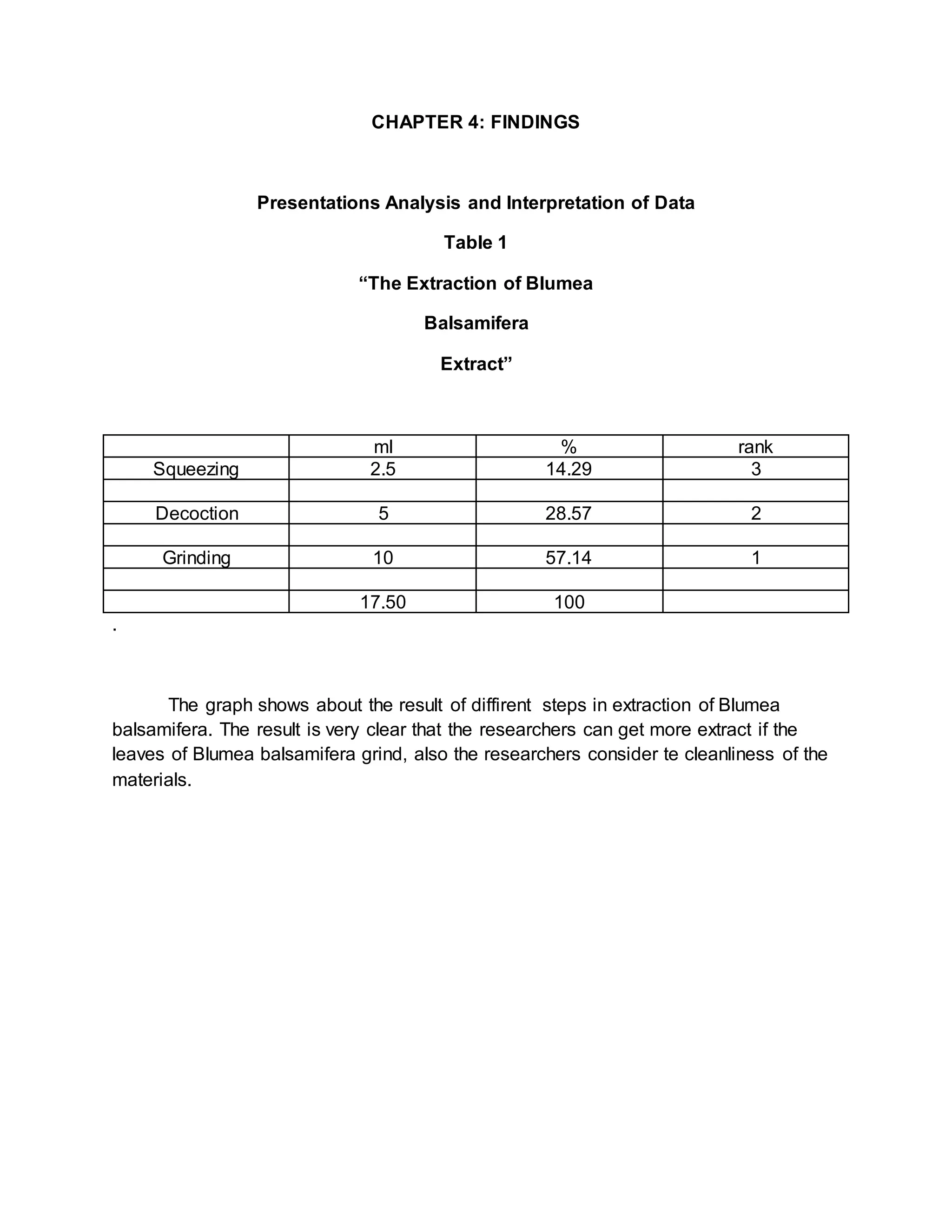
CHAPTER 4: FINDINGS
Presentations Analysis and Interpretation of Data
Table 1
“The Extraction of Blumea
Balsamifera
Extract”
ml % rank
Squeezing 2.5 14.29 3
Decoction 5 28.57 2
Grinding 10 57.14 1
17.50 100
.
The graph shows about the result of diffirent steps in extraction of Blumea
balsamifera. The result is very clear that the researchers can get more extract if the
leaves of Blumea balsamifera grind, also the researchers consider te cleanliness of the
materials.
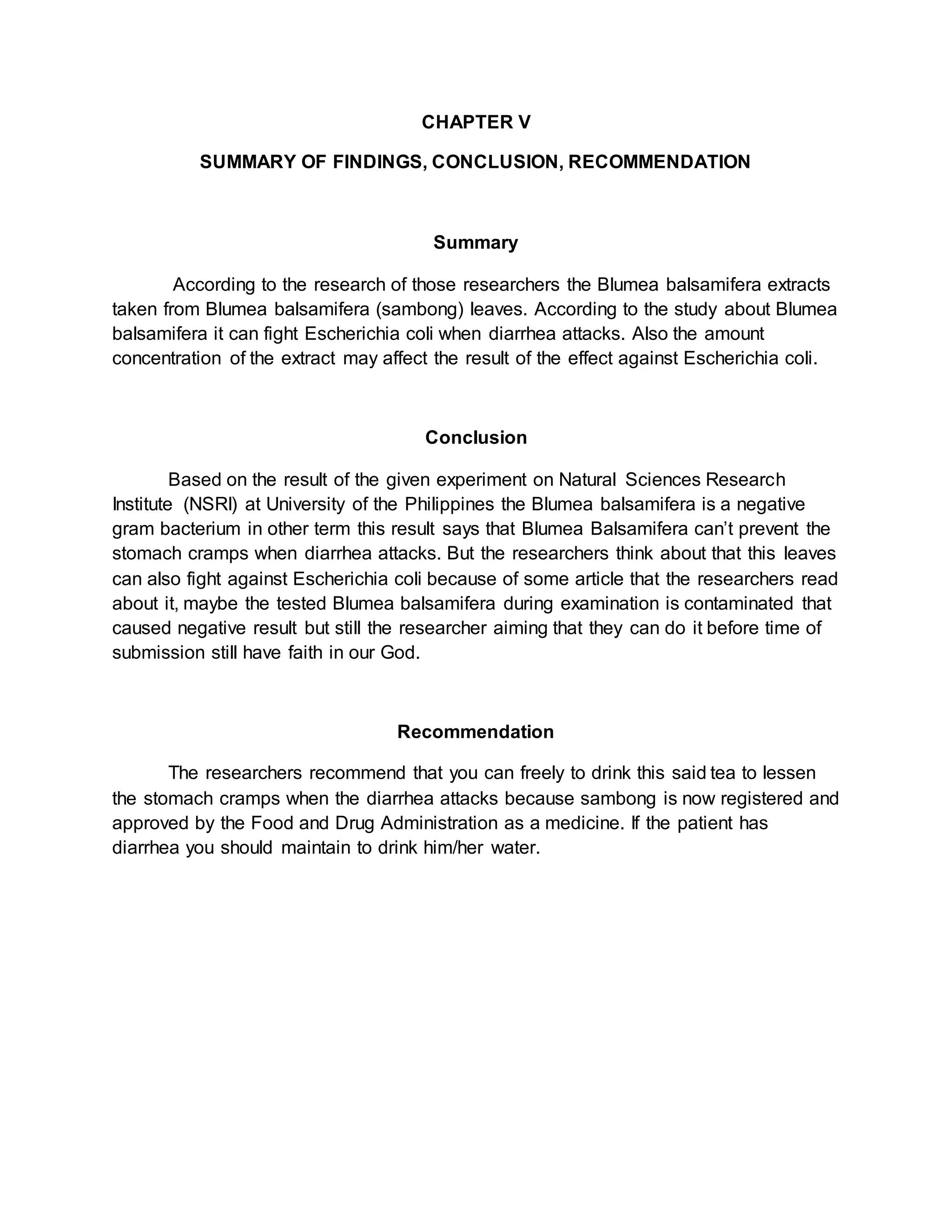
CHAPTER V
SUMMARY OF FINDINGS, CONCLUSION, RECOMMENDATION
Summary
According to the research of those researchers the Blumea balsamifera extracts
taken from Blumea balsamifera (sambong) leaves. According to the study about Blumea
balsamifera it can fight Escherichia coli when diarrhea attacks. Also the amount
concentration of the extract may affect the result of the effect against Escherichia coli.
Conclusion
Based on the result of the given experiment on Natural Sciences Research
Institute (NSRI) at University of the Philippines the Blumea balsamifera is a negative
gram bacterium in other term this result says that Blumea Balsamifera can’t prevent the
stomach cramps when diarrhea attacks. But the researchers think about that this leaves
can also fight against Escherichia coli because of some article that the researchers read
about it, maybe the tested Blumea balsamifera during examination is contaminated that
caused negative result but still the researcher aiming that they can do it before time of
submission still have faith in our God.
Recommendation
The researchers recommend that you can freely to drink this said tea to lessen
the stomach cramps when the diarrhea attacks because sambong is now registered and
approved by the Food and Drug Administration as a medicine. If the patient has
diarrhea you should maintain to drink him/her water.
BIBLIOGRAPHY
- http://www.webmd.com/digestive-disorders/features/diarrhea-common-triggers-
treatments
- http://www.wikihow.com/Cure-Diarrhea
- http://health.howstuffworks.com/wellness/natural-medicine/home-remedies/how-to-
cure-diarrhea.htm
- http://www.ncbi.nlm.nih.gov/books/NBK11764/
- http://www.medicalhealthguide.com/articles/sambong.htm
- http://en.wikipedia.org/wiki/Percentage
- en.wikipedia.org/wiki/Frequency
- http://neuleaftea.com/sambong/nutrients-benefits.php
- http://www.herbaldb.com/sambong-for-diabetes-is-it-really-effective/
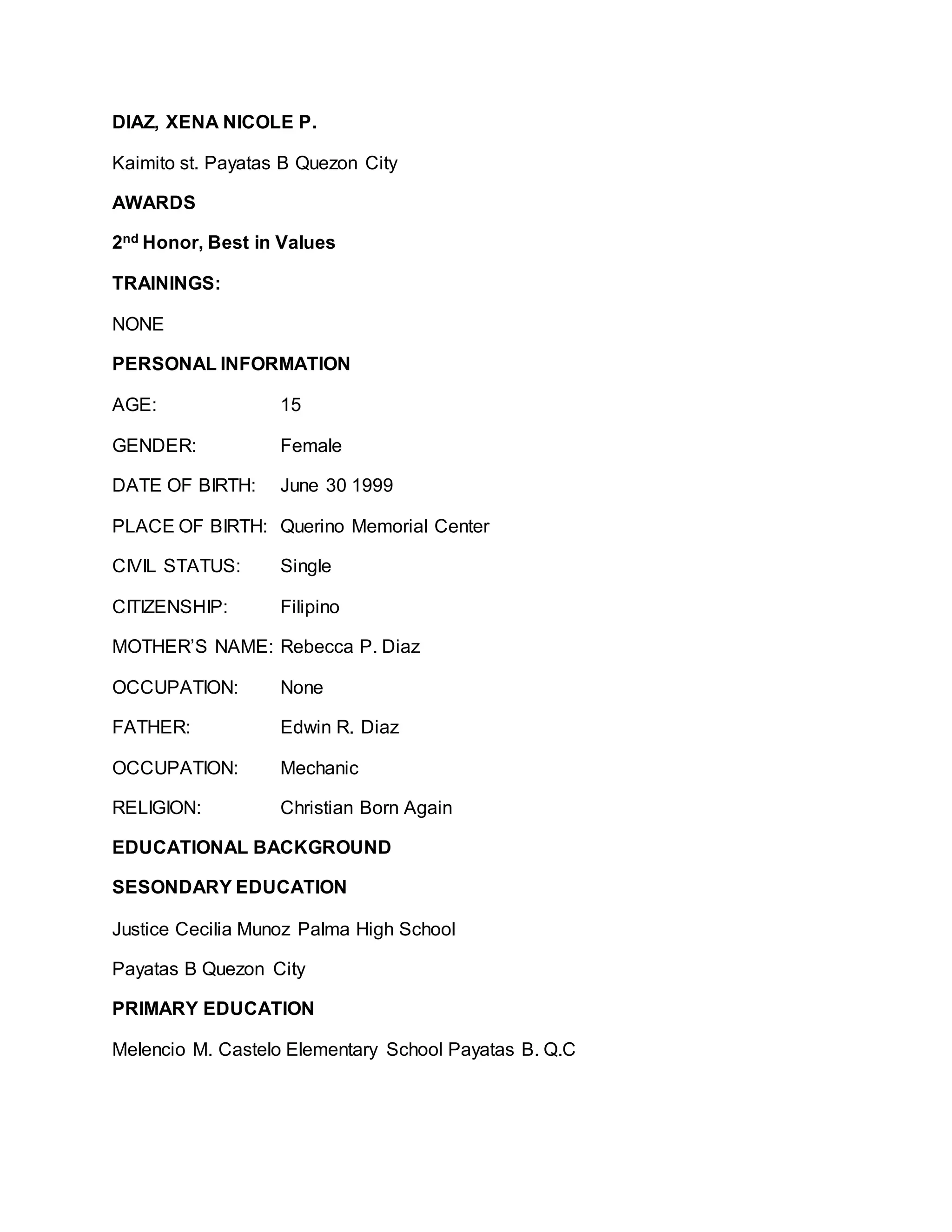
DIAZ, XENA NICOLE P.
Kaimito st. Payatas B Quezon City
AWARDS
2nd Honor, Best in Values
TRAININGS:
NONE
PERSONAL INFORMATION
AGE: 15
GENDER: Female
DATE OF BIRTH: June 30 1999
PLACE OF BIRTH: Querino Memorial Center
CIVIL STATUS: Single
CITIZENSHIP: Filipino
MOTHER’S NAME: Rebecca P. Diaz
OCCUPATION: None
FATHER: Edwin R. Diaz
OCCUPATION: Mechanic
RELIGION: Christian Born Again
EDUCATIONAL BACKGROUND
SESONDARY EDUCATION
Justice Cecilia Munoz Palma High School
Payatas B Quezon City
PRIMARY EDUCATION
Melencio M. Castelo Elementary School Payatas B. Q.C
LLIDO, DANICE Y.
Lower Atis St. Payatas B Quezon City
AWARDS:
NONE
TRAININGS:
NONE
PERSONAL INFORMATION
AGE: 14
GENDER: Female
DATE OF BIRTH: June 30 2000
PLACE OF BIRTH: Mandaluyong City
CIVIL STATUS: Single
CITIZENSHIP: Filipino
MOTHER’S NAME: Marivic Y. Llido
OCCUPATION: House Wife
FATHER: Daniel C. Llido
OCCUPATION: Trailer truck Driver
RELIGION: Christian Born Again
EDUCATIONAL BACKGROUND
SESONDARY EDUCATION
Justice Cecilia Munoz Palma High School
Payatas B Quezon City
PRIMARY EDUCATION
Melencio M. Castelo Elementary School Payatas B. Q.C
FEDELIS, JAY PAUL
14 Phase 2 purok 8 payatas B. Quezon City
AWARDS:
MATHEMAGICIAN CHAMPION
TRAININGS:
NONE
PERSONAL INFORMATION
AGE: 15
GENDER: male
DATE OF BIRTH: July 10 1999
PLACE OF BIRTH: Muntinlupa City
CIVIL STATUS: Single
CITIZENSHIP: Filipino
MOTHER’S NAME: Paulita Fedelis
OCCUPATION: House wife
FATHER: Romulo Fedelis
OCCUPATION: Traffic enforcer
RELIGION: Christian Born Again
EDUCATIONAL BACKGROUND
SESONDARY EDUCATION
Justice Cecilia Munoz Palma High School
Payatas B Quezon City
PRIMARY EDUCATION
Lupang Pangako Elementary School
DEL CARMEN, DENICE LEA
Block 2 Lot 8 Bistekville 1 brgy. Payatas B Quezon City
AWARDS:
1st Honor
TRAININGS:
NONE
PERSONAL INFORMATION
AGE: 15
GENDER: Female
DATE OF BIRTH: February 12 2000
PLACE OF BIRTH: Quezon City
CIVIL STATUS: Single
CITIZENSHIP: Filipino
MOTHER’S NAME: Ma. Gemma Del Camen
OCCUPATION: Teacher
FATHER: Marlon Del Carmen
OCCUPATION: Driver
RELIGION: Christian Born Again
EDUCATIONAL BACKGROUND
SESONDARY EDUCATION
Justice Cecilia Munoz Palma High School
Payatas B Quezon City
PRIMARY EDUCATION
Benigno Aquino Jr. Elementary School
ESPINOSA, MARIELEN
AWARDS:
TRAININGS:
NONE
PERSONAL INFORMATION
AGE: 15
GENDER: Female
DATE OF BIRTH:
PLACE OF BIRTH:
CIVIL STATUS: Single
CITIZENSHIP: Filipino
MOTHER’S NAME:
OCCUPATION:
FATHER:
OCCUPATION:
RELIGION: Christian Born Again
EDUCATIONAL BACKGROUND
SESONDARY EDUCATION
Justice Cecilia Munoz Palma High School
Payatas B Quezon City
PRIMARY EDUCATION
CANTUANGCO, JESRICK
AWARDS:
1ST Honor
TRAININGS:
NONE
PERSONAL INFORMATION
AGE: 15
GENDER: Male
DATE OF BIRTH:
PLACE OF BIRTH:
CIVIL STATUS: Single
CITIZENSHIP: Filipino
MOTHER’S NAME:
OCCUPATION:
FATHER:
OCCUPATION:
RELIGION: Christian Born Again
EDUCATIONAL BACKGROUND
SESONDARY EDUCATION
Justice Cecilia Munoz Palma High School
Payatas B Quezon City
PRIMARY EDUCATION
ORDOVEZA, GENEVA MAE
14 Makisig St. Spiritual cmpd.
AWARDS:
5th place at Pagsulat ng lathalain
TRAININGS:
Journalism
PERSONAL INFORMATION
AGE: 15
GENDER: Female
DATE OF BIRTH: February 12 2000
PLACE OF BIRTH: Sta. Monica Hospital
CIVIL STATUS: Single
CITIZENSHIP: Filipino
MOTHER’S NAME: Jojie D. Ordoveza
OCCUPATION: House Wife
FATHER: Juancho V. Ordoveza
OCCUPATION: Safety Officer
RELIGION: Christian Catholic
EDUCATIONAL BACKGROUND
SESONDARY EDUCAT
Justice Cecilia Munoz Palma High School
Payatas B Quezon City
PRIMARY EDUCATION
Payatas B. Elementary School
APPROVAL SHEET
Dear Sir Denis Dyvee Errabo,
Good day sir! We did this letter to ask permission for our investigatory project
because we know that approval of the teacher is important before we start doing this
project.
Our project is all about the concentration of sambong that can kill the bacteria
such as Escherichia coli (E.coli). Nowadays, many people suffering from many diseases
like hyper tension, kidney cancer, stomach ailments etc so that we choose sambong to
make a tea as our main product to fight the said diseases.
Based on the study and research of the researchers, sambong tea has
flavonoids which are from a plant and act as anti-oxidant that can makes our human
body cells and DNA totally free from radicals.
We will continue to study more about our product. We hope for your approval and
understanding about this matter. Thank You!
Sincerely yours,
The Researchers

Sip.2014 impo.-4

  • 1.
    Effectiveness of Blumeabalsamifera (sambong) As tea against Escherichia coli A science investigatory project In partial fulfillment for Science Investigatory project From the class of Mr. Denis Dyvee Errabo Submitted by: Llido, Danice Y. Diaz, Xena Nicole P. Del Carmen, Denice Ordoveza, Geneva Mae Espinosa, Marielen Fedelis, Jay Paul Cantangco, Jesrick October 7, 2014
  • 2.
    ACKNOWLEDGEMENT The researchers acknowledgethe person who give importance for this investigation and also a person whose valuable experience and for those people who help to make this investigatory project together: First of all the researchers give thanks for our JESUS CHRIST SON OF GOD For those wisdom and knowledge that He gave to make this project perfectly by the God’s purpose, by the strength and blessings to be part of this project and by proving that all things are possible by His name and also for His generous personality. PRAISE THE LORD that the researchers receive it all from Him; And for the researcher’s PARENTS who totally support in some activities of the school also for this kind of experimentation and who has been there along their journey also giving encouragement and inspiration. And for the TEACHERS of researcher who also understand when the researcher came to school lately, and also giving inspiration and giving strength and when each of them strive for the researchers happiness at the back of stressful projects. To their loving FRIENDS who cheer up along the journey and also proposing hope when the things seemed to be impossible. THE RESEARCHERS
  • 3.
    DEDICATION The RESEARCHERS dedicateit for those people who have been there in times of needs and also along their journey. And for the researcher’s supportive PARENTS who help when no one is around to make this project together with other researchers. And Mr. Denis Dyvee Errabo who persists to make this project and give authority to study about this given priority. Lastly our FATHER GOD holy in His purpose and proving that the researchers can do this before the submission, who also guides the researchers to make possible the impossible.
  • 4.
    ABSTRACT The researchers wantto conduct an investigatory project that is all about concentration that can kill microorganisms. The researchers want to create a product that can kill the E. coli that cause diarrhea. The researchers want to prove that the Blumea balsamifera (Sambong) is effective in curing diarrhea or killing E. coli. The importance of this study is to help the people needed medicine for healing, maintenance of health, activity, body comfortable and conditioning. The researchers use the Blumea balsamifera (Sambong) as the main ingredient of the product. Blumea balsamifera (Sambong) is the one of the common anti-microbial herbal medicine to prevent Escherichia coli. The researchers start doing this investigatory project on August 5, 2014 during the rainy season where the diarrhea is prone. The researchers hypothesized that Blumea balsamifera (sambong) is effective in killing the Escherichia coli. In 1997, the Traditional and Alternative Medicine Acts (TAMA) was passed and it became legal to sell these plants for medicinal purposes in the Philippines. Sambong tea is also used for herbal treatment of diarrhea and stomach spasms. A Photochemical study indicates that sambong leaves contains the chemicals icthyothereol acetate, cyptomeridiol, lutein and ß-carotene that has been found to have positive activity against microbes such as a Niger, T mentagrophytes and C albicans. Results also showed activity against P aeruginosa, S aureus, B subtilis and E coli. The researchers tested their extract in Natural Science Research Institute (NSRI) in University of the Philippines, to test the effectiveness of the Blumea balsamifera to
  • 5.
    the Escherichia coli.The researchers use the leaves of Blumea balsamifera as the main subject of the research and used 100 % concentration. Microbial suspension was prepared from 24-hour old culture of the test organism. The suspending medium use was 0.1% peptone water. Pre-poured Nutrient Agar (NA) plates, about 3 mm thick, were inoculated with the microbial suspension by swabbing the agar surface. The cotton on swab on an applicator stick was dipped into the microbial suspension, rotated several time and pressed firmly on the inside wall of the tube above the fluid level to remove excess inoculums from the swab. The swab was streaked over the entire agar surface. This procedure was repeated in two more times, rotating the plate 60 degree each time to ensure even distribution of the inoculums. Three equidistant wells were on the agar plate using a cork bore (10mm diameter). Two hundred (200) ml of the sample was placed in each well. For the positive control, a chloramphenicol disc was placed on the center of the agar plate. It incubated at 35 degree Celsius and observed 24 hours. Based on the findings the extracted Blumea balsamifera can’t kill the microorganisms in diarrhea such as Escherichia coli either during the examination the extracted sambong is contaminated. Therefore, the researchers aiming that they can do this in a perfect way although there’s a possibility to fail just to prove that this leaves are effective as an alternative to prevent the diarrhea or stomach cramps.
  • 6.
    TABLE OF CONTENTS Page ApprovalSheet i Acknowledgement ii Dedication iii Abstract iv Chapter I: Review of Related Literature Introduction ………………………………………………………. 1-2 Background of the Study ……………………………………….. 3-4 Scope and Limitation ……………………………………………. 5 Statement of the Problem ………………………………………. 6 Chapter II: Evaluation Design and Framework Discussion of expected Output And Justification …………….………………………………….. 7 Theoretical Framework …………………………………………. 8 Conceptual Framework ………………………………………… 9 The Variables, The Definitions and Importance to the Study ……………………………………….. 10-11 Definition of Terms …………………………………………….. 12 Chapter III: Research Methodology Research Design ……………………………………………… 13 Setting of the Study …………………………………………... 14 Subject of the Study ……………………………………………. 14
  • 7.
    Procedure of theStudy ………………………………………… 15 Sources of Data ………………………………………………… 16 Statistical Treatment …………………………………………… 17 Chapter IV: Result and Discussion Presentation of data, analysis And Interpretation of Data …………………………………… 18 Chapter V: Summary, Conclusion and Recommendation Summary …………………………………………………………. 19 Conclusion ………………………………………………………. 19 Recommendation ………………………………………………. 19 Chapter IV: End Matters Bibliography ……………………………………………………. 20 Curriculum Vitae ……………………………………………….. 21
  • 8.
    CHAPTER I INTRODUCTION Nowadays, diarrhealdiseases remain a leading cause of preventable death, especially among children under five in developing countries. The normal intestinal tract regulates the absorption and secretion of electrolytes and water to meet the body's physiological needs. More than 98 percent of the 10 liters per day of fluid entering the adult intestines are reabsorbed. The remaining stool water, related primarily to the indigestible fiber content, determines the consistency of normal feces from dry, hard pellets to mushy, bulky stools, varying from person to person, day to day, and stool to stool. This variation complicates the definition of diarrhea, which by convention is present when three or more stools are passed in 24 hours that are sufficiently liquid to take the shape of the container in which they are placed. Diarrhea is prone when the country is encountering rainy days. Traditionally, our ancestors used tea as an herbal medicine in curing diarrhea. Tea is a substance that can be use to lessen the stomach pain, in our country diarrhea greatly spread, according to the study the most prone on it are the marginalized family in this case they are immune to eat contaminated food one of this familiar terms are the pagpag which can cause diarrhea. Although tea is common to prevent or to lessen the stomach ache the researchers continue to study about it, because of a higher formulation of the people who totally involve in this said disease. The Sambong (Blumea balsamifera) is now registered and approved by the Food and Drug Administration as a medicine. This includes the researchers to have a strong
  • 9.
    determination to killthe microorganism Escherichia coli (E.coli) that actively cause of diarrhea. The researchers want to conduct a product that can prevent the diarrhea cause by Escherichia coli (E.coli) and the main ingredient of this product is Blumea Balsamifera. The researchers may prove it using Blumea Balsamifera tea but therefore the researchers also expect that there’s a possibility to fail.
  • 10.
    BACKGROUND OF THESTUDY Based on the research the most affected of diarrhea is among children under five years old in a country. Also marginalized people can encounter this kind of disease because sometimes the food that they prepare for their daily meal is contaminated or also known as “pagpag”. In this case the most prone to diarrhea are the families that are marginalized so the researchers want to end those problems by using Blumea balsamifera in killing Escherichia coli. The researchers use Blumea balsamifera (sambong) in killing Escherichia coli (E.coli). Sambong is an herbal plant that grows wild in tropical countries including the Philippines. It has a long history in traditional medicine as a diuretic and analgesic. Modern technology has made it possible to study sambong and its active ingredients. Blumea balsamifera is used as an herbal treatment for the common cold and as a diuretic in Philippine medicine, where it is most commonly known as sambong. It is used to treat infected wounds, respiratory infections, and stomach pains in Thai and Chinese folk medicine. Sambong is known for treating kidney stones, rheumatism, coughs and colds, hypertension, heart disease and anti-diarrhea. While Escherichia coli is a gram-negative, facultative anaerobic, rod shaped bacterium of the genus Escherichia that is commonly found in the lower intestine of warm-blooded organisms (endotherms). Most Escherichia coli strains are harmless, but some serotypes can cause serious food poisoning in their hosts, and are occasionally responsible for product recalls due to food contamination. The harmless strains are part
  • 11.
    of the normalflora of the gut, and can benefit their hosts by producing vitamin K2, and preventing colonization of the intestine pathogenic bacteria. Diarrhea is abnormally frequent and watery bowel movements caused by E. coli and the researchers want to prevent the said disease.
  • 12.
    SCOPE AND LIMITATION Theresearch is about concentration that can kill microorganism. The researchers want to kill Escherichia coli (E.coli) by using Blumea Balsamifera (sambong). The researchers make this investigation to make a product with the main ingredient Blumea balsamifera (sambong) that can cure diarrhea. The researchers bring their extract in Natural Sciences Research Institute (NSRI) in University of the Philippines. The main objective of the researchers in this investigation is to prove an alternative medicine against the Escherichia coli (E.coli) in an affordable and easier way. Also the other objective is to provide an herbal tea using Blumea Balsamifera (sambong). The researchers get the result of the tested extract in Natural Sciences Research Institute (NSRI) in University of the Philippines and if it is positive, they will test it in to the subject (person) and observe what will happen after using it. The researchers do not use any chemical substances in making the tea.
  • 13.
    STATEMENT OF THEPROBLEM The problem in this investigation is, the side effect of the product is not constant and predictable. Also the researchers have not don’t know the specific temperature to preserve the product. The researchers want to know if product can’t affect the condition of the subject (person). 1. What is the effect of the Blumea balsamifera in treating diarrhea? 2. Is there any significant effect on the zone of inhibition in the concentration of the Blumea balsamifera against Escherichia coli (E.coli)? a. 100 % b.75 % c.50 % 3. How did the Blumea Balsamifera kill Escherichia coli (E.coli)? HYPOTHESES There is no significant effect on the gram-negative bacteria.
  • 14.
    CHAPTER II: EVALUATION, DESIGNAND FRAMEWORK In this chapter, the resarchers will explain what product is all about. The researchers will evaluate the process of making the herbal tea using Blumea balsamifera (Sambong). The reseasrchers give an appropiate design of the product want to conduct. Also the variables that the reserachers used. Using methodologies, dependent, independent and other article the researchers may prove that this herbal medicine is effectively to kill the said microorganisms. Discussion of expected Output and Justification This experiment is about the extracted Blumea balsamifera (Sambong) use a main ingredient to make an herbal tea. The researchers conduct this output (herbal tea) because tea can prevent diarrhea. It is affordable and easy to make. The researchers want to prove that herbal tea with main ingredient Blumea balsamifera (Sambong) is effective in killing Escherichia coli (E.coli). The researchers expect that the possible result is perfect.
  • 15.
    DEFINITION OF TERMS Blumeabalsamifera - An herbal medicine usually grows in the Philippines in open grasslands, and a widely used herbal treatment country. Known for remarkable treatment for kidney stones, rheumatism, coughs and colds, hypertension, heart disease and anti- diarrhea. Diarrhea - Abnormally frequent and watery bowel movements caused by E. coli Escherichia coli (E.coli) - Bacteria normally live in the intestines of healthy people and animals. Marginalize - Poor than a poor. Agar Plate - Is a Petri dish that contains a growth medium (typically agar plus nutrients) used to culture microorganismsor small plants like the moss Physcomitrella patens. Pathogenic bacteria - Are bacteria that cause bacterial infection.
  • 16.
    THEORITICAL FRAMEWORK Based onthe research, Blumea balsamifera is a source of the flavonoids blumeatin, flavone and quercetin. Flavonoids or bioflavonoids are plant pigments which act like antioxidants, protecting our cells and DNA from being damaged by free radicals. Initial findings show that the blumeatin extracted from sambong leaves may protect our liver from damage. Still other studies show that extracts from sambong tend to inhibit the growth of cancer cells, whether the cells be from mice or people. Investigations further opened up the possibility that the quercetin from sambong may be a strong antioxidant and inflammatory, and have other anti-aging health benefits such as keeping skin supple and looking young and healthy. Lastly, the actions of the antioxidant flavones may prevent the development of cancer and heart disease. Sambong extracts also display antifungal, antibacterial and antihistamine activities. It is an astringent that can be used for the faster healing of cuts and wounds, for post-partum baths and for bathing sensitive and painful areas affected by rheumatism. It is an expectorant and sambong leaves can be prepared as a herbal tea that helps relieve the symptoms of a cold by expelling mucus and phlegm from the respiratory system.Like coffee and tea, sambong is a diuretic that facilitates the removal of excess salt and water from our bodies and helps to dissolve kidney stones Findings from clinical studies conducted by the Philippine Department of Health support the potential of sambong as a safe and effective way to treat kidney stones. The Philippine National Kidney and Transplant Institute has already approved the use of the herb for patients with kidney problems in preventing or delaying dialysis and kidney transplants. Health.
  • 17.
    CONCEPTUAL FRAMEWORK I.P.O Paradigm Input-In this study the researchers input is the Blumea balsamifera leaves. The researchers choose this as main ingredient to test if it is effective. Process– the researchers choose the first process by gathering materials it is because the researcher cannot start without it. Then culturing the bacteria that will be use to test Blumea balsamifera extract. Next the isolating the bacteria, doing the product (tea), testing the product and then observe the result. Output – After doing the process the researchers make a product that can cure the diarrhea. INPUT * Blumea balsamifera leaves PROCESS *Gathering materials * Culturation * Isolation *Doing the product *Testing the product *Observation *Result OUTPUT * Blumea balsamifera tea
  • 18.
    The Variables, Theirdefinitions and importance of the study Independent variable: Blumea balsamifera – Blumea balsamifera (sambong) is an herbal medicine usually grows in the Philippines in open grassland, and a widely used herbal treatment in the country. It is known for its remarkable treatment for anti-diarrhea and use from stomach problems indigestion and diarrhea spasm. Dependent variable: Blumea balsamifera Tea- in our culture tea is very effective alternative to lessen the stomach cramp, taken as tea, the leaves of sambong help control the diarrhea and relieve stomach pains. Some people also use the plant as a drug for its hallugenic effect. The researchers use this for its tested and recommended herbal medicine.
  • 19.
    Controlled variable: Chloramphenicol- isthe controlled variable because it is has the standard of significance. The researchers can say it is significance if it passed the standard of the measure of the zone of inhibition of the controlled variable. Importance of the study: Is to control the number of people who involve in this case which is diarrhea according to study the most prone on it are the people who actively to eat an food which is contaminated or some water that is not totally filtered neither raw .
  • 20.
    CHAPTER 3: RESEARCHMETHODOLOGY The researchers tested their extract in Natural Science Research Institute (NSRI) in University of the Philippines, to test the effectiveness of the Blumea balsamifera to the Escherichia coli. The researchers use the leaves of Blumea balsamifera as the main subject of the research and used 100 % concentration. Microbial suspension was prepared from 24-hour old culture of the test organism. The suspending medium use was 0.1% peptone water. Pre-poured Nutrient Agar (NA) plates, about 3 mm thick, were inoculated with the microbial suspension by swabbing the agar surface. The cotton on swab on an applicator stick was dipped into the microbial suspension, rotated several time and pressed firmly on the inside wall of the tube above the fluid level to remove excess inoculums from the swab. The swab was streaked over the entire agar surface. This procedure was repeated in two more times, rotating the plate 60 degree each time to ensure even distribution of the inoculums. Three equidistant wells were on the agar plate using a cork bore (10mm diameter). Two hundred (200) µl of the sample was placed in each well. For the positive control, a chloramphenicol disc was placed on the center of the agar plate. The NA plates were incubated at 35ºC and observed after 24 hours. The clearing zone was measured in millimeters and the average diameter of the clearing zones was calculated. The antimicrobial index (Al) was the following formula:
  • 21.
    RESEARCH DESIGN The researchersknow that there are many ways to conduct this experiment that’s why the researchers think the best way to introduce the product that the researchers made. The researchers manipulate one variable, and control/randomizes the rest of the variables the researchers used. The researchers has a gatherings thow to done this investigatory project. The researchers assigned in different task or chapters to done it to have an easy way to finish the experiment. If every researchers done with their task it is the time they gather and start planing about the said investigatory project. The researchers got some info in books and internet to have an acceptable reseacrh.
  • 22.
    SETTING OF THESTUDY This study was conducted at the researchers house where located in Block2 Lot8 Bistekville 1 brgy. Payatas B Quezon City. The researchers used this place because they are comfortable and it’s because it has a big enough space, this place is also near in some store where the researchers can find some of the ingredients that will be use in the study, also in Kaimito st. Payatas B Quezon city where the researchers used this place to make a documents about their studies. The testing was held in Natural Science Research Institute (NSRI), where in University of the Philippines, Diliman. SUBJECT OF THE STUDY Escherichia coli is a gram-negative, facultative anaerobic, rod shaped bacterium of the genus Escherichia that is commonly found in the lower intestine of warm-blooded organisms (endotherms). Most Escherichia coli strains are harmless, but some serotypes can cause serious food poisoning in their hosts, and are occasionally responsible for product recalls due to food contamination. The harmless strains are part of the normal flora of the gut, and can benefit their hosts by producing vitamin K2, and preventing colonization of the intestine pathogenic bacteria. The researchers want to kill this kind of bacteria.
  • 23.
    PROCEDURE OF THESTUDY Materials: Dried sambong leaves (1-2 days) Tea Filter Bowl Teaspoon Plastic bags Procedure First, gently crushed the dried sambong until it loosen and get a tea filter. Next put 1-2 tsp.of loose leaves in tea filter, then seal with staple lastly packed in appropriate plastic bag.
  • 24.
    SOURCES OF DATA Theresearchers tested their extract in Natural Science Research Institute (NSRI) in University of the Philippines, to test the effectiveness of the Blumea balsamifera to the Escherichia coli. Natural Science Research Institute (NSRI) is the one who tested the extract and they use Agar Plate, Microbal suspension and Chorampinecol. STATISTICAL TREATMENT Frequency Is the number of occurrences of a repeating event per unit time. It is also referred to as temporal frequency, which emphasizes the contrast tospatial frequency and angular frequency. The period is the duration of one cyclein a repeating event, so the period is the reciprocal of the frequency. Percentage Is a number or ratio expressed as a fraction of 100. It is often denoted using the percent sign, "%", or the abbreviation "pct."
  • 25.
    CHAPTER 4: FINDINGS PresentationsAnalysis and Interpretation of Data Table 1 “The Extraction of Blumea Balsamifera Extract” ml % rank Squeezing 2.5 14.29 3 Decoction 5 28.57 2 Grinding 10 57.14 1 17.50 100 . The graph shows about the result of diffirent steps in extraction of Blumea balsamifera. The result is very clear that the researchers can get more extract if the leaves of Blumea balsamifera grind, also the researchers consider te cleanliness of the materials.
  • 26.
    CHAPTER V SUMMARY OFFINDINGS, CONCLUSION, RECOMMENDATION Summary According to the research of those researchers the Blumea balsamifera extracts taken from Blumea balsamifera (sambong) leaves. According to the study about Blumea balsamifera it can fight Escherichia coli when diarrhea attacks. Also the amount concentration of the extract may affect the result of the effect against Escherichia coli. Conclusion Based on the result of the given experiment on Natural Sciences Research Institute (NSRI) at University of the Philippines the Blumea balsamifera is a negative gram bacterium in other term this result says that Blumea Balsamifera can’t prevent the stomach cramps when diarrhea attacks. But the researchers think about that this leaves can also fight against Escherichia coli because of some article that the researchers read about it, maybe the tested Blumea balsamifera during examination is contaminated that caused negative result but still the researcher aiming that they can do it before time of submission still have faith in our God. Recommendation The researchers recommend that you can freely to drink this said tea to lessen the stomach cramps when the diarrhea attacks because sambong is now registered and approved by the Food and Drug Administration as a medicine. If the patient has diarrhea you should maintain to drink him/her water.
  • 27.
    BIBLIOGRAPHY - http://www.webmd.com/digestive-disorders/features/diarrhea-common-triggers- treatments - http://www.wikihow.com/Cure-Diarrhea -http://health.howstuffworks.com/wellness/natural-medicine/home-remedies/how-to- cure-diarrhea.htm - http://www.ncbi.nlm.nih.gov/books/NBK11764/ - http://www.medicalhealthguide.com/articles/sambong.htm - http://en.wikipedia.org/wiki/Percentage - en.wikipedia.org/wiki/Frequency - http://neuleaftea.com/sambong/nutrients-benefits.php - http://www.herbaldb.com/sambong-for-diabetes-is-it-really-effective/
  • 28.
    DIAZ, XENA NICOLEP. Kaimito st. Payatas B Quezon City AWARDS 2nd Honor, Best in Values TRAININGS: NONE PERSONAL INFORMATION AGE: 15 GENDER: Female DATE OF BIRTH: June 30 1999 PLACE OF BIRTH: Querino Memorial Center CIVIL STATUS: Single CITIZENSHIP: Filipino MOTHER’S NAME: Rebecca P. Diaz OCCUPATION: None FATHER: Edwin R. Diaz OCCUPATION: Mechanic RELIGION: Christian Born Again EDUCATIONAL BACKGROUND SESONDARY EDUCATION Justice Cecilia Munoz Palma High School Payatas B Quezon City PRIMARY EDUCATION Melencio M. Castelo Elementary School Payatas B. Q.C
  • 29.
    LLIDO, DANICE Y. LowerAtis St. Payatas B Quezon City AWARDS: NONE TRAININGS: NONE PERSONAL INFORMATION AGE: 14 GENDER: Female DATE OF BIRTH: June 30 2000 PLACE OF BIRTH: Mandaluyong City CIVIL STATUS: Single CITIZENSHIP: Filipino MOTHER’S NAME: Marivic Y. Llido OCCUPATION: House Wife FATHER: Daniel C. Llido OCCUPATION: Trailer truck Driver RELIGION: Christian Born Again EDUCATIONAL BACKGROUND SESONDARY EDUCATION Justice Cecilia Munoz Palma High School Payatas B Quezon City PRIMARY EDUCATION Melencio M. Castelo Elementary School Payatas B. Q.C
  • 30.
    FEDELIS, JAY PAUL 14Phase 2 purok 8 payatas B. Quezon City AWARDS: MATHEMAGICIAN CHAMPION TRAININGS: NONE PERSONAL INFORMATION AGE: 15 GENDER: male DATE OF BIRTH: July 10 1999 PLACE OF BIRTH: Muntinlupa City CIVIL STATUS: Single CITIZENSHIP: Filipino MOTHER’S NAME: Paulita Fedelis OCCUPATION: House wife FATHER: Romulo Fedelis OCCUPATION: Traffic enforcer RELIGION: Christian Born Again EDUCATIONAL BACKGROUND SESONDARY EDUCATION Justice Cecilia Munoz Palma High School Payatas B Quezon City PRIMARY EDUCATION Lupang Pangako Elementary School
  • 31.
    DEL CARMEN, DENICELEA Block 2 Lot 8 Bistekville 1 brgy. Payatas B Quezon City AWARDS: 1st Honor TRAININGS: NONE PERSONAL INFORMATION AGE: 15 GENDER: Female DATE OF BIRTH: February 12 2000 PLACE OF BIRTH: Quezon City CIVIL STATUS: Single CITIZENSHIP: Filipino MOTHER’S NAME: Ma. Gemma Del Camen OCCUPATION: Teacher FATHER: Marlon Del Carmen OCCUPATION: Driver RELIGION: Christian Born Again EDUCATIONAL BACKGROUND SESONDARY EDUCATION Justice Cecilia Munoz Palma High School Payatas B Quezon City PRIMARY EDUCATION Benigno Aquino Jr. Elementary School
  • 32.
    ESPINOSA, MARIELEN AWARDS: TRAININGS: NONE PERSONAL INFORMATION AGE:15 GENDER: Female DATE OF BIRTH: PLACE OF BIRTH: CIVIL STATUS: Single CITIZENSHIP: Filipino MOTHER’S NAME: OCCUPATION: FATHER: OCCUPATION: RELIGION: Christian Born Again EDUCATIONAL BACKGROUND SESONDARY EDUCATION Justice Cecilia Munoz Palma High School Payatas B Quezon City PRIMARY EDUCATION
  • 33.
    CANTUANGCO, JESRICK AWARDS: 1ST Honor TRAININGS: NONE PERSONALINFORMATION AGE: 15 GENDER: Male DATE OF BIRTH: PLACE OF BIRTH: CIVIL STATUS: Single CITIZENSHIP: Filipino MOTHER’S NAME: OCCUPATION: FATHER: OCCUPATION: RELIGION: Christian Born Again EDUCATIONAL BACKGROUND SESONDARY EDUCATION Justice Cecilia Munoz Palma High School Payatas B Quezon City PRIMARY EDUCATION
  • 34.
    ORDOVEZA, GENEVA MAE 14Makisig St. Spiritual cmpd. AWARDS: 5th place at Pagsulat ng lathalain TRAININGS: Journalism PERSONAL INFORMATION AGE: 15 GENDER: Female DATE OF BIRTH: February 12 2000 PLACE OF BIRTH: Sta. Monica Hospital CIVIL STATUS: Single CITIZENSHIP: Filipino MOTHER’S NAME: Jojie D. Ordoveza OCCUPATION: House Wife FATHER: Juancho V. Ordoveza OCCUPATION: Safety Officer RELIGION: Christian Catholic EDUCATIONAL BACKGROUND SESONDARY EDUCAT Justice Cecilia Munoz Palma High School Payatas B Quezon City PRIMARY EDUCATION Payatas B. Elementary School
  • 35.
    APPROVAL SHEET Dear SirDenis Dyvee Errabo, Good day sir! We did this letter to ask permission for our investigatory project because we know that approval of the teacher is important before we start doing this project. Our project is all about the concentration of sambong that can kill the bacteria such as Escherichia coli (E.coli). Nowadays, many people suffering from many diseases like hyper tension, kidney cancer, stomach ailments etc so that we choose sambong to make a tea as our main product to fight the said diseases. Based on the study and research of the researchers, sambong tea has flavonoids which are from a plant and act as anti-oxidant that can makes our human body cells and DNA totally free from radicals. We will continue to study more about our product. We hope for your approval and understanding about this matter. Thank You! Sincerely yours, The Researchers