Changing Leadership"... innovations don't require genius, just a willingness to question the way things have always been done." ...Robert J. Kriegel with Louis Patler from ... If It Ain't Broke . . . Break It! 1
The World is Changing so We Have to Change How We LeadAs technology enables workers to decentralize their work, clocking "in" and "out" will no longer be necessary. Workers may rarely be in the office, and their working hours may bear little resemblance to the traditional nine-to-five schedule. What might the workplace look like in the year 2020?2
Changes We Can ExpectThough office buildings will not disappear, the space inside them will be reconfigured to support a workforce that comes in primarily to attend meetings and retrieve dataThe office of the future will be a place for focused work that requires true collaboration. It will also be a key site for socializing and cementing the relationships that keep an organization going. 3
Why Is This Important to Workforce Planning?Keeping employees is a key strategy for workforce planningThe #1 reason people look for another job is they do not like their supervisorThe need for leadership to be accepted and respected by employees is one of the most important strategies to employee retentionLeaders need to be more innovative and flexible in the future to lead in a changing workplace 4
The Current State of LeadershipWhat Is Working Now?What is Not Working?5
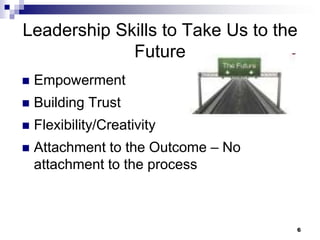
Leadership Skills to Take Us to the FutureEmpowermentBuilding TrustFlexibility/CreativityAttachment to the Outcome – No attachment to the process6
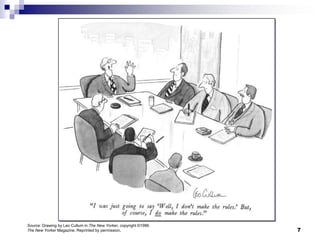
Source: Drawing by Leo Cullum in The New Yorker, copyright ©1986 The New Yorker Magazine. Reprinted by permission.7
Empowerment - DefinedGranting  employees the autonomy to assume more responsibility within an organization and strengthening their sense of effectiveness8
Empowerment Includes:Letting employees complete their work in their own way within parametersAssisting employees to eliminate unnecessary work in order to streamline tasks9
Four Aspects of EmpowermentMeaning – their work is important
Competence – confidence in their ability, self-efficacy
Self-determination – autonomy to decide how to do the work
Impact – influence in their work unit10
How Managers Empower EmployeesSolicit input on a regular basis
Ask for help in solving problems
Let employees make progressively harder decisions
Remove bureaucratic obstacles19 -911
How Managers Empower Employees (Cont’d)Ask questions rather than supplying all the answers
Provide workers with info they need
Give employees freedom to respond to customer needs
Serve as a role model
Coach employees to mastery12
13
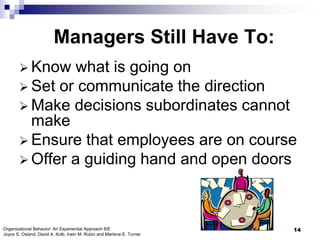
Managers Still Have To:Know what is going on
Set or communicate the direction
Make decisions subordinates cannot make
Ensure that employees are on course
Offer a guiding hand and open doors14

Changing Leadership for Changing Times

  • 1.
    Changing Leadership"... innovationsdon't require genius, just a willingness to question the way things have always been done." ...Robert J. Kriegel with Louis Patler from ... If It Ain't Broke . . . Break It! 1
  • 2.
    The World isChanging so We Have to Change How We LeadAs technology enables workers to decentralize their work, clocking "in" and "out" will no longer be necessary. Workers may rarely be in the office, and their working hours may bear little resemblance to the traditional nine-to-five schedule. What might the workplace look like in the year 2020?2
  • 3.
    Changes We CanExpectThough office buildings will not disappear, the space inside them will be reconfigured to support a workforce that comes in primarily to attend meetings and retrieve dataThe office of the future will be a place for focused work that requires true collaboration. It will also be a key site for socializing and cementing the relationships that keep an organization going. 3
  • 4.
    Why Is ThisImportant to Workforce Planning?Keeping employees is a key strategy for workforce planningThe #1 reason people look for another job is they do not like their supervisorThe need for leadership to be accepted and respected by employees is one of the most important strategies to employee retentionLeaders need to be more innovative and flexible in the future to lead in a changing workplace 4
  • 5.
    The Current Stateof LeadershipWhat Is Working Now?What is Not Working?5
  • 6.
    Leadership Skills toTake Us to the FutureEmpowermentBuilding TrustFlexibility/CreativityAttachment to the Outcome – No attachment to the process6
  • 7.
    Source: Drawing byLeo Cullum in The New Yorker, copyright ©1986 The New Yorker Magazine. Reprinted by permission.7
  • 8.
    Empowerment - DefinedGranting employees the autonomy to assume more responsibility within an organization and strengthening their sense of effectiveness8
  • 9.
    Empowerment Includes:Letting employeescomplete their work in their own way within parametersAssisting employees to eliminate unnecessary work in order to streamline tasks9
  • 10.
    Four Aspects ofEmpowermentMeaning – their work is important
  • 11.
    Competence – confidencein their ability, self-efficacy
  • 12.
    Self-determination – autonomyto decide how to do the work
  • 13.
    Impact – influencein their work unit10
  • 14.
    How Managers EmpowerEmployeesSolicit input on a regular basis
  • 15.
    Ask for helpin solving problems
  • 16.
    Let employees makeprogressively harder decisions
  • 17.
  • 18.
    How Managers EmpowerEmployees (Cont’d)Ask questions rather than supplying all the answers
  • 19.
    Provide workers withinfo they need
  • 20.
    Give employees freedomto respond to customer needs
  • 21.
    Serve as arole model
  • 22.
  • 23.
  • 24.
    Managers Still HaveTo:Know what is going on
  • 25.
    Set or communicatethe direction
  • 26.
  • 27.
  • 28.
    Offer a guidinghand and open doors14