Sandia National Laboratories is a multimission laboratory managed and operated by National Technology and Engineering Solutions of Sandia,
LLC., a wholly owned subsidiary of Honeywell International, Inc., for the U.S. Department of Energy’s National Nuclear Security Administration
under contract DE-NA-0003525.
Kokkos:	The	C++	Performance	Portability	Programming	
Model
Christian	 Trott (crtrott@sandia.gov),	 Carter	Edwards
D.	Sunderland,	 N.	Ellingwood,	D.	Ibanez,	S.	Hammond,	S.	Rajamanickam,	K.	Kim,	M.	Deveci,	M.	Hoemmen,	G.		
Center	for	Computing	Research,	Sandia	National	Laboratories,	NM
SAND2017-4935	C
New	Programming	Models
§ HPC	is	at	a	Crossroads
§ Diversifying	Hardware	Architectures
§ More	parallelism	necessitates	paradigm	shift	from	MPI-only
§ Need	for	New	Programming	Models	
§ Performance	Portability:	OpenMP 4.5,	OpenACC,	Kokkos,	RAJA,	SyCL,	
C++20?,	…
§ Resilience	and	Load	Balancing:	Legion,	HPX,	UPC++,	...
§ Vendor	decoupling	drives	external	development
2
New	Programming	Models
§ HPC	is	at	a	Crossroads
§ Diversifying	Hardware	Architectures
§ More	parallelism	necessitates	paradigm	shift	from	MPI-only
§ Need	for	New	Programming	Models	
§ Performance	Portability:	OpenMP 4.5,	OpenACC,	Kokkos,	RAJA,	SyCL,	
C++20?,	…
§ Resilience	and	Load	Balancing:	Legion,	HPX,	UPC++,	...
§ Vendor	decoupling	drives	external	development
3
What	is	Kokkos?
What	is	new?
Why	should	you	trust	us?
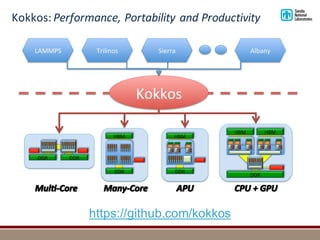
Kokkos:	Performance,	Portability	and	Productivity
DDR#
HBM#
DDR#
HBM#
DDR#DDR#
DDR#
HBM#HBM#
Kokkos#
LAMMPS# Sierra# Albany#Trilinos#
https://github.com/kokkos
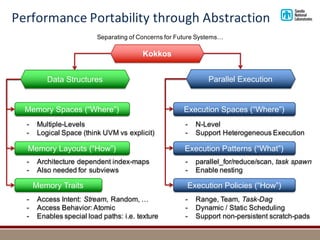
Performance	Portability	through	Abstraction
Kokkos
Execution Spaces (“Where”)
Execution Patterns (“What”)
Execution Policies (“How”)
- N-Level
- Support Heterogeneous Execution
- parallel_for/reduce/scan, task spawn
- Enable nesting
- Range, Team, Task-Dag
- Dynamic / Static Scheduling
- Support non-persistent scratch-pads
Memory Spaces (“Where”)
Memory Layouts (“How”)
Memory Traits
- Multiple-Levels
- Logical Space (think UVM vs explicit)
- Architecture dependent index-maps
- Also needed for subviews
- Access Intent: Stream, Random, …
- Access Behavior: Atomic
- Enables special load paths: i.e. texture
Parallel ExecutionData Structures
Separating of Concerns for Future Systems…
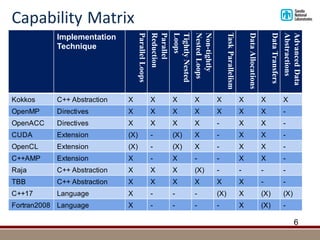
Capability	Matrix
6
Implementation
Technique
ParallelLoops
Parallel
Reduction
TightlyNested
Loops
Non-tightly
NestedLoops
TaskParallelism
DataAllocations
DataTransfers
AdvancedData
Abstractions
Kokkos C++ Abstraction X X X X X X X X
OpenMP Directives X X X X X X X -
OpenACC Directives X X X X - X X -
CUDA Extension (X) - (X) X - X X -
OpenCL Extension (X) - (X) X - X X -
C++AMP Extension X - X - - X X -
Raja C++ Abstraction X X X (X) - - - -
TBB C++ Abstraction X X X X X X - -
C++17 Language X - - - (X) X (X) (X)
Fortran2008 Language X - - - - X (X) -
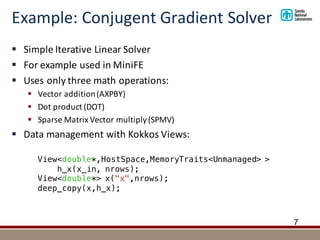
Example:	Conjugent Gradient	Solver
§ Simple	Iterative	Linear	Solver
§ For	example	used	in	MiniFE
§ Uses	only	three	math	operations:
§ Vector	addition	(AXPBY)
§ Dot	product	(DOT)
§ Sparse	Matrix	Vector	multiply	(SPMV)
§ Data	management	with	Kokkos	Views:
7
View<double*,HostSpace,MemoryTraits<Unmanaged> >
h_x(x_in, nrows);
View<double*> x("x",nrows);
deep_copy(x,h_x);
CG	Solve:	The	AXPBY
8
void axpby(int n, View<double*> z, double alpha, View<const double*> x,
double beta, View<const double*> y) {
parallel_for("AXpBY", n, KOKKOS_LAMBDA ( const int& i) {
z(i) = alpha*x(i) + beta*y(i);
});
}
§ Simple	data	parallel	loop:	Kokkos::parallel_for
§ Easy	to	express	in	most	programming	models
§ Bandwidth	bound
§ Serial	Implementation:	
§ Kokkos	Implementation:
void axpby(int n, double* z, double alpha, const double* x,
double beta, const double* y) {
for(int i=0; i<n; i++)
z[i] = alpha*x[i] + beta*y[i];
}
CG	Solve:	The	AXPBY
9
void axpby(int n, View<double*> z, double alpha, View<const double*> x,
double beta, View<const double*> y) {
parallel_for("AXpBY", n, KOKKOS_LAMBDA ( const int& i) {
z(i) = alpha*x(i) + beta*y(i);
});
}
§ Simple	data	parallel	loop:	Kokkos::parallel_for
§ Easy	to	express	in	most	programming	models
§ Bandwidth	bound
§ Serial	Implementation:	
§ Kokkos	Implementation:
void axpby(int n, double* z, double alpha, const double* x,
double beta, const double* y) {
for(int i=0; i<n; i++)
z[i] = alpha*x[i] + beta*y[i];
}
Parallel Pattern: for loop
CG	Solve:	The	AXPBY
10
void axpby(int n, View<double*> z, double alpha, View<const double*> x,
double beta, View<const double*> y) {
parallel_for("AXpBY", n, KOKKOS_LAMBDA ( const int& i) {
z(i) = alpha*x(i) + beta*y(i);
});
}
§ Simple	data	parallel	loop:	Kokkos::parallel_for
§ Easy	to	express	in	most	programming	models
§ Bandwidth	bound
§ Serial	Implementation:	
§ Kokkos	Implementation:
void axpby(int n, double* z, double alpha, const double* x,
double beta, const double* y) {
for(int i=0; i<n; i++)
z[i] = alpha*x[i] + beta*y[i];
}
String Label: Profiling/Debugging
CG	Solve:	The	AXPBY
11
void axpby(int n, View<double*> z, double alpha, View<const double*> x,
double beta, View<const double*> y) {
parallel_for("AXpBY", n, KOKKOS_LAMBDA ( const int& i) {
z(i) = alpha*x(i) + beta*y(i);
});
}
§ Simple	data	parallel	loop:	Kokkos::parallel_for
§ Easy	to	express	in	most	programming	models
§ Bandwidth	bound
§ Serial	Implementation:	
§ Kokkos	Implementation:
void axpby(int n, double* z, double alpha, const double* x,
double beta, const double* y) {
for(int i=0; i<n; i++)
z[i] = alpha*x[i] + beta*y[i];
}
Execution Policy: do n iterations
CG	Solve:	The	AXPBY
12
void axpby(int n, View<double*> z, double alpha, View<const double*> x,
double beta, View<const double*> y) {
parallel_for("AXpBY", n, KOKKOS_LAMBDA ( const int& i) {
z(i) = alpha*x(i) + beta*y(i);
});
}
§ Simple	data	parallel	loop:	Kokkos::parallel_for
§ Easy	to	express	in	most	programming	models
§ Bandwidth	bound
§ Serial	Implementation:	
§ Kokkos	Implementation:
void axpby(int n, double* z, double alpha, const double* x,
double beta, const double* y) {
for(int i=0; i<n; i++)
z[i] = alpha*x[i] + beta*y[i];
}
Iteration handle: integer index
CG	Solve:	The	AXPBY
13
void axpby(int n, View<double*> z, double alpha, View<const double*> x,
double beta, View<const double*> y) {
parallel_for("AXpBY", n, KOKKOS_LAMBDA ( const int& i) {
z(i) = alpha*x(i) + beta*y(i);
});
}
§ Simple	data	parallel	loop:	Kokkos::parallel_for
§ Easy	to	express	in	most	programming	models
§ Bandwidth	bound
§ Serial	Implementation:	
§ Kokkos	Implementation:
void axpby(int n, double* z, double alpha, const double* x,
double beta, const double* y) {
for(int i=0; i<n; i++)
z[i] = alpha*x[i] + beta*y[i];
}
Loop Body
CG	Solve:	The	AXPBY
14
void axpby(int n, View<double*> z, double alpha, View<const double*> x,
double beta, View<const double*> y) {
parallel_for("AXpBY", n, KOKKOS_LAMBDA ( const int& i) {
z(i) = alpha*x(i) + beta*y(i);
});
}
§ Simple	data	parallel	loop:	Kokkos::parallel_for
§ Easy	to	express	in	most	programming	models
§ Bandwidth	bound
§ Serial	Implementation:	
§ Kokkos	Implementation:
void axpby(int n, double* z, double alpha, const double* x,
double beta, const double* y) {
for(int i=0; i<n; i++)
z[i] = alpha*x[i] + beta*y[i];
}
CG	Solve:	The	Dot	Product
15
double dot(int n, View<const double*> x, View<const double*> y) {
double x_dot_y = 0.0;
parallel_reduce("Dot",n, KOKKOS_LAMBDA (const int& i,double& sum) {
sum += x[i]*y[i];
}, x_dot_y);
return x_dot_y;
}
§ Simple	data	parallel	loop	with	reduction:	Kokkos::parallel_reduce
§ Non	trivial	in	CUDA	due	to	lack	of	built-in	reduction	support
§ Bandwidth	bound
§ Serial	Implementation:	
§ Kokkos	Implementation:
double dot(int n, const double* x, const double* y) {
double sum = 0.0;
for(int i=0; i<n; i++)
sum += x[i]*y[i];
return sum;
}
CG	Solve:	The	Dot	Product
16
double dot(int n, View<const double*> x, View<const double*> y) {
double x_dot_y = 0.0;
parallel_reduce("Dot",n, KOKKOS_LAMBDA (const int& i,double& sum) {
sum += x[i]*y[i];
}, x_dot_y);
return x_dot_y;
}
§ Simple	data	parallel	loop	with	reduction:	Kokkos::parallel_reduce
§ Non	trivial	in	CUDA	due	to	lack	of	built-in	reduction	support
§ Bandwidth	bound
§ Serial	Implementation:	
§ Kokkos	Implementation:
double dot(int n, const double* x, const double* y) {
double sum = 0.0;
for(int i=0; i<n; i++)
sum += x[i]*y[i];
return sum;
} Parallel Pattern: loop with reduction
CG	Solve:	The	Dot	Product
17
double dot(int n, View<const double*> x, View<const double*> y) {
double x_dot_y = 0.0;
parallel_reduce("Dot",n, KOKKOS_LAMBDA (const int& i,double& sum) {
sum += x[i]*y[i];
}, x_dot_y);
return x_dot_y;
}
§ Simple	data	parallel	loop	with	reduction:	Kokkos::parallel_reduce
§ Non	trivial	in	CUDA	due	to	lack	of	built-in	reduction	support
§ Bandwidth	bound
§ Serial	Implementation:	
§ Kokkos	Implementation:
double dot(int n, const double* x, const double* y) {
double sum = 0.0;
for(int i=0; i<n; i++)
sum += x[i]*y[i];
return sum;
} Iteration Index + Thread-Local Red. Varible
CG	Solve:	The	Dot	Product
18
double dot(int n, View<const double*> x, View<const double*> y) {
double x_dot_y = 0.0;
parallel_reduce("Dot",n, KOKKOS_LAMBDA (const int& i,double& sum) {
sum += x[i]*y[i];
}, x_dot_y);
return x_dot_y;
}
§ Simple	data	parallel	loop	with	reduction:	Kokkos::parallel_reduce
§ Non	trivial	in	CUDA	due	to	lack	of	built-in	reduction	support
§ Bandwidth	bound
§ Serial	Implementation:	
§ Kokkos	Implementation:
double dot(int n, const double* x, const double* y) {
double sum = 0.0;
for(int i=0; i<n; i++)
sum += x[i]*y[i];
return sum;
}
CG	Solve:	The	SPMV
§ Loop	over	rows
§ Dot	product	of	matrix	row	with	a	vector
§ Example	of	Non-Tightly	nested	loops
§ Random	access	on	the	vector	(Texture	fetch	on	GPUs)
19
void SPMV(int nrows, const int* A_row_offsets, const int* A_cols,
const double* A_vals, double* y, const double* x) {
for(int row=0; row<nrows; ++row) {
double sum = 0.0;
int row_start=A_row_offsets[row];
int row_end=A_row_offsets[row+1];
for(int i=row_start; i<row_end; ++i) {
sum += A_vals[i]*x[A_cols[i]];
}
y[row] = sum;
}
}
CG	Solve:	The	SPMV
§ Loop	over	rows
§ Dot	product	of	matrix	row	with	a	vector
§ Example	of	Non-Tightly	nested	loops
§ Random	access	on	the	vector	(Texture	fetch	on	GPUs)
20
void SPMV(int nrows, const int* A_row_offsets, const int* A_cols,
const double* A_vals, double* y, const double* x) {
for(int row=0; row<nrows; ++row) {
double sum = 0.0;
int row_start=A_row_offsets[row];
int row_end=A_row_offsets[row+1];
for(int i=row_start; i<row_end; ++i) {
sum += A_vals[i]*x[A_cols[i]];
}
y[row] = sum;
}
}
Outer loop over matrix rows
CG	Solve:	The	SPMV
§ Loop	over	rows
§ Dot	product	of	matrix	row	with	a	vector
§ Example	of	Non-Tightly	nested	loops
§ Random	access	on	the	vector	(Texture	fetch	on	GPUs)
21
void SPMV(int nrows, const int* A_row_offsets, const int* A_cols,
const double* A_vals, double* y, const double* x) {
for(int row=0; row<nrows; ++row) {
double sum = 0.0;
int row_start=A_row_offsets[row];
int row_end=A_row_offsets[row+1];
for(int i=row_start; i<row_end; ++i) {
sum += A_vals[i]*x[A_cols[i]];
}
y[row] = sum;
}
}
Inner dot product row x vector
CG	Solve:	The	SPMV
§ Loop	over	rows
§ Dot	product	of	matrix	row	with	a	vector
§ Example	of	Non-Tightly	nested	loops
§ Random	access	on	the	vector	(Texture	fetch	on	GPUs)
22
void SPMV(int nrows, const int* A_row_offsets, const int* A_cols,
const double* A_vals, double* y, const double* x) {
for(int row=0; row<nrows; ++row) {
double sum = 0.0;
int row_start=A_row_offsets[row];
int row_end=A_row_offsets[row+1];
for(int i=row_start; i<row_end; ++i) {
sum += A_vals[i]*x[A_cols[i]];
}
y[row] = sum;
}
}
CG	Solve:	The	SPMV
23
void SPMV(int nrows, View<const int*> A_row_offsets,
View<const int*> A_cols, View<const double*> A_vals,
View<double*> y,
View<const double*, MemoryTraits< RandomAccess>> x) {
#ifdef KOKKOS_ENABLE_CUDA
int rows_per_team = 64;int team_size = 64;
#else
int rows_per_team = 512;int team_size = 1;
#endif
parallel_for("SPMV:Hierarchy", TeamPolicy< Schedule< Static > >
((nrows+rows_per_team-1)/rows_per_team,team_size,8),
KOKKOS_LAMBDA (const TeamPolicy<>::member_type& team) {
const int first_row = team.league_rank()*rows_per_team;
const int last_row = first_row+rows_per_team<nrows? first_row+rows_per_team : nrows;
parallel_for(TeamThreadRange(team,first_row,last_row),[&] (const int row) {
const int row_start=A_row_offsets[row];
const int row_length=A_row_offsets[row+1]-row_start;
double y_row;
parallel_reduce(ThreadVectorRange(team,row_length),[=] (const int i,double& sum) {
sum += A_vals(i+row_start)*x(A_cols(i+row_start));
} , y_row);
y(row) = y_row;
});
});
}
CG	Solve:	The	SPMV
24
void SPMV(int nrows, View<const int*> A_row_offsets,
View<const int*> A_cols, View<const double*> A_vals,
View<double*> y,
View<const double*, MemoryTraits< RandomAccess>> x) {
#ifdef KOKKOS_ENABLE_CUDA
int rows_per_team = 64;int team_size = 64;
#else
int rows_per_team = 512;int team_size = 1;
#endif
parallel_for("SPMV:Hierarchy", TeamPolicy< Schedule< Static > >
((nrows+rows_per_team-1)/rows_per_team,team_size,8),
KOKKOS_LAMBDA (const TeamPolicy<>::member_type& team) {
const int first_row = team.league_rank()*rows_per_team;
const int last_row = first_row+rows_per_team<nrows? first_row+rows_per_team : nrows;
parallel_for(TeamThreadRange(team,first_row,last_row),[&] (const int row) {
const int row_start=A_row_offsets[row];
const int row_length=A_row_offsets[row+1]-row_start;
double y_row;
parallel_reduce(ThreadVectorRange(team,row_length),[=] (const int i,double& sum) {
sum += A_vals(i+row_start)*x(A_cols(i+row_start));
} , y_row);
y(row) = y_row;
});
});
}
Team Parallelism over Row Worksets
CG	Solve:	The	SPMV
25
void SPMV(int nrows, View<const int*> A_row_offsets,
View<const int*> A_cols, View<const double*> A_vals,
View<double*> y,
View<const double*, MemoryTraits< RandomAccess>> x) {
#ifdef KOKKOS_ENABLE_CUDA
int rows_per_team = 64;int team_size = 64;
#else
int rows_per_team = 512;int team_size = 1;
#endif
parallel_for("SPMV:Hierarchy", TeamPolicy< Schedule< Static > >
((nrows+rows_per_team-1)/rows_per_team,team_size,8),
KOKKOS_LAMBDA (const TeamPolicy<>::member_type& team) {
const int first_row = team.league_rank()*rows_per_team;
const int last_row = first_row+rows_per_team<nrows? first_row+rows_per_team : nrows;
parallel_for(TeamThreadRange(team,first_row,last_row),[&] (const int row) {
const int row_start=A_row_offsets[row];
const int row_length=A_row_offsets[row+1]-row_start;
double y_row;
parallel_reduce(ThreadVectorRange(team,row_length),[=] (const int i,double& sum) {
sum += A_vals(i+row_start)*x(A_cols(i+row_start));
} , y_row);
y(row) = y_row;
});
});
}
Distribute rows in workset over team-threads
CG	Solve:	The	SPMV
26
void SPMV(int nrows, View<const int*> A_row_offsets,
View<const int*> A_cols, View<const double*> A_vals,
View<double*> y,
View<const double*, MemoryTraits< RandomAccess>> x) {
#ifdef KOKKOS_ENABLE_CUDA
int rows_per_team = 64;int team_size = 64;
#else
int rows_per_team = 512;int team_size = 1;
#endif
parallel_for("SPMV:Hierarchy", TeamPolicy< Schedule< Static > >
((nrows+rows_per_team-1)/rows_per_team,team_size,8),
KOKKOS_LAMBDA (const TeamPolicy<>::member_type& team) {
const int first_row = team.league_rank()*rows_per_team;
const int last_row = first_row+rows_per_team<nrows? first_row+rows_per_team : nrows;
parallel_for(TeamThreadRange(team,first_row,last_row),[&] (const int row) {
const int row_start=A_row_offsets[row];
const int row_length=A_row_offsets[row+1]-row_start;
double y_row;
parallel_reduce(ThreadVectorRange(team,row_length),[=] (const int i,double& sum) {
sum += A_vals(i+row_start)*x(A_cols(i+row_start));
} , y_row);
y(row) = y_row;
});
});
} Row x Vector dot product
CG	Solve:	The	SPMV
27
void SPMV(int nrows, View<const int*> A_row_offsets,
View<const int*> A_cols, View<const double*> A_vals,
View<double*> y,
View<const double*, MemoryTraits< RandomAccess>> x) {
#ifdef KOKKOS_ENABLE_CUDA
int rows_per_team = 64;int team_size = 64;
#else
int rows_per_team = 512;int team_size = 1;
#endif
parallel_for("SPMV:Hierarchy", TeamPolicy< Schedule< Static > >
((nrows+rows_per_team-1)/rows_per_team,team_size,8),
KOKKOS_LAMBDA (const TeamPolicy<>::member_type& team) {
const int first_row = team.league_rank()*rows_per_team;
const int last_row = first_row+rows_per_team<nrows? first_row+rows_per_team : nrows;
parallel_for(TeamThreadRange(team,first_row,last_row),[&] (const int row) {
const int row_start=A_row_offsets[row];
const int row_length=A_row_offsets[row+1]-row_start;
double y_row;
parallel_reduce(ThreadVectorRange(team,row_length),[=] (const int i,double& sum) {
sum += A_vals(i+row_start)*x(A_cols(i+row_start));
} , y_row);
y(row) = y_row;
});
});
}
CG	Solve:	Performance
28
0
10
20
30
40
50
60
70
80
90
AXPBY-100 AXPBY-200 DOT-100 DOT-200 SPMV-100 SPMV-200
Performance	[Gflop/s]
NVIDIA	P100	/	IBM	Power8
OpenACC CUDA Kokkos OpenMP
0
10
20
30
40
50
60
AXPBY-100 AXPBY-200 DOT-100 DOT-200 SPMV-100 SPMV-200
Performance	[Gflop/s]
Intel	KNL	7250	
OpenACC Kokkos OpenMP TBB	(Flat) TBB	(Hierarchical)
§ Comparison	with	other	
Programming	Models	
§ Straight	forward	
implementation	of	
kernels
§ OpenMP	4.5	is	
immature	at	this	point
§ Two	problem	sizes:	
100x100x100	and	
200x200x200	elements
Custom	Reductions	With	Lambdas
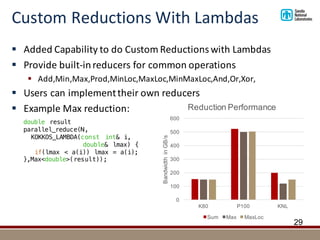
§ Added	Capability	to	do	Custom	Reductions	with	Lambdas
§ Provide	built-in	reducers	for	common	operations
§ Add,Min,Max,Prod,MinLoc,MaxLoc,MinMaxLoc,And,Or,Xor,
§ Users	can	implement	their	own	reducers
§ Example	Max	reduction:
29
double result
parallel_reduce(N,
KOKKOS_LAMBDA(const int& i,
double& lmax) {
if(lmax < a(i)) lmax = a(i);
},Max<double>(result));
0
100
200
300
400
500
600
K80 P100 KNL
BandwidthinGB/s
Reduction Performance
Sum Max MaxLoc
New	Features:	MDRangePolicy
§ Many	people	perform	structured	grid	calculations	
§ Sandia’s	codes	are	predominantly	unstructured	though
§ MDRangePolicy introduced	for	tightly	nested	loops
§ Usecase corresponding	to	OpenMP	collapse	clause
§ Optionally	set	iteration	order	and	tiling:
30
void launch (int N0, int N1, [ARGS]) {
parallel_for(MDRangePolicy<Rank<3>>({0,0,0},{N0,N1,N2}),
KOKKOS_LAMBDA (int i0, int i1)
{/*...*/});
}
MDRangePolicy<Rank<3,Iterate::Right,Iterate::Left>>
({0,0,0},{N0,N1,N2},{T0,T1,T2})
0
100
200
300
400
500
600
KNL P100
Gflop/s
Albany Kernel
Naïve Best Raw MDRange
New	Features:	Task	Graphs
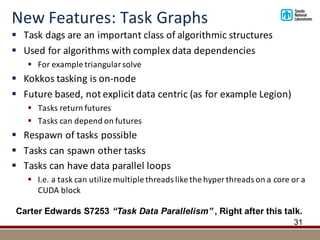
§ Task	dags are	an	important	class	of	algorithmic	structures
§ Used	for	algorithms	with	complex	data	dependencies
§ For	example	triangular	solve
§ Kokkos	tasking	is	on-node
§ Future	based,	not	explicit	data	centric	(as	for	example	Legion)
§ Tasks	return	futures
§ Tasks	can	depend	on	futures
§ Respawn	of	tasks	possible
§ Tasks	can	spawn	other	tasks
§ Tasks	can	have	data	parallel	loops	
§ I.e.	a	task	can	utilize	multiple	threads	like	the	hyper	threads	on	a	core	or	a	
CUDA	block
31
Carter Edwards S7253 “Task Data Parallelism” , Right after this talk.
New	Features:	Pascal	Support
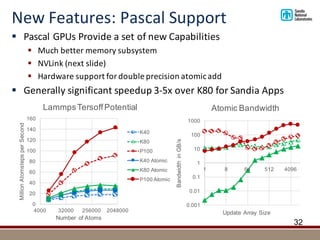
§ Pascal	GPUs	Provide	a	set	of	new	Capabilities
§ Much	better	memory	subsystem
§ NVLink (next	slide)
§ Hardware	support	for	double	precision	atomic	add
§ Generally	significant	speedup	3-5x	over	K80	for	Sandia	Apps
32
0
20
40
60
80
100
120
140
160
4000 32000 256000 2048000
MillionAtomstepsperSecond
Number of Atoms
LammpsTersoffPotential
K40
K80
P100
K40 Atomic
K80 Atomic
P100 Atomic
0.001
0.01
0.1
1
10
100
1000
1 8 64 512 4096
BandwidthinGB/s
Update Array Size
Atomic Bandwidth
New	Features:	HBM	Support
§ New	architectures	with	HBM:	Intel	KNL,	NVIDIA	P100	
§ Generally	three	types	of	allocations:
§ Page	pinned	in	DDR
§ Page	pinned	in	HBM
§ Page	migratable by	OS	or	hardware	caching
§ Kokkos	supports	all	three	on	both	architectures
§ For	Cuda backend:	CudaHostPinnedSpace,CudaSpace and	CudaUVMSpace
§ E.g.:	Kokkos::View<double*,	CudaUVMSpace>	a(”A”,N);
§ P100	Bandwidth	with	and	without	data	Reuse
33
1
10
100
1000
0.125 0.25 0.5 1 2 4 8 16 32 64
BandwidthGB/s
Problem Size [GB]
HostPinned 1
HostPinned 32
UVM 1
UVM 32
Upcoming	Features
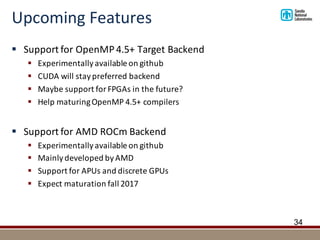
§ Support	for	OpenMP	4.5+	Target	Backend
§ Experimentally	available	on	github
§ CUDA	will	stay	preferred	backend
§ Maybe	support	for	FPGAs	in	the	future?
§ Help	maturing	OpenMP	4.5+	compilers
§ Support	for	AMD	ROCm Backend
§ Experimentally	available on	github
§ Mainly	developed	by	AMD
§ Support	for	APUs	and	discrete	GPUs
§ Expect	maturation	fall	2017
34
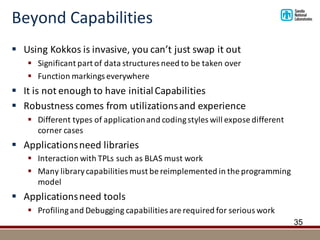
Beyond	Capabilities
§ Using	Kokkos	is	invasive,	you	can’t	just	swap	it	out
§ Significant	part	of	data	structures	need	to	be	taken	over
§ Function	markings	everywhere
§ It	is	not	enough	to	have	initial	Capabilities
§ Robustness	comes	from	utilizations	and	experience
§ Different	types	of	application	and	coding	styles	will	expose	different	
corner	cases
§ Applications	need	libraries
§ Interaction	with	TPLs	such	as	BLAS	must	work
§ Many	library	capabilities	must	be	reimplemented in	the	programming	
model
§ Applications	need	tools
§ Profiling	and	Debugging	capabilities	are	required	for	serious	work
35
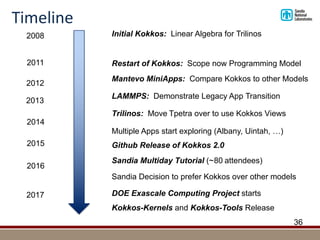
Timeline
36
Initial Kokkos: Linear Algebra for Trilinos
Restart of Kokkos: Scope now Programming Model
Mantevo MiniApps: Compare Kokkos to other Models
LAMMPS: Demonstrate Legacy App Transition
Trilinos: Move Tpetra over to use Kokkos Views
Multiple Apps start exploring (Albany, Uintah, …)
Sandia Multiday Tutorial (~80 attendees)
Sandia Decision to prefer Kokkos over other models
Github Release of Kokkos 2.0
Kokkos-Kernels and Kokkos-Tools Release
DOE Exascale Computing Project starts
2008
2011
2013
2012
2014
2016
2015
2017
17"
0"
2000"
4000"
6000"
8000"
10000"
12000"
14000"
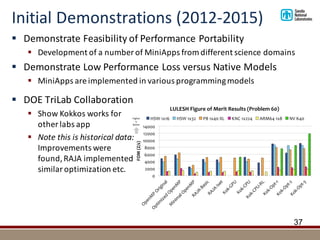
FOM+(Z/s)+
LULESH+Figure+of+Merit+Results+(Problem+60)+
HSW"1x16" HSW"1x32" P8"1x40"XL" KNC"1x224" ARM64"1x8" NV"K40"Higher"
is"
Better"
Results"by"Dennis"Dinge,"Christian"Trott"and"Si"Hammond"
Initial	Demonstrations	(2012-2015)
37
§ Demonstrate	Feasibility	of	Performance	Portability
§ Development	of	a	number	of	MiniApps from	different	science	domains
§ Demonstrate	Low	Performance	Loss	versus	Native	Models
§ MiniApps are	implemented	in	various	programming	models
§ DOE	TriLab Collaboration
§ Show	Kokkos works	for	
other	labs	app
§ Note	this	is	historical	data:	
Improvements	were	
found,	RAJA	implemented	
similar	optimization	etc.
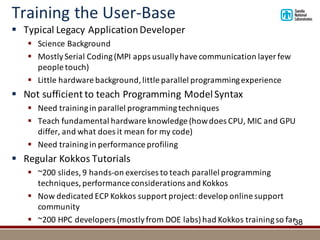
Training	the	User-Base
§ Typical	Legacy	Application	Developer
§ Science	Background
§ Mostly	Serial	Coding	(MPI	apps	usually	have	communication	layer	few	
people	touch)
§ Little	hardware	background,	little	parallel	programming	experience
§ Not	sufficient	to	teach	Programming	Model	Syntax
§ Need	training	in	parallel	programming	techniques
§ Teach	fundamental	hardware	knowledge	(how	does	CPU,	MIC	and	GPU	
differ,	and	what	does	it	mean	for	my	code)
§ Need	training	in	performance	profiling
§ Regular	Kokkos Tutorials
§ ~200	slides,	9	hands-on	exercises	to	teach	parallel	programming	
techniques,	performance	considerations	and	Kokkos
§ Now	dedicated	ECP	Kokkos	support	project:	develop	online	support	
community
§ ~200	HPC	developers	(mostly	from	DOE	labs)	had	Kokkos	training	so	far38
Keeping	Applications	Happy
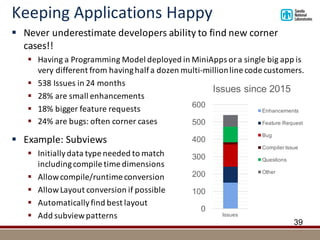
§ Never	underestimate	developers	ability	to	find	new	corner	
cases!!
§ Having	a	Programming	Model	deployed	in	MiniApps or	a	single	big	app	is	
very	different	from	having	half	a	dozen	multi-million	line	code	customers.
§ 538	Issues	in	24	months
§ 28%	are	small	enhancements
§ 18%	bigger	feature	requests
§ 24%	are	bugs:	often	corner	cases
39
0
100
200
300
400
500
600
Issues
Issues since 2015
Enhancements
Feature Request
Bug
Compiler Issue
Questions
Other
§ Example:	Subviews
§ Initially	data	type	needed	to	match	
including	compile	time	dimensions
§ Allow	compile/runtime	conversion
§ Allow	Layout	conversion	if	possible
§ Automatically	find	best	layout
§ Add	subviewpatterns
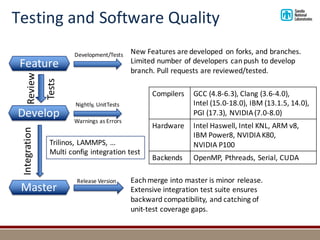
Testing	and	Software	Quality
Develop
Release	Version
Compilers GCC	(4.8-6.3),	Clang (3.6-4.0),	
Intel	(15.0-18.0),	IBM	(13.1.5,	14.0),	
PGI	(17.3),	NVIDIA	(7.0-8.0)
Hardware Intel	Haswell,	Intel	KNL,	ARM	v8,
IBM	Power8,	NVIDIA	K80,	
NVIDIA	P100
Backends OpenMP,	Pthreads,	Serial,	CUDA
Warnings	as	Errors
Feature
Development/Tests
Review
Tests
Master
Integration
Trilinos,	LAMMPS,	…
Multi	config	integration	test
Nightly,	UnitTests
New	Features	are	developed	 on	forks,	and	branches.	
Limited	number	of	developers	can	push	to	develop	
branch.	Pull	requests	are	reviewed/tested.
Each	merge	into	master	is	minor	release.	
Extensive	integration	test	suite	ensures	
backward	compatibility,	and	catching	of	
unit-test	coverage	gaps.
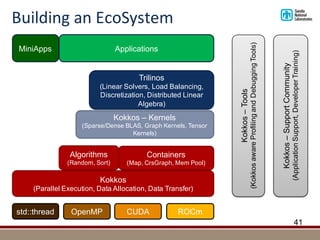
Building	an	EcoSystem
41
Algorithms
(Random, Sort)
Containers
(Map, CrsGraph, Mem Pool)
Kokkos
(Parallel Execution, Data Allocation, Data Transfer)
Kokkos – Kernels
(Sparse/Dense BLAS, Graph Kernels, Tensor
Kernels)
Kokkos–Tools
(KokkosawareProfilingandDebuggingTools)
Trilinos
(Linear Solvers, Load Balancing,
Discretization, Distributed Linear
Algebra)
Kokkos–SupportCommunity
(ApplicationSupport,DeveloperTraining)
ApplicationsMiniApps
std::thread OpenMP CUDA ROCm
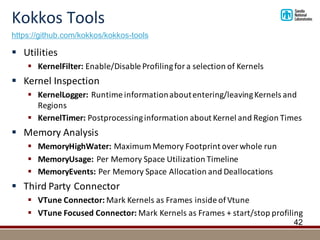
Kokkos	Tools
42
§ Utilities
§ KernelFilter: Enable/Disable	Profiling	for	a	selection	of	Kernels
§ Kernel	Inspection
§ KernelLogger:	Runtime	information	about	entering/leaving	Kernels	and	
Regions
§ KernelTimer:	Postprocessinginformation	about	Kernel	and	Region	Times
§ Memory	Analysis
§ MemoryHighWater: Maximum	Memory	Footprint	over	whole	run
§ MemoryUsage:	Per	Memory	Space	Utilization	Timeline
§ MemoryEvents:	Per	Memory	Space	Allocation	and	Deallocations
§ Third	Party	Connector
§ VTune Connector:	Mark	Kernels	as	Frames	inside	of	Vtune
§ VTune Focused	Connector:	Mark	Kernels	as	Frames	+	start/stop	profiling
https://github.com/kokkos/kokkos-tools
Kokkos-Tools:	Example	MemUsage
§ Tools	are	loaded	at	runtime
§ Profile	actual	release	builds	of	applications
§ Set	via:	export	KOKKOS_PROFILE_LIBRARY=[PATH_TO_PROFILING_LIB]
§ Output	depends	on	tool
§ Often	per	process	file
§ MemoryUsage provides	per	MemorySpace utilization	timelines
§ Time	starts	with	Kokkos::initialize
§ HOSTNAME-PROCESSID-CudaUVM.memspace_usage
43
# Space CudaUVM
# Time(s) Size(MB) HighWater(MB) HighWater-Process(MB)
0.317260 38.1 38.1 81.8
0.377285 0.0 38.1 158.1
0.384785 38.1 38.1 158.1
0.441988 0.0 38.1 158.1
Kokkos-Kernels
44
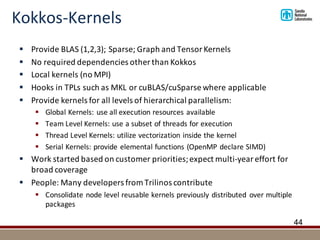
§ Provide	BLAS	(1,2,3);	Sparse;	Graph	and	Tensor	Kernels
§ No	required	dependencies	other	than	Kokkos
§ Local	kernels	(no	MPI)	
§ Hooks	in	TPLs	such	as	MKL	or	cuBLAS/cuSparse where	applicable
§ Provide	kernels	for	all	levels	of	hierarchical	parallelism:
§ Global	Kernels:	use	all	execution	resources	available
§ Team	Level	Kernels:	use	a	subset	of	threads	for	execution
§ Thread	Level	Kernels:	utilize	vectorization inside	the	kernel
§ Serial	Kernels:	provide	elemental	functions	(OpenMP declare	SIMD)
§ Work	started	based	on	customer	priorities;	expect	multi-year	effort	for	
broad	coverage
§ People:	Many	developers	from	Trilinos contribute
§ Consolidate	node	level	reusable	kernels	previously	distributed	 over	multiple	
packages
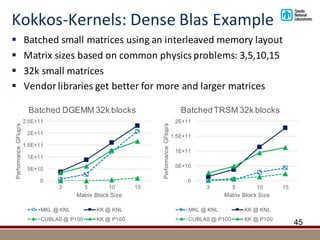
Kokkos-Kernels:	Dense	Blas	Example
45
0
5E+10
1E+11
1.5E+11
2E+11
2.5E+11
3 5 10 15
PerformanceGFlop/s
Matrix Block Size
Batched DGEMM 32k blocks
MKL @ KNL KK @ KNL
CUBLAS @ P100 KK @ P100
0
5E+10
1E+11
1.5E+11
2E+11
3 5 10 15
PerformanceGFlop/s
Matrix Block Size
BatchedTRSM 32k blocks
MKL @ KNL KK @ KNL
CUBLAS @ P100 KK @ P100
§ Batched	small	matrices	using	an	interleaved	memory	layout
§ Matrix	sizes	based	on	common	physics	problems:	3,5,10,15
§ 32k	small	matrices	
§ Vendor	libraries	get	better	for	more	and	larger	matrices
Kokkos	Users	Spread
46
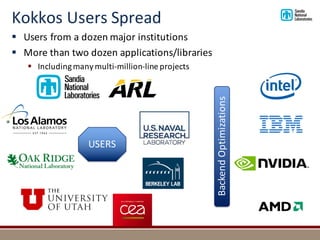
§ Users	from	a	dozen	major	institutions
§ More	than	two	dozen	applications/libraries
§ Including	many	multi-million-line	projects
UsersUSERS
Backend	Optimizations
Further	Material
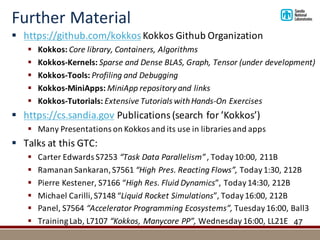
§ https://github.com/kokkosKokkos Github Organization
§ Kokkos: Core	library,	Containers,	Algorithms
§ Kokkos-Kernels: Sparse	and	Dense	BLAS,	Graph,	Tensor	(under	development)
§ Kokkos-Tools: Profiling	and	Debugging	
§ Kokkos-MiniApps: MiniApp repository	and	links
§ Kokkos-Tutorials: Extensive	Tutorials	with	Hands-On	Exercises
§ https://cs.sandia.gov Publications	(search	for	’Kokkos’)
§ Many	Presentations	on	Kokkos and	its	use	in	libraries	and	apps
§ Talks	at	this	GTC:
§ Carter	Edwards	S7253	“Task	Data	Parallelism”,	Today	10:00,	211B
§ Ramanan Sankaran,	S7561	“High	Pres.	Reacting	Flows”,	Today	1:30,	212B
§ Pierre	Kestener,	S7166	“High	Res.	Fluid	Dynamics”,	Today	14:30,	212B
§ Michael	Carilli,	S7148	“Liquid	Rocket	Simulations”,	Today	16:00,	212B
§ Panel,	S7564	“Accelerator	Programming	Ecosystems”,	Tuesday	16:00,	Ball3
§ Training	Lab,	L7107	“Kokkos,	Manycore PP”,	Wednesday	16:00,	LL21E 47
http://www.github.com/kokkos

The Kokkos C++ Performance Portability EcoSystem

  • 1.
    Sandia National Laboratoriesis a multimission laboratory managed and operated by National Technology and Engineering Solutions of Sandia, LLC., a wholly owned subsidiary of Honeywell International, Inc., for the U.S. Department of Energy’s National Nuclear Security Administration under contract DE-NA-0003525. Kokkos: The C++ Performance Portability Programming Model Christian Trott (crtrott@sandia.gov), Carter Edwards D. Sunderland, N. Ellingwood, D. Ibanez, S. Hammond, S. Rajamanickam, K. Kim, M. Deveci, M. Hoemmen, G. Center for Computing Research, Sandia National Laboratories, NM SAND2017-4935 C
  • 2.
    New Programming Models § HPC is at a Crossroads § Diversifying Hardware Architectures §More parallelism necessitates paradigm shift from MPI-only § Need for New Programming Models § Performance Portability: OpenMP 4.5, OpenACC, Kokkos, RAJA, SyCL, C++20?, … § Resilience and Load Balancing: Legion, HPX, UPC++, ... § Vendor decoupling drives external development 2
  • 3.
    New Programming Models § HPC is at a Crossroads § Diversifying Hardware Architectures §More parallelism necessitates paradigm shift from MPI-only § Need for New Programming Models § Performance Portability: OpenMP 4.5, OpenACC, Kokkos, RAJA, SyCL, C++20?, … § Resilience and Load Balancing: Legion, HPX, UPC++, ... § Vendor decoupling drives external development 3 What is Kokkos? What is new? Why should you trust us?
  • 4.
  • 5.
    Performance Portability through Abstraction Kokkos Execution Spaces (“Where”) ExecutionPatterns (“What”) Execution Policies (“How”) - N-Level - Support Heterogeneous Execution - parallel_for/reduce/scan, task spawn - Enable nesting - Range, Team, Task-Dag - Dynamic / Static Scheduling - Support non-persistent scratch-pads Memory Spaces (“Where”) Memory Layouts (“How”) Memory Traits - Multiple-Levels - Logical Space (think UVM vs explicit) - Architecture dependent index-maps - Also needed for subviews - Access Intent: Stream, Random, … - Access Behavior: Atomic - Enables special load paths: i.e. texture Parallel ExecutionData Structures Separating of Concerns for Future Systems…
  • 6.
    Capability Matrix 6 Implementation Technique ParallelLoops Parallel Reduction TightlyNested Loops Non-tightly NestedLoops TaskParallelism DataAllocations DataTransfers AdvancedData Abstractions Kokkos C++ AbstractionX X X X X X X X OpenMP Directives X X X X X X X - OpenACC Directives X X X X - X X - CUDA Extension (X) - (X) X - X X - OpenCL Extension (X) - (X) X - X X - C++AMP Extension X - X - - X X - Raja C++ Abstraction X X X (X) - - - - TBB C++ Abstraction X X X X X X - - C++17 Language X - - - (X) X (X) (X) Fortran2008 Language X - - - - X (X) -
  • 7.
    Example: Conjugent Gradient Solver § Simple Iterative Linear Solver §For example used in MiniFE § Uses only three math operations: § Vector addition (AXPBY) § Dot product (DOT) § Sparse Matrix Vector multiply (SPMV) § Data management with Kokkos Views: 7 View<double*,HostSpace,MemoryTraits<Unmanaged> > h_x(x_in, nrows); View<double*> x("x",nrows); deep_copy(x,h_x);
  • 8.
    CG Solve: The AXPBY 8 void axpby(int n,View<double*> z, double alpha, View<const double*> x, double beta, View<const double*> y) { parallel_for("AXpBY", n, KOKKOS_LAMBDA ( const int& i) { z(i) = alpha*x(i) + beta*y(i); }); } § Simple data parallel loop: Kokkos::parallel_for § Easy to express in most programming models § Bandwidth bound § Serial Implementation: § Kokkos Implementation: void axpby(int n, double* z, double alpha, const double* x, double beta, const double* y) { for(int i=0; i<n; i++) z[i] = alpha*x[i] + beta*y[i]; }
  • 9.
    CG Solve: The AXPBY 9 void axpby(int n,View<double*> z, double alpha, View<const double*> x, double beta, View<const double*> y) { parallel_for("AXpBY", n, KOKKOS_LAMBDA ( const int& i) { z(i) = alpha*x(i) + beta*y(i); }); } § Simple data parallel loop: Kokkos::parallel_for § Easy to express in most programming models § Bandwidth bound § Serial Implementation: § Kokkos Implementation: void axpby(int n, double* z, double alpha, const double* x, double beta, const double* y) { for(int i=0; i<n; i++) z[i] = alpha*x[i] + beta*y[i]; } Parallel Pattern: for loop
  • 10.
    CG Solve: The AXPBY 10 void axpby(int n,View<double*> z, double alpha, View<const double*> x, double beta, View<const double*> y) { parallel_for("AXpBY", n, KOKKOS_LAMBDA ( const int& i) { z(i) = alpha*x(i) + beta*y(i); }); } § Simple data parallel loop: Kokkos::parallel_for § Easy to express in most programming models § Bandwidth bound § Serial Implementation: § Kokkos Implementation: void axpby(int n, double* z, double alpha, const double* x, double beta, const double* y) { for(int i=0; i<n; i++) z[i] = alpha*x[i] + beta*y[i]; } String Label: Profiling/Debugging
  • 11.
    CG Solve: The AXPBY 11 void axpby(int n,View<double*> z, double alpha, View<const double*> x, double beta, View<const double*> y) { parallel_for("AXpBY", n, KOKKOS_LAMBDA ( const int& i) { z(i) = alpha*x(i) + beta*y(i); }); } § Simple data parallel loop: Kokkos::parallel_for § Easy to express in most programming models § Bandwidth bound § Serial Implementation: § Kokkos Implementation: void axpby(int n, double* z, double alpha, const double* x, double beta, const double* y) { for(int i=0; i<n; i++) z[i] = alpha*x[i] + beta*y[i]; } Execution Policy: do n iterations
  • 12.
    CG Solve: The AXPBY 12 void axpby(int n,View<double*> z, double alpha, View<const double*> x, double beta, View<const double*> y) { parallel_for("AXpBY", n, KOKKOS_LAMBDA ( const int& i) { z(i) = alpha*x(i) + beta*y(i); }); } § Simple data parallel loop: Kokkos::parallel_for § Easy to express in most programming models § Bandwidth bound § Serial Implementation: § Kokkos Implementation: void axpby(int n, double* z, double alpha, const double* x, double beta, const double* y) { for(int i=0; i<n; i++) z[i] = alpha*x[i] + beta*y[i]; } Iteration handle: integer index
  • 13.
    CG Solve: The AXPBY 13 void axpby(int n,View<double*> z, double alpha, View<const double*> x, double beta, View<const double*> y) { parallel_for("AXpBY", n, KOKKOS_LAMBDA ( const int& i) { z(i) = alpha*x(i) + beta*y(i); }); } § Simple data parallel loop: Kokkos::parallel_for § Easy to express in most programming models § Bandwidth bound § Serial Implementation: § Kokkos Implementation: void axpby(int n, double* z, double alpha, const double* x, double beta, const double* y) { for(int i=0; i<n; i++) z[i] = alpha*x[i] + beta*y[i]; } Loop Body
  • 14.
    CG Solve: The AXPBY 14 void axpby(int n,View<double*> z, double alpha, View<const double*> x, double beta, View<const double*> y) { parallel_for("AXpBY", n, KOKKOS_LAMBDA ( const int& i) { z(i) = alpha*x(i) + beta*y(i); }); } § Simple data parallel loop: Kokkos::parallel_for § Easy to express in most programming models § Bandwidth bound § Serial Implementation: § Kokkos Implementation: void axpby(int n, double* z, double alpha, const double* x, double beta, const double* y) { for(int i=0; i<n; i++) z[i] = alpha*x[i] + beta*y[i]; }
  • 15.
    CG Solve: The Dot Product 15 double dot(int n,View<const double*> x, View<const double*> y) { double x_dot_y = 0.0; parallel_reduce("Dot",n, KOKKOS_LAMBDA (const int& i,double& sum) { sum += x[i]*y[i]; }, x_dot_y); return x_dot_y; } § Simple data parallel loop with reduction: Kokkos::parallel_reduce § Non trivial in CUDA due to lack of built-in reduction support § Bandwidth bound § Serial Implementation: § Kokkos Implementation: double dot(int n, const double* x, const double* y) { double sum = 0.0; for(int i=0; i<n; i++) sum += x[i]*y[i]; return sum; }
  • 16.
    CG Solve: The Dot Product 16 double dot(int n,View<const double*> x, View<const double*> y) { double x_dot_y = 0.0; parallel_reduce("Dot",n, KOKKOS_LAMBDA (const int& i,double& sum) { sum += x[i]*y[i]; }, x_dot_y); return x_dot_y; } § Simple data parallel loop with reduction: Kokkos::parallel_reduce § Non trivial in CUDA due to lack of built-in reduction support § Bandwidth bound § Serial Implementation: § Kokkos Implementation: double dot(int n, const double* x, const double* y) { double sum = 0.0; for(int i=0; i<n; i++) sum += x[i]*y[i]; return sum; } Parallel Pattern: loop with reduction
  • 17.
    CG Solve: The Dot Product 17 double dot(int n,View<const double*> x, View<const double*> y) { double x_dot_y = 0.0; parallel_reduce("Dot",n, KOKKOS_LAMBDA (const int& i,double& sum) { sum += x[i]*y[i]; }, x_dot_y); return x_dot_y; } § Simple data parallel loop with reduction: Kokkos::parallel_reduce § Non trivial in CUDA due to lack of built-in reduction support § Bandwidth bound § Serial Implementation: § Kokkos Implementation: double dot(int n, const double* x, const double* y) { double sum = 0.0; for(int i=0; i<n; i++) sum += x[i]*y[i]; return sum; } Iteration Index + Thread-Local Red. Varible
  • 18.
    CG Solve: The Dot Product 18 double dot(int n,View<const double*> x, View<const double*> y) { double x_dot_y = 0.0; parallel_reduce("Dot",n, KOKKOS_LAMBDA (const int& i,double& sum) { sum += x[i]*y[i]; }, x_dot_y); return x_dot_y; } § Simple data parallel loop with reduction: Kokkos::parallel_reduce § Non trivial in CUDA due to lack of built-in reduction support § Bandwidth bound § Serial Implementation: § Kokkos Implementation: double dot(int n, const double* x, const double* y) { double sum = 0.0; for(int i=0; i<n; i++) sum += x[i]*y[i]; return sum; }
  • 19.
    CG Solve: The SPMV § Loop over rows § Dot product of matrix row with a vector §Example of Non-Tightly nested loops § Random access on the vector (Texture fetch on GPUs) 19 void SPMV(int nrows, const int* A_row_offsets, const int* A_cols, const double* A_vals, double* y, const double* x) { for(int row=0; row<nrows; ++row) { double sum = 0.0; int row_start=A_row_offsets[row]; int row_end=A_row_offsets[row+1]; for(int i=row_start; i<row_end; ++i) { sum += A_vals[i]*x[A_cols[i]]; } y[row] = sum; } }
  • 20.
    CG Solve: The SPMV § Loop over rows § Dot product of matrix row with a vector §Example of Non-Tightly nested loops § Random access on the vector (Texture fetch on GPUs) 20 void SPMV(int nrows, const int* A_row_offsets, const int* A_cols, const double* A_vals, double* y, const double* x) { for(int row=0; row<nrows; ++row) { double sum = 0.0; int row_start=A_row_offsets[row]; int row_end=A_row_offsets[row+1]; for(int i=row_start; i<row_end; ++i) { sum += A_vals[i]*x[A_cols[i]]; } y[row] = sum; } } Outer loop over matrix rows
  • 21.
    CG Solve: The SPMV § Loop over rows § Dot product of matrix row with a vector §Example of Non-Tightly nested loops § Random access on the vector (Texture fetch on GPUs) 21 void SPMV(int nrows, const int* A_row_offsets, const int* A_cols, const double* A_vals, double* y, const double* x) { for(int row=0; row<nrows; ++row) { double sum = 0.0; int row_start=A_row_offsets[row]; int row_end=A_row_offsets[row+1]; for(int i=row_start; i<row_end; ++i) { sum += A_vals[i]*x[A_cols[i]]; } y[row] = sum; } } Inner dot product row x vector
  • 22.
    CG Solve: The SPMV § Loop over rows § Dot product of matrix row with a vector §Example of Non-Tightly nested loops § Random access on the vector (Texture fetch on GPUs) 22 void SPMV(int nrows, const int* A_row_offsets, const int* A_cols, const double* A_vals, double* y, const double* x) { for(int row=0; row<nrows; ++row) { double sum = 0.0; int row_start=A_row_offsets[row]; int row_end=A_row_offsets[row+1]; for(int i=row_start; i<row_end; ++i) { sum += A_vals[i]*x[A_cols[i]]; } y[row] = sum; } }
  • 23.
    CG Solve: The SPMV 23 void SPMV(int nrows,View<const int*> A_row_offsets, View<const int*> A_cols, View<const double*> A_vals, View<double*> y, View<const double*, MemoryTraits< RandomAccess>> x) { #ifdef KOKKOS_ENABLE_CUDA int rows_per_team = 64;int team_size = 64; #else int rows_per_team = 512;int team_size = 1; #endif parallel_for("SPMV:Hierarchy", TeamPolicy< Schedule< Static > > ((nrows+rows_per_team-1)/rows_per_team,team_size,8), KOKKOS_LAMBDA (const TeamPolicy<>::member_type& team) { const int first_row = team.league_rank()*rows_per_team; const int last_row = first_row+rows_per_team<nrows? first_row+rows_per_team : nrows; parallel_for(TeamThreadRange(team,first_row,last_row),[&] (const int row) { const int row_start=A_row_offsets[row]; const int row_length=A_row_offsets[row+1]-row_start; double y_row; parallel_reduce(ThreadVectorRange(team,row_length),[=] (const int i,double& sum) { sum += A_vals(i+row_start)*x(A_cols(i+row_start)); } , y_row); y(row) = y_row; }); }); }
  • 24.
    CG Solve: The SPMV 24 void SPMV(int nrows,View<const int*> A_row_offsets, View<const int*> A_cols, View<const double*> A_vals, View<double*> y, View<const double*, MemoryTraits< RandomAccess>> x) { #ifdef KOKKOS_ENABLE_CUDA int rows_per_team = 64;int team_size = 64; #else int rows_per_team = 512;int team_size = 1; #endif parallel_for("SPMV:Hierarchy", TeamPolicy< Schedule< Static > > ((nrows+rows_per_team-1)/rows_per_team,team_size,8), KOKKOS_LAMBDA (const TeamPolicy<>::member_type& team) { const int first_row = team.league_rank()*rows_per_team; const int last_row = first_row+rows_per_team<nrows? first_row+rows_per_team : nrows; parallel_for(TeamThreadRange(team,first_row,last_row),[&] (const int row) { const int row_start=A_row_offsets[row]; const int row_length=A_row_offsets[row+1]-row_start; double y_row; parallel_reduce(ThreadVectorRange(team,row_length),[=] (const int i,double& sum) { sum += A_vals(i+row_start)*x(A_cols(i+row_start)); } , y_row); y(row) = y_row; }); }); } Team Parallelism over Row Worksets
  • 25.
    CG Solve: The SPMV 25 void SPMV(int nrows,View<const int*> A_row_offsets, View<const int*> A_cols, View<const double*> A_vals, View<double*> y, View<const double*, MemoryTraits< RandomAccess>> x) { #ifdef KOKKOS_ENABLE_CUDA int rows_per_team = 64;int team_size = 64; #else int rows_per_team = 512;int team_size = 1; #endif parallel_for("SPMV:Hierarchy", TeamPolicy< Schedule< Static > > ((nrows+rows_per_team-1)/rows_per_team,team_size,8), KOKKOS_LAMBDA (const TeamPolicy<>::member_type& team) { const int first_row = team.league_rank()*rows_per_team; const int last_row = first_row+rows_per_team<nrows? first_row+rows_per_team : nrows; parallel_for(TeamThreadRange(team,first_row,last_row),[&] (const int row) { const int row_start=A_row_offsets[row]; const int row_length=A_row_offsets[row+1]-row_start; double y_row; parallel_reduce(ThreadVectorRange(team,row_length),[=] (const int i,double& sum) { sum += A_vals(i+row_start)*x(A_cols(i+row_start)); } , y_row); y(row) = y_row; }); }); } Distribute rows in workset over team-threads
  • 26.
    CG Solve: The SPMV 26 void SPMV(int nrows,View<const int*> A_row_offsets, View<const int*> A_cols, View<const double*> A_vals, View<double*> y, View<const double*, MemoryTraits< RandomAccess>> x) { #ifdef KOKKOS_ENABLE_CUDA int rows_per_team = 64;int team_size = 64; #else int rows_per_team = 512;int team_size = 1; #endif parallel_for("SPMV:Hierarchy", TeamPolicy< Schedule< Static > > ((nrows+rows_per_team-1)/rows_per_team,team_size,8), KOKKOS_LAMBDA (const TeamPolicy<>::member_type& team) { const int first_row = team.league_rank()*rows_per_team; const int last_row = first_row+rows_per_team<nrows? first_row+rows_per_team : nrows; parallel_for(TeamThreadRange(team,first_row,last_row),[&] (const int row) { const int row_start=A_row_offsets[row]; const int row_length=A_row_offsets[row+1]-row_start; double y_row; parallel_reduce(ThreadVectorRange(team,row_length),[=] (const int i,double& sum) { sum += A_vals(i+row_start)*x(A_cols(i+row_start)); } , y_row); y(row) = y_row; }); }); } Row x Vector dot product
  • 27.
    CG Solve: The SPMV 27 void SPMV(int nrows,View<const int*> A_row_offsets, View<const int*> A_cols, View<const double*> A_vals, View<double*> y, View<const double*, MemoryTraits< RandomAccess>> x) { #ifdef KOKKOS_ENABLE_CUDA int rows_per_team = 64;int team_size = 64; #else int rows_per_team = 512;int team_size = 1; #endif parallel_for("SPMV:Hierarchy", TeamPolicy< Schedule< Static > > ((nrows+rows_per_team-1)/rows_per_team,team_size,8), KOKKOS_LAMBDA (const TeamPolicy<>::member_type& team) { const int first_row = team.league_rank()*rows_per_team; const int last_row = first_row+rows_per_team<nrows? first_row+rows_per_team : nrows; parallel_for(TeamThreadRange(team,first_row,last_row),[&] (const int row) { const int row_start=A_row_offsets[row]; const int row_length=A_row_offsets[row+1]-row_start; double y_row; parallel_reduce(ThreadVectorRange(team,row_length),[=] (const int i,double& sum) { sum += A_vals(i+row_start)*x(A_cols(i+row_start)); } , y_row); y(row) = y_row; }); }); }
  • 28.
    CG Solve: Performance 28 0 10 20 30 40 50 60 70 80 90 AXPBY-100 AXPBY-200 DOT-100DOT-200 SPMV-100 SPMV-200 Performance [Gflop/s] NVIDIA P100 / IBM Power8 OpenACC CUDA Kokkos OpenMP 0 10 20 30 40 50 60 AXPBY-100 AXPBY-200 DOT-100 DOT-200 SPMV-100 SPMV-200 Performance [Gflop/s] Intel KNL 7250 OpenACC Kokkos OpenMP TBB (Flat) TBB (Hierarchical) § Comparison with other Programming Models § Straight forward implementation of kernels § OpenMP 4.5 is immature at this point § Two problem sizes: 100x100x100 and 200x200x200 elements
  • 29.
    Custom Reductions With Lambdas § Added Capability to do Custom Reductions with Lambdas § Provide built-in reducers for common operations §Add,Min,Max,Prod,MinLoc,MaxLoc,MinMaxLoc,And,Or,Xor, § Users can implement their own reducers § Example Max reduction: 29 double result parallel_reduce(N, KOKKOS_LAMBDA(const int& i, double& lmax) { if(lmax < a(i)) lmax = a(i); },Max<double>(result)); 0 100 200 300 400 500 600 K80 P100 KNL BandwidthinGB/s Reduction Performance Sum Max MaxLoc
  • 30.
    New Features: MDRangePolicy § Many people perform structured grid calculations § Sandia’s codes are predominantly unstructured though §MDRangePolicy introduced for tightly nested loops § Usecase corresponding to OpenMP collapse clause § Optionally set iteration order and tiling: 30 void launch (int N0, int N1, [ARGS]) { parallel_for(MDRangePolicy<Rank<3>>({0,0,0},{N0,N1,N2}), KOKKOS_LAMBDA (int i0, int i1) {/*...*/}); } MDRangePolicy<Rank<3,Iterate::Right,Iterate::Left>> ({0,0,0},{N0,N1,N2},{T0,T1,T2}) 0 100 200 300 400 500 600 KNL P100 Gflop/s Albany Kernel Naïve Best Raw MDRange
  • 31.
    New Features: Task Graphs § Task dags are an important class of algorithmic structures §Used for algorithms with complex data dependencies § For example triangular solve § Kokkos tasking is on-node § Future based, not explicit data centric (as for example Legion) § Tasks return futures § Tasks can depend on futures § Respawn of tasks possible § Tasks can spawn other tasks § Tasks can have data parallel loops § I.e. a task can utilize multiple threads like the hyper threads on a core or a CUDA block 31 Carter Edwards S7253 “Task Data Parallelism” , Right after this talk.
  • 32.
    New Features: Pascal Support § Pascal GPUs Provide a set of new Capabilities § Much better memory subsystem §NVLink (next slide) § Hardware support for double precision atomic add § Generally significant speedup 3-5x over K80 for Sandia Apps 32 0 20 40 60 80 100 120 140 160 4000 32000 256000 2048000 MillionAtomstepsperSecond Number of Atoms LammpsTersoffPotential K40 K80 P100 K40 Atomic K80 Atomic P100 Atomic 0.001 0.01 0.1 1 10 100 1000 1 8 64 512 4096 BandwidthinGB/s Update Array Size Atomic Bandwidth
  • 33.
    New Features: HBM Support § New architectures with HBM: Intel KNL, NVIDIA P100 § Generally three types of allocations: §Page pinned in DDR § Page pinned in HBM § Page migratable by OS or hardware caching § Kokkos supports all three on both architectures § For Cuda backend: CudaHostPinnedSpace,CudaSpace and CudaUVMSpace § E.g.: Kokkos::View<double*, CudaUVMSpace> a(”A”,N); § P100 Bandwidth with and without data Reuse 33 1 10 100 1000 0.125 0.25 0.5 1 2 4 8 16 32 64 BandwidthGB/s Problem Size [GB] HostPinned 1 HostPinned 32 UVM 1 UVM 32
  • 34.
    Upcoming Features § Support for OpenMP 4.5+ Target Backend § Experimentally available on github §CUDA will stay preferred backend § Maybe support for FPGAs in the future? § Help maturing OpenMP 4.5+ compilers § Support for AMD ROCm Backend § Experimentally available on github § Mainly developed by AMD § Support for APUs and discrete GPUs § Expect maturation fall 2017 34
  • 35.
    Beyond Capabilities § Using Kokkos is invasive, you can’t just swap it out § Significant part of data structures need to be taken over §Function markings everywhere § It is not enough to have initial Capabilities § Robustness comes from utilizations and experience § Different types of application and coding styles will expose different corner cases § Applications need libraries § Interaction with TPLs such as BLAS must work § Many library capabilities must be reimplemented in the programming model § Applications need tools § Profiling and Debugging capabilities are required for serious work 35
  • 36.
    Timeline 36 Initial Kokkos: LinearAlgebra for Trilinos Restart of Kokkos: Scope now Programming Model Mantevo MiniApps: Compare Kokkos to other Models LAMMPS: Demonstrate Legacy App Transition Trilinos: Move Tpetra over to use Kokkos Views Multiple Apps start exploring (Albany, Uintah, …) Sandia Multiday Tutorial (~80 attendees) Sandia Decision to prefer Kokkos over other models Github Release of Kokkos 2.0 Kokkos-Kernels and Kokkos-Tools Release DOE Exascale Computing Project starts 2008 2011 2013 2012 2014 2016 2015 2017
  • 37.
    17" 0" 2000" 4000" 6000" 8000" 10000" 12000" 14000" FOM+(Z/s)+ LULESH+Figure+of+Merit+Results+(Problem+60)+ HSW"1x16" HSW"1x32" P8"1x40"XL"KNC"1x224" ARM64"1x8" NV"K40"Higher" is" Better" Results"by"Dennis"Dinge,"Christian"Trott"and"Si"Hammond" Initial Demonstrations (2012-2015) 37 § Demonstrate Feasibility of Performance Portability § Development of a number of MiniApps from different science domains § Demonstrate Low Performance Loss versus Native Models § MiniApps are implemented in various programming models § DOE TriLab Collaboration § Show Kokkos works for other labs app § Note this is historical data: Improvements were found, RAJA implemented similar optimization etc.
  • 38.
    Training the User-Base § Typical Legacy Application Developer § Science Background §Mostly Serial Coding (MPI apps usually have communication layer few people touch) § Little hardware background, little parallel programming experience § Not sufficient to teach Programming Model Syntax § Need training in parallel programming techniques § Teach fundamental hardware knowledge (how does CPU, MIC and GPU differ, and what does it mean for my code) § Need training in performance profiling § Regular Kokkos Tutorials § ~200 slides, 9 hands-on exercises to teach parallel programming techniques, performance considerations and Kokkos § Now dedicated ECP Kokkos support project: develop online support community § ~200 HPC developers (mostly from DOE labs) had Kokkos training so far38
  • 39.
    Keeping Applications Happy § Never underestimate developers ability to find new corner cases!! § Having a Programming Model deployed in MiniAppsor a single big app is very different from having half a dozen multi-million line code customers. § 538 Issues in 24 months § 28% are small enhancements § 18% bigger feature requests § 24% are bugs: often corner cases 39 0 100 200 300 400 500 600 Issues Issues since 2015 Enhancements Feature Request Bug Compiler Issue Questions Other § Example: Subviews § Initially data type needed to match including compile time dimensions § Allow compile/runtime conversion § Allow Layout conversion if possible § Automatically find best layout § Add subviewpatterns
  • 40.
    Testing and Software Quality Develop Release Version Compilers GCC (4.8-6.3), Clang (3.6-4.0), Intel (15.0-18.0), IBM (13.1.5, 14.0), PGI (17.3), NVIDIA (7.0-8.0) HardwareIntel Haswell, Intel KNL, ARM v8, IBM Power8, NVIDIA K80, NVIDIA P100 Backends OpenMP, Pthreads, Serial, CUDA Warnings as Errors Feature Development/Tests Review Tests Master Integration Trilinos, LAMMPS, … Multi config integration test Nightly, UnitTests New Features are developed on forks, and branches. Limited number of developers can push to develop branch. Pull requests are reviewed/tested. Each merge into master is minor release. Extensive integration test suite ensures backward compatibility, and catching of unit-test coverage gaps.
  • 41.
    Building an EcoSystem 41 Algorithms (Random, Sort) Containers (Map, CrsGraph,Mem Pool) Kokkos (Parallel Execution, Data Allocation, Data Transfer) Kokkos – Kernels (Sparse/Dense BLAS, Graph Kernels, Tensor Kernels) Kokkos–Tools (KokkosawareProfilingandDebuggingTools) Trilinos (Linear Solvers, Load Balancing, Discretization, Distributed Linear Algebra) Kokkos–SupportCommunity (ApplicationSupport,DeveloperTraining) ApplicationsMiniApps std::thread OpenMP CUDA ROCm
  • 42.
    Kokkos Tools 42 § Utilities § KernelFilter:Enable/Disable Profiling for a selection of Kernels § Kernel Inspection § KernelLogger: Runtime information about entering/leaving Kernels and Regions § KernelTimer: Postprocessinginformation about Kernel and Region Times § Memory Analysis § MemoryHighWater: Maximum Memory Footprint over whole run § MemoryUsage: Per Memory Space Utilization Timeline § MemoryEvents: Per Memory Space Allocation and Deallocations § Third Party Connector § VTune Connector: Mark Kernels as Frames inside of Vtune § VTune Focused Connector: Mark Kernels as Frames + start/stop profiling https://github.com/kokkos/kokkos-tools
  • 43.
    Kokkos-Tools: Example MemUsage § Tools are loaded at runtime § Profile actual release builds of applications §Set via: export KOKKOS_PROFILE_LIBRARY=[PATH_TO_PROFILING_LIB] § Output depends on tool § Often per process file § MemoryUsage provides per MemorySpace utilization timelines § Time starts with Kokkos::initialize § HOSTNAME-PROCESSID-CudaUVM.memspace_usage 43 # Space CudaUVM # Time(s) Size(MB) HighWater(MB) HighWater-Process(MB) 0.317260 38.1 38.1 81.8 0.377285 0.0 38.1 158.1 0.384785 38.1 38.1 158.1 0.441988 0.0 38.1 158.1
  • 44.
    Kokkos-Kernels 44 § Provide BLAS (1,2,3); Sparse; Graph and Tensor Kernels § No required dependencies other than Kokkos §Local kernels (no MPI) § Hooks in TPLs such as MKL or cuBLAS/cuSparse where applicable § Provide kernels for all levels of hierarchical parallelism: § Global Kernels: use all execution resources available § Team Level Kernels: use a subset of threads for execution § Thread Level Kernels: utilize vectorization inside the kernel § Serial Kernels: provide elemental functions (OpenMP declare SIMD) § Work started based on customer priorities; expect multi-year effort for broad coverage § People: Many developers from Trilinos contribute § Consolidate node level reusable kernels previously distributed over multiple packages
  • 45.
    Kokkos-Kernels: Dense Blas Example 45 0 5E+10 1E+11 1.5E+11 2E+11 2.5E+11 3 5 1015 PerformanceGFlop/s Matrix Block Size Batched DGEMM 32k blocks MKL @ KNL KK @ KNL CUBLAS @ P100 KK @ P100 0 5E+10 1E+11 1.5E+11 2E+11 3 5 10 15 PerformanceGFlop/s Matrix Block Size BatchedTRSM 32k blocks MKL @ KNL KK @ KNL CUBLAS @ P100 KK @ P100 § Batched small matrices using an interleaved memory layout § Matrix sizes based on common physics problems: 3,5,10,15 § 32k small matrices § Vendor libraries get better for more and larger matrices
  • 46.
    Kokkos Users Spread 46 § Users from a dozen major institutions § More than two dozen applications/libraries §Including many multi-million-line projects UsersUSERS Backend Optimizations
  • 47.
    Further Material § https://github.com/kokkosKokkos GithubOrganization § Kokkos: Core library, Containers, Algorithms § Kokkos-Kernels: Sparse and Dense BLAS, Graph, Tensor (under development) § Kokkos-Tools: Profiling and Debugging § Kokkos-MiniApps: MiniApp repository and links § Kokkos-Tutorials: Extensive Tutorials with Hands-On Exercises § https://cs.sandia.gov Publications (search for ’Kokkos’) § Many Presentations on Kokkos and its use in libraries and apps § Talks at this GTC: § Carter Edwards S7253 “Task Data Parallelism”, Today 10:00, 211B § Ramanan Sankaran, S7561 “High Pres. Reacting Flows”, Today 1:30, 212B § Pierre Kestener, S7166 “High Res. Fluid Dynamics”, Today 14:30, 212B § Michael Carilli, S7148 “Liquid Rocket Simulations”, Today 16:00, 212B § Panel, S7564 “Accelerator Programming Ecosystems”, Tuesday 16:00, Ball3 § Training Lab, L7107 “Kokkos, Manycore PP”, Wednesday 16:00, LL21E 47
  • 48.