oneAPI DPC++ Workshop
9th December 2020
Intel Confidential 2
Agenda
• Intel® oneAPI
• Introduction
• DPC++
• Introduction
• DPC++ “Hello world”
• Lab
• Intel® DPC++ Compatibility Tool
• Introduction
• Demo
Optimization Notice
2
Introduction to Intel®
oneAPI
Intel Confidential 4
XPUs
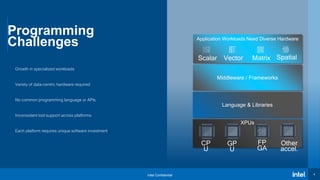
Programming
Challenges
Growth in specialized workloads
Variety of data-centric hardware required
No common programming language or APIs
Inconsistent tool support across platforms
Each platform requires unique software investment
Middleware / Frameworks
Application Workloads Need Diverse Hardware
Language & Libraries
Scalar Vector Matrix Spatial
4
CP
U
GP
U
FP
GA
Other
accel.
Intel Confidential 5
5
introducing
oneapi
Unified programming model to simplify development across diverse
architectures
Unified and simplified language and libraries for expressing parallelism
Uncompromised native high-level language performance
Based on industry standards and open specifications
Interoperable with existing HPC programming models
Industry Intel
Initiative Product
Middleware / Frameworks
Application Workloads Need Diverse Hardware
Scalar Vector Matrix Spatial
XPUs
CP
U
GP
U
FP
GA
Other
accel.
oneAPI
Data Parallel C++
Subarnarekha Ghosal
Intel Confidential 7
Introduction
Intel Confidential 8
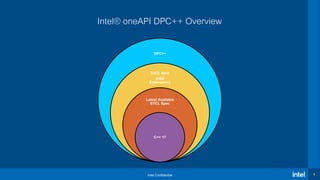
Intel® oneAPI DPC++ Overview
DPC++
SYCL Next
(Intel
Extensions)
Latest Available
SYCL Spec
C++ 17
Intel Confidential 9
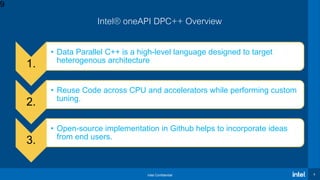
Intel® oneAPI DPC++ Overview
1.
• Data Parallel C++ is a high-level language designed to target
heterogenous architecture and take advantage of data parallelism.
2.
• Reuse Code across CPU and accelerators while performing custom
tuning.
3.
• Open-source implementation in Github helps to incorporate ideas
from end users.
9
Intel Confidential 10
Before we start
Lambda Expressions #include <algorithm>
#include <cmath>
void abssort(float* x, unsigned n) {
std::sort(x, x + n,
// Lambda expression
[ ](float a, float b)
{
return (std::abs(a) < std::abs(b));
}
);
}
• A convenient way of defining an
anonymous function object right at
the location where it is invoked or
passed as an argument to a function
• Lambda functions can be used to
define kernels in SYCL
• The kernel lambda MUST use copy
for all its captures (i.e., [=])
Capture clause
Parameter list
Lambda body
10
Intel Confidential 11
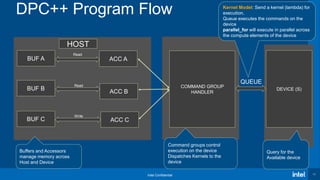
COMMAND GROUP
HANDLER
DEVICE (S)
Query for the
Available device
Kernel Model: Send a kernel (lambda) for
execution.
Queue executes the commands on the
device
parallel_for will execute in parallel across
the compute elements of the device
BUF A
BUF B
BUF C
ACC B
ACC C
Read
Read
Write
ACC A
Command groups control
execution on the device
Dispatches Kernels to the
device
Buffers and Accessors
manage memory across
Host and Device
QUEUE
HOST
DPC++ Program Flow
Intel Confidential 12
DPC++ “Hello world”
Intel Confidential 13
13
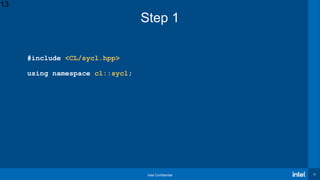
Step 1
#include <CL/sycl.hpp>
using namespace cl::sycl;
Intel Confidential 14
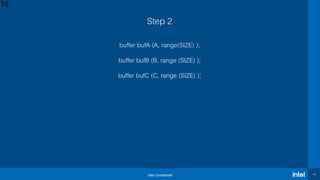
Step 2
buffer bufA (A, range(SIZE) );
buffer bufB (B, range (SIZE) );
buffer bufC (C, range (SIZE) );
14
Intel Confidential 15
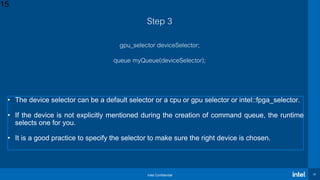
Step 3
gpu_selector deviceSelector;
queue myQueue(deviceSelector);
15
• The device selector can be a default selector or a cpu or gpu selector or intel::fpga_selector.
• If the device is not explicitly mentioned during the creation of command queue, the runtime
selects one for you.
• It is a good practice to specify the selector to make sure the right device is chosen.
Intel Confidential 16
Step 4
myQueue.submit([&](handler& cgh) {
16
Intel Confidential 17
Step 5
auto A = bufA.get_access(cgh, read_only);
auto B = bufB.get_access(cgh, read_only);
auto C = bufC.get_access(cgh);
17
Intel Confidential 18
Step 6
cgh.parallel_for<class vector_add>(N, [=](auto i) {
C[i] = A[i] + B[i];});
18
 Each iteration (work-
item) will have a
separate index id (i)
Intel Confidential 19
int main() {
float A[N], B[N], C[N];
{ buffer bufA (A, range(N));
buffer bufB (B, range(N));
buffer bufC (C, range(N));
queue myQueue;
myQueue.submit([&](handler& cgh) {
auto A = bufA.get_access(cgh, read_only);
auto B = bufB.get_access(cgh, read_only);
auto C = bufC.get_access(cgh);
cgh.parallel_for<class vector_add>(N, [=](auto i){
C[i] = A[i] + B[i];});
});
}
for (int i = 0; i < 5; i++){
cout << "C[" << i << "] = " << C[i] <<std::endl;
}
return 0;
}
DPC++ “Hello World”: Vector Addition Entire Code
19
Intel Confidential 20
int main() {
float A[N], B[N], C[N];
{ buffer bufA (A, range(N));
buffer bufB (B, range(N));
buffer bufC (C, range(N));
queue myQueue;
myQueue.submit([&](handler& cgh) {
auto A = bufA.get_access(cgh, read_only);
auto B = bufB.get_access(cgh, read_only);
auto C = bufC.get_access(cgh);
cgh.parallel_for<class vector_add>(N, [=](auto i) {
C[i] = A[i] + B[i];});
});
}
for (int i = 0; i < 5; i++){
cout << "C[" << i << "] = " << C[i] <<std::endl;}
return 0;
}
Host code
Anatomy of a DPC++ Application
20
Host code
Intel Confidential 21
int main() {
float A[N], B[N], C[N];
{ buffer bufA (A, range(N));
buffer bufB (B, range(N));
buffer bufC (C, range(N));
queue myQueue;
myQueue.submit([&](handler& cgh) {
auto A = bufA.get_access(cgh, read_only);
auto B = bufB.get_access(cgh, read_only);
auto C = bufC.get_access(cgh);
cgh.parallel_for<class vector_add>(N, [=](auto i) {
C[i] = A[i] + B[i];});
});
}
for (int i = 0; i < 5; i++){
cout << "C[" << i << "] = " << C[i] <<std::endl;
}
return 0;
}
Accelerator
device code
Anatomy of a DPC++ Application
21
Host code
Host code
Intel Confidential 22
int main() {
float A[N], B[N], C[N];
{ buffer bufA (A, range(N));
buffer bufB (B, range(N));
buffer bufC (C, range(N));
queue myQueue;
myQueue.submit([&](handler& cgh) {
auto A = bufA.get_access(cgh, read_only);
auto B = bufB.get_access(cgh, read_only);
auto C = bufC.get_access(cgh);
cgh.parallel_for<class vector_add>(N, [=](auto i) {
C[i] = A[i] + B[i];});
});
}
for (int i = 0; i < 5; i++){
cout << "C[" << i << "] = " << C[i] <<std::endl;
}
return 0;
}
22
DPC++ basics
 Write-buffer is now out-of-scope, so
kernel completes, and host pointer
has consistent view of output.
Intel Confidential 23
int main() {
float A[N], B[N], C[N];
{ buffer bufA (A, range(N));
buffer bufB (B, range(N));
buffer bufC (C, range(N));
queue myQueue;
myQueue.submit([&](handler& cgh) {
auto A = bufA.get_access(cgh, read_only);
auto B = bufB.get_access(cgh, read_only);
auto C = bufC.get_access(cgh);
cgh.parallel_for<class vector_add>(N, [=](auto i) {
C[i] = A[i] + B[i];});
});
}
for (int i = 0; i < 5; i++){
cout << "C[" << i << "] = " << C[i] <<std::endl;
}
return 0;
}
23
DPC++ basics
Intel Confidential 24
DPCPP Demo session
Intel Confidential 25
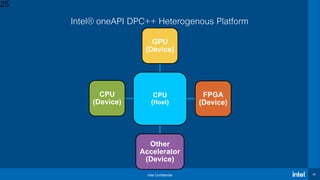
Intel® oneAPI DPC++ Heterogenous Platform
CPU
(Host)
GPU
(Device)
FPGA
(Device)
Other
Accelerator
(Device)
CPU
(Device)
25
26Intel Confidential
For code samples on all these concepts Visit:
https://github.com/oneapi-src/oneAPI-samples/
Intel Confidential 27
DPC++ Summary
•DPC++ is an open standard based programming model for Heterogenous Platforms.
•It can target different accelerators from different vendors
•Single sourced programming model
•oneAPI specifications available publicly:
https://github.com/intel/llvm/tree/sycl/sycl/doc/extensions
Feedback and active participation encouraged
Intel® DPC++ Compatibility Tool
Intel Confidential 29
 Migrates some portion of their existing code written in CUDA to the newly developed DPC++
language.
 Our experience has shown that this can vary greatly, but on average, about 80-90% of CUDA code in
applications can be migrated by this tool.
 Completion of the code and verification of the final code is expected to be manual process done by
the developer.
https://software.intel.com/content/www/us/en/develop/documentation/get-started-with-intel-dpcpp-
compatibility-tool/top.html
What is the Intel® DPC++ Compatibility Tool?
Intel Confidential 30
DPCT* Demo session
Intel Confidential 31
Backup
Intel Confidential 32
DPC++ Deep Dive
Intel Confidential 33
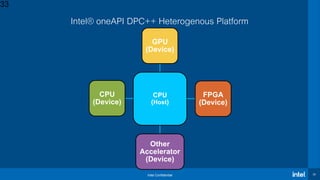
Intel® oneAPI DPC++ Heterogenous Platform
CPU
(Host)
GPU
(Device)
FPGA
(Device)
Other
Accelerator
(Device)
CPU
(Device)
33
Intel Confidential 34
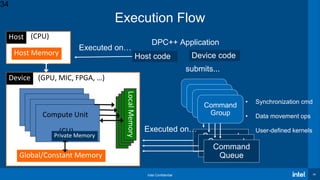
Execution Flow
Global/Constant Memory
Host Memory
Host
Device
(CPU)
(GPU, MIC, FPGA, …)
Compute Unit
(CU)
LocalMemoryLocalMemoryLocalMemoryLocalMemory
Command
Group
• Synchronization cmd
• Data movement ops
• User-defined kernels
Command
GroupCommand
GroupCommand
Group
Command
Queue
Executed on…
submits...
Command
QueueCommand
Queue
Host code
Executed on…
DPC++ Application
Device code
Private Memory
34
Intel Confidential 35
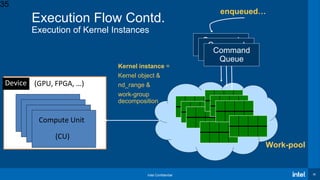
Execution Flow Contd.
Execution of Kernel Instances
Device (GPU, FPGA, …)
Compute Unit
(CU)
Kernel instance =
Kernel object &
nd_range &
work-group
decomposition
Work-pool
Command
QueueCommand
QueueCommand
Queue
enqueued…
35
Intel Confidential 36
Memory Model
Intel Confidential 37
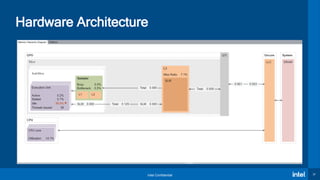
Hardware Architecture
Intel Confidential 38
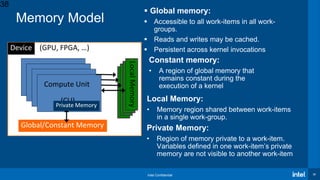
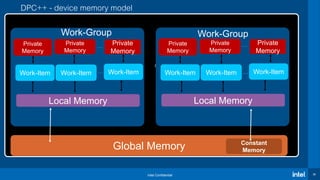
 Global memory:
 Accessible to all work-items in all work-
groups.
 Reads and writes may be cached.
 Persistent across kernel invocations
Memory Model
Constant memory:
• A region of global memory that
remains constant during the
execution of a kernel
Local Memory:
• Memory region shared between work-items
in a single work-group.
Private Memory:
• Region of memory private to a work-item.
Variables defined in one work-item’s private
memory are not visible to another work-item
Global/Constant Memory
Device (GPU, FPGA, …)
Compute Unit
(CU)
LocalMemoryLocalMemoryLocalMemoryLocalMemory
Private Memory
38
Intel Confidential 39
DPC++ - device memory model
Local Memory
Private
Memory
Work-Item
Private
Memory
Work-Item
Private
Memory
Work-Item
Work-Group
Global Memory Constant
Memory
Device
Work-Group
……
Work-GroupWork-Group
…
…
Local Memory
Private
Memory
Work-Item
Private
Memory
Work-Item
Private
Memory
Work-Item…
Work-Group
…
Device
Intel Confidential 40
Unified Shared Memory
 SYCL 1.2.1 specification offers: – Buffer/Accessor: For tracking and managing memory transfer and
guarantee data consistency across host and DPC++ devices.
 Many HPC and Enterprise applications use pointers to manage data.
 DPC++ Extension for Pointer Based programming: – Unified Shared Memory (USM): Device Kernels
can access the data using pointers
Intel Confidential 41
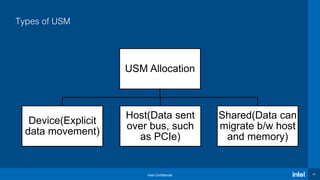
USM Allocation
Device(Explicit
data movement)
Host(Data sent
over bus, such
as PCIe)
Shared(Data can
migrate b/w host
and memory)
Types of USM
Intel Confidential 42
Kernel Model
Intel Confidential 43
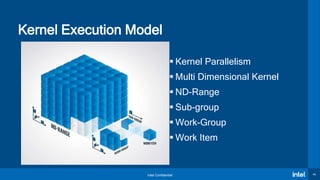
Kernel Execution Model
 Kernel Parallelism
 Multi Dimensional Kernel
 ND-Range
 Sub-group
 Work-Group
 Work Item
Intel Confidential 44
Kernel Execution Model
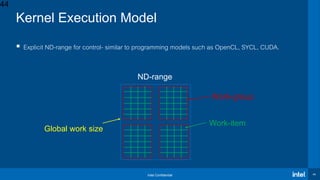
 Explicit ND-range for control- similar to programming models such as OpenCL, SYCL, CUDA.
ND-range
Global work size
Work-group
Work-item
44
Intel Confidential 45
nd_range & nd_item
 Example: Process every pixel in a 1920x1080 image
 Each pixel needs processing, kernel is executed on each pixel (work-item)
 1920 x 1080 = 2M pixels = global size
 Not all 2M can run in parallel on device, there is hardware resource limits.
 We have to split into smaller groups of pixel blocks = local size (work-group)
 Either let the complier determine work-group size OR we can specify the work-group size using nd_range()

Intel Confidential 46
Example: Process every pixel in a 1920x1080 image
 Let compiler determine work-group size

 Programmer specifies work-group size
h.parallel_for(nd_range<2>(range<2>(1920,1080),range<2>(8,8)),
[=](id<2> item){
// CODE THAT RUNS ON DEVICE
})
h.parallel_for(range<2>(1920,1080), [=](id<2>
item){
// CODE THAT RUNS ON DEVICE
});
nd_range & nd_item
global
size
local size
(work-group
size)
Intel Confidential 47
nd_range & nd_item
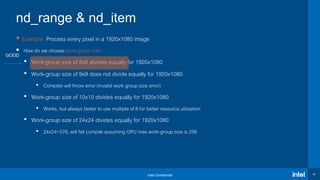
 Example: Process every pixel in a 1920x1080 image
 How do we choose work-group size?
• Work-group size of 8x8 divides equally for 1920x1080
• Work-group size of 9x9 does not divide equally for 1920x1080
• Compiler will throw error (invalid work group size error)
• Work-group size of 10x10 divides equally for 1920x1080
• Works, but always better to use multiple of 8 for better resource utilization
• Work-group size of 24x24 divides equally for 1920x1080
• 24x24=576, will fail compile assuming GPU max work-group size is 256
GOOD
48

OneAPI dpc++ Virtual Workshop 9th Dec-20

  • 1.
  • 2.
    Intel Confidential 2 Agenda •Intel® oneAPI • Introduction • DPC++ • Introduction • DPC++ “Hello world” • Lab • Intel® DPC++ Compatibility Tool • Introduction • Demo Optimization Notice 2
  • 3.
  • 4.
    Intel Confidential 4 XPUs Programming Challenges Growthin specialized workloads Variety of data-centric hardware required No common programming language or APIs Inconsistent tool support across platforms Each platform requires unique software investment Middleware / Frameworks Application Workloads Need Diverse Hardware Language & Libraries Scalar Vector Matrix Spatial 4 CP U GP U FP GA Other accel.
  • 5.
    Intel Confidential 5 5 introducing oneapi Unifiedprogramming model to simplify development across diverse architectures Unified and simplified language and libraries for expressing parallelism Uncompromised native high-level language performance Based on industry standards and open specifications Interoperable with existing HPC programming models Industry Intel Initiative Product Middleware / Frameworks Application Workloads Need Diverse Hardware Scalar Vector Matrix Spatial XPUs CP U GP U FP GA Other accel. oneAPI
  • 6.
  • 7.
  • 8.
    Intel Confidential 8 Intel®oneAPI DPC++ Overview DPC++ SYCL Next (Intel Extensions) Latest Available SYCL Spec C++ 17
  • 9.
    Intel Confidential 9 Intel®oneAPI DPC++ Overview 1. • Data Parallel C++ is a high-level language designed to target heterogenous architecture and take advantage of data parallelism. 2. • Reuse Code across CPU and accelerators while performing custom tuning. 3. • Open-source implementation in Github helps to incorporate ideas from end users. 9
  • 10.
    Intel Confidential 10 Beforewe start Lambda Expressions #include <algorithm> #include <cmath> void abssort(float* x, unsigned n) { std::sort(x, x + n, // Lambda expression [ ](float a, float b) { return (std::abs(a) < std::abs(b)); } ); } • A convenient way of defining an anonymous function object right at the location where it is invoked or passed as an argument to a function • Lambda functions can be used to define kernels in SYCL • The kernel lambda MUST use copy for all its captures (i.e., [=]) Capture clause Parameter list Lambda body 10
  • 11.
    Intel Confidential 11 COMMANDGROUP HANDLER DEVICE (S) Query for the Available device Kernel Model: Send a kernel (lambda) for execution. Queue executes the commands on the device parallel_for will execute in parallel across the compute elements of the device BUF A BUF B BUF C ACC B ACC C Read Read Write ACC A Command groups control execution on the device Dispatches Kernels to the device Buffers and Accessors manage memory across Host and Device QUEUE HOST DPC++ Program Flow
  • 12.
    Intel Confidential 12 DPC++“Hello world”
  • 13.
    Intel Confidential 13 13 Step1 #include <CL/sycl.hpp> using namespace cl::sycl;
  • 14.
    Intel Confidential 14 Step2 buffer bufA (A, range(SIZE) ); buffer bufB (B, range (SIZE) ); buffer bufC (C, range (SIZE) ); 14
  • 15.
    Intel Confidential 15 Step3 gpu_selector deviceSelector; queue myQueue(deviceSelector); 15 • The device selector can be a default selector or a cpu or gpu selector or intel::fpga_selector. • If the device is not explicitly mentioned during the creation of command queue, the runtime selects one for you. • It is a good practice to specify the selector to make sure the right device is chosen.
  • 16.
    Intel Confidential 16 Step4 myQueue.submit([&](handler& cgh) { 16
  • 17.
    Intel Confidential 17 Step5 auto A = bufA.get_access(cgh, read_only); auto B = bufB.get_access(cgh, read_only); auto C = bufC.get_access(cgh); 17
  • 18.
    Intel Confidential 18 Step6 cgh.parallel_for<class vector_add>(N, [=](auto i) { C[i] = A[i] + B[i];}); 18  Each iteration (work- item) will have a separate index id (i)
  • 19.
    Intel Confidential 19 intmain() { float A[N], B[N], C[N]; { buffer bufA (A, range(N)); buffer bufB (B, range(N)); buffer bufC (C, range(N)); queue myQueue; myQueue.submit([&](handler& cgh) { auto A = bufA.get_access(cgh, read_only); auto B = bufB.get_access(cgh, read_only); auto C = bufC.get_access(cgh); cgh.parallel_for<class vector_add>(N, [=](auto i){ C[i] = A[i] + B[i];}); }); } for (int i = 0; i < 5; i++){ cout << "C[" << i << "] = " << C[i] <<std::endl; } return 0; } DPC++ “Hello World”: Vector Addition Entire Code 19
  • 20.
    Intel Confidential 20 intmain() { float A[N], B[N], C[N]; { buffer bufA (A, range(N)); buffer bufB (B, range(N)); buffer bufC (C, range(N)); queue myQueue; myQueue.submit([&](handler& cgh) { auto A = bufA.get_access(cgh, read_only); auto B = bufB.get_access(cgh, read_only); auto C = bufC.get_access(cgh); cgh.parallel_for<class vector_add>(N, [=](auto i) { C[i] = A[i] + B[i];}); }); } for (int i = 0; i < 5; i++){ cout << "C[" << i << "] = " << C[i] <<std::endl;} return 0; } Host code Anatomy of a DPC++ Application 20 Host code
  • 21.
    Intel Confidential 21 intmain() { float A[N], B[N], C[N]; { buffer bufA (A, range(N)); buffer bufB (B, range(N)); buffer bufC (C, range(N)); queue myQueue; myQueue.submit([&](handler& cgh) { auto A = bufA.get_access(cgh, read_only); auto B = bufB.get_access(cgh, read_only); auto C = bufC.get_access(cgh); cgh.parallel_for<class vector_add>(N, [=](auto i) { C[i] = A[i] + B[i];}); }); } for (int i = 0; i < 5; i++){ cout << "C[" << i << "] = " << C[i] <<std::endl; } return 0; } Accelerator device code Anatomy of a DPC++ Application 21 Host code Host code
  • 22.
    Intel Confidential 22 intmain() { float A[N], B[N], C[N]; { buffer bufA (A, range(N)); buffer bufB (B, range(N)); buffer bufC (C, range(N)); queue myQueue; myQueue.submit([&](handler& cgh) { auto A = bufA.get_access(cgh, read_only); auto B = bufB.get_access(cgh, read_only); auto C = bufC.get_access(cgh); cgh.parallel_for<class vector_add>(N, [=](auto i) { C[i] = A[i] + B[i];}); }); } for (int i = 0; i < 5; i++){ cout << "C[" << i << "] = " << C[i] <<std::endl; } return 0; } 22 DPC++ basics  Write-buffer is now out-of-scope, so kernel completes, and host pointer has consistent view of output.
  • 23.
    Intel Confidential 23 intmain() { float A[N], B[N], C[N]; { buffer bufA (A, range(N)); buffer bufB (B, range(N)); buffer bufC (C, range(N)); queue myQueue; myQueue.submit([&](handler& cgh) { auto A = bufA.get_access(cgh, read_only); auto B = bufB.get_access(cgh, read_only); auto C = bufC.get_access(cgh); cgh.parallel_for<class vector_add>(N, [=](auto i) { C[i] = A[i] + B[i];}); }); } for (int i = 0; i < 5; i++){ cout << "C[" << i << "] = " << C[i] <<std::endl; } return 0; } 23 DPC++ basics
  • 24.
  • 25.
    Intel Confidential 25 Intel®oneAPI DPC++ Heterogenous Platform CPU (Host) GPU (Device) FPGA (Device) Other Accelerator (Device) CPU (Device) 25
  • 26.
    26Intel Confidential For codesamples on all these concepts Visit: https://github.com/oneapi-src/oneAPI-samples/
  • 27.
    Intel Confidential 27 DPC++Summary •DPC++ is an open standard based programming model for Heterogenous Platforms. •It can target different accelerators from different vendors •Single sourced programming model •oneAPI specifications available publicly: https://github.com/intel/llvm/tree/sycl/sycl/doc/extensions Feedback and active participation encouraged
  • 28.
  • 29.
    Intel Confidential 29 Migrates some portion of their existing code written in CUDA to the newly developed DPC++ language.  Our experience has shown that this can vary greatly, but on average, about 80-90% of CUDA code in applications can be migrated by this tool.  Completion of the code and verification of the final code is expected to be manual process done by the developer. https://software.intel.com/content/www/us/en/develop/documentation/get-started-with-intel-dpcpp- compatibility-tool/top.html What is the Intel® DPC++ Compatibility Tool?
  • 30.
  • 31.
  • 32.
  • 33.
    Intel Confidential 33 Intel®oneAPI DPC++ Heterogenous Platform CPU (Host) GPU (Device) FPGA (Device) Other Accelerator (Device) CPU (Device) 33
  • 34.
    Intel Confidential 34 ExecutionFlow Global/Constant Memory Host Memory Host Device (CPU) (GPU, MIC, FPGA, …) Compute Unit (CU) LocalMemoryLocalMemoryLocalMemoryLocalMemory Command Group • Synchronization cmd • Data movement ops • User-defined kernels Command GroupCommand GroupCommand Group Command Queue Executed on… submits... Command QueueCommand Queue Host code Executed on… DPC++ Application Device code Private Memory 34
  • 35.
    Intel Confidential 35 ExecutionFlow Contd. Execution of Kernel Instances Device (GPU, FPGA, …) Compute Unit (CU) Kernel instance = Kernel object & nd_range & work-group decomposition Work-pool Command QueueCommand QueueCommand Queue enqueued… 35
  • 36.
  • 37.
  • 38.
    Intel Confidential 38 Global memory:  Accessible to all work-items in all work- groups.  Reads and writes may be cached.  Persistent across kernel invocations Memory Model Constant memory: • A region of global memory that remains constant during the execution of a kernel Local Memory: • Memory region shared between work-items in a single work-group. Private Memory: • Region of memory private to a work-item. Variables defined in one work-item’s private memory are not visible to another work-item Global/Constant Memory Device (GPU, FPGA, …) Compute Unit (CU) LocalMemoryLocalMemoryLocalMemoryLocalMemory Private Memory 38
  • 39.
    Intel Confidential 39 DPC++- device memory model Local Memory Private Memory Work-Item Private Memory Work-Item Private Memory Work-Item Work-Group Global Memory Constant Memory Device Work-Group …… Work-GroupWork-Group … … Local Memory Private Memory Work-Item Private Memory Work-Item Private Memory Work-Item… Work-Group … Device
  • 40.
    Intel Confidential 40 UnifiedShared Memory  SYCL 1.2.1 specification offers: – Buffer/Accessor: For tracking and managing memory transfer and guarantee data consistency across host and DPC++ devices.  Many HPC and Enterprise applications use pointers to manage data.  DPC++ Extension for Pointer Based programming: – Unified Shared Memory (USM): Device Kernels can access the data using pointers
  • 41.
    Intel Confidential 41 USMAllocation Device(Explicit data movement) Host(Data sent over bus, such as PCIe) Shared(Data can migrate b/w host and memory) Types of USM
  • 42.
  • 43.
    Intel Confidential 43 KernelExecution Model  Kernel Parallelism  Multi Dimensional Kernel  ND-Range  Sub-group  Work-Group  Work Item
  • 44.
    Intel Confidential 44 KernelExecution Model  Explicit ND-range for control- similar to programming models such as OpenCL, SYCL, CUDA. ND-range Global work size Work-group Work-item 44
  • 45.
    Intel Confidential 45 nd_range& nd_item  Example: Process every pixel in a 1920x1080 image  Each pixel needs processing, kernel is executed on each pixel (work-item)  1920 x 1080 = 2M pixels = global size  Not all 2M can run in parallel on device, there is hardware resource limits.  We have to split into smaller groups of pixel blocks = local size (work-group)  Either let the complier determine work-group size OR we can specify the work-group size using nd_range() 
  • 46.
    Intel Confidential 46 Example:Process every pixel in a 1920x1080 image  Let compiler determine work-group size   Programmer specifies work-group size h.parallel_for(nd_range<2>(range<2>(1920,1080),range<2>(8,8)), [=](id<2> item){ // CODE THAT RUNS ON DEVICE }) h.parallel_for(range<2>(1920,1080), [=](id<2> item){ // CODE THAT RUNS ON DEVICE }); nd_range & nd_item global size local size (work-group size)
  • 47.
    Intel Confidential 47 nd_range& nd_item  Example: Process every pixel in a 1920x1080 image  How do we choose work-group size? • Work-group size of 8x8 divides equally for 1920x1080 • Work-group size of 9x9 does not divide equally for 1920x1080 • Compiler will throw error (invalid work group size error) • Work-group size of 10x10 divides equally for 1920x1080 • Works, but always better to use multiple of 8 for better resource utilization • Work-group size of 24x24 divides equally for 1920x1080 • 24x24=576, will fail compile assuming GPU max work-group size is 256 GOOD
  • 48.