
THE INTERNET
OBJECTIVES:
Understand Basic Web
Terminologies
Discover the history of the
Internet and the World Wide
Web
Learn the common means of
accessing the web
WEB DESIGN TERMINOLOGIES
Network – several computers
connected together with purpose of
sharing resources including data,
information and hardware.
Internet – worldwide collection of
computers interconnected to one
another either wired or wireless
including all computers that we use at
home, in schools, offices and many
other places.
WEB DESIGN TERMINOLOGIES
World Wide Web – a collection of
resources and information
interconnected via the internet.
Web page – a formatted page within a
website that may contain text,
graphics, video and multimedia.
WEB DESIGN TERMINOLOGIES
Home page - usually the first web
page of the website which usually
provides information about the
website, its purpose and contents.
Splash page – may precede the
homepage. It usually contains
multimedia which is designed to be
attractive and intriguing in order to
create curiosity and invite anyone to
see its contents.
HISTORY OF THE INTERNET
DARPA (Defense Advanced Research
Project Agency) – an agency of the US
Department of Defense for the
development of new technology for
military use.
ARPA (Advance Research Project
Agency) – original name of DARPA.
HISTORY OF THE INTERNET
Packet Switching – a network
communication method that splits the
data in chunks, called packets, then
reassembled in the correct order.
HISTORY OF THE INTERNET
Robert Taylor – head of the
Information Processing Office in
DARPA
Larry Roberts – from Massachusetts
Institute of Technology
The two initiated the project called the
ARPANET to build a working computer
network.
HISTORY OF THE INTERNET
There are four interconnected
computers used I the ARPANET
Project:
1. University of California
2. Stanford Research Institute
3. University of Utah
4. University of California
HISTORY OF THE INTERNET
Vinton Cerf and Robert Khan –
formulated a common internetwork
protocol, which eventually become a
the TCP/IP protocol.
ANSNET (Advanced Network and
Services)
HISTORY OF THE INTERNET
ICANN (Internet Corporation for
Assigned Names and Numbers) – the
one responsible for domain names,
internet protocol, ip address and other
parameters.
HISTORY OF THE WORLD WIDE WEB
Tim Berners Lee in 1989 started the
WWW.
W3C (World Wide Web Consortium) –
an organization that is willing to create
standards and ways to improve the
quality of the web. It sets standards for
HTML, XHTML, CSS and many other
applications.
ACCESSING THE WEB
Cable Internet service provides high-
speed Internet access through the
cable television network via a cable
modem.
DSL (digital subscriber line) provides
high-speed Internet connections using
regular copper telephone lines.
ACCESSING THE WEB
Fiber to the Premises (FTTP) uses
fiber-optic cable to provide high-speed
Internet access to home and business
users.
Fixed wireless provides high-speed
Internet connections using a dish-
shaped antenna on your house or
business to communicate with a tower
location via radio signals.
ACCESSING THE WEB
Cellular radio network offers high-
speed Internet connections to devices
with built-in compatible technology or
computers with wireless modems.
ACCESSING THE WEB
Wi-Fi (wireless fidelity) network uses
radio signals to provide high-speed
Internet connections to compatible or
properly equipped wireless computers
and devices.
ACCESSING THE WEB
Satellite Internet service provides
high-speed Internet connections via
satellite to a satellite dish that
communicates with a satellite modem.
Internet
Wifi
Web page
Home page
w3c
DSL
Packet
Switching
ICANN
Cable Internet
Splash screen
ACTIVITY 1. IDENTIFICATION
1. A worldwide collection of computers
interconnected to one another either wired
or wireless including all computers that we
use at home, in schools, offices and many
other places.
2. Network uses radio signals to provide high-
speed Internet connections to compatible or
properly equipped wireless computers and
devices.
3. A formatted page within a website
that may contain text, graphics, video
and multimedia.
4. Usually the first web page of the
website which usually provides
information about the website, its
purpose and contents.
5. An organization that is willing to create
standards and ways to improve the quality
of the web. It sets standards for HTML,
XHTML, CSS and many other applications.
6. It provides high-speed Internet connections
using regular copper telephone lines.
7. A network communication method that
splits the data in chunks, called packets,
then reassembled in the correct order.
ACTIVITY 1. IDENTIFICATION
8. The one responsible for domain names,
internet protocol, IP address and other
parameters.
9. A service provides high-speed Internet
access through the cable television network
via a cable modem.
10. May precede the homepage. It usually
contains multimedia which is designed to
be attractive and intriguing in order to
create curiosity and invite anyone to see its
contents
ANSWERS:
1. Internet
2. Wifi
3. Web page
4. Home page
5. w3c
6. DSL
7. Packet Switching
8. ICANN
9. Cable Internet
10. Splash screen/splash page
Write corrected by; with your complete name. make
sure you check correctly
ACCESS PROVIDERS
An access provider is a business that provides
individuals and organizations access to the Internet
free or for a fee.
Access providers are categorized as regional or
national ISPs, online service providers, and
wireless Internet service providers.
ISP AND OSP
 ISP (Internet service provider) is a regional or national
access provider.
 A regional ISP usually provides Internet access to a
specific geographic area.
 A national ISP is a business that provides Internet
access in cities and towns nationwide.
 OSP (Online service provider) also has many
members-only features such as instant messaging or
their own customized version of a Web browser. The two
more popular OSPs are AOL (America Online) and MSN
(Microsoft Network).
INTERNET ADDRESS
 IP address, short for Internet Protocol address, is a
number that uniquely identifies each computer or
device connected to the Internet.
 IP address 72.14.207.99
 Domain name www.google.com
DOMAIN NAMES
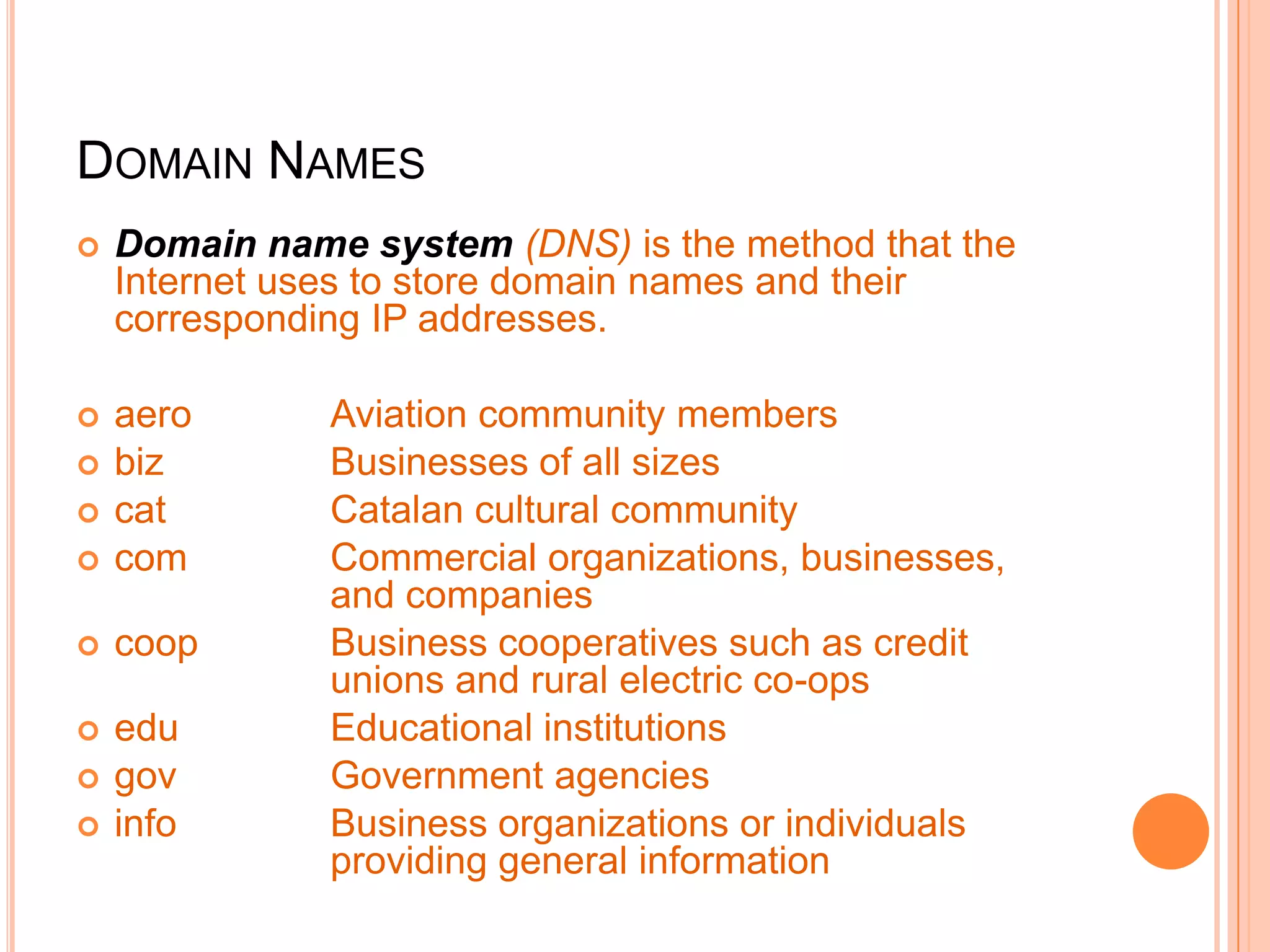
 Domain name system (DNS) is the method that the
Internet uses to store domain names and their
corresponding IP addresses.
 aero Aviation community members
 biz Businesses of all sizes
 cat Catalan cultural community
 com Commercial organizations, businesses,
and companies
 coop Business cooperatives such as credit
unions and rural electric co-ops
 edu Educational institutions
 gov Government agencies
 info Business organizations or individuals
providing general information
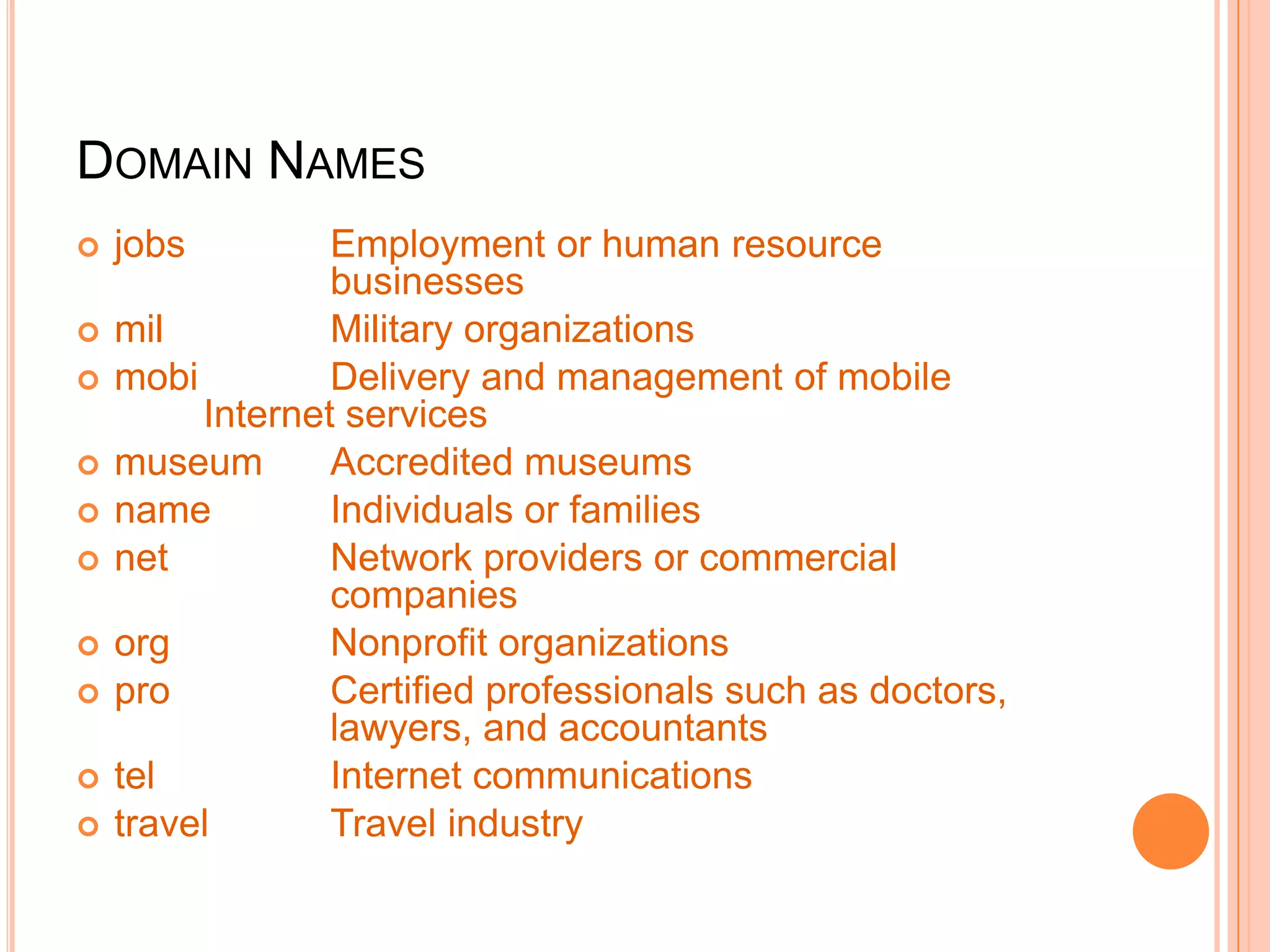
DOMAIN NAMES
 jobs Employment or human resource
businesses
 mil Military organizations
 mobi Delivery and management of mobile
Internet services
 museum Accredited museums
 name Individuals or families
 net Network providers or commercial
companies
 org Nonprofit organizations
 pro Certified professionals such as doctors,
lawyers, and accountants
 tel Internet communications
 travel Travel industry
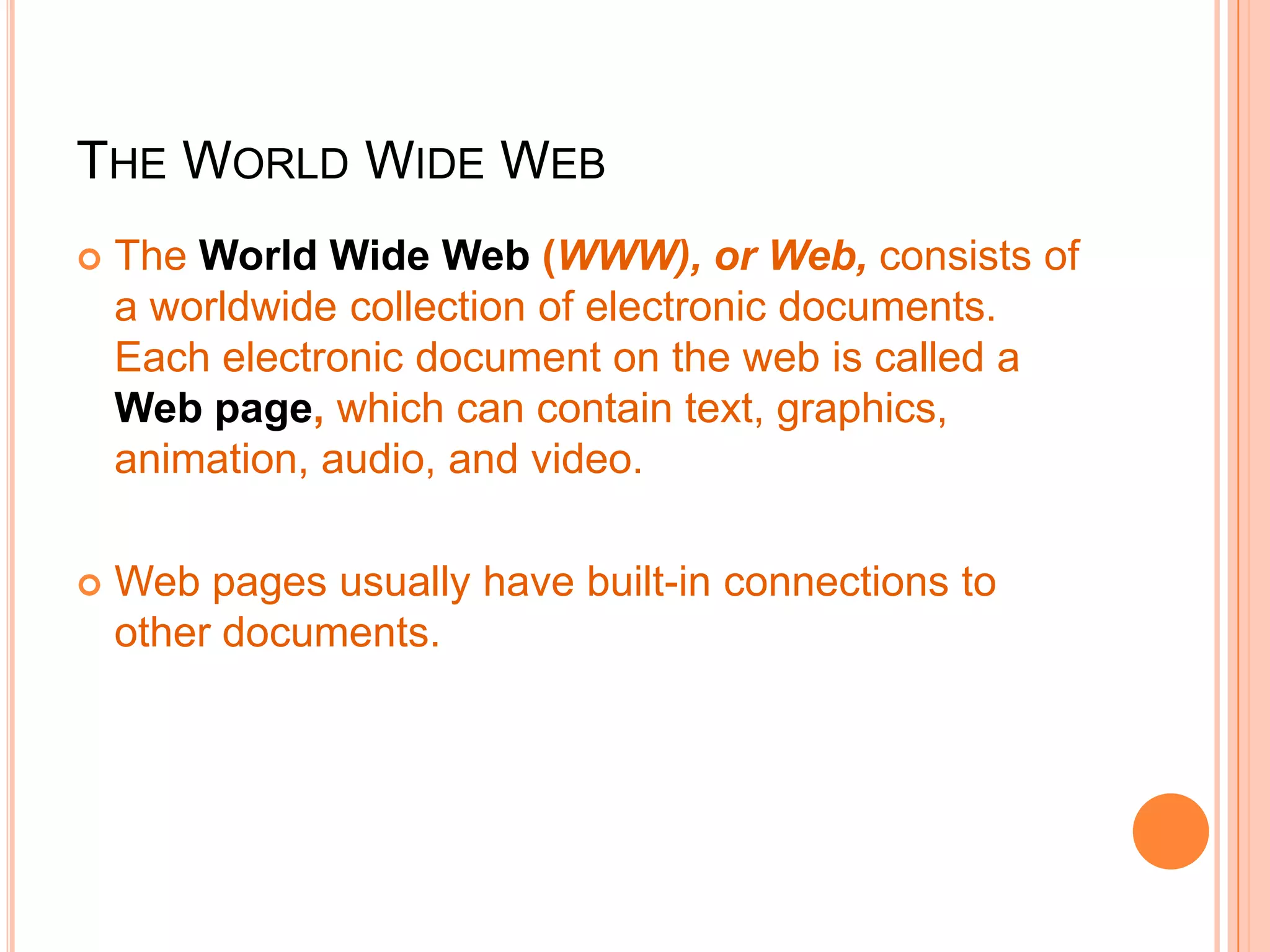
THE WORLD WIDE WEB
 The World Wide Web (WWW), or Web, consists of
a worldwide collection of electronic documents.
Each electronic document on the web is called a
Web page, which can contain text, graphics,
animation, audio, and video.
 Web pages usually have built-in connections to
other documents.
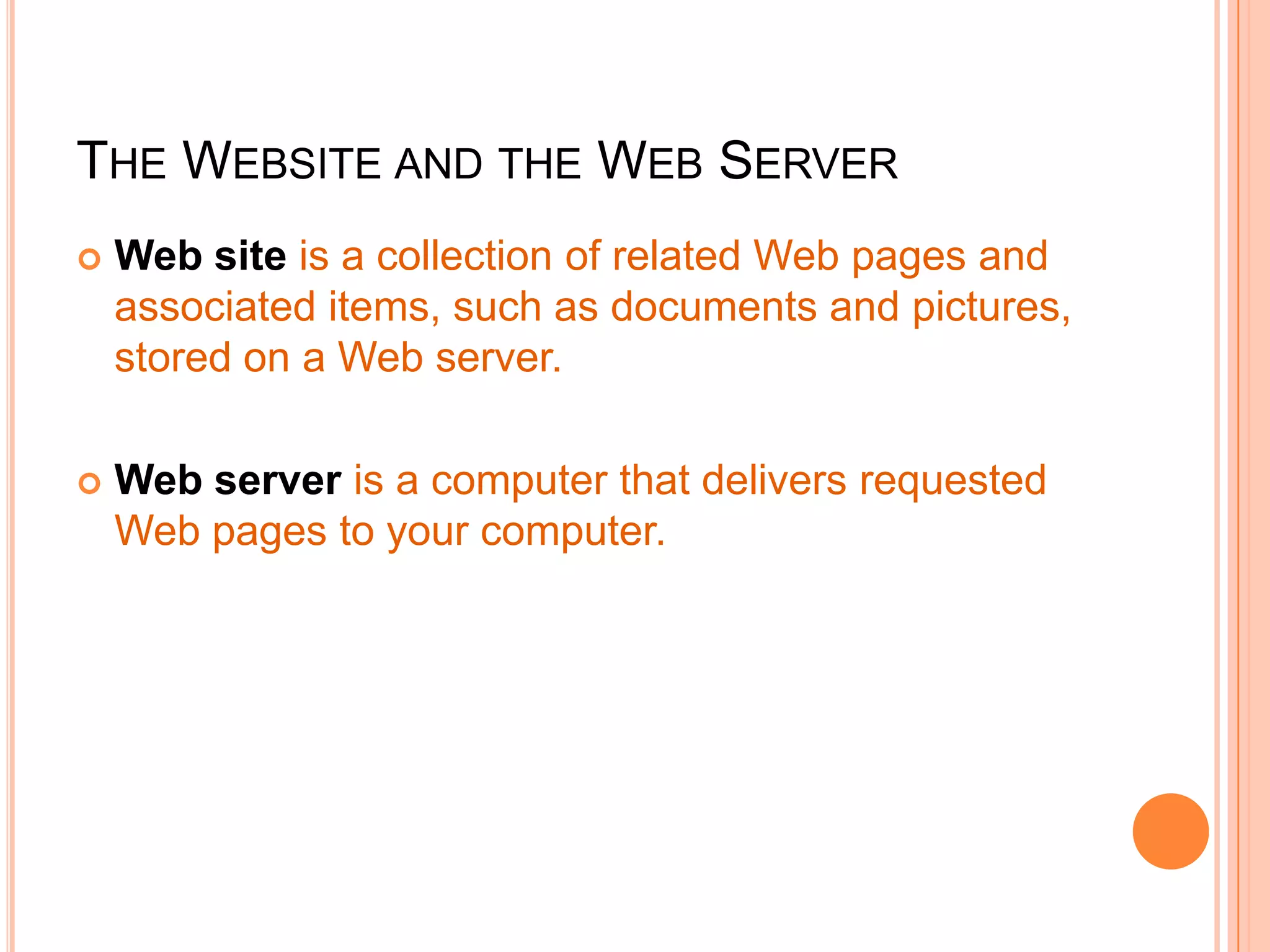
THE WEBSITE AND THE WEB SERVER
 Web site is a collection of related Web pages and
associated items, such as documents and pictures,
stored on a Web server.
 Web server is a computer that delivers requested
Web pages to your computer.
THE WEB BROWSER
 Web browser, or browser, is application software
that allows users to access and view Web pages.
 Home page refers to the first page that a Web site
displays. Similar to a book cover or a table of
contents for a Web site, the home page provides
information about the Web site’s purpose and
content.
KINDS OF WEB BROWSERS
 IE or Internet Explorer
A graphical web browser designed and develop by
Microsoft Corporation, it is the most popular internet
browser used by more tan 60% of worldwide users.
KINDS OF WEB BROWSERS
 Mozilla Firefox
A free and open source web browser downloadable
from www.mozilla.com/firefox running on Gecko
layout engine. Developed by Mozilla Corporation,
this is the second most popular web browser.
KINDS OF WEB BROWSERS
 Safari
Web browse for MAC OS developed and designed
by Apple Inc using the WebKit engine.
KINDS OF WEB BROWSERS
 Google Chrome
A vey new web browser from Google Inc, the
creator of the most popular search engine Google.
KINDS OF WEB BROWSERS
 Opera
The fifth most popular web browser. It was released
in 1996. It is an Internet suite which includes
phishing and malware protection.
KINDS OF WEB BROWSERS
 Netscape
The most popular web browser in the 990’s and its
further development has bee stopped by its owner
AOL (America Online).
KINDS OF WEB BROWSERS
 Flock
A new browser that supports Microsoft Windows,
Mac OS X and Linux OS.
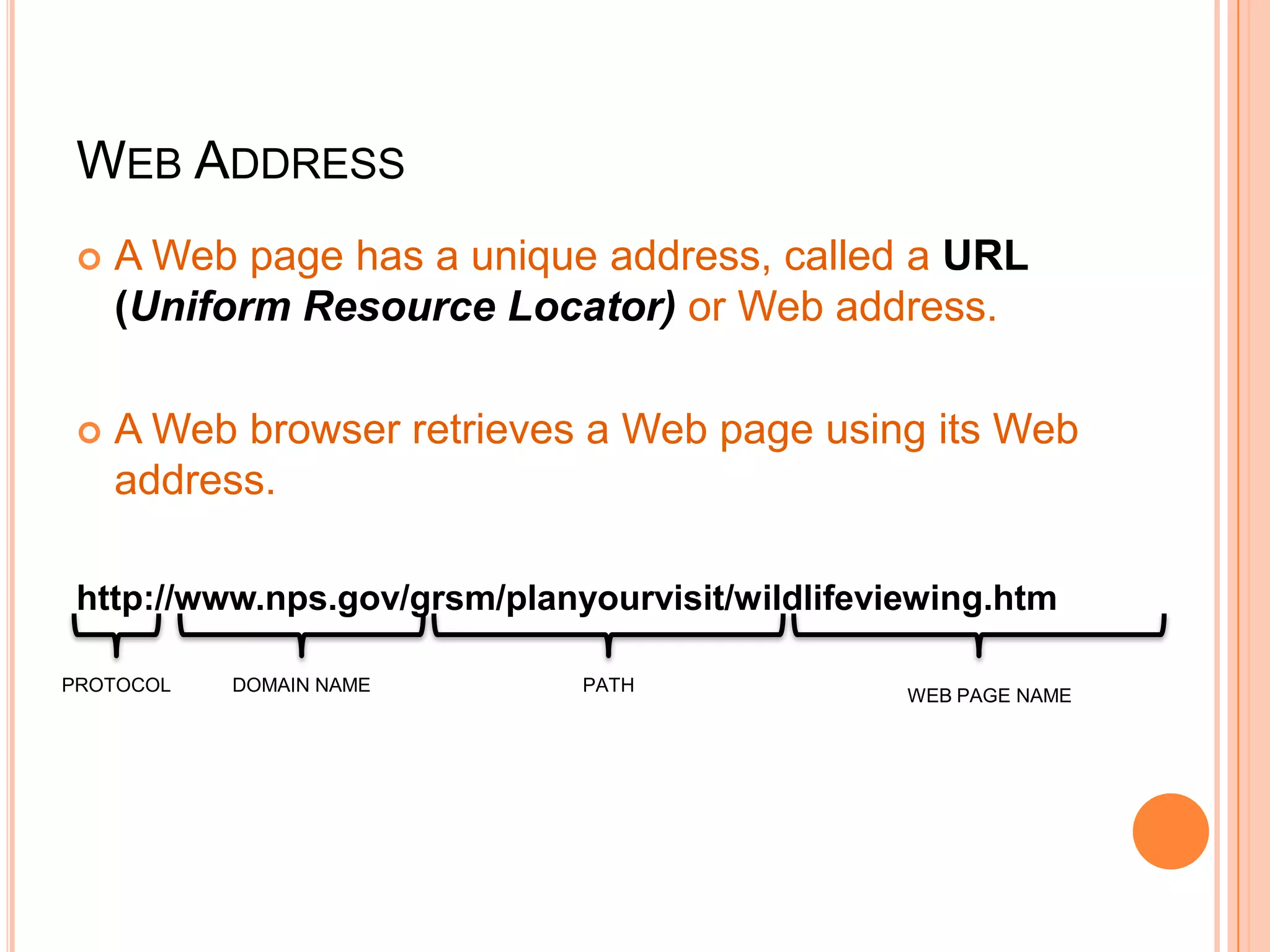
WEB ADDRESS
 A Web page has a unique address, called a URL
(Uniform Resource Locator) or Web address.
 A Web browser retrieves a Web page using its Web
address.
http://www.nps.gov/grsm/planyourvisit/wildlifeviewing.htm
PROTOCOL DOMAIN NAME PATH
WEB PAGE NAME
BASIC WEB DESIGN PRINCIPLES
 Balance – this concept has something to do with
symmetrical and asymmetrical arrangements of the
objects of the web page.
 Proximity – the placement of element with logical
relationship close to each other.
 White Spaces – are blank spaces which are placed
around web page elements which allow readability
of important texts and draw attention to images on
the web site.
 Contrast – a way to differentiate the elements of a
web page.
BASIC WEB DESIGN PRINCIPLES
 Focus – the element in the web site which should
get the attention of the viewer first.
 Unity – the sense of agreement and harmony of all
elements of the web site.
 Alignment – proper arrangement and positioning of
the elements of the web site. It will facilitate proper
viewing, reading and navigating on the web site.
ESSENTIAL ELEMENTS OF WEB CONTENT
 Accuracy – ensuring the reliability of the
information you publish on the web site.
 Readability – designing and composing the
content of the web pages making them easily
accessible and readable by the web audience.
 Understandable – presenting the contents of the
web page in a way the web viewer will easily
comprehend.
 Concise – using the least words to convey a
message on the Internet.
 Ethical and Legal – publishing a website that will
not get you into legal trouble.

The internet

  • 1.
  • 2.
    OBJECTIVES: Understand Basic Web Terminologies Discoverthe history of the Internet and the World Wide Web Learn the common means of accessing the web
  • 3.
    WEB DESIGN TERMINOLOGIES Network– several computers connected together with purpose of sharing resources including data, information and hardware. Internet – worldwide collection of computers interconnected to one another either wired or wireless including all computers that we use at home, in schools, offices and many other places.
  • 4.
    WEB DESIGN TERMINOLOGIES WorldWide Web – a collection of resources and information interconnected via the internet. Web page – a formatted page within a website that may contain text, graphics, video and multimedia.
  • 5.
    WEB DESIGN TERMINOLOGIES Homepage - usually the first web page of the website which usually provides information about the website, its purpose and contents. Splash page – may precede the homepage. It usually contains multimedia which is designed to be attractive and intriguing in order to create curiosity and invite anyone to see its contents.
  • 6.
    HISTORY OF THEINTERNET DARPA (Defense Advanced Research Project Agency) – an agency of the US Department of Defense for the development of new technology for military use. ARPA (Advance Research Project Agency) – original name of DARPA.
  • 7.
    HISTORY OF THEINTERNET Packet Switching – a network communication method that splits the data in chunks, called packets, then reassembled in the correct order.
  • 8.
    HISTORY OF THEINTERNET Robert Taylor – head of the Information Processing Office in DARPA Larry Roberts – from Massachusetts Institute of Technology The two initiated the project called the ARPANET to build a working computer network.
  • 9.
    HISTORY OF THEINTERNET There are four interconnected computers used I the ARPANET Project: 1. University of California 2. Stanford Research Institute 3. University of Utah 4. University of California
  • 10.
    HISTORY OF THEINTERNET Vinton Cerf and Robert Khan – formulated a common internetwork protocol, which eventually become a the TCP/IP protocol. ANSNET (Advanced Network and Services)
  • 11.
    HISTORY OF THEINTERNET ICANN (Internet Corporation for Assigned Names and Numbers) – the one responsible for domain names, internet protocol, ip address and other parameters.
  • 12.
    HISTORY OF THEWORLD WIDE WEB Tim Berners Lee in 1989 started the WWW. W3C (World Wide Web Consortium) – an organization that is willing to create standards and ways to improve the quality of the web. It sets standards for HTML, XHTML, CSS and many other applications.
  • 13.
    ACCESSING THE WEB CableInternet service provides high- speed Internet access through the cable television network via a cable modem. DSL (digital subscriber line) provides high-speed Internet connections using regular copper telephone lines.
  • 14.
    ACCESSING THE WEB Fiberto the Premises (FTTP) uses fiber-optic cable to provide high-speed Internet access to home and business users. Fixed wireless provides high-speed Internet connections using a dish- shaped antenna on your house or business to communicate with a tower location via radio signals.
  • 15.
    ACCESSING THE WEB Cellularradio network offers high- speed Internet connections to devices with built-in compatible technology or computers with wireless modems.
  • 16.
    ACCESSING THE WEB Wi-Fi(wireless fidelity) network uses radio signals to provide high-speed Internet connections to compatible or properly equipped wireless computers and devices.
  • 17.
    ACCESSING THE WEB SatelliteInternet service provides high-speed Internet connections via satellite to a satellite dish that communicates with a satellite modem.
  • 18.
  • 19.
    ACTIVITY 1. IDENTIFICATION 1.A worldwide collection of computers interconnected to one another either wired or wireless including all computers that we use at home, in schools, offices and many other places. 2. Network uses radio signals to provide high- speed Internet connections to compatible or properly equipped wireless computers and devices.
  • 20.
    3. A formattedpage within a website that may contain text, graphics, video and multimedia. 4. Usually the first web page of the website which usually provides information about the website, its purpose and contents.
  • 21.
    5. An organizationthat is willing to create standards and ways to improve the quality of the web. It sets standards for HTML, XHTML, CSS and many other applications. 6. It provides high-speed Internet connections using regular copper telephone lines. 7. A network communication method that splits the data in chunks, called packets, then reassembled in the correct order. ACTIVITY 1. IDENTIFICATION
  • 22.
    8. The oneresponsible for domain names, internet protocol, IP address and other parameters. 9. A service provides high-speed Internet access through the cable television network via a cable modem. 10. May precede the homepage. It usually contains multimedia which is designed to be attractive and intriguing in order to create curiosity and invite anyone to see its contents
  • 23.
    ANSWERS: 1. Internet 2. Wifi 3.Web page 4. Home page 5. w3c 6. DSL 7. Packet Switching 8. ICANN 9. Cable Internet 10. Splash screen/splash page Write corrected by; with your complete name. make sure you check correctly
  • 24.
    ACCESS PROVIDERS An accessprovider is a business that provides individuals and organizations access to the Internet free or for a fee. Access providers are categorized as regional or national ISPs, online service providers, and wireless Internet service providers.
  • 25.
    ISP AND OSP ISP (Internet service provider) is a regional or national access provider.  A regional ISP usually provides Internet access to a specific geographic area.  A national ISP is a business that provides Internet access in cities and towns nationwide.  OSP (Online service provider) also has many members-only features such as instant messaging or their own customized version of a Web browser. The two more popular OSPs are AOL (America Online) and MSN (Microsoft Network).
  • 26.
    INTERNET ADDRESS  IPaddress, short for Internet Protocol address, is a number that uniquely identifies each computer or device connected to the Internet.  IP address 72.14.207.99  Domain name www.google.com
  • 27.
    DOMAIN NAMES  Domainname system (DNS) is the method that the Internet uses to store domain names and their corresponding IP addresses.  aero Aviation community members  biz Businesses of all sizes  cat Catalan cultural community  com Commercial organizations, businesses, and companies  coop Business cooperatives such as credit unions and rural electric co-ops  edu Educational institutions  gov Government agencies  info Business organizations or individuals providing general information
  • 28.
    DOMAIN NAMES  jobsEmployment or human resource businesses  mil Military organizations  mobi Delivery and management of mobile Internet services  museum Accredited museums  name Individuals or families  net Network providers or commercial companies  org Nonprofit organizations  pro Certified professionals such as doctors, lawyers, and accountants  tel Internet communications  travel Travel industry
  • 29.
    THE WORLD WIDEWEB  The World Wide Web (WWW), or Web, consists of a worldwide collection of electronic documents. Each electronic document on the web is called a Web page, which can contain text, graphics, animation, audio, and video.  Web pages usually have built-in connections to other documents.
  • 30.
    THE WEBSITE ANDTHE WEB SERVER  Web site is a collection of related Web pages and associated items, such as documents and pictures, stored on a Web server.  Web server is a computer that delivers requested Web pages to your computer.
  • 31.
    THE WEB BROWSER Web browser, or browser, is application software that allows users to access and view Web pages.  Home page refers to the first page that a Web site displays. Similar to a book cover or a table of contents for a Web site, the home page provides information about the Web site’s purpose and content.
  • 32.
    KINDS OF WEBBROWSERS  IE or Internet Explorer A graphical web browser designed and develop by Microsoft Corporation, it is the most popular internet browser used by more tan 60% of worldwide users.
  • 33.
    KINDS OF WEBBROWSERS  Mozilla Firefox A free and open source web browser downloadable from www.mozilla.com/firefox running on Gecko layout engine. Developed by Mozilla Corporation, this is the second most popular web browser.
  • 34.
    KINDS OF WEBBROWSERS  Safari Web browse for MAC OS developed and designed by Apple Inc using the WebKit engine.
  • 35.
    KINDS OF WEBBROWSERS  Google Chrome A vey new web browser from Google Inc, the creator of the most popular search engine Google.
  • 36.
    KINDS OF WEBBROWSERS  Opera The fifth most popular web browser. It was released in 1996. It is an Internet suite which includes phishing and malware protection.
  • 37.
    KINDS OF WEBBROWSERS  Netscape The most popular web browser in the 990’s and its further development has bee stopped by its owner AOL (America Online).
  • 38.
    KINDS OF WEBBROWSERS  Flock A new browser that supports Microsoft Windows, Mac OS X and Linux OS.
  • 39.
    WEB ADDRESS  AWeb page has a unique address, called a URL (Uniform Resource Locator) or Web address.  A Web browser retrieves a Web page using its Web address. http://www.nps.gov/grsm/planyourvisit/wildlifeviewing.htm PROTOCOL DOMAIN NAME PATH WEB PAGE NAME
  • 40.
    BASIC WEB DESIGNPRINCIPLES  Balance – this concept has something to do with symmetrical and asymmetrical arrangements of the objects of the web page.  Proximity – the placement of element with logical relationship close to each other.  White Spaces – are blank spaces which are placed around web page elements which allow readability of important texts and draw attention to images on the web site.  Contrast – a way to differentiate the elements of a web page.
  • 41.
    BASIC WEB DESIGNPRINCIPLES  Focus – the element in the web site which should get the attention of the viewer first.  Unity – the sense of agreement and harmony of all elements of the web site.  Alignment – proper arrangement and positioning of the elements of the web site. It will facilitate proper viewing, reading and navigating on the web site.
  • 42.
    ESSENTIAL ELEMENTS OFWEB CONTENT  Accuracy – ensuring the reliability of the information you publish on the web site.  Readability – designing and composing the content of the web pages making them easily accessible and readable by the web audience.  Understandable – presenting the contents of the web page in a way the web viewer will easily comprehend.  Concise – using the least words to convey a message on the Internet.  Ethical and Legal – publishing a website that will not get you into legal trouble.