PRESENTED BY :DEEPAK KUMAR AND ABINASH
PADHY .
UNDER GUIDANCE
K.K. ACHARYA.
HISTORY OF SERFAESI ACT :
Before SARFAESI Act , recovery of debts due to
Banks and financial institutions Act of 1993, was
used for recovery of default loans .
However there were several loopholes , that
were misused by the borrowers as well as the
lawyers .
The committee recommended various new
legislations to empower Banks and other
financial institutions to take possession of the
NPA s .
WHAT IS SERFAESI ACT ?
The Securitization and Reconstruction of
Financial Assets and Enforcement of
Security Interest Act, 2002 (also known as the
SARFAESI Act) is an Indian law.
It allows banks and other financial institution to
auction residential or commercial properties to
recover loans .
The first asset reconstruction company (ARC) of
India, ARCIL, was set up under this act.
ARCIL : Asset Reconstruction Company (India) Ltd,,
It enables banks to reduce their non-
performing assets (NPAs) by adopting measures
for recovery or reconstruction .
Upon loan default , bank can seize the
securities (except agricultural land ) without
intervention of the court .
SERFAESI is effective only for secured loans
where bank can enforce the underlying security
(e.g. hypothecation pledge ,and mortgages .)
• .
HOW IT WORKS ?
THE SERFAESI Act , 2002 gives powers of “seize
and desist “ to banks .
Bank can give a Notice in writing to the
defaulting borrower requiring it to discharge its
liabilities within 60 days .
If the borrower fails to comply with the notice ,
the bank may take resources to one or more of
the following measures :
Take possession of the security for the loan .
Sale or lease or assign the right over the security .
RIGHT OF BORROWER :
The borrower can at any time before the sale is
concluded , remit the dues and avoid losing the
security .
In case any unhealthy / illegal act is done by the
Authorized officer , he will be liable for penal
consequences
The borrowers will be entitled to get compensation
for such acts.
For redressing the grievances , the borrowers can
approach firstly DRT and thereafter the DRAT in
appeal . The limitation period is 45 days and 30 days
respectively.
METHODSOFRECOVERY:
The act makes provisions for two main methods of
recovery of the NPAs as follows:
1) Securitization : It is a process of issuing marketable
securities , backed by a pool of existing assets such as auto
or home loans. After an asset is converted into a
marketable security , it is sold .
2) ASSET RECONSTRUCTION :
Enacting SERFAESI act has given birth to the asset
reconstruction company in India .
it can be done by either proper management of the business
of the borrower , by taking over it or by selling a part or
whole of the business or by rescheduling of payments of debt
payable by the borrower enforcement Of security interest in
accordance with the provision act .
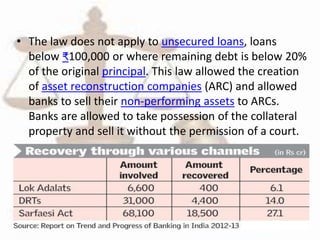
• The law does not apply to unsecured loans, loans
below ₹100,000 or where remaining debt is below 20%
of the original principal. This law allowed the creation
of asset reconstruction companies (ARC) and allowed
banks to sell their non-performing assets to ARCs.
Banks are allowed to take possession of the collateral
property and sell it without the permission of a court.
• Conclusion :
 The high level of NPAs has led to lower interest
income and loan loss provisioning requirements
which reduced the profitability of banks .
The act is intended to strengthen banks to
recover NPAs faster
The act empowers banks to seize charged assets
without court’s intervention and sell them off.
Sarfaesi act

Sarfaesi act

  • 1.
    PRESENTED BY :DEEPAKKUMAR AND ABINASH PADHY . UNDER GUIDANCE K.K. ACHARYA.
  • 2.
    HISTORY OF SERFAESIACT : Before SARFAESI Act , recovery of debts due to Banks and financial institutions Act of 1993, was used for recovery of default loans . However there were several loopholes , that were misused by the borrowers as well as the lawyers . The committee recommended various new legislations to empower Banks and other financial institutions to take possession of the NPA s .
  • 3.
    WHAT IS SERFAESIACT ? The Securitization and Reconstruction of Financial Assets and Enforcement of Security Interest Act, 2002 (also known as the SARFAESI Act) is an Indian law. It allows banks and other financial institution to auction residential or commercial properties to recover loans . The first asset reconstruction company (ARC) of India, ARCIL, was set up under this act. ARCIL : Asset Reconstruction Company (India) Ltd,,
  • 4.
    It enables banksto reduce their non- performing assets (NPAs) by adopting measures for recovery or reconstruction . Upon loan default , bank can seize the securities (except agricultural land ) without intervention of the court . SERFAESI is effective only for secured loans where bank can enforce the underlying security (e.g. hypothecation pledge ,and mortgages .)
  • 5.
  • 6.
    HOW IT WORKS? THE SERFAESI Act , 2002 gives powers of “seize and desist “ to banks . Bank can give a Notice in writing to the defaulting borrower requiring it to discharge its liabilities within 60 days . If the borrower fails to comply with the notice , the bank may take resources to one or more of the following measures : Take possession of the security for the loan . Sale or lease or assign the right over the security .
  • 7.
    RIGHT OF BORROWER: The borrower can at any time before the sale is concluded , remit the dues and avoid losing the security . In case any unhealthy / illegal act is done by the Authorized officer , he will be liable for penal consequences The borrowers will be entitled to get compensation for such acts. For redressing the grievances , the borrowers can approach firstly DRT and thereafter the DRAT in appeal . The limitation period is 45 days and 30 days respectively.
  • 8.
    METHODSOFRECOVERY: The act makesprovisions for two main methods of recovery of the NPAs as follows: 1) Securitization : It is a process of issuing marketable securities , backed by a pool of existing assets such as auto or home loans. After an asset is converted into a marketable security , it is sold . 2) ASSET RECONSTRUCTION : Enacting SERFAESI act has given birth to the asset reconstruction company in India . it can be done by either proper management of the business of the borrower , by taking over it or by selling a part or whole of the business or by rescheduling of payments of debt payable by the borrower enforcement Of security interest in accordance with the provision act .
  • 9.
    • The lawdoes not apply to unsecured loans, loans below ₹100,000 or where remaining debt is below 20% of the original principal. This law allowed the creation of asset reconstruction companies (ARC) and allowed banks to sell their non-performing assets to ARCs. Banks are allowed to take possession of the collateral property and sell it without the permission of a court.
  • 10.
    • Conclusion : The high level of NPAs has led to lower interest income and loan loss provisioning requirements which reduced the profitability of banks . The act is intended to strengthen banks to recover NPAs faster The act empowers banks to seize charged assets without court’s intervention and sell them off.