1
Introduction to Masala Bonds
B S Rathi
Director
Sumedha Fiscal Services Ltd
9867751705/022 40332400
bs_rathi@sumedhafiscal.com
by
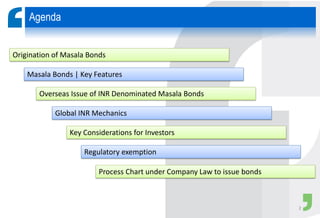
Agenda
Origination of Masala Bonds
Masala Bonds | Key Features
Global INR Mechanics
Key Considerations for Investors
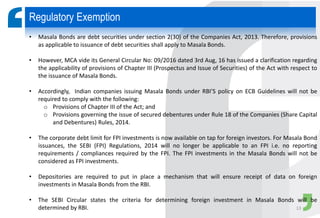
Regulatory exemption
Process Chart under Company Law to issue bonds
Overseas Issue of INR Denominated Masala Bonds
2
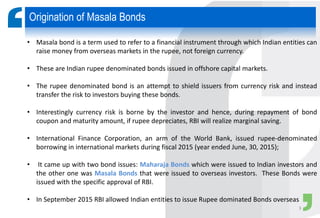
• Masala bond is a term used to refer to a financial instrument through which Indian entities can
raise money from overseas markets in the rupee, not foreign currency.
• These are Indian rupee denominated bonds issued in offshore capital markets.
• The rupee denominated bond is an attempt to shield issuers from currency risk and instead
transfer the risk to investors buying these bonds.
• Interestingly currency risk is borne by the investor and hence, during repayment of bond
coupon and maturity amount, if rupee depreciates, RBI will realize marginal saving.
• International Finance Corporation, an arm of the World Bank, issued rupee-denominated
borrowing in international markets during fiscal 2015 (year ended June, 30, 2015);
• It came up with two bond issues: Maharaja Bonds which were issued to Indian investors and
the other one was Masala Bonds that were issued to overseas investors. These Bonds were
issued with the specific approval of RBI.
• In September 2015 RBI allowed Indian entities to issue Rupee dominated Bonds overseas
Origination of Masala Bonds
3
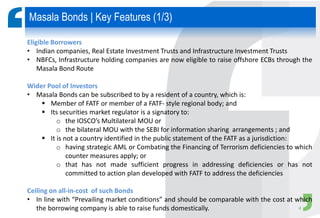
Eligible Borrowers
• Indian companies, Real Estate Investment Trusts and Infrastructure Investment Trusts
• NBFCs, Infrastructure holding companies are now eligible to raise offshore ECBs through the
Masala Bond Route
Wider Pool of Investors
• Masala Bonds can be subscribed to by a resident of a country, which is:
 Member of FATF or member of a FATF- style regional body; and
 Its securities market regulator is a signatory to:
o the IOSCO’s Multilateral MOU or
o the bilateral MOU with the SEBI for information sharing arrangements ; and
 It is not a country identified in the public statement of the FATF as a jurisdiction:
o having strategic AML or Combating the Financing of Terrorism deficiencies to which
counter measures apply; or
o that has not made sufficient progress in addressing deficiencies or has not
committed to action plan developed with FATF to address the deficiencies
Ceiling on all-in-cost of such Bonds
• In line with “Prevailing market conditions” and should be comparable with the cost at which
the borrowing company is able to raise funds domestically.
Masala Bonds | Key Features (1/3)
4
Minimum Maturity
The minimum maturity period for such bonds will be 3 years. In case the subscription to the
bonds/ redemption of the bonds is in tranches, minimum average maturity period should be 3
years.
Amount
The maximum amount that any eligible borrower can raise through issuance of these bonds
under automatic route is INR 50 billion or its equivalent during a financial year. This limit is over
and above the amount permitted to be raised under the automatic route by an entity eligible to
raise External Commercial Borrowings (ECB).
Security
Creation of charge on immovable assets, movable assets, financial securities, corporate or
personal guarantees is permitted with prior no-objection of the authorised dealer bank
Underwriting restrictions
Where an Indian bank underwrites an issue of Masala bonds, it will not be able to hold more
than 5% of the issue size after completion of 6 months of the issue subject to applicable
prudential norms. This is not stated to apply to non-Indian banks
Masala Bonds | Key Features (2/3)
5
Flexibility to Issue Unlisted Instruments
Bonds can either be placed privately or listed on exchanges as per host country regulations
Conversion Rate
Market prevailing rate on the date of settlement
Hedging
Non-resident investors will be eligible to hedge their exposure in Rupee denominated bonds
through permitted derivative products with AD Category - I banks in India. The investors can also
access the domestic market through branches / subsidiaries of Indian banks abroad or branches
of foreign banks with Indian presence abroad on a back to back basis.
Documentation to stipulate that bonds can be sold/transferred / pledge subject to above
conditions
Masala Bonds | Key Features (3/3)
6
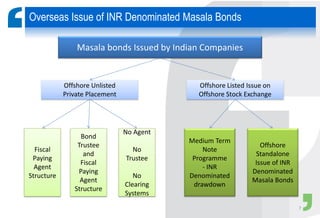
Overseas Issue of INR Denominated Masala Bonds
Masala bonds Issued by Indian Companies
Offshore Unlisted
Private Placement
Offshore Listed Issue on
Offshore Stock Exchange
Fiscal
Paying
Agent
Structure
Bond
Trustee
and
Fiscal
Paying
Agent
Structure
No Agent
No
Trustee
No
Clearing
Systems
Medium Term
Note
Programme
- INR
Denominated
drawdown
Offshore
Standalone
Issue of INR
Denominated
Masala Bonds
7
Global INR Mechanics (1/2)
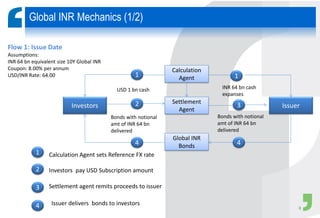
Flow 1: Issue Date
Assumptions:
INR 64 bn equivalent size 10Y Global INR
Coupon: 8.00% per annum
USD/INR Rate: 64.00
Investors
Settlement
Agent
Calculation
Agent
Global INR
Bonds
1
4
Issuer
1
2 3
4
INR 64 bn cash
expanses
USD 1 bn cash
Bonds with notional
amt of INR 64 bn
delivered
Bonds with notional
amt of INR 64 bn
delivered
1
2
3
4
Calculation Agent sets Reference FX rate
Investors pay USD Subscription amount
Settlement agent remits proceeds to issuer
Issuer delivers bonds to investors
8
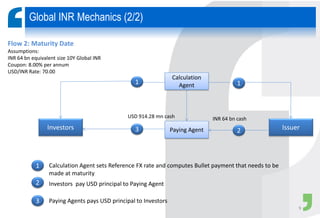
Global INR Mechanics (2/2)
Flow 2: Maturity Date
Assumptions:
INR 64 bn equivalent size 10Y Global INR
Coupon: 8.00% per annum
USD/INR Rate: 70.00
Investors
Calculation
Agent
Paying Agent
1
3 Issuer
1
2
USD 914.28 mn cash INR 64 bn cash
1
2
3
Calculation Agent sets Reference FX rate and computes Bullet payment that needs to be
made at maturity
Investors pay USD principal to Paying Agent
Paying Agents pays USD principal to Investors
9
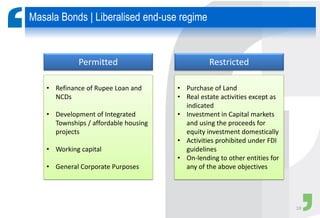
Masala Bonds | Liberalised end-use regime
• Refinance of Rupee Loan and
NCDs
• Development of Integrated
Townships / affordable housing
projects
• Working capital
• General Corporate Purposes
• Purchase of Land
• Real estate activities except as
indicated
• Investment in Capital markets
and using the proceeds for
equity investment domestically
• Activities prohibited under FDI
guidelines
• On-lending to other entities for
any of the above objectives
Permitted Restricted
10
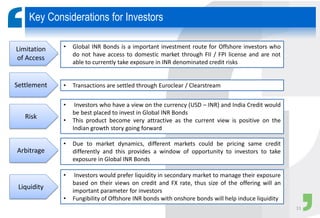
Key Considerations for Investors
Limitation
of Access
Settlement
Risk
Arbitrage
Liquidity
• Global INR Bonds is a important investment route for Offshore investors who
do not have access to domestic market through FII / FPI license and are not
able to currently take exposure in INR denominated credit risks
• Transactions are settled through Euroclear / Clearstream
• Investors who have a view on the currency (USD – INR) and India Credit would
be best placed to invest in Global INR Bonds
• This product become very attractive as the current view is positive on the
Indian growth story going forward
• Due to market dynamics, different markets could be pricing same credit
differently and this provides a window of opportunity to investors to take
exposure in Global INR Bonds
• Investors would prefer liquidity in secondary market to manage their exposure
based on their views on credit and FX rate, thus size of the offering will an
important parameter for investors
• Fungibility of Offshore INR bonds with onshore bonds will help induce liquidity
11
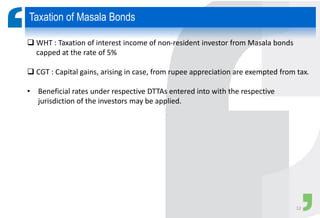
 WHT : Taxation of interest income of non-resident investor from Masala bonds
capped at the rate of 5%
 CGT : Capital gains, arising in case, from rupee appreciation are exempted from tax.
• Beneficial rates under respective DTTAs entered into with the respective
jurisdiction of the investors may be applied.
Taxation of Masala Bonds
12
• Masala Bonds are debt securities under section 2(30) of the Companies Act, 2013. Therefore, provisions
as applicable to issuance of debt securities shall apply to Masala Bonds.
• However, MCA vide its General Circular No: 09/2016 dated 3rd Aug, 16 has issued a clarification regarding
the applicability of provisions of Chapter III (Prospectus and Issue of Securities) of the Act with respect to
the issuance of Masala Bonds.
• Accordingly, Indian companies issuing Masala Bonds under RBI’S policy on ECB Guidelines will not be
required to comply with the following:
o Provisions of Chapter III of the Act; and
o Provisions governing the issue of secured debentures under Rule 18 of the Companies (Share Capital
and Debentures) Rules, 2014.
• The corporate debt limit for FPI investments is now available on tap for foreign investors. For Masala Bond
issuances, the SEBI (FPI) Regulations, 2014 will no longer be applicable to an FPI i.e. no reporting
requirements / compliances required by the FPI. The FPI investments in the Masala Bonds will not be
considered as FPI investments.
• Depositories are required to put in place a mechanism that will ensure receipt of data on foreign
investments in Masala Bonds from the RBI.
• The SEBI Circular states the criteria for determining foreign investment in Masala Bonds will be
determined by RBI.
Regulatory Exemption
13
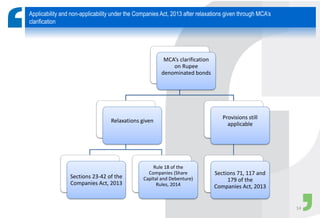
Applicability and non-applicability under the Companies Act, 2013 after relaxations given through MCA’s
clarification
MCA’s clarification
on Rupee
denominated bonds
Relaxations given
Sections 23-42 of the
Companies Act, 2013
Rule 18 of the
Companies (Share
Capital and Debenture)
Rules, 2014
Provisions still
applicable
Sections 71, 117 and
179 of the
Companies Act, 2013
14
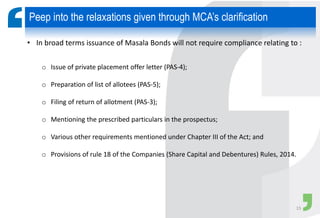
• In broad terms issuance of Masala Bonds will not require compliance relating to :
o Issue of private placement offer letter (PAS-4);
o Preparation of list of allotees (PAS-5);
o Filing of return of allotment (PAS-3);
o Mentioning the prescribed particulars in the prospectus;
o Various other requirements mentioned under Chapter III of the Act; and
o Provisions of rule 18 of the Companies (Share Capital and Debentures) Rules, 2014.
Peep into the relaxations given through MCA’s clarification
15
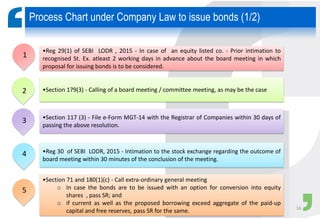
Process Chart under Company Law to issue bonds (1/2)
•Reg 29(1) of SEBI LODR , 2015 - In case of an equity listed co. - Prior intimation to
recognised St. Ex. atleast 2 working days in advance about the board meeting in which
proposal for issuing bonds is to be considered.
•Section 179(3) - Calling of a board meeting / committee meeting, as may be the case
•Section 117 (3) - File e-Form MGT-14 with the Registrar of Companies within 30 days of
passing the above resolution.
•Reg 30 of SEBI LODR, 2015 - Intimation to the stock exchange regarding the outcome of
board meeting within 30 minutes of the conclusion of the meeting.
•Section 71 and 180(1)(c) - Call extra-ordinary general meeting
o In case the bonds are to be issued with an option for conversion into equity
shares , pass SR; and
o if current as well as the proposed borrowing exceed aggregate of the paid-up
capital and free reserves, pass SR for the same.
1
2
3
4
5
16
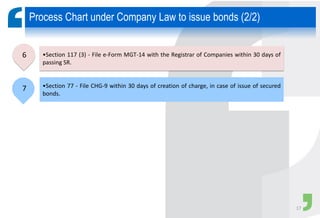
Process Chart under Company Law to issue bonds (2/2)
•Section 117 (3) - File e-Form MGT-14 with the Registrar of Companies within 30 days of
passing SR.
•Section 77 - File CHG-9 within 30 days of creation of charge, in case of issue of secured
bonds.
6
7
17
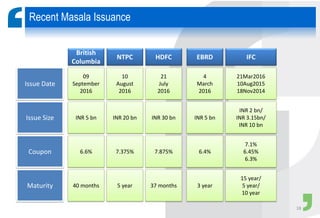
Recent Masala Issuance
Issue Date
Issue Size
Coupon
Maturity
09
September
2016
INR 5 bn
6.6%
40 months
10
August
2016
INR 20 bn
7.375%
5 year
21
July
2016
INR 30 bn
7.875%
37 months
4
March
2016
INR 5 bn
6.4%
3 year
21Mar2016
10Aug2015
18Nov2014
INR 2 bn/
INR 3.15bn/
INR 10 bn
7.1%
6.45%
6.3%
15 year/
5 year/
10 year
British
Columbia
NTPC HDFC EBRD IFC
18
Recent Masala Issuance
19
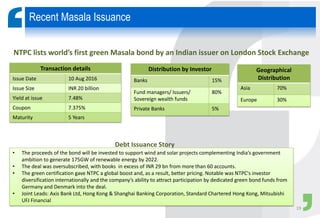
NTPC lists world’s first green Masala bond by an Indian issuer on London Stock Exchange
Transaction details
Issue Date 10 Aug 2016
Issue Size INR 20 billion
Yield at issue 7.48%
Coupon 7.375%
Maturity 5 Years
Distribution by Investor
Banks 15%
Fund managers/ Issuers/
Sovereign wealth funds
80%
Private Banks 5%
Geographical
Distribution
Asia 70%
Europe 30%
• The proceeds of the bond will be invested to support wind and solar projects complementing India’s government
ambition to generate 175GW of renewable energy by 2022.
• The deal was oversubscribed, with books in excess of INR 29 bn from more than 60 accounts.
• The green certification gave NTPC a global boost and, as a result, better pricing. Notable was NTPC's investor
diversification internationally and the company’s ability to attract participation by dedicated green bond funds from
Germany and Denmark into the deal.
• Joint Leads: Axis Bank Ltd, Hong Kong & Shanghai Banking Corporation, Standard Chartered Hong Kong, Mitsubishi
UFJ Financial
Debt Issuance Story
Recent Masala Issuance
20
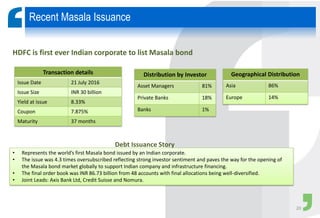
HDFC is first ever Indian corporate to list Masala bond
Transaction details
Issue Date 21 July 2016
Issue Size INR 30 billion
Yield at issue 8.33%
Coupon 7.875%
Maturity 37 months
Distribution by Investor
Asset Managers 81%
Private Banks 18%
Banks 1%
Geographical Distribution
Asia 86%
Europe 14%
• Represents the world’s first Masala bond issued by an Indian corporate.
• The issue was 4.3 times oversubscribed reflecting strong investor sentiment and paves the way for the opening of
the Masala bond market globally to support Indian company and infrastructure financing.
• The final order book was INR 86.73 billion from 48 accounts with final allocations being well-diversified.
• Joint Leads: Axis Bank Ltd, Credit Suisse and Nomura.
Debt Issuance Story
 One stop destination for financial solutions. A SEBI registered
Merchant Banker & Stock Broker
 Incorporated in the year 1989 and listed on BSE
 Promoted by a group of Chartered Accountants
 PAN India presence across seven locations
 Has large pool of talents
 Provides professional services in Merchant Banking, Corporate
Finance, International Finance
About Sumedha Fiscal
21
THANK YOU
22

An Introduction to Masala Bonds

  • 1.
    1 Introduction to MasalaBonds B S Rathi Director Sumedha Fiscal Services Ltd 9867751705/022 40332400 bs_rathi@sumedhafiscal.com by
  • 2.
    Agenda Origination of MasalaBonds Masala Bonds | Key Features Global INR Mechanics Key Considerations for Investors Regulatory exemption Process Chart under Company Law to issue bonds Overseas Issue of INR Denominated Masala Bonds 2
  • 3.
    • Masala bondis a term used to refer to a financial instrument through which Indian entities can raise money from overseas markets in the rupee, not foreign currency. • These are Indian rupee denominated bonds issued in offshore capital markets. • The rupee denominated bond is an attempt to shield issuers from currency risk and instead transfer the risk to investors buying these bonds. • Interestingly currency risk is borne by the investor and hence, during repayment of bond coupon and maturity amount, if rupee depreciates, RBI will realize marginal saving. • International Finance Corporation, an arm of the World Bank, issued rupee-denominated borrowing in international markets during fiscal 2015 (year ended June, 30, 2015); • It came up with two bond issues: Maharaja Bonds which were issued to Indian investors and the other one was Masala Bonds that were issued to overseas investors. These Bonds were issued with the specific approval of RBI. • In September 2015 RBI allowed Indian entities to issue Rupee dominated Bonds overseas Origination of Masala Bonds 3
  • 4.
    Eligible Borrowers • Indiancompanies, Real Estate Investment Trusts and Infrastructure Investment Trusts • NBFCs, Infrastructure holding companies are now eligible to raise offshore ECBs through the Masala Bond Route Wider Pool of Investors • Masala Bonds can be subscribed to by a resident of a country, which is:  Member of FATF or member of a FATF- style regional body; and  Its securities market regulator is a signatory to: o the IOSCO’s Multilateral MOU or o the bilateral MOU with the SEBI for information sharing arrangements ; and  It is not a country identified in the public statement of the FATF as a jurisdiction: o having strategic AML or Combating the Financing of Terrorism deficiencies to which counter measures apply; or o that has not made sufficient progress in addressing deficiencies or has not committed to action plan developed with FATF to address the deficiencies Ceiling on all-in-cost of such Bonds • In line with “Prevailing market conditions” and should be comparable with the cost at which the borrowing company is able to raise funds domestically. Masala Bonds | Key Features (1/3) 4
  • 5.
    Minimum Maturity The minimummaturity period for such bonds will be 3 years. In case the subscription to the bonds/ redemption of the bonds is in tranches, minimum average maturity period should be 3 years. Amount The maximum amount that any eligible borrower can raise through issuance of these bonds under automatic route is INR 50 billion or its equivalent during a financial year. This limit is over and above the amount permitted to be raised under the automatic route by an entity eligible to raise External Commercial Borrowings (ECB). Security Creation of charge on immovable assets, movable assets, financial securities, corporate or personal guarantees is permitted with prior no-objection of the authorised dealer bank Underwriting restrictions Where an Indian bank underwrites an issue of Masala bonds, it will not be able to hold more than 5% of the issue size after completion of 6 months of the issue subject to applicable prudential norms. This is not stated to apply to non-Indian banks Masala Bonds | Key Features (2/3) 5
  • 6.
    Flexibility to IssueUnlisted Instruments Bonds can either be placed privately or listed on exchanges as per host country regulations Conversion Rate Market prevailing rate on the date of settlement Hedging Non-resident investors will be eligible to hedge their exposure in Rupee denominated bonds through permitted derivative products with AD Category - I banks in India. The investors can also access the domestic market through branches / subsidiaries of Indian banks abroad or branches of foreign banks with Indian presence abroad on a back to back basis. Documentation to stipulate that bonds can be sold/transferred / pledge subject to above conditions Masala Bonds | Key Features (3/3) 6
  • 7.
    Overseas Issue ofINR Denominated Masala Bonds Masala bonds Issued by Indian Companies Offshore Unlisted Private Placement Offshore Listed Issue on Offshore Stock Exchange Fiscal Paying Agent Structure Bond Trustee and Fiscal Paying Agent Structure No Agent No Trustee No Clearing Systems Medium Term Note Programme - INR Denominated drawdown Offshore Standalone Issue of INR Denominated Masala Bonds 7
  • 8.
    Global INR Mechanics(1/2) Flow 1: Issue Date Assumptions: INR 64 bn equivalent size 10Y Global INR Coupon: 8.00% per annum USD/INR Rate: 64.00 Investors Settlement Agent Calculation Agent Global INR Bonds 1 4 Issuer 1 2 3 4 INR 64 bn cash expanses USD 1 bn cash Bonds with notional amt of INR 64 bn delivered Bonds with notional amt of INR 64 bn delivered 1 2 3 4 Calculation Agent sets Reference FX rate Investors pay USD Subscription amount Settlement agent remits proceeds to issuer Issuer delivers bonds to investors 8
  • 9.
    Global INR Mechanics(2/2) Flow 2: Maturity Date Assumptions: INR 64 bn equivalent size 10Y Global INR Coupon: 8.00% per annum USD/INR Rate: 70.00 Investors Calculation Agent Paying Agent 1 3 Issuer 1 2 USD 914.28 mn cash INR 64 bn cash 1 2 3 Calculation Agent sets Reference FX rate and computes Bullet payment that needs to be made at maturity Investors pay USD principal to Paying Agent Paying Agents pays USD principal to Investors 9
  • 10.
    Masala Bonds |Liberalised end-use regime • Refinance of Rupee Loan and NCDs • Development of Integrated Townships / affordable housing projects • Working capital • General Corporate Purposes • Purchase of Land • Real estate activities except as indicated • Investment in Capital markets and using the proceeds for equity investment domestically • Activities prohibited under FDI guidelines • On-lending to other entities for any of the above objectives Permitted Restricted 10
  • 11.
    Key Considerations forInvestors Limitation of Access Settlement Risk Arbitrage Liquidity • Global INR Bonds is a important investment route for Offshore investors who do not have access to domestic market through FII / FPI license and are not able to currently take exposure in INR denominated credit risks • Transactions are settled through Euroclear / Clearstream • Investors who have a view on the currency (USD – INR) and India Credit would be best placed to invest in Global INR Bonds • This product become very attractive as the current view is positive on the Indian growth story going forward • Due to market dynamics, different markets could be pricing same credit differently and this provides a window of opportunity to investors to take exposure in Global INR Bonds • Investors would prefer liquidity in secondary market to manage their exposure based on their views on credit and FX rate, thus size of the offering will an important parameter for investors • Fungibility of Offshore INR bonds with onshore bonds will help induce liquidity 11
  • 12.
     WHT :Taxation of interest income of non-resident investor from Masala bonds capped at the rate of 5%  CGT : Capital gains, arising in case, from rupee appreciation are exempted from tax. • Beneficial rates under respective DTTAs entered into with the respective jurisdiction of the investors may be applied. Taxation of Masala Bonds 12
  • 13.
    • Masala Bondsare debt securities under section 2(30) of the Companies Act, 2013. Therefore, provisions as applicable to issuance of debt securities shall apply to Masala Bonds. • However, MCA vide its General Circular No: 09/2016 dated 3rd Aug, 16 has issued a clarification regarding the applicability of provisions of Chapter III (Prospectus and Issue of Securities) of the Act with respect to the issuance of Masala Bonds. • Accordingly, Indian companies issuing Masala Bonds under RBI’S policy on ECB Guidelines will not be required to comply with the following: o Provisions of Chapter III of the Act; and o Provisions governing the issue of secured debentures under Rule 18 of the Companies (Share Capital and Debentures) Rules, 2014. • The corporate debt limit for FPI investments is now available on tap for foreign investors. For Masala Bond issuances, the SEBI (FPI) Regulations, 2014 will no longer be applicable to an FPI i.e. no reporting requirements / compliances required by the FPI. The FPI investments in the Masala Bonds will not be considered as FPI investments. • Depositories are required to put in place a mechanism that will ensure receipt of data on foreign investments in Masala Bonds from the RBI. • The SEBI Circular states the criteria for determining foreign investment in Masala Bonds will be determined by RBI. Regulatory Exemption 13
  • 14.
    Applicability and non-applicabilityunder the Companies Act, 2013 after relaxations given through MCA’s clarification MCA’s clarification on Rupee denominated bonds Relaxations given Sections 23-42 of the Companies Act, 2013 Rule 18 of the Companies (Share Capital and Debenture) Rules, 2014 Provisions still applicable Sections 71, 117 and 179 of the Companies Act, 2013 14
  • 15.
    • In broadterms issuance of Masala Bonds will not require compliance relating to : o Issue of private placement offer letter (PAS-4); o Preparation of list of allotees (PAS-5); o Filing of return of allotment (PAS-3); o Mentioning the prescribed particulars in the prospectus; o Various other requirements mentioned under Chapter III of the Act; and o Provisions of rule 18 of the Companies (Share Capital and Debentures) Rules, 2014. Peep into the relaxations given through MCA’s clarification 15
  • 16.
    Process Chart underCompany Law to issue bonds (1/2) •Reg 29(1) of SEBI LODR , 2015 - In case of an equity listed co. - Prior intimation to recognised St. Ex. atleast 2 working days in advance about the board meeting in which proposal for issuing bonds is to be considered. •Section 179(3) - Calling of a board meeting / committee meeting, as may be the case •Section 117 (3) - File e-Form MGT-14 with the Registrar of Companies within 30 days of passing the above resolution. •Reg 30 of SEBI LODR, 2015 - Intimation to the stock exchange regarding the outcome of board meeting within 30 minutes of the conclusion of the meeting. •Section 71 and 180(1)(c) - Call extra-ordinary general meeting o In case the bonds are to be issued with an option for conversion into equity shares , pass SR; and o if current as well as the proposed borrowing exceed aggregate of the paid-up capital and free reserves, pass SR for the same. 1 2 3 4 5 16
  • 17.
    Process Chart underCompany Law to issue bonds (2/2) •Section 117 (3) - File e-Form MGT-14 with the Registrar of Companies within 30 days of passing SR. •Section 77 - File CHG-9 within 30 days of creation of charge, in case of issue of secured bonds. 6 7 17
  • 18.
    Recent Masala Issuance IssueDate Issue Size Coupon Maturity 09 September 2016 INR 5 bn 6.6% 40 months 10 August 2016 INR 20 bn 7.375% 5 year 21 July 2016 INR 30 bn 7.875% 37 months 4 March 2016 INR 5 bn 6.4% 3 year 21Mar2016 10Aug2015 18Nov2014 INR 2 bn/ INR 3.15bn/ INR 10 bn 7.1% 6.45% 6.3% 15 year/ 5 year/ 10 year British Columbia NTPC HDFC EBRD IFC 18
  • 19.
    Recent Masala Issuance 19 NTPClists world’s first green Masala bond by an Indian issuer on London Stock Exchange Transaction details Issue Date 10 Aug 2016 Issue Size INR 20 billion Yield at issue 7.48% Coupon 7.375% Maturity 5 Years Distribution by Investor Banks 15% Fund managers/ Issuers/ Sovereign wealth funds 80% Private Banks 5% Geographical Distribution Asia 70% Europe 30% • The proceeds of the bond will be invested to support wind and solar projects complementing India’s government ambition to generate 175GW of renewable energy by 2022. • The deal was oversubscribed, with books in excess of INR 29 bn from more than 60 accounts. • The green certification gave NTPC a global boost and, as a result, better pricing. Notable was NTPC's investor diversification internationally and the company’s ability to attract participation by dedicated green bond funds from Germany and Denmark into the deal. • Joint Leads: Axis Bank Ltd, Hong Kong & Shanghai Banking Corporation, Standard Chartered Hong Kong, Mitsubishi UFJ Financial Debt Issuance Story
  • 20.
    Recent Masala Issuance 20 HDFCis first ever Indian corporate to list Masala bond Transaction details Issue Date 21 July 2016 Issue Size INR 30 billion Yield at issue 8.33% Coupon 7.875% Maturity 37 months Distribution by Investor Asset Managers 81% Private Banks 18% Banks 1% Geographical Distribution Asia 86% Europe 14% • Represents the world’s first Masala bond issued by an Indian corporate. • The issue was 4.3 times oversubscribed reflecting strong investor sentiment and paves the way for the opening of the Masala bond market globally to support Indian company and infrastructure financing. • The final order book was INR 86.73 billion from 48 accounts with final allocations being well-diversified. • Joint Leads: Axis Bank Ltd, Credit Suisse and Nomura. Debt Issuance Story
  • 21.
     One stopdestination for financial solutions. A SEBI registered Merchant Banker & Stock Broker  Incorporated in the year 1989 and listed on BSE  Promoted by a group of Chartered Accountants  PAN India presence across seven locations  Has large pool of talents  Provides professional services in Merchant Banking, Corporate Finance, International Finance About Sumedha Fiscal 21
  • 22.