NON-BANKING FINANCIAL
SERVICE CRISIS AND RISK
MANAGEMENT
Narinder Kumar Bhasin, Amity University
Sunil Kadyan, Amity University
Richa Bhatia, The Bhopal School of Social Sciences
Introduction
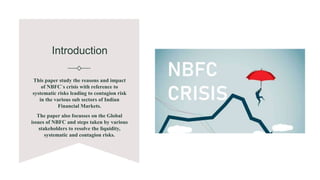
This paper study the reasons and impact
of NBFC`s crisis with reference to
systematic risks leading to contagion risk
in the various sub sectors of Indian
Financial Markets.
The paper also focusses on the Global
issues of NBFC and steps taken by various
stakeholders to resolve the liquidity,
systematic and contagion risks.
History and Evolution of NBFC`s in India
NBFCs in India made a humble
beginning way back in the
1960’s to serve the need of the
savers and investors whose
financial requirements were not
sufficiently covered by the existing
banking system in India.
During the first stages of their
development, this business of
financing was regulated by the
Companies Act.
The RBI accepted and
implemented the key
recommendations of James S.
Raj Study Group formed in 1975
that financial companies be
allowed to gearing often times.
Between 1980’s and 1990’s,
NBFCs gained good ground and
started to attract a huge number
of investors owing to their
customer friendly reputation.
In the period following the
amendment of the Act in 1997,
the NBFCs have evolved
substantially in terms of
operations, variety of market
products and instruments,
technological sophistication etc.
Regulatory Framework
NBFCs are regulated by the Reserve Bank of India
(RBI) which outlines norms and standards, issues
relevant notifications, and monitors overall
functioning of NBFCs within the framework of the
Reserve Bank of India Act, 1934 along with any
amendments.
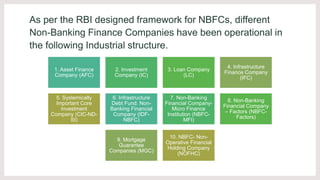
As per the RBI designed framework for NBFCs, different
Non-Banking Finance Companies have been operational in
the following Industrial structure.
1. Asset Finance
Company (AFC)
2. Investment
Company (IC)
3. Loan Company
(LC)
4. Infrastructure
Finance Company
(IFC)
5. Systemically
Important Core
Investment
Company (CIC-ND-
SI)
6. Infrastructure
Debt Fund: Non-
Banking Financial
Company (IDF-
NBFC)
7. Non-Banking
Financial Company-
Micro Finance
Institution (NBFC-
MFI)
8. Non-Banking
Financial Company
– Factors (NBFC-
Factors)
9. Mortgage
Guarantee
Companies (MGC)
10. NBFC- Non-
Operative Financial
Holding Company
(NOFHC)
Overview of NBFC Crisis: Reasons of
Failure
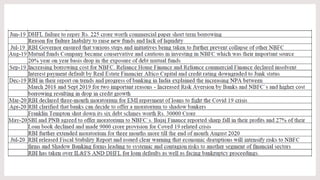
The crisis started from the default made on bonds payment by ILFS and
other irregularities related to officials of the NBFC were pointed out.
Some of the main factors leading to the NBFCs crisis were credit squeeze,
over-leveraging, excessive concentration, inappropriate business model
causing massive mismatch between assets and liabilities, which were
exacerbated by misadventures by a few rogue promotors.
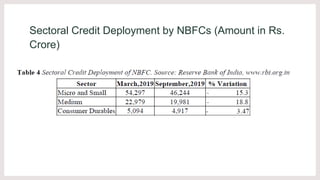
Sectoral Credit Deployment by NBFCs (Amount in Rs.
Crore)
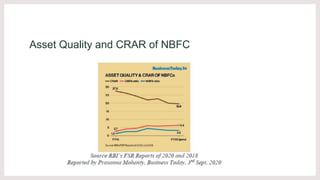
Asset Quality and CRAR of NBFC
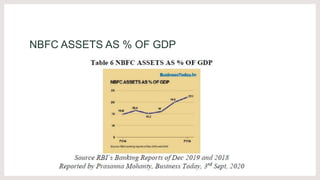
NBFC ASSETS AS % OF GDP
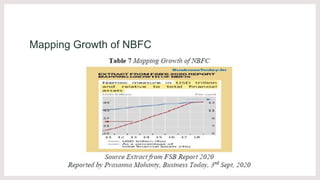
Mapping Growth of NBFC
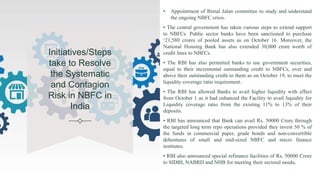
Initiatives/Steps
take to Resolve
the Systematic
and Contagion
Risk in NBFC in
India
• Appointment of Bimal Jalan committee to study and understand
the ongoing NBFC crisis.
• The central government has taken various steps to extend support
to NBFCs. Public sector banks have been sanctioned to purchase
‘21,580 crores of pooled assets as on October 16. Moreover, the
National Housing Bank has also extended 30,000 crore worth of
credit lines to NBFCs.
• The RBI has also permitted banks to use government securities,
equal to their incremental outstanding credit to NBFCs, over and
above their outstanding credit to them as on October 19, to meet the
liquidity coverage ratio requirement.
• The RBI has allowed Banks to avail higher liquidity with effect
from October 1 as it had enhanced the Facility to avail liquidity for
Liquidity coverage ratio from the existing 11% to 13% of their
deposits.
• RBI has announced that Bank can avail Rs. 50000 Crore through
the targeted long term repo operations provided they invest 50 % of
the funds in commercial paper, grade bonds and non-convertible
debentures of small and mid-sized NBFC and micro finance
institutes.
• RBI also announced special refinance facilities of Rs, 50000 Crore
to SIDBI, NABRD and NHB for meeting their sectoral needs.
Suggestions and Recommendations
• Adoption of very sound due diligence on working of NBFC sector.
• Regular monitoring on business growth of the specific companies.
• Emphasis on very sound financial management of the sector.
• Proper Asset Liability Management (ALM) policies and its matching with
demand and liability positions.
• The RBI should give approval on appointment of Audit Firms and to avoid
related transactions.
• Company specific exposure limits for Banks and its regular monitoring by
RBI.
• Checks and balances on day to day working of downgraded companies.
Conclusion
The NBFC crisis has highlighted the shortcomings that forced the Regulator and Government of India
to rethink about regulation and monitoring of the sector.
No doubt the crisis will pave the way for better corporate governance, adoption of proper due-
diligence and proper policy frame work to consolidate the growth of the sector.
Ten parameters that provides foundation for NBFC for sustainable growth and efficient operations in
the uncertain times, dynamic and competitive market place. These ten considerations are Enterprise
strategy, customer experience, process and operations, Underwriting, collections, Robust IT and
digital capabilities, partnership with Fintech players, proactive risk management, agile organization
design and effective government mechanism.
The successful transformation of robust risks and governance model can build the NBFC of the future.
NBFC CRISIS AND RISK MANAGEMENT

NBFC CRISIS AND RISK MANAGEMENT

  • 1.
    NON-BANKING FINANCIAL SERVICE CRISISAND RISK MANAGEMENT Narinder Kumar Bhasin, Amity University Sunil Kadyan, Amity University Richa Bhatia, The Bhopal School of Social Sciences
  • 2.
    Introduction This paper studythe reasons and impact of NBFC`s crisis with reference to systematic risks leading to contagion risk in the various sub sectors of Indian Financial Markets. The paper also focusses on the Global issues of NBFC and steps taken by various stakeholders to resolve the liquidity, systematic and contagion risks.
  • 3.
    History and Evolutionof NBFC`s in India NBFCs in India made a humble beginning way back in the 1960’s to serve the need of the savers and investors whose financial requirements were not sufficiently covered by the existing banking system in India. During the first stages of their development, this business of financing was regulated by the Companies Act. The RBI accepted and implemented the key recommendations of James S. Raj Study Group formed in 1975 that financial companies be allowed to gearing often times. Between 1980’s and 1990’s, NBFCs gained good ground and started to attract a huge number of investors owing to their customer friendly reputation. In the period following the amendment of the Act in 1997, the NBFCs have evolved substantially in terms of operations, variety of market products and instruments, technological sophistication etc.
  • 4.
    Regulatory Framework NBFCs areregulated by the Reserve Bank of India (RBI) which outlines norms and standards, issues relevant notifications, and monitors overall functioning of NBFCs within the framework of the Reserve Bank of India Act, 1934 along with any amendments.
  • 5.
    As per theRBI designed framework for NBFCs, different Non-Banking Finance Companies have been operational in the following Industrial structure. 1. Asset Finance Company (AFC) 2. Investment Company (IC) 3. Loan Company (LC) 4. Infrastructure Finance Company (IFC) 5. Systemically Important Core Investment Company (CIC-ND- SI) 6. Infrastructure Debt Fund: Non- Banking Financial Company (IDF- NBFC) 7. Non-Banking Financial Company- Micro Finance Institution (NBFC- MFI) 8. Non-Banking Financial Company – Factors (NBFC- Factors) 9. Mortgage Guarantee Companies (MGC) 10. NBFC- Non- Operative Financial Holding Company (NOFHC)
  • 10.
    Overview of NBFCCrisis: Reasons of Failure The crisis started from the default made on bonds payment by ILFS and other irregularities related to officials of the NBFC were pointed out. Some of the main factors leading to the NBFCs crisis were credit squeeze, over-leveraging, excessive concentration, inappropriate business model causing massive mismatch between assets and liabilities, which were exacerbated by misadventures by a few rogue promotors.
  • 11.
    Sectoral Credit Deploymentby NBFCs (Amount in Rs. Crore)
  • 12.
    Asset Quality andCRAR of NBFC
  • 13.
  • 14.
  • 15.
    Initiatives/Steps take to Resolve theSystematic and Contagion Risk in NBFC in India • Appointment of Bimal Jalan committee to study and understand the ongoing NBFC crisis. • The central government has taken various steps to extend support to NBFCs. Public sector banks have been sanctioned to purchase ‘21,580 crores of pooled assets as on October 16. Moreover, the National Housing Bank has also extended 30,000 crore worth of credit lines to NBFCs. • The RBI has also permitted banks to use government securities, equal to their incremental outstanding credit to NBFCs, over and above their outstanding credit to them as on October 19, to meet the liquidity coverage ratio requirement. • The RBI has allowed Banks to avail higher liquidity with effect from October 1 as it had enhanced the Facility to avail liquidity for Liquidity coverage ratio from the existing 11% to 13% of their deposits. • RBI has announced that Bank can avail Rs. 50000 Crore through the targeted long term repo operations provided they invest 50 % of the funds in commercial paper, grade bonds and non-convertible debentures of small and mid-sized NBFC and micro finance institutes. • RBI also announced special refinance facilities of Rs, 50000 Crore to SIDBI, NABRD and NHB for meeting their sectoral needs.
  • 16.
    Suggestions and Recommendations •Adoption of very sound due diligence on working of NBFC sector. • Regular monitoring on business growth of the specific companies. • Emphasis on very sound financial management of the sector. • Proper Asset Liability Management (ALM) policies and its matching with demand and liability positions. • The RBI should give approval on appointment of Audit Firms and to avoid related transactions. • Company specific exposure limits for Banks and its regular monitoring by RBI. • Checks and balances on day to day working of downgraded companies.
  • 17.
    Conclusion The NBFC crisishas highlighted the shortcomings that forced the Regulator and Government of India to rethink about regulation and monitoring of the sector. No doubt the crisis will pave the way for better corporate governance, adoption of proper due- diligence and proper policy frame work to consolidate the growth of the sector. Ten parameters that provides foundation for NBFC for sustainable growth and efficient operations in the uncertain times, dynamic and competitive market place. These ten considerations are Enterprise strategy, customer experience, process and operations, Underwriting, collections, Robust IT and digital capabilities, partnership with Fintech players, proactive risk management, agile organization design and effective government mechanism. The successful transformation of robust risks and governance model can build the NBFC of the future.