Write down 3 personal goals for 
each of your members and their 
why behind their current role.
team member program: 
An experience for a young person to develop 
responsible and entrepreneurial leadership by living a 
practical team experience at a local, national or global 
level.
team member program: 
An experience for a young person to develop 
responsible and entrepreneurial leadership by 
living a practical team experience at a local, national 
or global level.
team member program: 
An experience for a young person to develop 
responsible and entrepreneurial leadership by 
living a practical team experience at a local, national 
or global level.
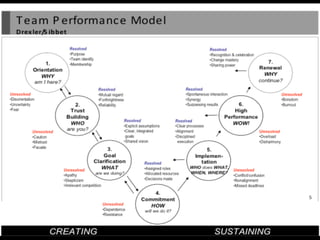
orientation
Members have just joined 
the team and they need to 
understand what the team 
is about, why they exist and 
do they belong to the team.
ORIENTATION WHY AM I HERE? 
A new oGCDP team is recruited 
and it’s their first meeting.
one week later. . .
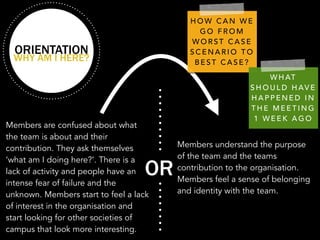
ORIENTATION WHY AM I HERE? 
Members are confused about what 
the team is about and their 
contribution. They ask themselves 
‘what am I doing here?’. There is a 
lack of activity and people have an 
intense fear of failure and the 
unknown. Members start to feel a lack 
of interest in the organisation and 
start looking for other societies of 
campus that look more interesting. 
Members understand the purpose 
of the team and the teams 
contribution to the organisation. 
Members feel a sense of belonging 
and identity with the team. 
OR 
HOW CAN WE 
GO FROM 
WORST CASE 
SCENARIO TO 
BEST CASE? 
WHAT 
SHOULD HAVE 
HAPPENED IN 
THE MEETING 
1 WEEK AGO
trust building
Members need to establish 
relationships within the 
team that creates a sense of 
mutual respect, reliability 
and trust.
TRUST BUILDING WHO ARE YOU? 
A few weeks after the newies 
first meeting…
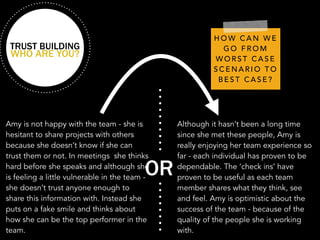
Amy is not happy with the team - she is 
hesitant to share projects with others 
because she doesn’t know if she can 
trust them or not. In meetings she thinks 
hard before she speaks and although she 
is feeling a little vulnerable in the team - 
she doesn’t trust anyone enough to 
share this information with. Instead she 
puts on a fake smile and thinks about 
how she can be the top performer in the 
team. 
Although it hasn’t been a long time 
since she met these people, Amy is 
really enjoying her team experience so 
far - each individual has proven to be 
dependable. The ‘check ins’ have 
proven to be useful as each team 
member shares what they think, see 
and feel. Amy is optimistic about the 
success of the team - because of the 
quality of the people she is working 
with. 
OR 
HOW CAN WE 
GO FROM 
WORST CASE 
SCENARIO TO 
BEST CASE? 
TRUST BUILDING WHO ARE YOU?
goal 
clarification
Members ask ‘what are we 
doing’ and translate the 
purpose into an end goal, 
milestones and measures of 
progress.
GOAL CLARIFICATION 
WHAT ARE WE 
DOING? 
Operational Induction is starting and members 
are expected to start work.
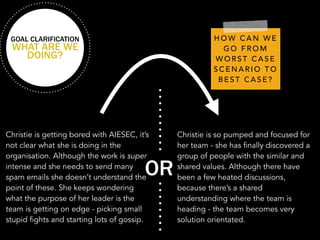
1 Week Later…
Christie is getting bored with AIESEC, it’s 
not clear what she is doing in the 
organisation. Although the work is super 
intense and she needs to send many 
spam emails she doesn’t understand the 
point of these. She keeps wondering 
what the purpose of her leader is the 
team is getting on edge - picking small 
stupid fights and starting lots of gossip. 
Christie is so pumped and focused for 
her team - she has finally discovered a 
group of people with the similar and 
shared values. Although there have 
been a few heated discussions, 
because there’s a shared 
understanding where the team is 
heading - the team becomes very 
solution orientated. 
OR 
HOW CAN WE 
GO FROM 
WORST CASE 
SCENARIO TO 
BEST CASE? 
GOAL CLARIFICATION 
WHAT ARE WE 
DOING?
commitment
Members make a genuine 
commitment to achieve the 
organisation’s goals as they 
settle down to work.
COMMITMENT 
HOW WILL WE 
DO IT? 
Operational Induction is in full swing and each team 
member has lots of work.
1 Week Later…
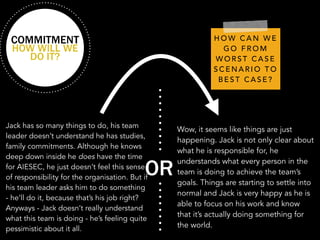
Jack has so many things to do, his team 
leader doesn’t understand he has studies, 
family commitments. Although he knows 
deep down inside he does have the time 
for AIESEC, he just doesn’t feel this sense 
of responsibility for the organisation. But if 
his team leader asks him to do something 
- he’ll do it, because that’s his job right? 
Anyways - Jack doesn’t really understand 
what this team is doing - he’s feeling quite 
pessimistic about it all. 
Wow, it seems like things are just 
happening. Jack is not only clear about 
what he is responsible for, he 
understands what every person in the 
team is doing to achieve the team’s 
goals. Things are starting to settle into 
normal and Jack is very happy as he is 
able to focus on his work and know 
that it’s actually doing something for 
the world. 
OR 
HOW CAN WE 
GO FROM 
WORST CASE 
SCENARIO TO 
BEST CASE? 
COMMITMENT 
HOW WILL WE 
DO IT?
implementation
With more intense 
workload member’s 
concern is ‘who does what, 
where and when?’.
IMPLEMENTATION WHO DOES WHAT, 
WHEN AND WHERE? 
Induction is closed and oGCDP is full within 
promotions and raising.
1 Week Later…
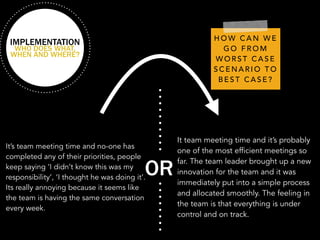
It’s team meeting time and no-one has 
completed any of their priorities, people 
keep saying ‘I didn’t know this was my 
responsibility’, ‘I thought he was doing it’. 
Its really annoying because it seems like 
the team is having the same conversation 
every week. 
It team meeting time and it’s probably 
one of the most efficient meetings so 
far. The team leader brought up a new 
innovation for the team and it was 
immediately put into a simple process 
and allocated smoothly. The feeling in 
the team is that everything is under 
control and on track. 
OR 
HOW CAN WE 
GO FROM 
WORST CASE 
SCENARIO TO 
BEST CASE? 
IMPLEMENTATION WHO DOES WHAT, 
WHEN AND WHERE?
high performance
Ease of team interactions 
allows effective responses 
to changing conditions and 
extraordinary results that 
produce a sense of WOW!
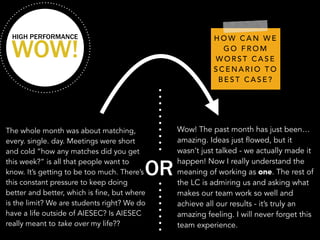
HIGH PERFORMANCE WOW! 
It’s matching time!
The whole month was about matching, 
every. single. day. Meetings were short 
and cold “how any matches did you get 
this week?” is all that people want to 
know. It’s getting to be too much. There’s 
this constant pressure to keep doing 
better and better, which is fine, but where 
is the limit? We are students right? We do 
have a life outside of AIESEC? Is AIESEC 
really meant to take over my life?? 
Wow! The past month has just been… 
amazing. Ideas just flowed, but it 
wasn’t just talked - we actually made it 
happen! Now I really understand the 
meaning of working as one. The rest of 
the LC is admiring us and asking what 
makes our team work so well and 
achieve all our results - it’s truly an 
amazing feeling. I will never forget this 
team experience. 
OR 
HOW CAN WE 
GO FROM 
WORST CASE 
SCENARIO TO 
BEST CASE? 
HIGH PERFORMANCE WOW!
let’s plot it out
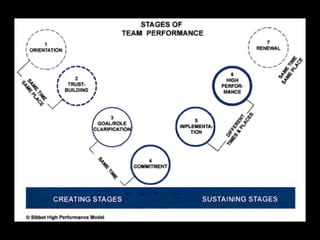
Where am I in the team development model?
What are my immediate action steps to get to the next 
stage?
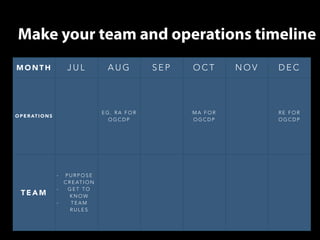
Make your team and operations timeline 
MONTH JUL AUG SEP OCT NOV DEC 
OPERATIONS EG. RA FOR 
OGCDP 
MA FOR 
OGCDP 
RE FOR 
OGCDP 
TEAM 
- PURPOSE 
CREATION 
- GET TO 
KNOW 
- TEAM 
RULES
What are the responsibilities I have 
as a TLP?
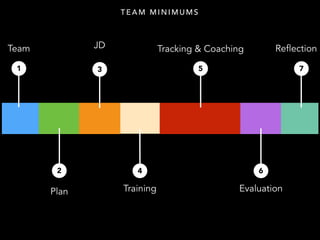
TEAM MINIMUMS 
1 
2 
Reflection 
3 5 7 
6 
Team 
Plan 
JD 
4 
Training 
Tracking & Coaching 
Evaluation
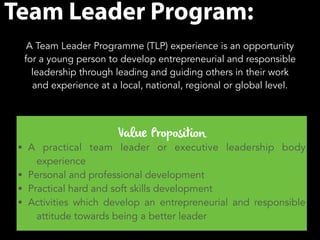
Team Leader Program: 
A Team Leader Programme (TLP) experience is an opportunity 
for a young person to develop entrepreneurial and responsible 
leadership through leading and guiding others in their work 
and experience at a local, national, regional or global level. 
Value Proposition 
• A practical team leader or executive leadership body 
experience 
• Personal and professional development 
• Practical hard and soft skills development 
• Activities which develop an entrepreneurial and responsible 
attitude towards being a better leader
What is my role as a Team Leader?
TEAM 
STANDARDS 
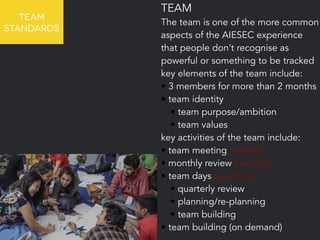
TEAM 
The team is one of the more common 
aspects of the AIESEC experience 
that people don’t recognise as 
powerful or something to be tracked 
key elements of the team include: 
• 3 members for more than 2 months 
• team identity 
• team purpose/ambition 
• team values 
key activities of the team include: 
• team meeting (weekly) 
• monthly review (monthly) 
• team days (quarterly) 
• quarterly review 
• planning/re-planning 
• team building 
• team building (on demand)
TEAM 
STANDARDS 
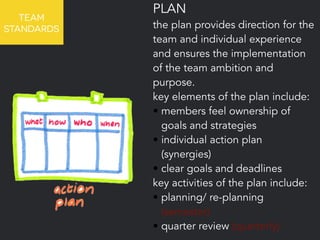
PLAN 
the plan provides direction for the 
team and individual experience 
and ensures the implementation 
of the team ambition and 
purpose. 
key elements of the plan include: 
• members feel ownership of 
goals and strategies 
• individual action plan 
(synergies) 
• clear goals and deadlines 
key activities of the plan include: 
• planning/ re-planning 
(semester) 
• quarter review (quarterly)
TEAM 
STANDARDS 
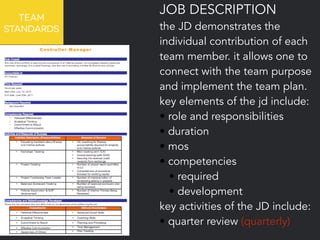
JOB DESCRIPTION 
the JD demonstrates the 
individual contribution of each 
team member. it allows one to 
connect with the team purpose 
and implement the team plan. 
key elements of the jd include: 
• role and responsibilities 
• duration 
• mos 
• competencies 
• required 
• development 
key activities of the JD include: 
• quarter review (quarterly)
TEAM 
STANDARDS 
TRAINING 
training is the next key step in 
the process to ensure that the 
people of our organisation can 
fulfil their jd. it’s important to 
remember that people learn from 
doing. 
key elements of the jd include: 
• educational cycle 
• knowledge (organisational 
and functional skills) 
• attitude 
• based on jd 
key activities of the jd include: 
• transition (start of term) 
• planning (each semester) 
• conference 
• outsource!
TEAM 
STANDARDS 
TRACKING AND COACHING 
tracking and coaching can be spilt 
into two elements. tracking is about 
ensuring implementation. coaching is 
about ensuring improvement of the 
individual’s ability to fulfil their jd. 
key elements of tracking include: 
• based on the plan (goals) 
• based on the jd 
key activities of tracking include: 
• team meeting (weekly) 
• general points (needs of all the 
team) 
• individual meeting (weekly) 
• done/not done 
• clear priorities for not done 
• virtual channels 
• adapt to the person
TEAM 
STANDARDS 
COACHING 
tracking and coaching can be spilt 
into two elements. coaching is about 
ensuring improvement of the 
individual’s ability to fulfil their jd. 
key elements of coaching include: 
• based on the plan (goals) 
• based on the JD (MOS) 
• focus on performance 
• connect development with 
performance 
• topics: professional, team, 
personal 
key activities of coaching include: 
• team meeting (quarterly) 
• consider having externals 
• individual meeting (monthly) 
• clear next steps 
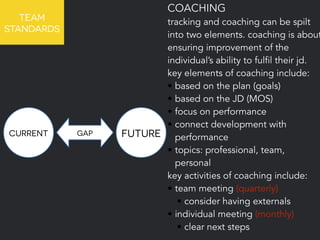
CURRENT GAP FUTURE
TEAM 
STANDARDS 
EVALUATION & REFLECTION 
Evaluation and Reflection enables 
individuals to experience the inner journey 
of leadership as supported by the team 
experience/team leader. evaluation enables 
learning from doing and reflection should 
include value generation and reinvention. 
key elements of coaching include: 
• performance and organisational 
contribution to mos 
• development of competencies 
key activities of coaching include: 
• tracking 
• individual meeting (monthly) 
• feedback 
• coaching meeting (monthly) 
• team days (quarterly) 
• rewards and recognition (monthly)

The I in Team

  • 2.
    Write down 3personal goals for each of your members and their why behind their current role.
  • 3.
    team member program: An experience for a young person to develop responsible and entrepreneurial leadership by living a practical team experience at a local, national or global level.
  • 4.
    team member program: An experience for a young person to develop responsible and entrepreneurial leadership by living a practical team experience at a local, national or global level.
  • 5.
    team member program: An experience for a young person to develop responsible and entrepreneurial leadership by living a practical team experience at a local, national or global level.
  • 7.
  • 8.
    Members have justjoined the team and they need to understand what the team is about, why they exist and do they belong to the team.
  • 9.
    ORIENTATION WHY AMI HERE? A new oGCDP team is recruited and it’s their first meeting.
  • 10.
  • 11.
    ORIENTATION WHY AMI HERE? Members are confused about what the team is about and their contribution. They ask themselves ‘what am I doing here?’. There is a lack of activity and people have an intense fear of failure and the unknown. Members start to feel a lack of interest in the organisation and start looking for other societies of campus that look more interesting. Members understand the purpose of the team and the teams contribution to the organisation. Members feel a sense of belonging and identity with the team. OR HOW CAN WE GO FROM WORST CASE SCENARIO TO BEST CASE? WHAT SHOULD HAVE HAPPENED IN THE MEETING 1 WEEK AGO
  • 12.
  • 13.
    Members need toestablish relationships within the team that creates a sense of mutual respect, reliability and trust.
  • 14.
    TRUST BUILDING WHOARE YOU? A few weeks after the newies first meeting…
  • 15.
    Amy is nothappy with the team - she is hesitant to share projects with others because she doesn’t know if she can trust them or not. In meetings she thinks hard before she speaks and although she is feeling a little vulnerable in the team - she doesn’t trust anyone enough to share this information with. Instead she puts on a fake smile and thinks about how she can be the top performer in the team. Although it hasn’t been a long time since she met these people, Amy is really enjoying her team experience so far - each individual has proven to be dependable. The ‘check ins’ have proven to be useful as each team member shares what they think, see and feel. Amy is optimistic about the success of the team - because of the quality of the people she is working with. OR HOW CAN WE GO FROM WORST CASE SCENARIO TO BEST CASE? TRUST BUILDING WHO ARE YOU?
  • 16.
  • 17.
    Members ask ‘whatare we doing’ and translate the purpose into an end goal, milestones and measures of progress.
  • 18.
    GOAL CLARIFICATION WHATARE WE DOING? Operational Induction is starting and members are expected to start work.
  • 19.
  • 20.
    Christie is gettingbored with AIESEC, it’s not clear what she is doing in the organisation. Although the work is super intense and she needs to send many spam emails she doesn’t understand the point of these. She keeps wondering what the purpose of her leader is the team is getting on edge - picking small stupid fights and starting lots of gossip. Christie is so pumped and focused for her team - she has finally discovered a group of people with the similar and shared values. Although there have been a few heated discussions, because there’s a shared understanding where the team is heading - the team becomes very solution orientated. OR HOW CAN WE GO FROM WORST CASE SCENARIO TO BEST CASE? GOAL CLARIFICATION WHAT ARE WE DOING?
  • 21.
  • 22.
    Members make agenuine commitment to achieve the organisation’s goals as they settle down to work.
  • 23.
    COMMITMENT HOW WILLWE DO IT? Operational Induction is in full swing and each team member has lots of work.
  • 24.
  • 25.
    Jack has somany things to do, his team leader doesn’t understand he has studies, family commitments. Although he knows deep down inside he does have the time for AIESEC, he just doesn’t feel this sense of responsibility for the organisation. But if his team leader asks him to do something - he’ll do it, because that’s his job right? Anyways - Jack doesn’t really understand what this team is doing - he’s feeling quite pessimistic about it all. Wow, it seems like things are just happening. Jack is not only clear about what he is responsible for, he understands what every person in the team is doing to achieve the team’s goals. Things are starting to settle into normal and Jack is very happy as he is able to focus on his work and know that it’s actually doing something for the world. OR HOW CAN WE GO FROM WORST CASE SCENARIO TO BEST CASE? COMMITMENT HOW WILL WE DO IT?
  • 26.
  • 27.
    With more intense workload member’s concern is ‘who does what, where and when?’.
  • 28.
    IMPLEMENTATION WHO DOESWHAT, WHEN AND WHERE? Induction is closed and oGCDP is full within promotions and raising.
  • 29.
  • 30.
    It’s team meetingtime and no-one has completed any of their priorities, people keep saying ‘I didn’t know this was my responsibility’, ‘I thought he was doing it’. Its really annoying because it seems like the team is having the same conversation every week. It team meeting time and it’s probably one of the most efficient meetings so far. The team leader brought up a new innovation for the team and it was immediately put into a simple process and allocated smoothly. The feeling in the team is that everything is under control and on track. OR HOW CAN WE GO FROM WORST CASE SCENARIO TO BEST CASE? IMPLEMENTATION WHO DOES WHAT, WHEN AND WHERE?
  • 31.
  • 32.
    Ease of teaminteractions allows effective responses to changing conditions and extraordinary results that produce a sense of WOW!
  • 33.
    HIGH PERFORMANCE WOW! It’s matching time!
  • 34.
    The whole monthwas about matching, every. single. day. Meetings were short and cold “how any matches did you get this week?” is all that people want to know. It’s getting to be too much. There’s this constant pressure to keep doing better and better, which is fine, but where is the limit? We are students right? We do have a life outside of AIESEC? Is AIESEC really meant to take over my life?? Wow! The past month has just been… amazing. Ideas just flowed, but it wasn’t just talked - we actually made it happen! Now I really understand the meaning of working as one. The rest of the LC is admiring us and asking what makes our team work so well and achieve all our results - it’s truly an amazing feeling. I will never forget this team experience. OR HOW CAN WE GO FROM WORST CASE SCENARIO TO BEST CASE? HIGH PERFORMANCE WOW!
  • 35.
  • 38.
    Where am Iin the team development model?
  • 39.
    What are myimmediate action steps to get to the next stage?
  • 40.
    Make your teamand operations timeline MONTH JUL AUG SEP OCT NOV DEC OPERATIONS EG. RA FOR OGCDP MA FOR OGCDP RE FOR OGCDP TEAM - PURPOSE CREATION - GET TO KNOW - TEAM RULES
  • 41.
    What are theresponsibilities I have as a TLP?
  • 42.
    TEAM MINIMUMS 1 2 Reflection 3 5 7 6 Team Plan JD 4 Training Tracking & Coaching Evaluation
  • 43.
    Team Leader Program: A Team Leader Programme (TLP) experience is an opportunity for a young person to develop entrepreneurial and responsible leadership through leading and guiding others in their work and experience at a local, national, regional or global level. Value Proposition • A practical team leader or executive leadership body experience • Personal and professional development • Practical hard and soft skills development • Activities which develop an entrepreneurial and responsible attitude towards being a better leader
  • 44.
    What is myrole as a Team Leader?
  • 45.
    TEAM STANDARDS TEAM The team is one of the more common aspects of the AIESEC experience that people don’t recognise as powerful or something to be tracked key elements of the team include: • 3 members for more than 2 months • team identity • team purpose/ambition • team values key activities of the team include: • team meeting (weekly) • monthly review (monthly) • team days (quarterly) • quarterly review • planning/re-planning • team building • team building (on demand)
  • 46.
    TEAM STANDARDS PLAN the plan provides direction for the team and individual experience and ensures the implementation of the team ambition and purpose. key elements of the plan include: • members feel ownership of goals and strategies • individual action plan (synergies) • clear goals and deadlines key activities of the plan include: • planning/ re-planning (semester) • quarter review (quarterly)
  • 47.
    TEAM STANDARDS JOBDESCRIPTION the JD demonstrates the individual contribution of each team member. it allows one to connect with the team purpose and implement the team plan. key elements of the jd include: • role and responsibilities • duration • mos • competencies • required • development key activities of the JD include: • quarter review (quarterly)
  • 48.
    TEAM STANDARDS TRAINING training is the next key step in the process to ensure that the people of our organisation can fulfil their jd. it’s important to remember that people learn from doing. key elements of the jd include: • educational cycle • knowledge (organisational and functional skills) • attitude • based on jd key activities of the jd include: • transition (start of term) • planning (each semester) • conference • outsource!
  • 49.
    TEAM STANDARDS TRACKINGAND COACHING tracking and coaching can be spilt into two elements. tracking is about ensuring implementation. coaching is about ensuring improvement of the individual’s ability to fulfil their jd. key elements of tracking include: • based on the plan (goals) • based on the jd key activities of tracking include: • team meeting (weekly) • general points (needs of all the team) • individual meeting (weekly) • done/not done • clear priorities for not done • virtual channels • adapt to the person
  • 50.
    TEAM STANDARDS COACHING tracking and coaching can be spilt into two elements. coaching is about ensuring improvement of the individual’s ability to fulfil their jd. key elements of coaching include: • based on the plan (goals) • based on the JD (MOS) • focus on performance • connect development with performance • topics: professional, team, personal key activities of coaching include: • team meeting (quarterly) • consider having externals • individual meeting (monthly) • clear next steps CURRENT GAP FUTURE
  • 51.
    TEAM STANDARDS EVALUATION& REFLECTION Evaluation and Reflection enables individuals to experience the inner journey of leadership as supported by the team experience/team leader. evaluation enables learning from doing and reflection should include value generation and reinvention. key elements of coaching include: • performance and organisational contribution to mos • development of competencies key activities of coaching include: • tracking • individual meeting (monthly) • feedback • coaching meeting (monthly) • team days (quarterly) • rewards and recognition (monthly)