NATURE AND
FUNCTION OF SOCIAL
SCIENCES WITH THE
HUMANITIES
MODULE 2 LESSON 1
Most Essential Learning Competency
• Differentiate the nature and functions of Social Science disciplines with the
natural sciences and humanities
A. GENERAL CONCEPTS
AND HISTORICAL
BACKGROUND
• Humanities are academic disciplines that deal with the study of the aspects of
human society and culture. HUMANISTS OR HUMANITY SCHOLARS are the
terms used to call the intellectuals studying humanities.
• The history of humanities started in Ancient Greece since there was wide-
ranging education of citizens in their early society. In Ancient Rome, they
introduced the seven liberal arts involving grammar, rhetoric, logic, arithmetic,
geometry, astronomy, and music. These liberal arts were also used during
medieval times, primarily in education because humanities were considered as
“ways of doing."
• During the 15th century in the Renaissance period, a major shift occurred in
Humanities- from being regarded as traditional subjects and fields into
literature and history. In the 20th century, the postmodernist movement
sought to redefine the humanities into more egalitarian, which is suitable in a
democratic society unlike during Ancient Greece and Rome, wherein
Humanities were not entirely democratic in nature.
BRANCHES OF
HUMANITIES
ANTHROPOLOGY
It is the holistic "science of
humans," a science of the totality of
human existence.
This discipline deals with the
integration of different aspects of
the social sciences, humanities, and
human biology.
ARCHAEOLOGY
It is the study of human activity through the
recovery and analysis of material culture.
The archaeological records involve fossils,
artifacts, architecture, biofacts or ecofacts,
and cultural landscapes.
Archaeology can be considered both as
social science and a branch of the
humanities.
It has various goals, which range from
understanding cultural history to
reconstructing past lifeways to documenting
and explaining changes in human societies
through time in the pre-historic and historical
records.
CLASSICS
The word classics is originated from the
Latin adjective “classicus,” meaning
"belonging to the highest class of
citizens." The term was initially used to
describe the members of the highest
class in ancient Rome.
Classics is also known as “classical
studies,” the study of classical antiquity
referring to the classical era. The
classical period of the Western world
traditionally refers to the study of
Classical Greek and Roman literature in
their original languages of Ancient
Greek and Latin, respectively. It may
also include the study of Greco-Roman
philosophy, history, and archaeology as
secondary subjects.
HISTORY
It is the systematic study of the collected information
about the past.
It refers to the study and interpretation of the record
of humans, societies, institutions, and any topic that
has changed over time.
Herodotus is the father of history.
LINGUISTICS
AND
LANGUAGES
It is the scientific study of language generally
considered a social science,a natural science, and
humanities.
It deals with the analysis of language, vocabulary,
and a variety of uses of language.
LAW AND POLITICS
It comes from the Old English “lagu,” which
means something laid down or fixed, and
the adjective legal comes from the Latin
word “lex.”
It also means to rule or system of rules in
the form of enforceable through
institutions.
It involves authority, command of a
sovereign, and legal policy where both
humans and society are benefited.
LITERATURE
It comes from the Latin word
“literatura/litteratura,” derived itself
from “littera,” which means letter or
handwriting or writing formed with
letters.
It deals with literary pieces, both
written and oral.
It is categorized into fiction, non-
fiction, prose, and poetry.
PHILOSOPHY
It comes from the two Greek words, “philos/philia,” which
means love and “sophia,” which means wisdom.
It is defined as “love of wisdom” that deals with the study
of problems concerning matters such as existence,
knowledge, justification, truth, justice, right and wrong,
beauty, validity, mind, and language.
Philosophy is distinguished from using the human mind
and wisdom to address issues into a critical, generally
systematic approach and its reliance on reasoned
argument, rather than experimental approach.
RELIGION
It comes from the two Latin words “re”
which means again, and “ligare,”
which means “to connect”.
It is defined as a social-cultural system
of designated behaviors and practices,
morals, worldviews, texts, sanctifie d
places, prophecies, ethics, or
organizations, that relate humanity to
supernatural, transcendental, or
spiritual elements.
PERFORMING ARTS
It refers to forms of art in which artists
use their voices, bodies, or inanimate
objects to convey artistic expression.
The performing arts are intended to
express one's emotions and feelings.
Performing arts, includes acrobatics,
busking, comedy, dance, film, magic,
music, opera, juggling, marching arts,
such as brass bands, and theatre
performance.
VISUAL ARTS
It refers to art forms such as
painting, drawing, printmaking,
sculpture, ceramics, photography,
video, filmmaking, de sign, crafts,
and architecture.
It includes many artistic disciplines
such as performing arts, conceptual
art, textile arts also involve aspects
of visual arts as well as arts of other
types and even fine arts.
Also included within the visual arts
are the applied arts such as
industrial design, graphic design,
fashion design, interior design, and
decorative art.
SOCIAL SCIENCES
DISCIPLINE ARE
INTEGRATED,
INTERRELATED, AND
INTERDISCIPLINARY TO THE
NATURAL SCIENCES AND
HUMANITIES
MODULE 2 LESSON 2
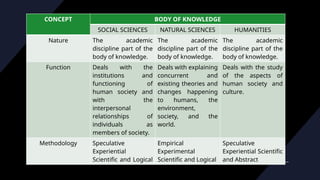
CONCEPT BODY OF KNOWLEDGE
SOCIAL SCIENCES NATURAL SCIENCES HUMANITIES
Nature The academic
discipline part of the
body of knowledge.
The academic
discipline part of the
body of knowledge.
The academic
discipline part of the
body of knowledge.
Function Deals with the
institutions and
functioning of
human society and
with the
interpersonal
relationships of
individuals as
members of society.
Deals with explaining
concurrent and
existing theories and
changes happening
to humans, the
environment,
society, and the
world.
Deals with the study
of the aspects of
human society and
culture.
Methodology Speculative
Experiential
Scientific and Logical
Empirical
Experimental
Scientific and Logical
Speculative
Experiential Scientific
and Abstract

MODULE-2-LESSON-1-AND-2. Nature and Functionspptx

  • 1.
    NATURE AND FUNCTION OFSOCIAL SCIENCES WITH THE HUMANITIES MODULE 2 LESSON 1
  • 2.
    Most Essential LearningCompetency • Differentiate the nature and functions of Social Science disciplines with the natural sciences and humanities
  • 3.
    A. GENERAL CONCEPTS ANDHISTORICAL BACKGROUND
  • 4.
    • Humanities areacademic disciplines that deal with the study of the aspects of human society and culture. HUMANISTS OR HUMANITY SCHOLARS are the terms used to call the intellectuals studying humanities.
  • 5.
    • The historyof humanities started in Ancient Greece since there was wide- ranging education of citizens in their early society. In Ancient Rome, they introduced the seven liberal arts involving grammar, rhetoric, logic, arithmetic, geometry, astronomy, and music. These liberal arts were also used during medieval times, primarily in education because humanities were considered as “ways of doing."
  • 6.
    • During the15th century in the Renaissance period, a major shift occurred in Humanities- from being regarded as traditional subjects and fields into literature and history. In the 20th century, the postmodernist movement sought to redefine the humanities into more egalitarian, which is suitable in a democratic society unlike during Ancient Greece and Rome, wherein Humanities were not entirely democratic in nature.
  • 7.
  • 8.
    ANTHROPOLOGY It is theholistic "science of humans," a science of the totality of human existence. This discipline deals with the integration of different aspects of the social sciences, humanities, and human biology.
  • 9.
    ARCHAEOLOGY It is thestudy of human activity through the recovery and analysis of material culture. The archaeological records involve fossils, artifacts, architecture, biofacts or ecofacts, and cultural landscapes. Archaeology can be considered both as social science and a branch of the humanities. It has various goals, which range from understanding cultural history to reconstructing past lifeways to documenting and explaining changes in human societies through time in the pre-historic and historical records.
  • 10.
    CLASSICS The word classicsis originated from the Latin adjective “classicus,” meaning "belonging to the highest class of citizens." The term was initially used to describe the members of the highest class in ancient Rome. Classics is also known as “classical studies,” the study of classical antiquity referring to the classical era. The classical period of the Western world traditionally refers to the study of Classical Greek and Roman literature in their original languages of Ancient Greek and Latin, respectively. It may also include the study of Greco-Roman philosophy, history, and archaeology as secondary subjects.
  • 11.
    HISTORY It is thesystematic study of the collected information about the past. It refers to the study and interpretation of the record of humans, societies, institutions, and any topic that has changed over time. Herodotus is the father of history.
  • 12.
    LINGUISTICS AND LANGUAGES It is thescientific study of language generally considered a social science,a natural science, and humanities. It deals with the analysis of language, vocabulary, and a variety of uses of language.
  • 13.
    LAW AND POLITICS Itcomes from the Old English “lagu,” which means something laid down or fixed, and the adjective legal comes from the Latin word “lex.” It also means to rule or system of rules in the form of enforceable through institutions. It involves authority, command of a sovereign, and legal policy where both humans and society are benefited.
  • 14.
    LITERATURE It comes fromthe Latin word “literatura/litteratura,” derived itself from “littera,” which means letter or handwriting or writing formed with letters. It deals with literary pieces, both written and oral. It is categorized into fiction, non- fiction, prose, and poetry.
  • 15.
    PHILOSOPHY It comes fromthe two Greek words, “philos/philia,” which means love and “sophia,” which means wisdom. It is defined as “love of wisdom” that deals with the study of problems concerning matters such as existence, knowledge, justification, truth, justice, right and wrong, beauty, validity, mind, and language. Philosophy is distinguished from using the human mind and wisdom to address issues into a critical, generally systematic approach and its reliance on reasoned argument, rather than experimental approach.
  • 16.
    RELIGION It comes fromthe two Latin words “re” which means again, and “ligare,” which means “to connect”. It is defined as a social-cultural system of designated behaviors and practices, morals, worldviews, texts, sanctifie d places, prophecies, ethics, or organizations, that relate humanity to supernatural, transcendental, or spiritual elements.
  • 17.
    PERFORMING ARTS It refersto forms of art in which artists use their voices, bodies, or inanimate objects to convey artistic expression. The performing arts are intended to express one's emotions and feelings. Performing arts, includes acrobatics, busking, comedy, dance, film, magic, music, opera, juggling, marching arts, such as brass bands, and theatre performance.
  • 18.
    VISUAL ARTS It refersto art forms such as painting, drawing, printmaking, sculpture, ceramics, photography, video, filmmaking, de sign, crafts, and architecture. It includes many artistic disciplines such as performing arts, conceptual art, textile arts also involve aspects of visual arts as well as arts of other types and even fine arts. Also included within the visual arts are the applied arts such as industrial design, graphic design, fashion design, interior design, and decorative art.
  • 19.
    SOCIAL SCIENCES DISCIPLINE ARE INTEGRATED, INTERRELATED,AND INTERDISCIPLINARY TO THE NATURAL SCIENCES AND HUMANITIES MODULE 2 LESSON 2
  • 20.
    CONCEPT BODY OFKNOWLEDGE SOCIAL SCIENCES NATURAL SCIENCES HUMANITIES Nature The academic discipline part of the body of knowledge. The academic discipline part of the body of knowledge. The academic discipline part of the body of knowledge. Function Deals with the institutions and functioning of human society and with the interpersonal relationships of individuals as members of society. Deals with explaining concurrent and existing theories and changes happening to humans, the environment, society, and the world. Deals with the study of the aspects of human society and culture. Methodology Speculative Experiential Scientific and Logical Empirical Experimental Scientific and Logical Speculative Experiential Scientific and Abstract