
Avoiding  Power Struggles and Setting Limits Beth Martin Johnston Interview May 13, 2009
Objectives Identify situations that could potentially turn into power struggles Apply strategies that prevent power struggles from occurring  Utilize additional strategies for students who do not respond to intervention strategies  Learn techniques and strategies for effect limit setting
What’s in it for me? Empowerment for adult and student by preserving dignity Less time engaging in “no win” situations Decrease in the likelihood of power struggles occurring  A classroom environment where more learning can take place
What do you know? 1. What does setting limits mean to  you?  2. If a student calls you a name, how  do you react to the name calling?  3. What does it take to be a good  listener?  4. What is the most powerful tool in setting limits and avoiding a power struggle?  a. gaining control immediately b. knowing your school’s rules and regulations c. knowing what consequences you can enforce d. listening
Our goal when working with children is to  preserve  human dignity  no matter what the behavior.
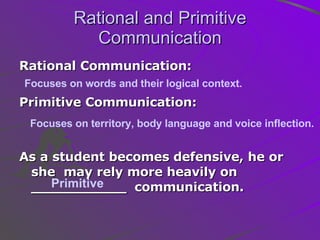
Rational and Primitive Communication Rational Communication:  Primitive Communication:  As a student becomes defensive, he or she  may rely more heavily on ___________  communication. Focuses on words and their logical context.   Focuses on territory, body language and voice inflection. Primitive
Characteristics of Effective Limit Setters Educators who are successful at limit setting and in defusing confrontations share several common characteristics.  They have the ability to:   A.  Avoid personal power struggles B.  Establish clear, objective limits & consistently enforce the consequences of those limits C.   Actively Listen
Power Struggles
Power Struggles What is a power struggle?  Any situation where a student refuses to comply and the teacher continues to engage the student
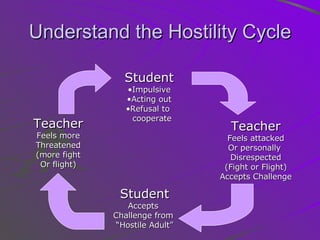
Understand the Hostility Cycle Student Impulsive Acting out Refusal to  cooperate Student Accepts  Challenge from  “ Hostile Adult” Teacher Feels attacked Or personally  Disrespected (Fight or Flight) Accepts Challenge Teacher Feels more Threatened (more fight Or flight)
Why do Power Struggles Happen?   Outside factors Dysfunctional Families Violence in our culture Effects of drugs and alcohol Fragmented communities Need for control, power, respect and belonging
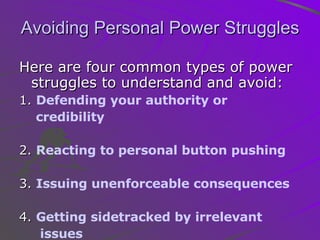
Avoiding Personal Power Struggles Here are four common types of power struggles to understand and avoid:  1.  Defending your authority or credibility 2.  Reacting to personal button pushing 3.  Issuing unenforceable consequences 4.  Getting sidetracked by irrelevant  issues
Establishing Clear, Objective Limits and Enforcing Consequences
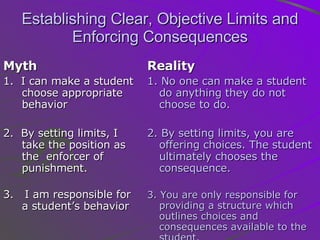
Establishing Clear, Objective Limits and Enforcing Consequences Myth 1.  I can make a student choose appropriate behavior 2.  By setting limits, I take the position as the  enforcer of punishment. 3.  I am responsible for a student’s behavior Reality 1.   No one can make a student do anything they do not choose to do.  2. By setting limits, you are offering choices. The student ultimately chooses the consequence.  3. You are only responsible for providing a structure which outlines choices and consequences available to the student.
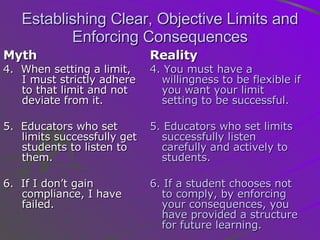
Establishing Clear, Objective Limits and Enforcing Consequences Myth 4.  When setting a limit, I must strictly adhere to that limit and not deviate from it.  5.  Educators who set limits successfully get students to listen to them. 6.  If I don’t gain compliance, I have failed. Reality 4. You must have a willingness to be flexible if you want your limit setting to be successful.  5. Educators who set limits successfully listen carefully and actively to students.  6. If a student chooses not to comply, by enforcing your consequences, you have provided a structure for future learning.
Video
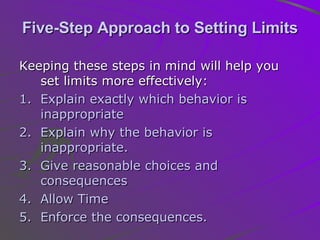
Five-Step Approach to Setting Limits Keeping these steps in mind will help you set limits more effectively:  1.  Explain exactly which behavior is inappropriate 2.  Explain why the behavior is inappropriate.  3.  Give reasonable choices and consequences 4.  Allow Time 5.  Enforce the consequences.
Actively Listen
Partner Activity Turn to a partner and decide who will be a concerned student and who will be the teacher Student- has a problem that is very important to them- seems like life and death almost Teacher- come with presenter for instructions in hall.
Actively Listen Concentrate  Acknowledge Respond Empathize
Prevention, Intervention  and Defusing
Preventative Strategies Convey Warmth Give Opportunities for Students to be in Charge Be Respectful of Differences in the Ways Students Learn
Intervention Strategies Learn to stay personal without personalizing the student’s hostile behavior Substitute Less Powerful Words and Images for Those that are Disturbing
Defusing Strategies Dignity for the student Dignity for yourself Keep the student in class Teach alternative to aggression Privacy, eye contact and proximity
Defusing Strategies cont’ Specific Defusing Statements Listening, acknowledging, agreeing and deferring Private Three-Step Technique Dealing with the Rest of the Class Other things that work
The Follow Up Always follow-up with the student after an incident A bad day needs to be followed by a welcoming attitude on the part of the teacher It is okay to apologize for your behavior if you let the power struggle get out of hand “ Your behavior made me mad and I think I’m owed an apology. BUT, whether or not you apologize, it didn’t make it right for me to go off on you and embarrass you in front of the class. My apologies, and welcome back to class!”
Sources and Resources “ The Art of Setting Limits for Educators Series”; Crisis Prevention Institute, Inc.  “ Power Struggles; Successful Techniques for Educators” by Allen N. Mendler, Ph D. “ Peculiar Tracks for Derailing Resistance” by John W. Maag and Suzanne E. Kamp “ Connecting with Students” by Allen N.  Mendler, Ph D.  [email_address]
Who thinks they are smarter than a power struggle?
Are you smarter than the power struggle Challenge It is Phil’s first day in your class, he arrives dressed completely in black, including black fingernail polish, make-up around his eyes and a bandanna.  He is distantly quiet, your leading an academic discussion.  At the end of the class, you say, “Phil is a new student in our class, I am interested in your first impressions.  Would you share your thoughts, ideas or impressions you have of the class? Phil stares ahead and without changing expression, looks directly at you and says, “I think you like guys/girls in tight pants”
Are you smarter than the power struggle Challenge Its your first meeting with a juvenile delinquent, Jane.  Midway through what you think is a productive discussion, you feel a warm sensation on your face.  Jane has just spit on you and is now smirking at you.
Are you smarter than the power struggle Challenge You have a student in your class that never cuts you break, is always trying to find ways to hurt your feelings.  If you say white, they say black. Resentful, challenging and consistently threatening towards you and when they are absent, you turn cartwheels in your head because this student always seems to know how to push your buttons.
Are you smarter than the power struggle Challenge Johnny comes late everyday to class,  he missed the first 2 days of school because it was his birthday.  He does not ever catch the school bus and arrives in different modes transportation every day.
Are you smarter than the power struggle Challenge Susie throws a full blown temper tantrum in your classroom, yells, screams, rips up her assignment, pushes over chairs, she does not hurt anyone,  but has been aggressive towards others in the past.
Are you smarter than the power struggle Challenge David is an excessive talker in your classroom, he never shuts up,  the other students are frustrated with him as well as you are, but his behaviors are not enough to warrant him to be removed from your room.
Are you smarter than the power struggle Challenge You are trying to get Chad to comply to your directions  and he replies “You can’t make me, you aren’t my mom”
Are you smarter than the power struggle Challenge It is the first day of school, you are taking role, and ask at the end if there is anyone you have missed. A tough look young man sitting at the back of the room leaning back on his chair while cleaning his nails with a pen, looks up and says, “Yeah you didn’t call me name?” You ask, “and what is your name?” he looks up and says, “F*$# you” in a calm voice.
Are you smarter than the power struggle Challenge Ralph is loves to use curse words to get the attention of other peers and of staff and sometimes just to get out of his work. You have tried everything that you know, sending him to the office, calling his parents and his father responds, “ I don’t know what the hell the goddamn problem is.”  The student knows that you don’t like his swearing and believes you can’t do anything about it.
Are you smarter than the power struggle Challenge Josh has been pushing the limits all morning as well as most mornings, spilling the pencil sharpener and sarcastically apologizing, nonchalantly  stepping on a classmate’s foot etc. You begin to circulate the room noticing Josh appears to be on task, only to find him writing “Math Sucks” all over his assignment. You redirect him, and he says back to you “F#@! no, you can’t make me!!”
Sources and Resources “ The Art of Setting Limits for Educators Series”; Crisis Prevention Institute, Inc.  “ Power Struggles; Successful Techniques for Educators” by Allen N. Mendler, Ph D. “ Peculiar Tracks for Derailing Resistance” by John W. Maag and Suzanne E. Kamp “ Connecting with Students” by Allen N.  Mendler, Ph D.  [email_address]

Avoiding Power Struggles And Setting Limits

  • 1.
    Avoiding PowerStruggles and Setting Limits Beth Martin Johnston Interview May 13, 2009
  • 2.
    Objectives Identify situationsthat could potentially turn into power struggles Apply strategies that prevent power struggles from occurring Utilize additional strategies for students who do not respond to intervention strategies Learn techniques and strategies for effect limit setting
  • 3.
    What’s in itfor me? Empowerment for adult and student by preserving dignity Less time engaging in “no win” situations Decrease in the likelihood of power struggles occurring A classroom environment where more learning can take place
  • 4.
    What do youknow? 1. What does setting limits mean to you? 2. If a student calls you a name, how do you react to the name calling? 3. What does it take to be a good listener? 4. What is the most powerful tool in setting limits and avoiding a power struggle? a. gaining control immediately b. knowing your school’s rules and regulations c. knowing what consequences you can enforce d. listening
  • 5.
    Our goal whenworking with children is to preserve human dignity no matter what the behavior.
  • 6.
    Rational and PrimitiveCommunication Rational Communication: Primitive Communication: As a student becomes defensive, he or she may rely more heavily on ___________ communication. Focuses on words and their logical context. Focuses on territory, body language and voice inflection. Primitive
  • 7.
    Characteristics of EffectiveLimit Setters Educators who are successful at limit setting and in defusing confrontations share several common characteristics. They have the ability to: A. Avoid personal power struggles B. Establish clear, objective limits & consistently enforce the consequences of those limits C. Actively Listen
  • 8.
  • 9.
    Power Struggles Whatis a power struggle? Any situation where a student refuses to comply and the teacher continues to engage the student
  • 10.
    Understand the HostilityCycle Student Impulsive Acting out Refusal to cooperate Student Accepts Challenge from “ Hostile Adult” Teacher Feels attacked Or personally Disrespected (Fight or Flight) Accepts Challenge Teacher Feels more Threatened (more fight Or flight)
  • 11.
    Why do PowerStruggles Happen? Outside factors Dysfunctional Families Violence in our culture Effects of drugs and alcohol Fragmented communities Need for control, power, respect and belonging
  • 12.
    Avoiding Personal PowerStruggles Here are four common types of power struggles to understand and avoid: 1. Defending your authority or credibility 2. Reacting to personal button pushing 3. Issuing unenforceable consequences 4. Getting sidetracked by irrelevant issues
  • 13.
    Establishing Clear, ObjectiveLimits and Enforcing Consequences
  • 14.
    Establishing Clear, ObjectiveLimits and Enforcing Consequences Myth 1. I can make a student choose appropriate behavior 2. By setting limits, I take the position as the enforcer of punishment. 3. I am responsible for a student’s behavior Reality 1. No one can make a student do anything they do not choose to do. 2. By setting limits, you are offering choices. The student ultimately chooses the consequence. 3. You are only responsible for providing a structure which outlines choices and consequences available to the student.
  • 15.
    Establishing Clear, ObjectiveLimits and Enforcing Consequences Myth 4. When setting a limit, I must strictly adhere to that limit and not deviate from it. 5. Educators who set limits successfully get students to listen to them. 6. If I don’t gain compliance, I have failed. Reality 4. You must have a willingness to be flexible if you want your limit setting to be successful. 5. Educators who set limits successfully listen carefully and actively to students. 6. If a student chooses not to comply, by enforcing your consequences, you have provided a structure for future learning.
  • 16.
  • 17.
    Five-Step Approach toSetting Limits Keeping these steps in mind will help you set limits more effectively: 1. Explain exactly which behavior is inappropriate 2. Explain why the behavior is inappropriate. 3. Give reasonable choices and consequences 4. Allow Time 5. Enforce the consequences.
  • 18.
  • 19.
    Partner Activity Turnto a partner and decide who will be a concerned student and who will be the teacher Student- has a problem that is very important to them- seems like life and death almost Teacher- come with presenter for instructions in hall.
  • 20.
    Actively Listen Concentrate Acknowledge Respond Empathize
  • 21.
  • 22.
    Preventative Strategies ConveyWarmth Give Opportunities for Students to be in Charge Be Respectful of Differences in the Ways Students Learn
  • 23.
    Intervention Strategies Learnto stay personal without personalizing the student’s hostile behavior Substitute Less Powerful Words and Images for Those that are Disturbing
  • 24.
    Defusing Strategies Dignityfor the student Dignity for yourself Keep the student in class Teach alternative to aggression Privacy, eye contact and proximity
  • 25.
    Defusing Strategies cont’Specific Defusing Statements Listening, acknowledging, agreeing and deferring Private Three-Step Technique Dealing with the Rest of the Class Other things that work
  • 26.
    The Follow UpAlways follow-up with the student after an incident A bad day needs to be followed by a welcoming attitude on the part of the teacher It is okay to apologize for your behavior if you let the power struggle get out of hand “ Your behavior made me mad and I think I’m owed an apology. BUT, whether or not you apologize, it didn’t make it right for me to go off on you and embarrass you in front of the class. My apologies, and welcome back to class!”
  • 27.
    Sources and Resources“ The Art of Setting Limits for Educators Series”; Crisis Prevention Institute, Inc. “ Power Struggles; Successful Techniques for Educators” by Allen N. Mendler, Ph D. “ Peculiar Tracks for Derailing Resistance” by John W. Maag and Suzanne E. Kamp “ Connecting with Students” by Allen N. Mendler, Ph D. [email_address]
  • 28.
    Who thinks theyare smarter than a power struggle?
  • 29.
    Are you smarterthan the power struggle Challenge It is Phil’s first day in your class, he arrives dressed completely in black, including black fingernail polish, make-up around his eyes and a bandanna. He is distantly quiet, your leading an academic discussion. At the end of the class, you say, “Phil is a new student in our class, I am interested in your first impressions. Would you share your thoughts, ideas or impressions you have of the class? Phil stares ahead and without changing expression, looks directly at you and says, “I think you like guys/girls in tight pants”
  • 30.
    Are you smarterthan the power struggle Challenge Its your first meeting with a juvenile delinquent, Jane. Midway through what you think is a productive discussion, you feel a warm sensation on your face. Jane has just spit on you and is now smirking at you.
  • 31.
    Are you smarterthan the power struggle Challenge You have a student in your class that never cuts you break, is always trying to find ways to hurt your feelings. If you say white, they say black. Resentful, challenging and consistently threatening towards you and when they are absent, you turn cartwheels in your head because this student always seems to know how to push your buttons.
  • 32.
    Are you smarterthan the power struggle Challenge Johnny comes late everyday to class, he missed the first 2 days of school because it was his birthday. He does not ever catch the school bus and arrives in different modes transportation every day.
  • 33.
    Are you smarterthan the power struggle Challenge Susie throws a full blown temper tantrum in your classroom, yells, screams, rips up her assignment, pushes over chairs, she does not hurt anyone, but has been aggressive towards others in the past.
  • 34.
    Are you smarterthan the power struggle Challenge David is an excessive talker in your classroom, he never shuts up, the other students are frustrated with him as well as you are, but his behaviors are not enough to warrant him to be removed from your room.
  • 35.
    Are you smarterthan the power struggle Challenge You are trying to get Chad to comply to your directions and he replies “You can’t make me, you aren’t my mom”
  • 36.
    Are you smarterthan the power struggle Challenge It is the first day of school, you are taking role, and ask at the end if there is anyone you have missed. A tough look young man sitting at the back of the room leaning back on his chair while cleaning his nails with a pen, looks up and says, “Yeah you didn’t call me name?” You ask, “and what is your name?” he looks up and says, “F*$# you” in a calm voice.
  • 37.
    Are you smarterthan the power struggle Challenge Ralph is loves to use curse words to get the attention of other peers and of staff and sometimes just to get out of his work. You have tried everything that you know, sending him to the office, calling his parents and his father responds, “ I don’t know what the hell the goddamn problem is.” The student knows that you don’t like his swearing and believes you can’t do anything about it.
  • 38.
    Are you smarterthan the power struggle Challenge Josh has been pushing the limits all morning as well as most mornings, spilling the pencil sharpener and sarcastically apologizing, nonchalantly stepping on a classmate’s foot etc. You begin to circulate the room noticing Josh appears to be on task, only to find him writing “Math Sucks” all over his assignment. You redirect him, and he says back to you “F#@! no, you can’t make me!!”
  • 39.
    Sources and Resources“ The Art of Setting Limits for Educators Series”; Crisis Prevention Institute, Inc. “ Power Struggles; Successful Techniques for Educators” by Allen N. Mendler, Ph D. “ Peculiar Tracks for Derailing Resistance” by John W. Maag and Suzanne E. Kamp “ Connecting with Students” by Allen N. Mendler, Ph D. [email_address]