









































3
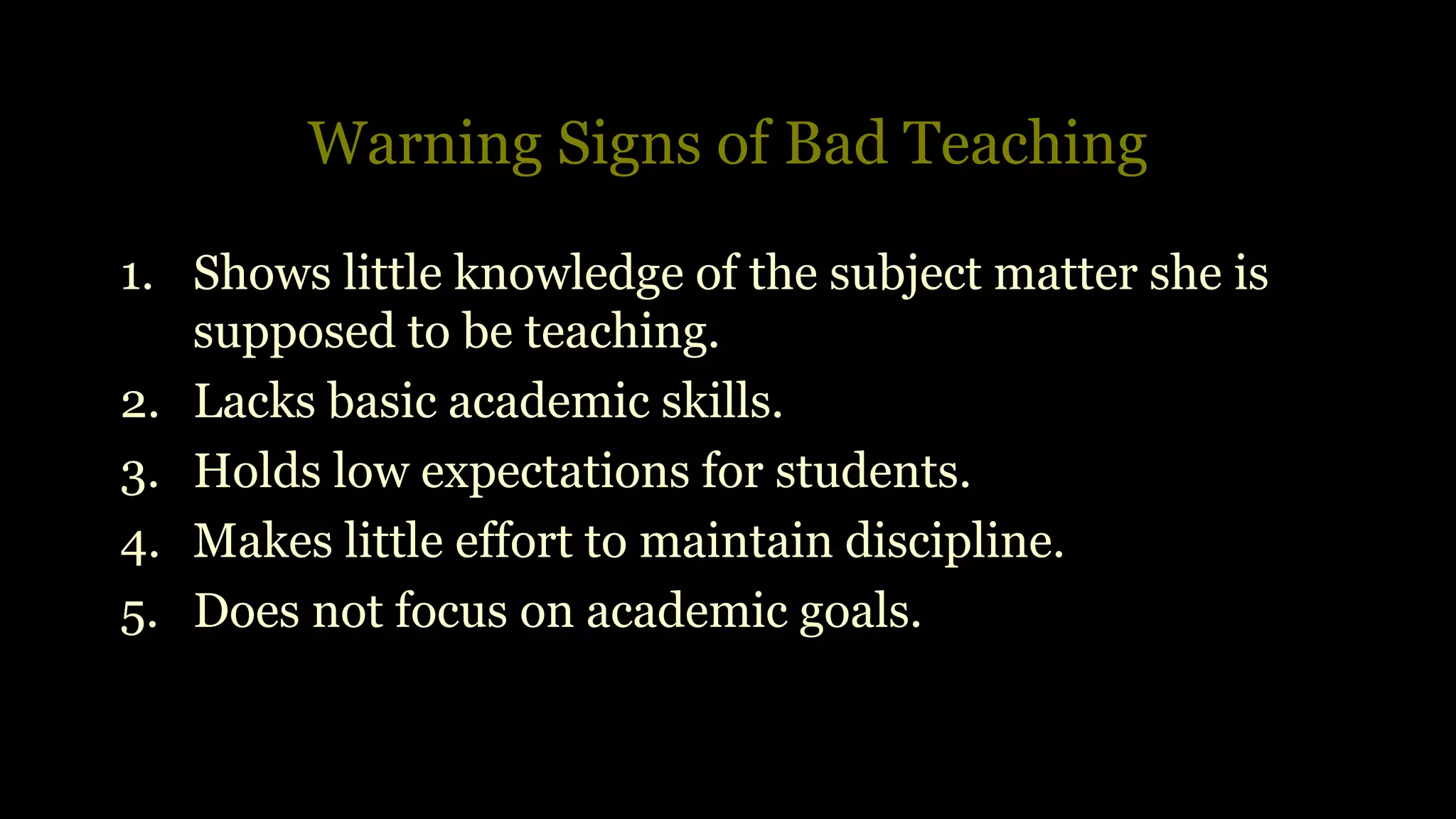
Warning Signs of Bad Teaching
1. Shows little knowledge of the subject matter she is
supposed to be teaching.
2. Lacks basic academic skills.
3. Holds low expectations for students.
4. Makes little effort to maintain discipline.
5. Does not focus on academic goals.
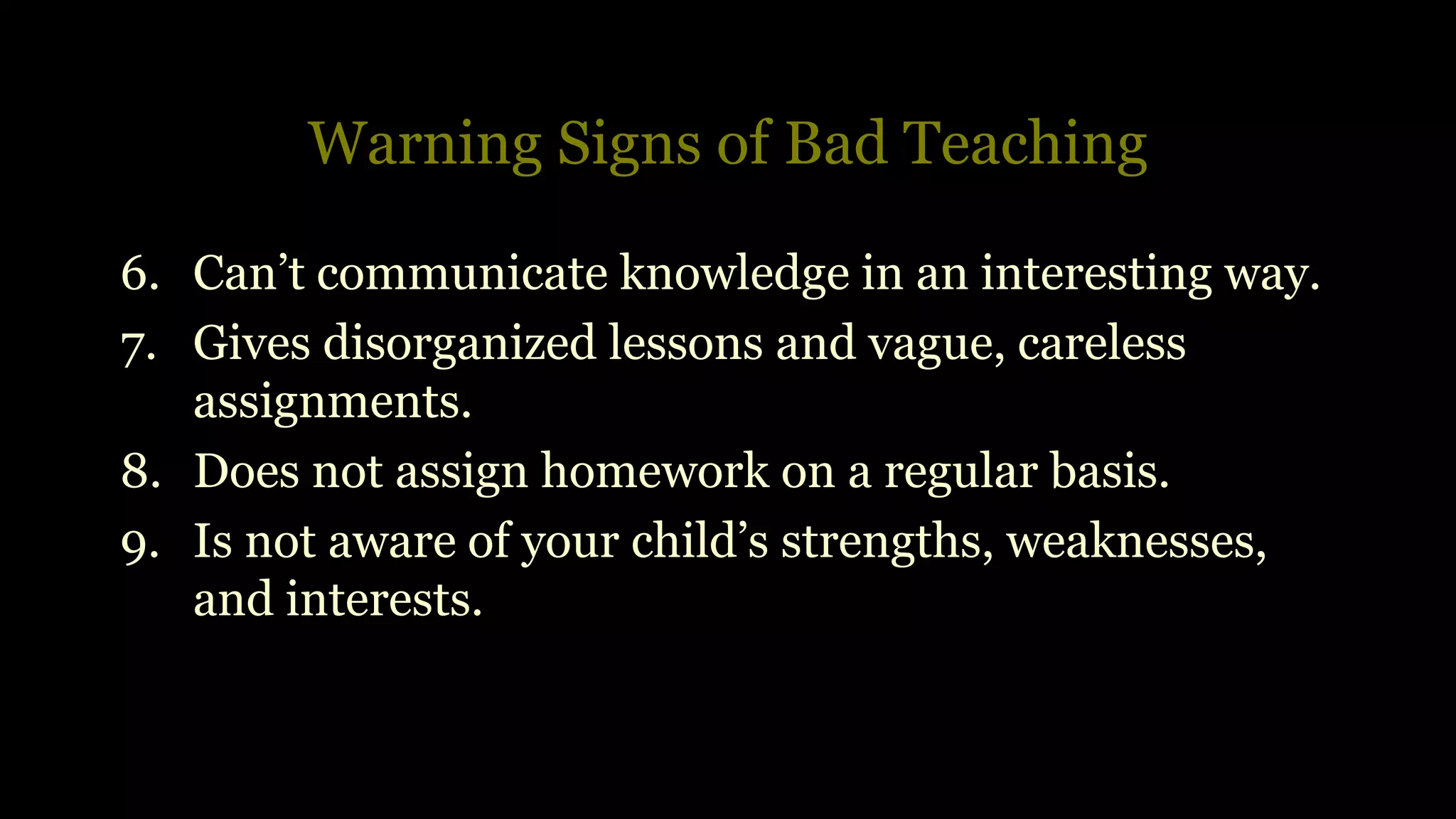
Warning Signs of Bad Teaching
6. Can’t communicate knowledge in an interesting way.
7. Gives disorganized lessons and vague, careless
assignments.
8. Does not assign homework on a regular basis.
9. Is not aware of your child’s strengths, weaknesses,
and interests.
Warning Signs of Bad Teaching
10. Shows little enthusiasm for her work.
11. Belittles students’ efforts.
12. Shows no interest in communicating with parents.
13. Exhibits unsound character or unprofessional
behavior.
FOUR STAGES OF
TEACHING
FANTASY
SURVIVAL
MASTERY
IMPACT
The Four Stages of Teaching:
FANTASY
SURVIVAL
MASTERY
IMPACT
Top 3 Traits of an
Effective Teacher:
(based on a 50-year study
published by
EDUCATIONAL LEADERSHIP)
AN EFFECTIVE TEACHER IS A
GOOD CLASSROOM MANAGER
AN EFFECTIVE TEACHER
DESIGNS LESSONS TO REACH
MASTERY
AN EFFECTIVE TEACHER HAS
POSITIVE EXPECTATION THAT
STUDENTS WILL BE
SUCCESSFUL
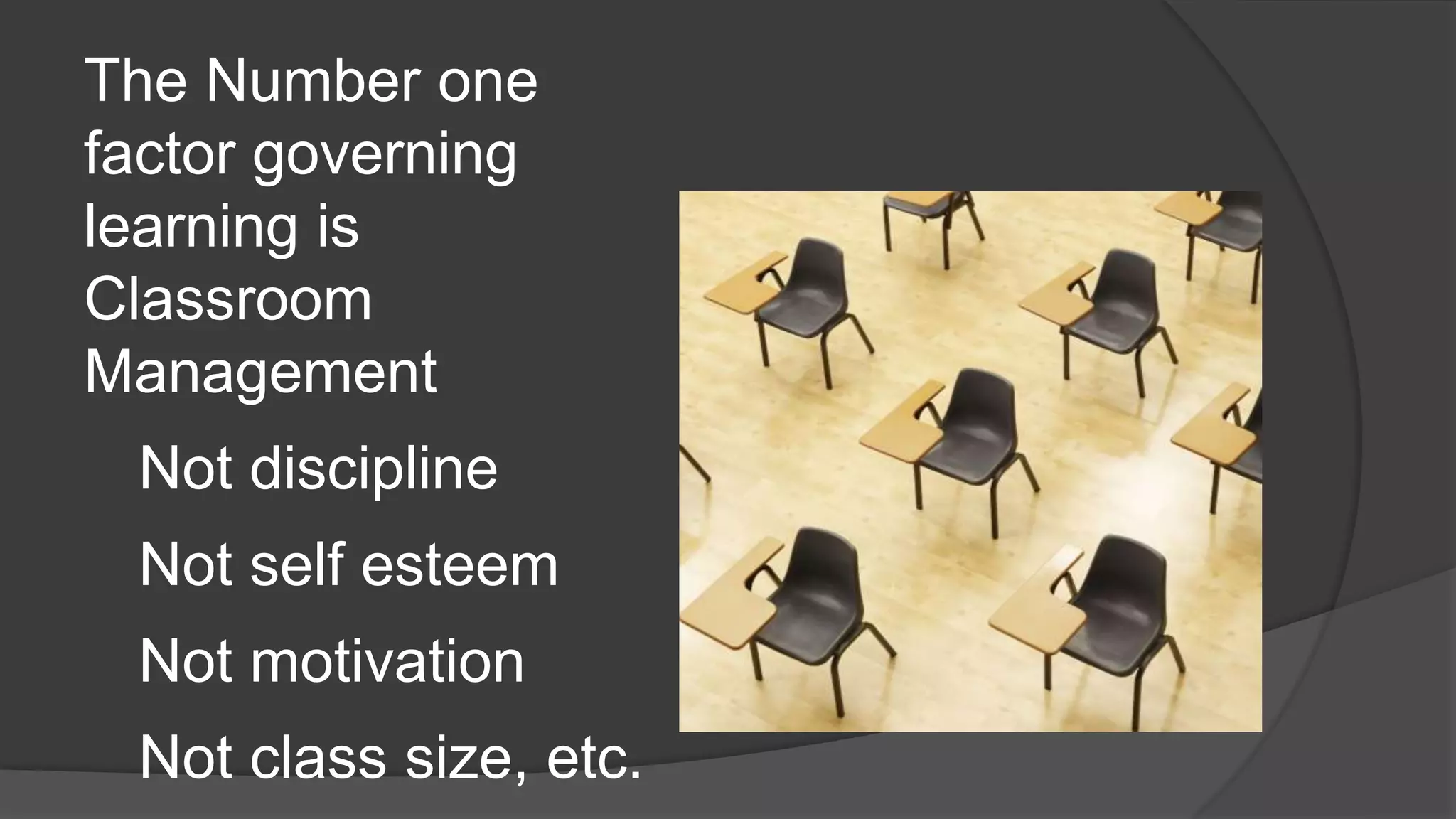
The Number one
factor governing
learning is
Classroom
Management
Not discipline
Not self esteem
Not motivation
Not class size, etc.
Discipline
v.s.
Classroom
Management
The best way to manage is to
have Procedures & Routines.
Clearly define
classroom procedures
and routines.
You want responsible
students?
1. The only way you can have
responsible students is if you have
procedures and routines which the
students can be responsible to.
2. When students know how the class is
run, they will more willingly do whatever
you want them to do.
PROCEDURES
AND
ROUTINES
PROCEDURES:
What you want students to do.
ROUTINES:
What the students do automatically.
THE NUMBER ONE
PROBLEM
IN THE CLASSROOM
IS NOT
DISCIPLINE;
IT IS THE LACK OF
PROCEDURES AND
ROUTINES.
Passing in papers
Heading of papers
Roll call
Entering the classroom
When asking a question
Getting to work immediately
When teacher is tardy
End of period class dismissal
Participating in Class Discussion
When a student needs paper/pen
Coming to attention
When you are absent
Working cooperatively
Changing groups
IT IS THE
PROCEDURES
THAT SET UP
THE CLASS
FOR ACHIEVEMENT
TO TAKE PLACE.
Kohlberg’s
Six Levels
of
Moral Development
I DON’T
WANT TO
GET INTO
TROUBLE
I WANT
A
REWARD
I WANT TO
PLEASE
SOMEBODY.
I FOLLOW
THE RULES
I AM CONSIDERATE OF
OTHER PREOPLE
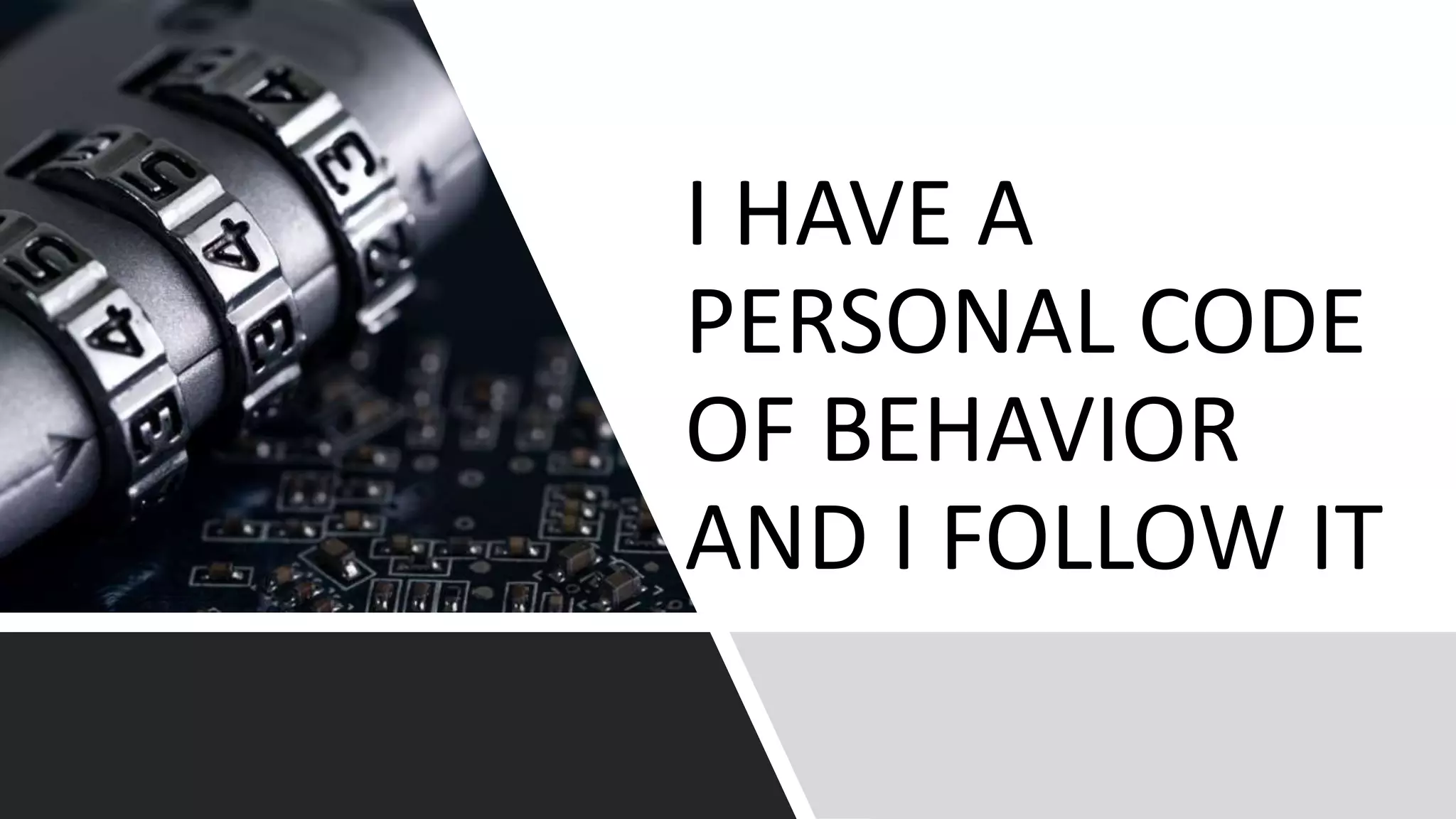
I HAVE A
PERSONAL CODE
OF BEHAVIOR
AND I FOLLOW IT
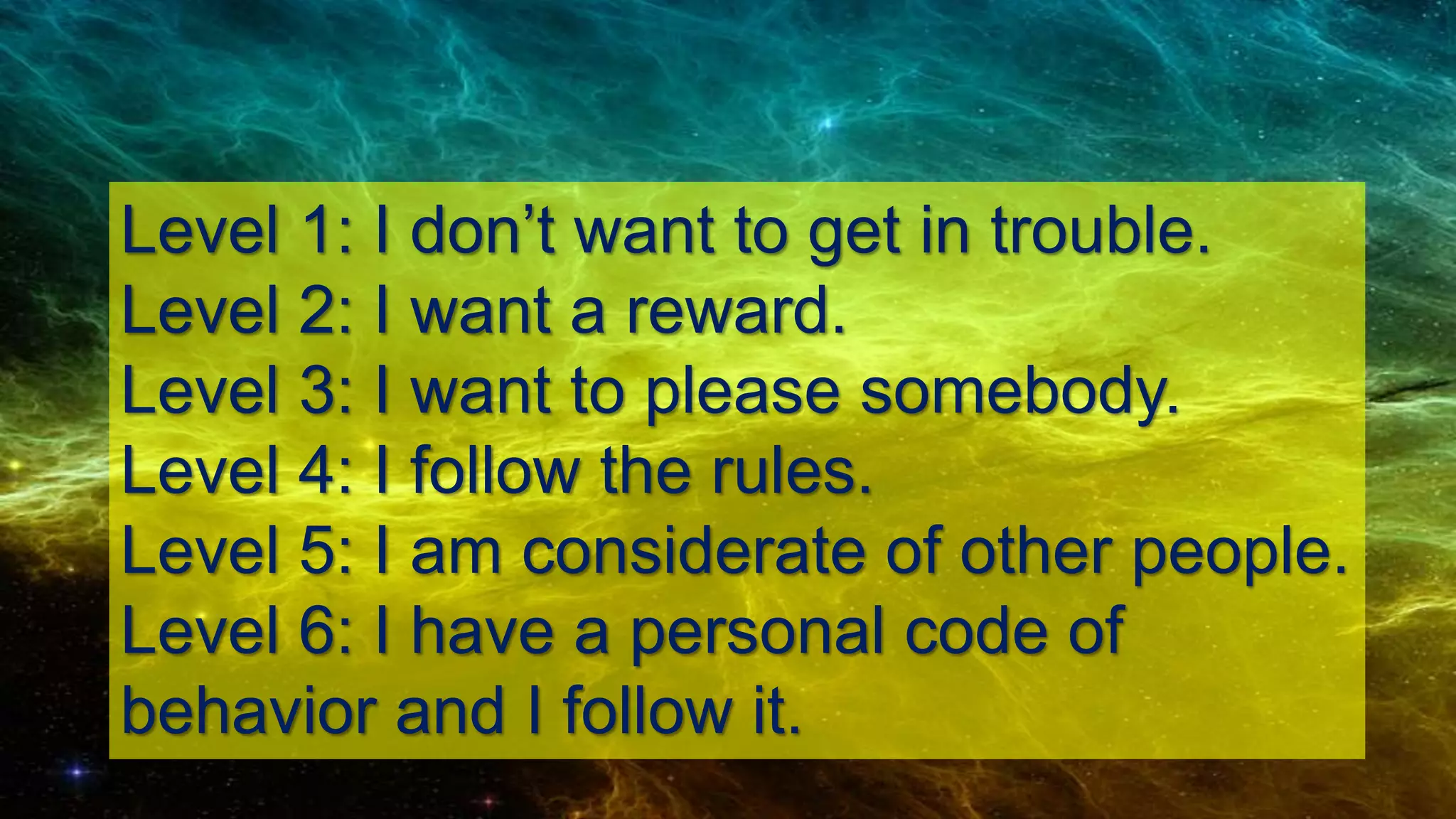
Level 1: I don’t want to get in trouble.
Level 2: I want a reward.
Level 3: I want to please somebody.
Level 4: I follow the rules.
Level 5: I am considerate of other people.
Level 6: I have a personal code of
behavior and I follow it.
Once and for all,
you can solve
that discipline problem.
THE KIDS
WANT DISCIPLINE
EVEN MORE THAN
YOU DO!
5 Myths of
Discipline
SMILE
BIG AND TOUGH
LATEST
GADGETS
MIDDLE CLASS
FRIENDS
Low Control,
Low Support
Low Control,
High Support
Bored
Frustrated
High Control,
Low Support
High Control,
High Support
Revengeful
Successful
The
Discipline
Plan
3 Parts
The Rules
Negative Consequences
(Penalty)
Positive Consequences
(Rewards)
"Good News" notes sent to parent
Smile-O-Gram for pupil
Happy face/rubber stamp/sticker
award on a good piece of work
"Citizen of the Day" award
Pat on shoulder
"I'm proud of you!" statement
Special "free time" allotment
Stars on chart for daily/weekly award
"Special Helper of the Day" award
Healthful food treat--if allowed
Tokens or chips to be traded
Time at learning center/computer
Row, line, or class leader job
Extra "free-choice" time
Selection from "Goodie Bag"
Lunch with the teacher
Extra media center time
Assistant to school secretary,
librarian, or custodian
Visit to principal for
special acknowledgement
Tutor or assist other students
Selector of group activity or project
Exchange card for extra points
Free homework pass
Call to parent(s) with good news
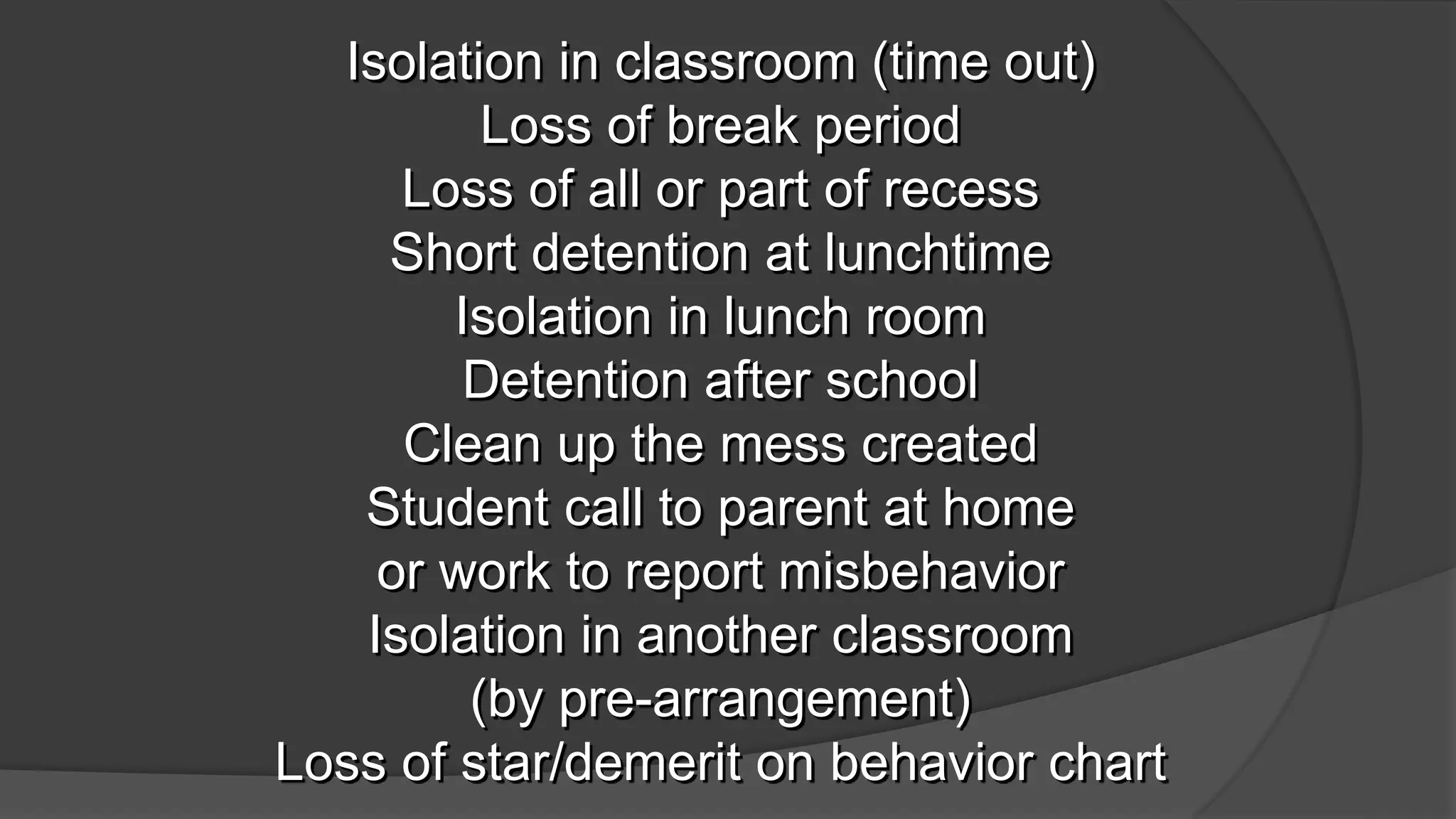
Isolation in classroom (time out)
Loss of break period
Loss of all or part of recess
Short detention at lunchtime
Isolation in lunch room
Detention after school
Clean up the mess created
Student call to parent at home
or work to report misbehavior
Isolation in another classroom
(by pre-arrangement)
Loss of star/demerit on behavior chart
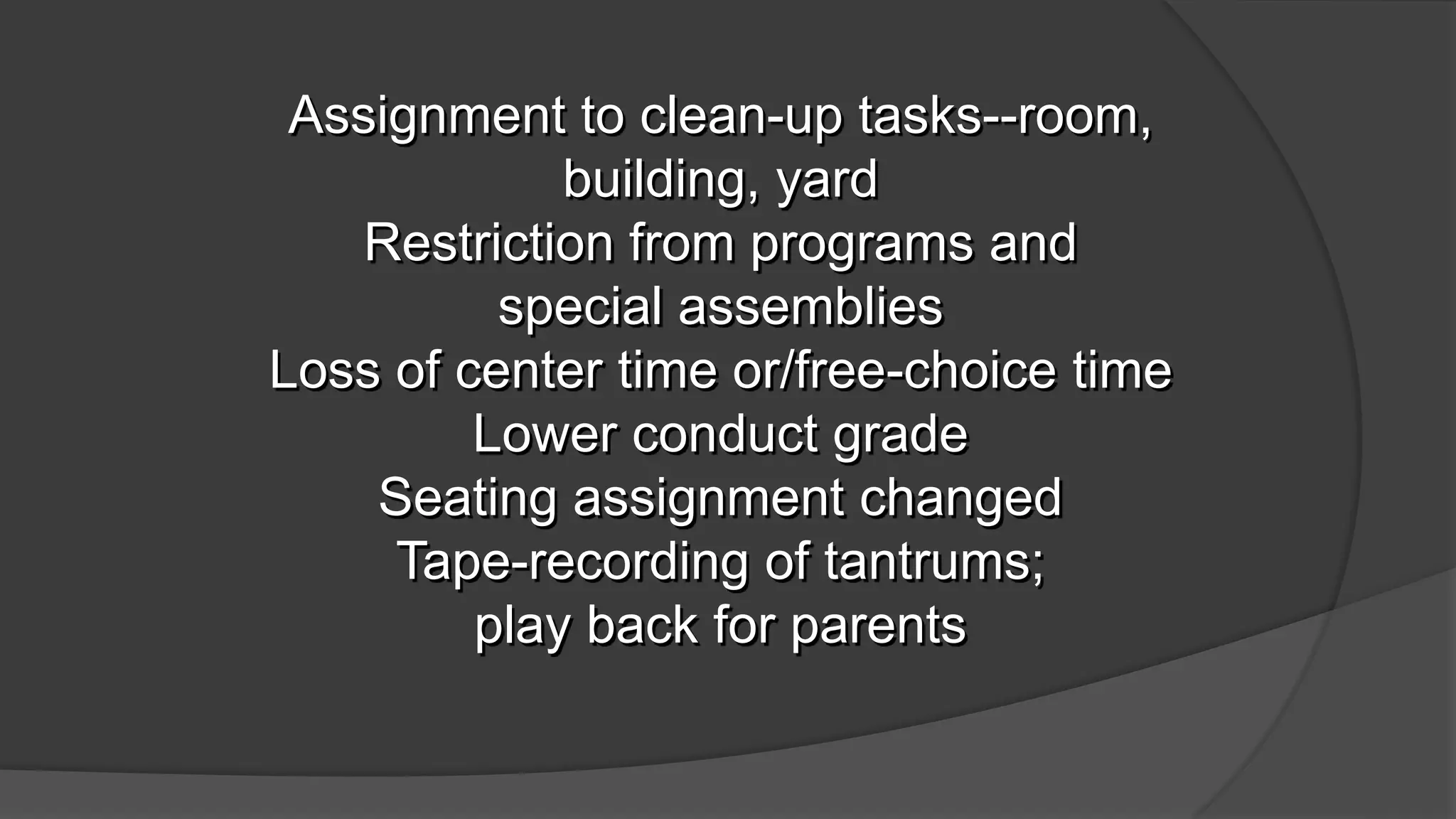
Assignment to clean-up tasks--room,
building, yard
Restriction from programs and
special assemblies
Loss of center time or/free-choice time
Lower conduct grade
Seating assignment changed
Tape-recording of tantrums;
play back for parents
Removal of pupil and desk to hallway
Student apology to those offended
Last in line
Request student to repeat
rule and to follow rule
Notes home to parent(s)
Removal to the office
In-school suspension
Recommendation for suspension
Recommendation for alternative school
There should be
more rewards
than penalties.
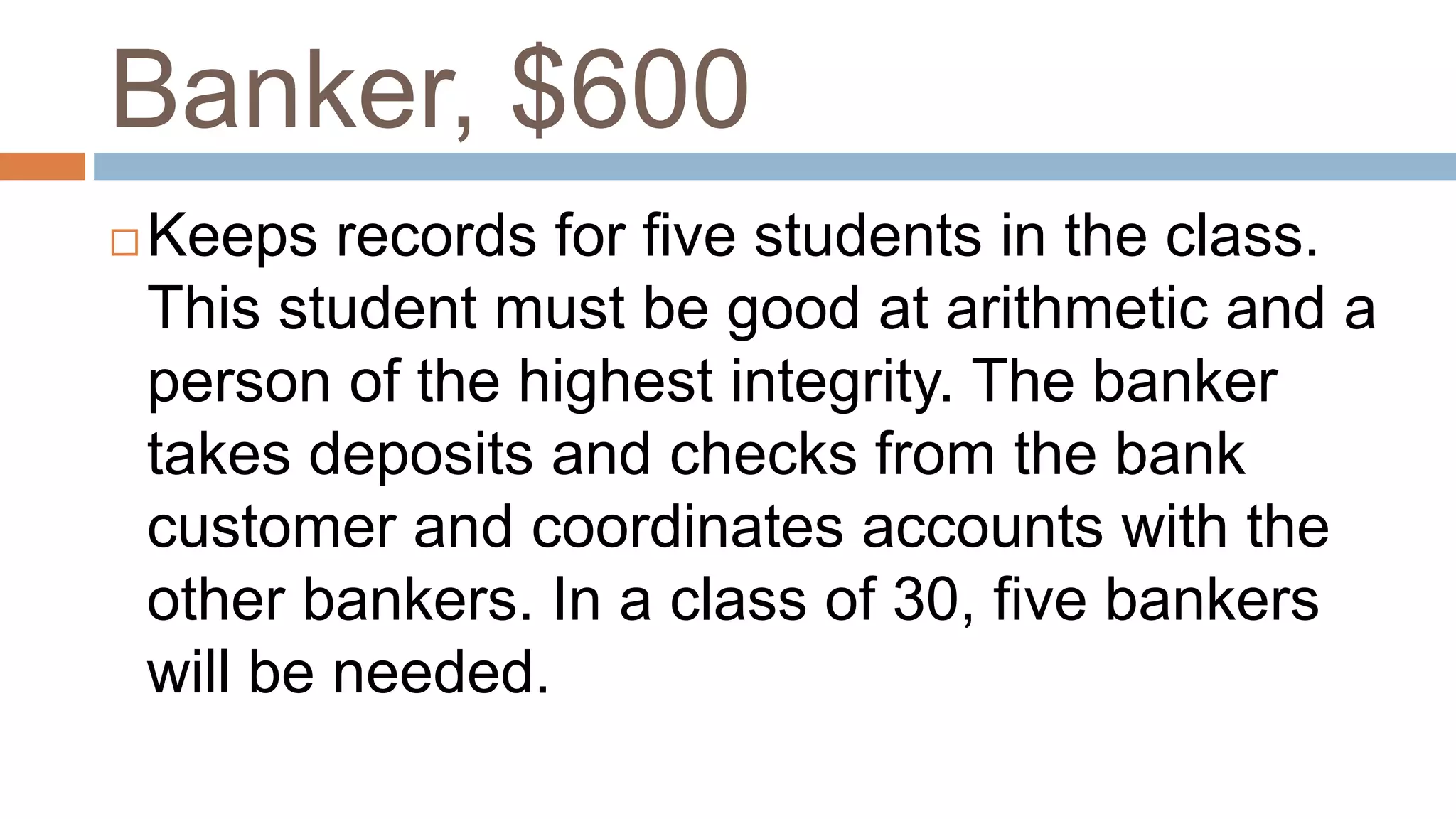
Banker, $600
 Keeps records for five students in the class.
This student must be good at arithmetic and a
person of the highest integrity. The banker
takes deposits and checks from the bank
customer and coordinates accounts with the
other bankers. In a class of 30, five bankers
will be needed.
Janitor, $650
 A janitor is given a specific area of the room
to keep spotless. One scrubs the sink daily.
Two sweep the room at least twice a day.
Others wax cabinets or scrub desks. They are
highly paid to keep the room dazzling.
Graders, $575
 There are two graders for grammar and
spelling. These are objective tests that come
with answer sheets. Teacher is left to check
writing assignments that only he is qualified to
handle.
 Spelling graders take home Friday’s spelling
tests and return them graded on Monday
morning. Grammar graders collect homework
Messenger, $575
 Two students handle all errands to other
classes or the office. These students must be
able to deliver oral messages accurately and
must know the school staff.
Police Officer, $500
 A police officer has several duties. Each one
patrols a selected area of the room. The
officer has a book with the names of all the
students in his jurisdiction. If a student breaks
any of the class rules, the officer keeps a
record of the infraction. The officer collects all
the fines that students pay for breaking rules.
There are usually 3 to 5 police officers.
Video Monitor, $575
 The video monitors keep the collection of
videos organized in the class library. They are
responsible for checking these out to students
on Fridays and for collecting video work and
videos Monday morning.
Recycler, $500
 Two monitors recycle the class waste. Cans
are taken each day to recycling bin.
Attendance Monitor, $475
 This student must have outstanding
attendance. The monitor silently takes
attendance each morning and accepts notes
from returning students to be kept on file.
Clerks, $550
 There are usually about three students acting
as official clerks. These students pass out
and collect papers. They also keep materials
organized and know where everything in the
closet is stored.
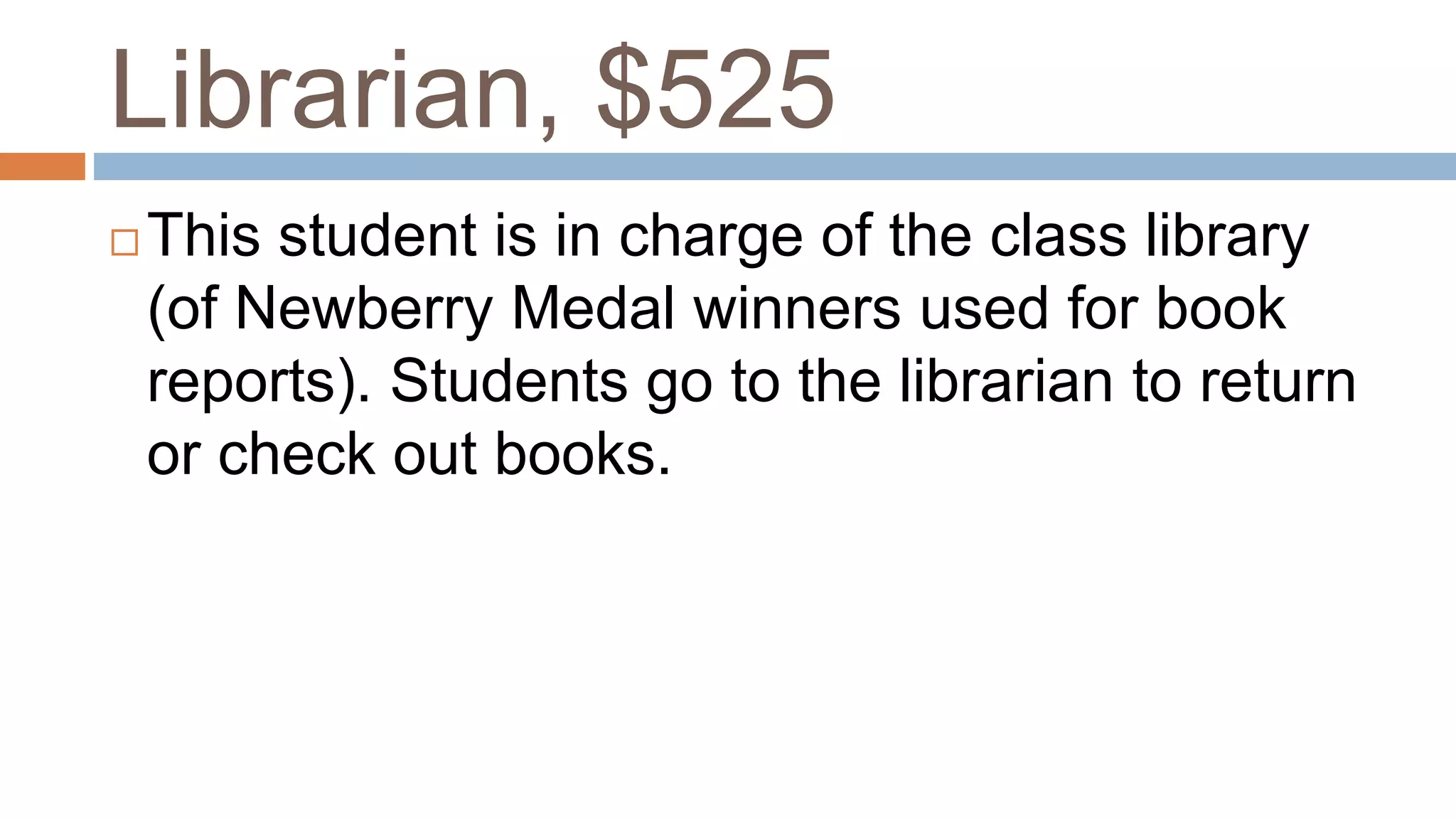
Librarian, $525
 This student is in charge of the class library
(of Newberry Medal winners used for book
reports). Students go to the librarian to return
or check out books.
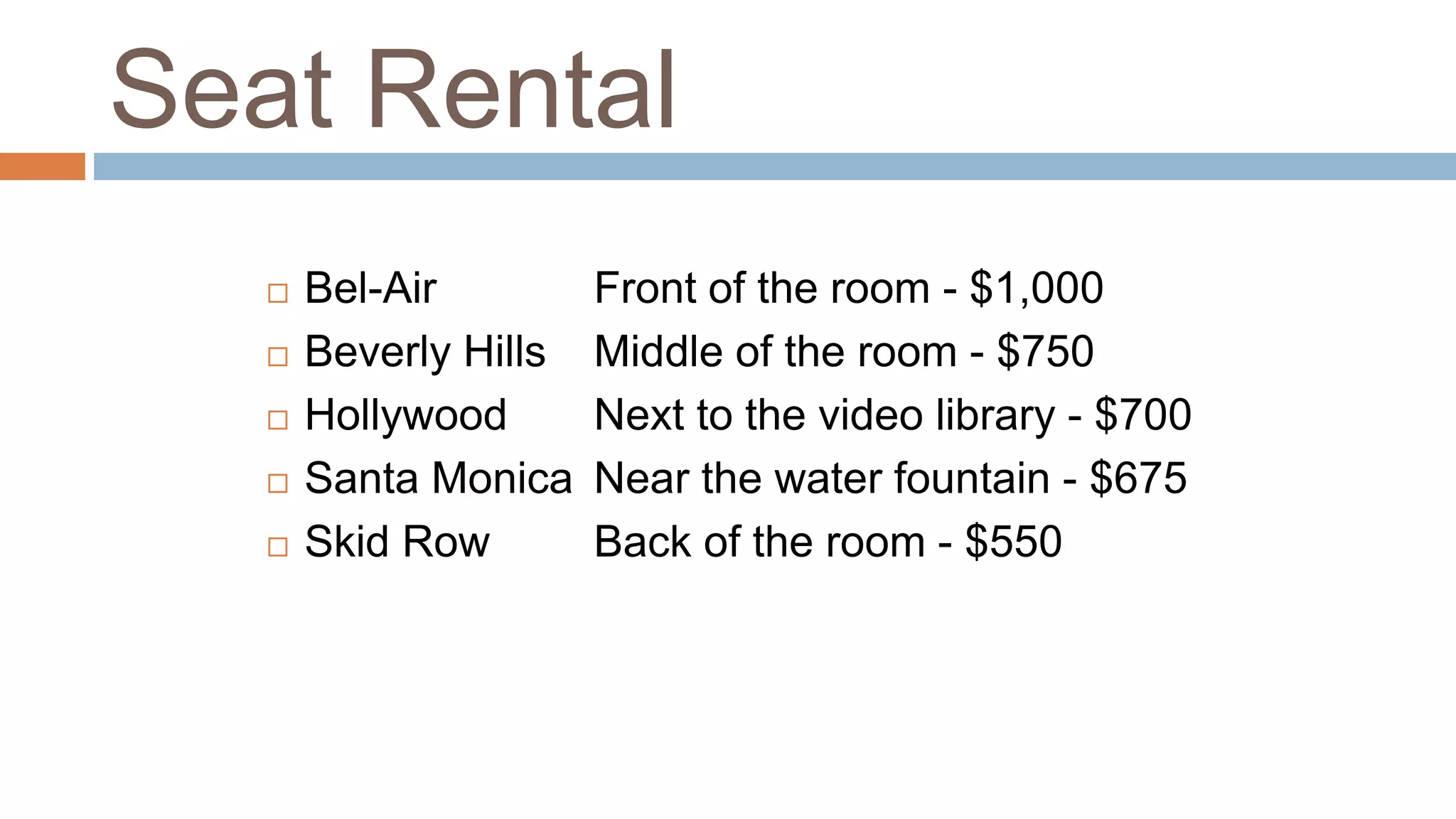
Seat Rental
 Bel-Air Front of the room - $1,000
 Beverly Hills Middle of the room - $750
 Hollywood Next to the video library - $700
 Santa Monica Near the water fountain - $675
 Skid Row Back of the room - $550
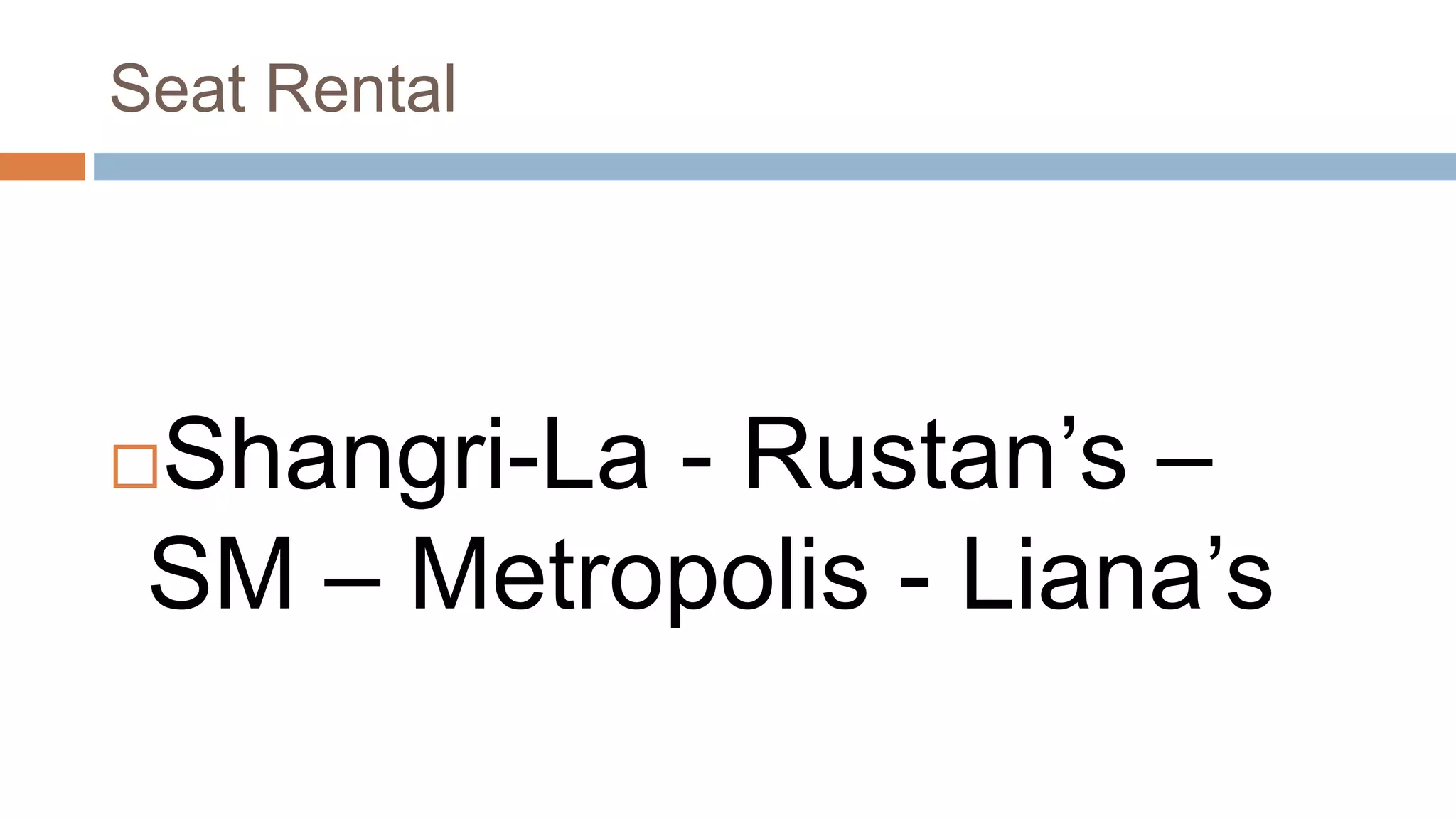
Seat Rental
Shangri-La - Rustan’s –
SM – Metropolis - Liana’s
Bonus Money
Perfect Spelling Test (After 3 in a row, the
amount doubles)
$50
90% on any other test $50
100% on any other test $200
Completing a weekend video assignment $50
Perfect attendance for the month $100
Coming to school early for extra Math $100
Staying after school for Shakespeare $100
Joining the school orchestra $100
Joining the school chorus $100
Playing guitar with the teacher during recess
and lunch
$100
Being complimented by another teacher $200
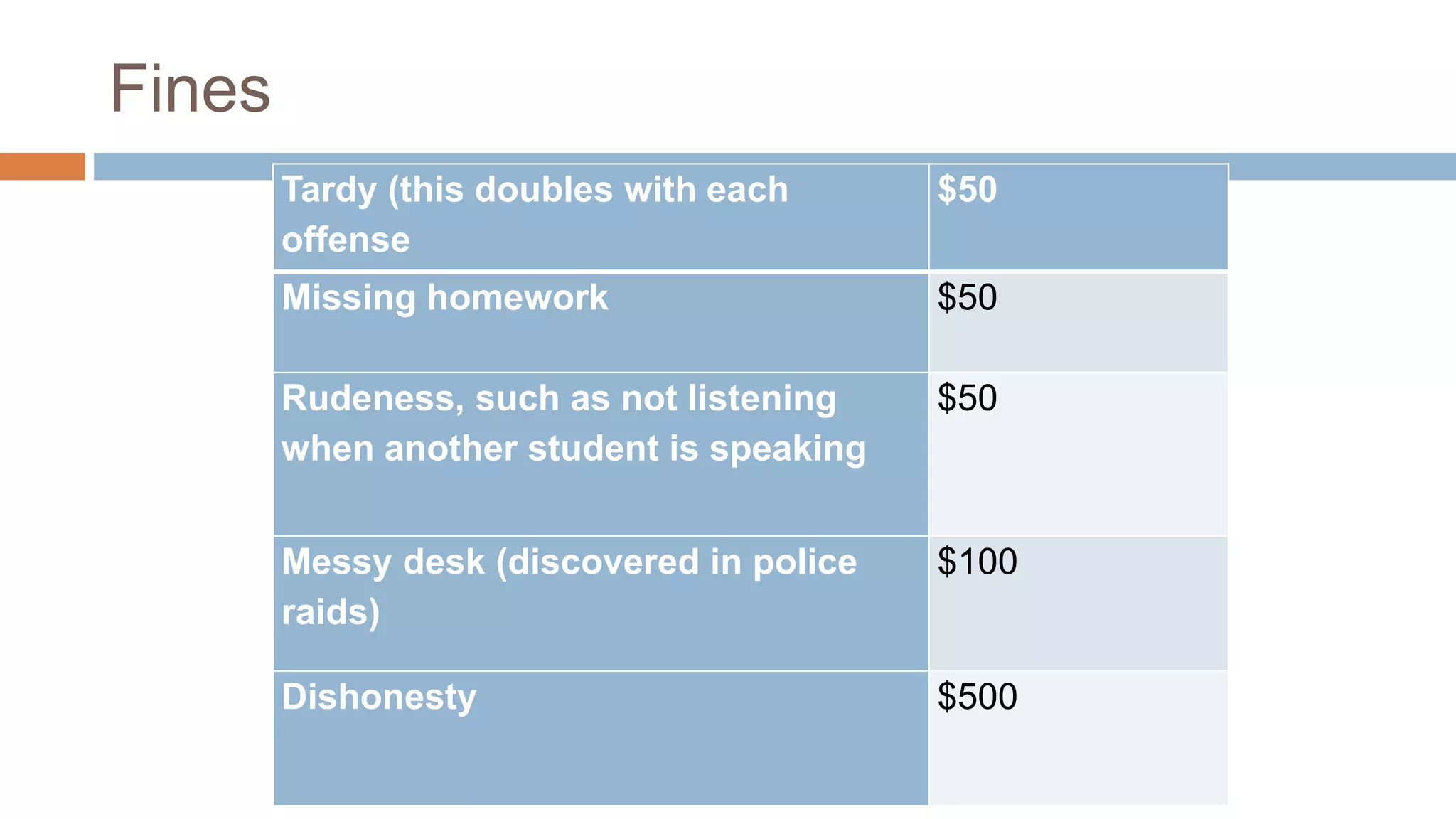
Fines
Tardy (this doubles with each
offense
$50
Missing homework $50
Rudeness, such as not listening
when another student is speaking
$50
Messy desk (discovered in police
raids)
$100
Dishonesty $500
The Road
that leads
to two
paths…
EMMANUEL M. RENTOY
NAME & TITLE OF THE SEMINAR
CATALYSTPDS@GMAIL.COM
FOR HANDOUTS,
please join us in
FaceBook:
GROUP: schools
of character
https://www.facebook.com/groups/schoolsofcharacter/
www.characterconferences.com
BETTER CLASSROOM MANAGEMENT

BETTER CLASSROOM MANAGEMENT

  • 3.
  • 18.
    Warning Signs ofBad Teaching 1. Shows little knowledge of the subject matter she is supposed to be teaching. 2. Lacks basic academic skills. 3. Holds low expectations for students. 4. Makes little effort to maintain discipline. 5. Does not focus on academic goals.
  • 19.
    Warning Signs ofBad Teaching 6. Can’t communicate knowledge in an interesting way. 7. Gives disorganized lessons and vague, careless assignments. 8. Does not assign homework on a regular basis. 9. Is not aware of your child’s strengths, weaknesses, and interests.
  • 20.
    Warning Signs ofBad Teaching 10. Shows little enthusiasm for her work. 11. Belittles students’ efforts. 12. Shows no interest in communicating with parents. 13. Exhibits unsound character or unprofessional behavior.
  • 21.
  • 22.
  • 23.
  • 24.
  • 25.
  • 26.
    The Four Stagesof Teaching: FANTASY SURVIVAL MASTERY IMPACT
  • 27.
    Top 3 Traitsof an Effective Teacher: (based on a 50-year study published by EDUCATIONAL LEADERSHIP)
  • 28.
    AN EFFECTIVE TEACHERIS A GOOD CLASSROOM MANAGER
  • 29.
    AN EFFECTIVE TEACHER DESIGNSLESSONS TO REACH MASTERY
  • 30.
    AN EFFECTIVE TEACHERHAS POSITIVE EXPECTATION THAT STUDENTS WILL BE SUCCESSFUL
  • 31.
    The Number one factorgoverning learning is Classroom Management Not discipline Not self esteem Not motivation Not class size, etc.
  • 32.
  • 33.
    The best wayto manage is to have Procedures & Routines. Clearly define classroom procedures and routines.
  • 34.
    You want responsible students? 1.The only way you can have responsible students is if you have procedures and routines which the students can be responsible to. 2. When students know how the class is run, they will more willingly do whatever you want them to do.
  • 35.
  • 36.
    PROCEDURES: What you wantstudents to do. ROUTINES: What the students do automatically.
  • 37.
    THE NUMBER ONE PROBLEM INTHE CLASSROOM IS NOT DISCIPLINE; IT IS THE LACK OF PROCEDURES AND ROUTINES.
  • 38.
    Passing in papers Headingof papers Roll call Entering the classroom When asking a question Getting to work immediately When teacher is tardy
  • 39.
    End of periodclass dismissal Participating in Class Discussion When a student needs paper/pen Coming to attention When you are absent Working cooperatively Changing groups
  • 40.
    IT IS THE PROCEDURES THATSET UP THE CLASS FOR ACHIEVEMENT TO TAKE PLACE.
  • 41.
  • 42.
  • 43.
  • 44.
  • 45.
  • 46.
    I AM CONSIDERATEOF OTHER PREOPLE
  • 47.
    I HAVE A PERSONALCODE OF BEHAVIOR AND I FOLLOW IT
  • 48.
    Level 1: Idon’t want to get in trouble. Level 2: I want a reward. Level 3: I want to please somebody. Level 4: I follow the rules. Level 5: I am considerate of other people. Level 6: I have a personal code of behavior and I follow it.
  • 49.
    Once and forall, you can solve that discipline problem.
  • 50.
  • 51.
  • 52.
  • 53.
    Low Control, Low Support LowControl, High Support Bored Frustrated
  • 55.
    High Control, Low Support HighControl, High Support Revengeful Successful
  • 56.
  • 57.
    3 Parts The Rules NegativeConsequences (Penalty) Positive Consequences (Rewards)
  • 58.
    "Good News" notessent to parent Smile-O-Gram for pupil Happy face/rubber stamp/sticker award on a good piece of work "Citizen of the Day" award Pat on shoulder "I'm proud of you!" statement Special "free time" allotment Stars on chart for daily/weekly award "Special Helper of the Day" award Healthful food treat--if allowed Tokens or chips to be traded Time at learning center/computer
  • 59.
    Row, line, orclass leader job Extra "free-choice" time Selection from "Goodie Bag" Lunch with the teacher Extra media center time Assistant to school secretary, librarian, or custodian Visit to principal for special acknowledgement Tutor or assist other students Selector of group activity or project Exchange card for extra points Free homework pass Call to parent(s) with good news
  • 60.
    Isolation in classroom(time out) Loss of break period Loss of all or part of recess Short detention at lunchtime Isolation in lunch room Detention after school Clean up the mess created Student call to parent at home or work to report misbehavior Isolation in another classroom (by pre-arrangement) Loss of star/demerit on behavior chart
  • 61.
    Assignment to clean-uptasks--room, building, yard Restriction from programs and special assemblies Loss of center time or/free-choice time Lower conduct grade Seating assignment changed Tape-recording of tantrums; play back for parents
  • 62.
    Removal of pupiland desk to hallway Student apology to those offended Last in line Request student to repeat rule and to follow rule Notes home to parent(s) Removal to the office In-school suspension Recommendation for suspension Recommendation for alternative school
  • 63.
    There should be morerewards than penalties.
  • 72.
    Banker, $600  Keepsrecords for five students in the class. This student must be good at arithmetic and a person of the highest integrity. The banker takes deposits and checks from the bank customer and coordinates accounts with the other bankers. In a class of 30, five bankers will be needed.
  • 73.
    Janitor, $650  Ajanitor is given a specific area of the room to keep spotless. One scrubs the sink daily. Two sweep the room at least twice a day. Others wax cabinets or scrub desks. They are highly paid to keep the room dazzling.
  • 74.
    Graders, $575  Thereare two graders for grammar and spelling. These are objective tests that come with answer sheets. Teacher is left to check writing assignments that only he is qualified to handle.  Spelling graders take home Friday’s spelling tests and return them graded on Monday morning. Grammar graders collect homework
  • 75.
    Messenger, $575  Twostudents handle all errands to other classes or the office. These students must be able to deliver oral messages accurately and must know the school staff.
  • 76.
    Police Officer, $500 A police officer has several duties. Each one patrols a selected area of the room. The officer has a book with the names of all the students in his jurisdiction. If a student breaks any of the class rules, the officer keeps a record of the infraction. The officer collects all the fines that students pay for breaking rules. There are usually 3 to 5 police officers.
  • 77.
    Video Monitor, $575 The video monitors keep the collection of videos organized in the class library. They are responsible for checking these out to students on Fridays and for collecting video work and videos Monday morning.
  • 78.
    Recycler, $500  Twomonitors recycle the class waste. Cans are taken each day to recycling bin.
  • 79.
    Attendance Monitor, $475 This student must have outstanding attendance. The monitor silently takes attendance each morning and accepts notes from returning students to be kept on file.
  • 80.
    Clerks, $550  Thereare usually about three students acting as official clerks. These students pass out and collect papers. They also keep materials organized and know where everything in the closet is stored.
  • 81.
    Librarian, $525  Thisstudent is in charge of the class library (of Newberry Medal winners used for book reports). Students go to the librarian to return or check out books.
  • 82.
    Seat Rental  Bel-AirFront of the room - $1,000  Beverly Hills Middle of the room - $750  Hollywood Next to the video library - $700  Santa Monica Near the water fountain - $675  Skid Row Back of the room - $550
  • 83.
    Seat Rental Shangri-La -Rustan’s – SM – Metropolis - Liana’s
  • 84.
    Bonus Money Perfect SpellingTest (After 3 in a row, the amount doubles) $50 90% on any other test $50 100% on any other test $200 Completing a weekend video assignment $50 Perfect attendance for the month $100 Coming to school early for extra Math $100 Staying after school for Shakespeare $100 Joining the school orchestra $100 Joining the school chorus $100 Playing guitar with the teacher during recess and lunch $100 Being complimented by another teacher $200
  • 85.
    Fines Tardy (this doubleswith each offense $50 Missing homework $50 Rudeness, such as not listening when another student is speaking $50 Messy desk (discovered in police raids) $100 Dishonesty $500
  • 86.
  • 88.
  • 89.
    NAME & TITLEOF THE SEMINAR CATALYSTPDS@GMAIL.COM
  • 90.
    FOR HANDOUTS, please joinus in FaceBook: GROUP: schools of character
  • 91.
  • 92.