The French and Indian War
1689 - 1754
England, France, and Spain went to war four times between
1689 and 1754.
 
Their North American colonies were active participants.
 
English colonies in the South fought with the Spanish in
Florida and the Caribbean Sea.
 
English colonies in the north fought with the French in Quebec
and the Great Lakes region. 


The trouble with Ohio
• 1607 – Britain claims Virginia. According to the
British, this claim included the Ohio River
Valley.
• 1699 – Sieur de La Salle claims the Mississippi
River “and all its tributaries” for France. Since
the Ohio River is a tributary of the Mississippi,
France insists that the Ohio River Valley is
theirs.
1754
The French build Fort Duquesne at the origin point of the Ohio
River, blocking English access into the Ohio River Valley. 
 
The Virginia colonial government sends 21 year-old militia
officer George Washington and a small force to tell the
French to leave.
 
When France refuses, Washington builds a small fort to
establish an English presence. 
 
During a routine patrol, Washington orders his men to fire on
a group of French soldiers. By doing so, he sparks a world war
between England and France.  
Fort Duquesne
British General Braddock is sent with a professional army to
capture the Fort and establish British control over the Ohio
Valley.
Stalemate and surrender
The British soon discover that the war will be much longer and
brutal than anticipated.  After while, a stalemate sets in,
where neither side gains nor loses anything. 
 
In 1760, the British launch a major offensive resulting in the
capture of Montreal and Quebec.  Spain also declares war on
Britain, but too late to do any good. 
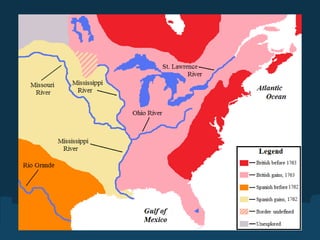
France, out of money and options, surrenders all of New
France to the British.  The British now control all of North
America east of the Mississippi River. 
France gives Louisiana to Spain as compensation for losing
Florida to the British.
Issues in 1763
Britain controls a massive empire that must be maintained
and protected. 
A military presence must be kept in North America because
while France may have surrendered, many of her Indian Allies
did not.
 
To win the war, Britain borrowed massive amounts of money
that now has to be paid back.
Additionally, the average British citizen in Britain paid 25
times more taxes than the average Colonial citizen.
 
 
The Solution to the Indian conflicts
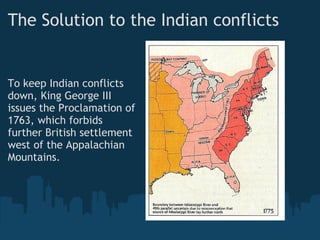
To keep Indian conflicts
down, King George III
issues the Proclamation of
1763, which forbids
further British settlement
west of the Appalachian
Mountains.
 
 
Solving the money problem
• 1764 – Sugar Act. Parliament taxes all sugar and
molasses imported into the colonies.
– Quartering Act. Colonial governments would be
required to pay for and provide housing and
provisions to British soldiers in America.
• 1765 – Stamp Act. Parliament taxes all
newspapers, almanacs, books, property titles,
wills, playing cards, dice, legal contracts, and a
lot of other things.

The french and_indian_war

  • 1.
    The French andIndian War
  • 2.
    1689 - 1754 England,France, and Spain went to war four times between 1689 and 1754.   Their North American colonies were active participants.   English colonies in the South fought with the Spanish in Florida and the Caribbean Sea.   English colonies in the north fought with the French in Quebec and the Great Lakes region.       
  • 3.
    The trouble withOhio • 1607 – Britain claims Virginia. According to the British, this claim included the Ohio River Valley. • 1699 – Sieur de La Salle claims the Mississippi River “and all its tributaries” for France. Since the Ohio River is a tributary of the Mississippi, France insists that the Ohio River Valley is theirs.
  • 4.
    1754 The French buildFort Duquesne at the origin point of the Ohio River, blocking English access into the Ohio River Valley.    The Virginia colonial government sends 21 year-old militia officer George Washington and a small force to tell the French to leave.   When France refuses, Washington builds a small fort to establish an English presence.    During a routine patrol, Washington orders his men to fire on a group of French soldiers. By doing so, he sparks a world war between England and France.  
  • 5.
    Fort Duquesne British GeneralBraddock is sent with a professional army to capture the Fort and establish British control over the Ohio Valley.
  • 6.
    Stalemate and surrender TheBritish soon discover that the war will be much longer and brutal than anticipated.  After while, a stalemate sets in, where neither side gains nor loses anything.    In 1760, the British launch a major offensive resulting in the capture of Montreal and Quebec.  Spain also declares war on Britain, but too late to do any good.  France, out of money and options, surrenders all of New France to the British.  The British now control all of North America east of the Mississippi River.  France gives Louisiana to Spain as compensation for losing Florida to the British.
  • 8.
    Issues in 1763 Britaincontrols a massive empire that must be maintained and protected.  A military presence must be kept in North America because while France may have surrendered, many of her Indian Allies did not.   To win the war, Britain borrowed massive amounts of money that now has to be paid back. Additionally, the average British citizen in Britain paid 25 times more taxes than the average Colonial citizen.    
  • 9.
    The Solution tothe Indian conflicts To keep Indian conflicts down, King George III issues the Proclamation of 1763, which forbids further British settlement west of the Appalachian Mountains.    
  • 10.
    Solving the moneyproblem • 1764 – Sugar Act. Parliament taxes all sugar and molasses imported into the colonies. – Quartering Act. Colonial governments would be required to pay for and provide housing and provisions to British soldiers in America. • 1765 – Stamp Act. Parliament taxes all newspapers, almanacs, books, property titles, wills, playing cards, dice, legal contracts, and a lot of other things.