1
The evolution of pervasive computing towards a Web of Things
Dr. Andreas Kamilaris
20 November 2017@Pervasive Systems RG, University of Twente
2
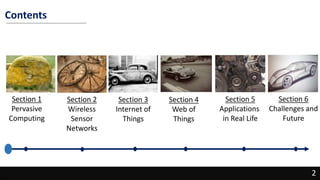
Contents
2
Section 1
Pervasive
Computing
Section 2
Wireless
Sensor
Networks
Section 3
Internet of
Things
Section 4
Web of
Things
Section 5
Applications
in Real Life
Section 6
Challenges and
Future
3
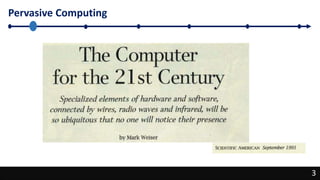
Pervasive Computing
3
4
Pervasive Computing
4
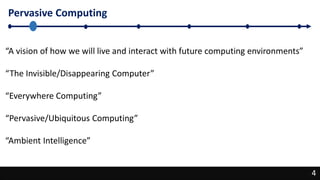
“A vision of how we will live and interact with future computing environments”
“The Invisible/Disappearing Computer”
“Everywhere Computing”
“Pervasive/Ubiquitous Computing”
“Ambient Intelligence”
5
Pervasive Computing
5
6
Pervasive Computing
6
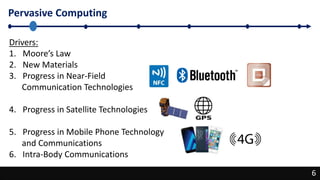
Drivers:
1. Moore’s Law
2. New Materials
3. Progress in Near-Field
Communication Technologies
4. Progress in Satellite Technologies
5. Progress in Mobile Phone Technology
and Communications
6. Intra-Body Communications
7
Wireless Sensor Networks
7
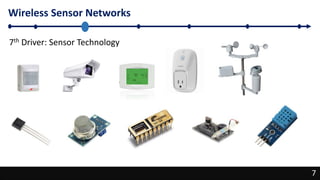
7th Driver: Sensor Technology
8
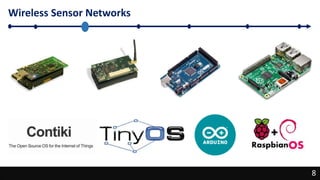
Wireless Sensor Networks
8
9
Wireless Sensor Networks
9
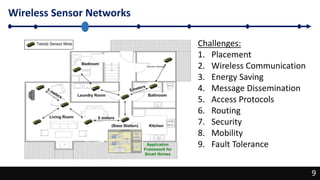
Challenges:
1. Placement
2. Wireless Communication
3. Energy Saving
4. Message Dissemination
5. Access Protocols
6. Routing
7. Security
8. Mobility
9. Fault Tolerance
10
Internet of Things
10
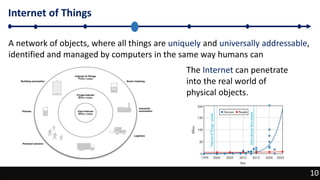
A network of objects, where all things are uniquely and universally addressable,
identified and managed by computers in the same way humans can
The Internet can penetrate
into the real world of
physical objects.
11
Internet of Things
11
12
Internet of Things
12
uIPv6
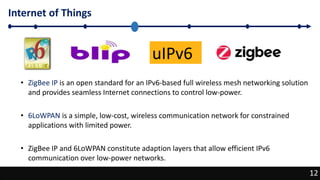
• ZigBee IP is an open standard for an IPv6-based full wireless mesh networking solution
and provides seamless Internet connections to control low-power.
• 6LoWPAN is a simple, low-cost, wireless communication network for constrained
applications with limited power.
• ZigBee IP and 6LoWPAN constitute adaption layers that allow efficient IPv6
communication over low-power networks.
13
Internet of Things
13
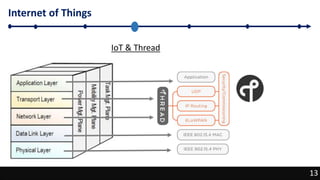
IoT & Thread
14
Internet of Things
14
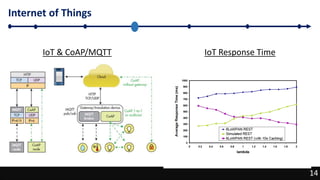
IoT & CoAP/MQTT IoT Response Time
15
Internet of Things
15
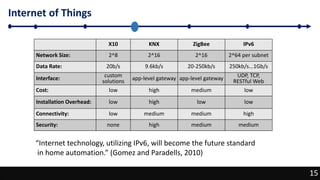
“Internet technology, utilizing IPv6, will become the future standard
in home automation.” (Gomez and Paradells, 2010)
X10 KNX ZigBee IPv6
Network Size: 2^8 2^16 2^16 2^64 per subnet
Data Rate: 20b/s 9.6kb/s 20-250kb/s 250kb/s...1Gb/s
Interface: custom
solutions app-level gateway app-level gateway UDP, TCP,
RESTful Web
Cost: low high medium low
Installation Overhead: low high low low
Connectivity: low medium medium high
Security: none high medium medium
16
Web of Things
16
Connectivity at the network layer is nice…
… but what about the application layer?
The WoT is a notion where everyday devices and sensors are connected by fully
integrating them to the Web.
Based on the success of the Web 2.0, this concept is about reusing well-accepted
and understood Web standards to connect constrained devices.
17
Web of Things
17
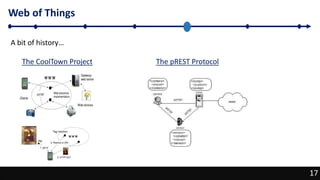
A bit of history…
The CoolTown Project The pREST Protocol
18
Web of Things
18
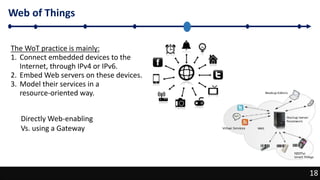
The WoT practice is mainly:
1. Connect embedded devices to the
Internet, through IPv4 or IPv6.
2. Embed Web servers on these devices.
3. Model their services in a
resource-oriented way.
Directly Web-enabling
Vs. using a Gateway
19
Web of Things
19
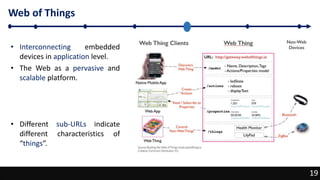
• Interconnecting embedded
devices in application level.
• The Web as a pervasive and
scalable platform.
• Different sub-URLs indicate
different characteristics of
“things”.
20
Web of Things
20
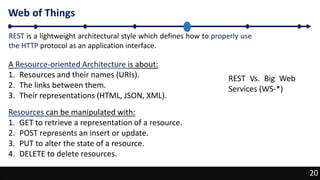
REST is a lightweight architectural style which defines how to properly use
the HTTP protocol as an application interface.
A Resource-oriented Architecture is about:
1. Resources and their names (URIs).
2. The links between them.
3. Their representations (HTML, JSON, XML).
Resources can be manipulated with:
1. GET to retrieve a representation of a resource.
2. POST represents an insert or update.
3. PUT to alter the state of a resource.
4. DELETE to delete resources.
REST Vs. Big Web
Services (WS-*)
21
Web of Things
21
22
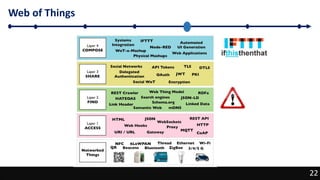
Web of Things
22
23
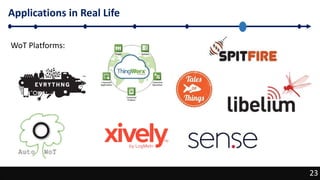
Applications in Real Life
23
WoT Platforms:
24
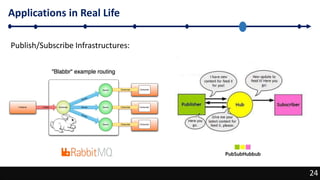
Applications in Real Life
24
Publish/Subscribe Infrastructures:
25
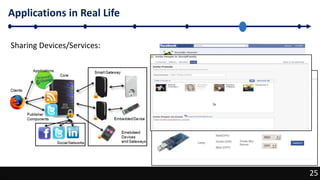
Applications in Real Life
25
Sharing Devices/Services:
26
Applications in Real Life
26
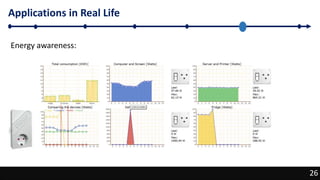
Energy awareness:
27
Applications in Real Life
27
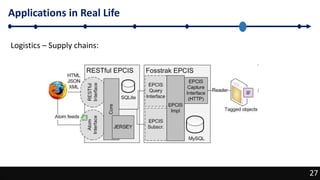
Logistics – Supply chains:
28
Applications in Real Life
28
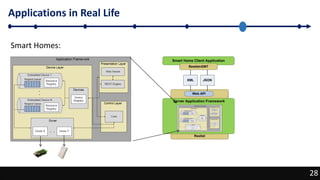
Smart Homes:
29
Applications in Real Life
29
Smart Homes:
function check {
if [ $? -le 20 ] ; then
curl -d "status=OFF" -X PUT
[serverAddress]/AirConditioner/Switch/
fi
}
curl -s -X GET
[serverAddress]/Kitchen/Temperature/ $1
check;
30
Applications in Real Life
30
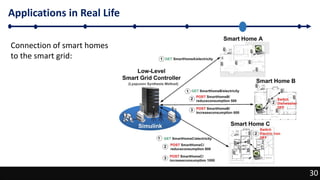
Connection of smart homes
to the smart grid:
31
Applications in Real Life
31
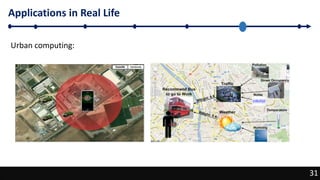
Urban computing:
32
Applications in Real Life
32
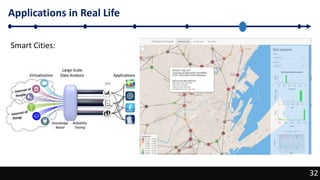
Smart Cities:
33
Applications in Real Life
33
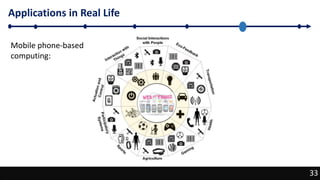
Mobile phone-based
computing:
34
Challenges and Future
34
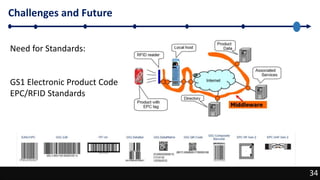
Need for Standards:
GS1 Electronic Product Code
EPC/RFID Standards
35
Challenges and Future
35
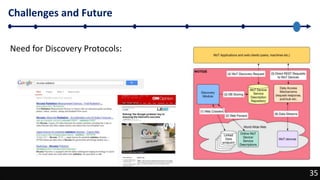
Need for Discovery Protocols:
36
Challenges and Future
36
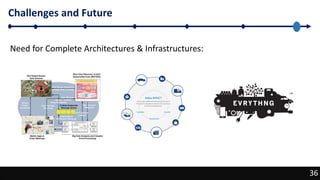
Need for Complete Architectures & Infrastructures:
37
Challenges and Future
37
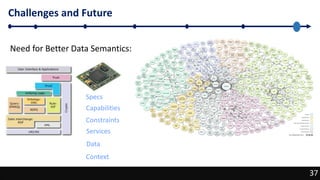
Need for Better Data Semantics:
Capabilities
Data
Constraints
Specs
Services
Context
38
Challenges and Future
38
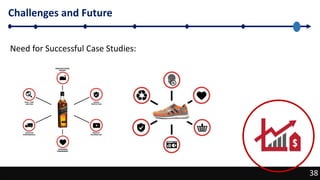
Need for Successful Case Studies:
39
Challenges and Future
39
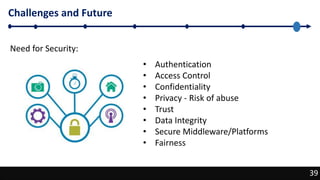
Need for Security:
• Authentication
• Access Control
• Confidentiality
• Privacy - Risk of abuse
• Trust
• Data Integrity
• Secure Middleware/Platforms
• Fairness
40
Challenges and Future
40
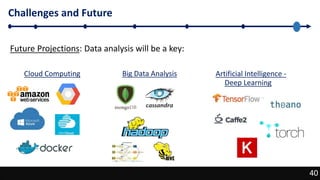
Future Projections: Data analysis will be a key:
Big Data Analysis Artificial Intelligence -
Deep Learning
Cloud Computing
41
Challenges and Future
41
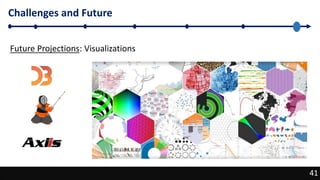
Future Projections: Visualizations
42
Challenges and Future
42
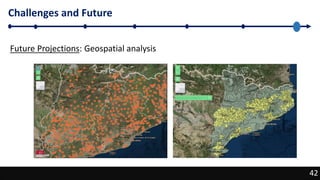
Future Projections: Geospatial analysis
43
Challenges and Future
43
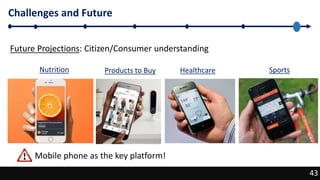
Future Projections: Citizen/Consumer understanding
Nutrition Products to Buy Healthcare Sports
Mobile phone as the key platform!
44
Challenges and Future
44
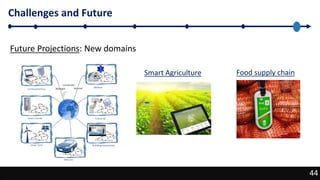
Future Projections: New domains
Smart Agriculture Food supply chain
45
Challenges and Future
45
Future Projections: Blockchain Technology
“The centralized security model common in the
enterprise today will struggle to scale up to meet the
demands of IoT”. (Forbes, June 2017)
• Decentralized
• More scalable security schemes
• Strong protections against data tampering
• Well-defined processes
• Maintains anonymity
46
Challenges and Future
46
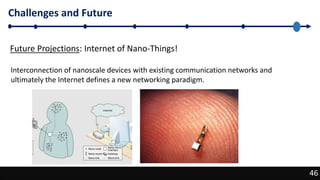
Future Projections: Internet of Nano-Things!
Interconnection of nanoscale devices with existing communication networks and
ultimately the Internet defines a new networking paradigm.
47
The End!
47
Section 1
Pervasive
Computing
Section 2
Wireless
Sensor
Networks
Section 3
Internet of
Things
Section 4
Web of
Things
Section 5
Applications
in Real Life
Section 6
Challenges and
Future
48
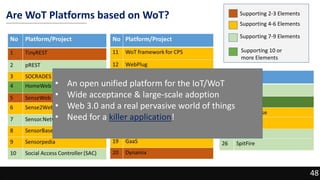
Are WoT Platforms based on WoT?
48
Supporting 2-3 Elements
Supporting 4-6 Elements
Supporting 7-9 Elements
Supporting 10 or
more Elements
• An open unified platform for the IoT/WoT
• Wide acceptance & large-scale adoption
• Web 3.0 and a real pervasive world of things
• Need for a killer application!
References I
Matthias Kovatsch et al., Embedding Internet Technology for Home Automation, in Proceedings of ETFA, Bilbao, Spain, September 2010.
Carles Gomez and Josep Paradells. Wireless home automation networks: A survey of architectures and technologies. IEEE Communications
Magazine, 48(6):92{101, 2010.
49
Anders Wallberg et al., Socially intelligent interfaces for increased energy awareness in the home, in IOT’08, 2008.
Juan Ignacio Vazquez and Diego Lopez-De-Ipina, Social devices: autonomous artifacts that communicate on the internet, in IOT’08, 2008.
Guinard, Dominique, and Vlad Trifa. Building the web of things: with examples in node. js and raspberry pi. Manning Publications Co., 2016.
Pautasso, Cesare, Olaf Zimmermann, and Frank Leymann. "Restful web services vs. big'web services: making the right architectural decision."
Proceedings of the 17th international conference on World Wide Web. ACM, 2008
Tim Kindberg et al., People, places, things: web presence for the real world, in Mobile Network Applications, 7(5):365–376, 2002.
Guinard, Dominique, Mathias Fischer, and Vlad Trifa. "Sharing using social networks in a composable web of things." Pervasive Computing
and Communications Workshops (PERCOM Workshops), 2010 8th IEEE International Conference on. IEEE, 2010.
Guinard, Dominique, et al. "From the internet of things to the web of things: Resource-oriented architecture and best practices." Architecting
the Internet of things (2011): 97-129.
References II
D. Guinard, M. Müller, Jacques Pasquier, Giving RFID a REST: Building a Web-Enabled EPCIS, Proceedings of the Internet of Things 2010
International Conference (IoT 2010), November 2010, Tokyo, Japan.
50
Andreas Kamilaris, Andreas Pitsillides and Michalis Yiallouros. Building Energy-aware Smart Homes using Web Technologies. Journal of
Ambient Intelligence and Smart Environments (JAISE), vol. 5, no. 2, pp. 161-186, March, 2013.
Andreas Kamilaris and Andreas Pitsillides. Mobile Phone Computing and the Internet of Things: A Survey. IEEE Internet of Things (IoT)
Journal, vol. 3, no. 6, pp. 885-898, December, 2016.
Andreas Kamilaris, Semih Yumusak and Muhammad Intizar Ali. WOTS2E: A Search Engine for a Semantic Web of Things. In Proc. of the IEEE
World Forum on Internet of Things (WF-IoT), Reston, VA, USA, December 2016.
Andreas Kamilaris and Andreas Pitsillides. Social Networking of the Smart Home. In 21st Annual IEEE International Symposium on
Personal,Indoor and Mobile Radio Communications (PIMRC 2010), Istanbul, Turkey, September 2010.
Juan Vazquez et al.,. SOAM: An Environment Adaptation Model for the Pervasive Semantic Web, in ICCSA, volume 3983 of Lecture Notes in
Computer Science, pages 108–117. Springer Berlin, Heidelberg, 2006.
Lars Schor et al., Towards a Zero-Configuration Wireless Sensor Network Architecture for Smart Buildings, in BuildSys, 2009.
Dogan Yazar and Adam Dunkels, Efficient Application Integration in IP-based Sensor Networks, in BuildSys, 2009.
51
Thanks for your attention!
Dr. Andreas Kamilaris
(Email: Andreas.Kamilaris@irta.cat)

The evolution of pervasive computing towards a Web of Things

  • 1.
    1 The evolution ofpervasive computing towards a Web of Things Dr. Andreas Kamilaris 20 November 2017@Pervasive Systems RG, University of Twente
  • 2.
    2 Contents 2 Section 1 Pervasive Computing Section 2 Wireless Sensor Networks Section3 Internet of Things Section 4 Web of Things Section 5 Applications in Real Life Section 6 Challenges and Future
  • 3.
  • 4.
    4 Pervasive Computing 4 “A visionof how we will live and interact with future computing environments” “The Invisible/Disappearing Computer” “Everywhere Computing” “Pervasive/Ubiquitous Computing” “Ambient Intelligence”
  • 5.
  • 6.
    6 Pervasive Computing 6 Drivers: 1. Moore’sLaw 2. New Materials 3. Progress in Near-Field Communication Technologies 4. Progress in Satellite Technologies 5. Progress in Mobile Phone Technology and Communications 6. Intra-Body Communications
  • 7.
    7 Wireless Sensor Networks 7 7thDriver: Sensor Technology
  • 8.
  • 9.
    9 Wireless Sensor Networks 9 Challenges: 1.Placement 2. Wireless Communication 3. Energy Saving 4. Message Dissemination 5. Access Protocols 6. Routing 7. Security 8. Mobility 9. Fault Tolerance
  • 10.
    10 Internet of Things 10 Anetwork of objects, where all things are uniquely and universally addressable, identified and managed by computers in the same way humans can The Internet can penetrate into the real world of physical objects.
  • 11.
  • 12.
    12 Internet of Things 12 uIPv6 •ZigBee IP is an open standard for an IPv6-based full wireless mesh networking solution and provides seamless Internet connections to control low-power. • 6LoWPAN is a simple, low-cost, wireless communication network for constrained applications with limited power. • ZigBee IP and 6LoWPAN constitute adaption layers that allow efficient IPv6 communication over low-power networks.
  • 13.
  • 14.
    14 Internet of Things 14 IoT& CoAP/MQTT IoT Response Time
  • 15.
    15 Internet of Things 15 “Internettechnology, utilizing IPv6, will become the future standard in home automation.” (Gomez and Paradells, 2010) X10 KNX ZigBee IPv6 Network Size: 2^8 2^16 2^16 2^64 per subnet Data Rate: 20b/s 9.6kb/s 20-250kb/s 250kb/s...1Gb/s Interface: custom solutions app-level gateway app-level gateway UDP, TCP, RESTful Web Cost: low high medium low Installation Overhead: low high low low Connectivity: low medium medium high Security: none high medium medium
  • 16.
    16 Web of Things 16 Connectivityat the network layer is nice… … but what about the application layer? The WoT is a notion where everyday devices and sensors are connected by fully integrating them to the Web. Based on the success of the Web 2.0, this concept is about reusing well-accepted and understood Web standards to connect constrained devices.
  • 17.
    17 Web of Things 17 Abit of history… The CoolTown Project The pREST Protocol
  • 18.
    18 Web of Things 18 TheWoT practice is mainly: 1. Connect embedded devices to the Internet, through IPv4 or IPv6. 2. Embed Web servers on these devices. 3. Model their services in a resource-oriented way. Directly Web-enabling Vs. using a Gateway
  • 19.
    19 Web of Things 19 •Interconnecting embedded devices in application level. • The Web as a pervasive and scalable platform. • Different sub-URLs indicate different characteristics of “things”.
  • 20.
    20 Web of Things 20 RESTis a lightweight architectural style which defines how to properly use the HTTP protocol as an application interface. A Resource-oriented Architecture is about: 1. Resources and their names (URIs). 2. The links between them. 3. Their representations (HTML, JSON, XML). Resources can be manipulated with: 1. GET to retrieve a representation of a resource. 2. POST represents an insert or update. 3. PUT to alter the state of a resource. 4. DELETE to delete resources. REST Vs. Big Web Services (WS-*)
  • 21.
  • 22.
  • 23.
    23 Applications in RealLife 23 WoT Platforms:
  • 24.
    24 Applications in RealLife 24 Publish/Subscribe Infrastructures:
  • 25.
    25 Applications in RealLife 25 Sharing Devices/Services:
  • 26.
    26 Applications in RealLife 26 Energy awareness:
  • 27.
    27 Applications in RealLife 27 Logistics – Supply chains:
  • 28.
    28 Applications in RealLife 28 Smart Homes:
  • 29.
    29 Applications in RealLife 29 Smart Homes: function check { if [ $? -le 20 ] ; then curl -d "status=OFF" -X PUT [serverAddress]/AirConditioner/Switch/ fi } curl -s -X GET [serverAddress]/Kitchen/Temperature/ $1 check;
  • 30.
    30 Applications in RealLife 30 Connection of smart homes to the smart grid:
  • 31.
    31 Applications in RealLife 31 Urban computing:
  • 32.
    32 Applications in RealLife 32 Smart Cities:
  • 33.
    33 Applications in RealLife 33 Mobile phone-based computing:
  • 34.
    34 Challenges and Future 34 Needfor Standards: GS1 Electronic Product Code EPC/RFID Standards
  • 35.
    35 Challenges and Future 35 Needfor Discovery Protocols:
  • 36.
    36 Challenges and Future 36 Needfor Complete Architectures & Infrastructures:
  • 37.
    37 Challenges and Future 37 Needfor Better Data Semantics: Capabilities Data Constraints Specs Services Context
  • 38.
    38 Challenges and Future 38 Needfor Successful Case Studies:
  • 39.
    39 Challenges and Future 39 Needfor Security: • Authentication • Access Control • Confidentiality • Privacy - Risk of abuse • Trust • Data Integrity • Secure Middleware/Platforms • Fairness
  • 40.
    40 Challenges and Future 40 FutureProjections: Data analysis will be a key: Big Data Analysis Artificial Intelligence - Deep Learning Cloud Computing
  • 41.
    41 Challenges and Future 41 FutureProjections: Visualizations
  • 42.
    42 Challenges and Future 42 FutureProjections: Geospatial analysis
  • 43.
    43 Challenges and Future 43 FutureProjections: Citizen/Consumer understanding Nutrition Products to Buy Healthcare Sports Mobile phone as the key platform!
  • 44.
    44 Challenges and Future 44 FutureProjections: New domains Smart Agriculture Food supply chain
  • 45.
    45 Challenges and Future 45 FutureProjections: Blockchain Technology “The centralized security model common in the enterprise today will struggle to scale up to meet the demands of IoT”. (Forbes, June 2017) • Decentralized • More scalable security schemes • Strong protections against data tampering • Well-defined processes • Maintains anonymity
  • 46.
    46 Challenges and Future 46 FutureProjections: Internet of Nano-Things! Interconnection of nanoscale devices with existing communication networks and ultimately the Internet defines a new networking paradigm.
  • 47.
    47 The End! 47 Section 1 Pervasive Computing Section2 Wireless Sensor Networks Section 3 Internet of Things Section 4 Web of Things Section 5 Applications in Real Life Section 6 Challenges and Future
  • 48.
    48 Are WoT Platformsbased on WoT? 48 Supporting 2-3 Elements Supporting 4-6 Elements Supporting 7-9 Elements Supporting 10 or more Elements • An open unified platform for the IoT/WoT • Wide acceptance & large-scale adoption • Web 3.0 and a real pervasive world of things • Need for a killer application!
  • 49.
    References I Matthias Kovatschet al., Embedding Internet Technology for Home Automation, in Proceedings of ETFA, Bilbao, Spain, September 2010. Carles Gomez and Josep Paradells. Wireless home automation networks: A survey of architectures and technologies. IEEE Communications Magazine, 48(6):92{101, 2010. 49 Anders Wallberg et al., Socially intelligent interfaces for increased energy awareness in the home, in IOT’08, 2008. Juan Ignacio Vazquez and Diego Lopez-De-Ipina, Social devices: autonomous artifacts that communicate on the internet, in IOT’08, 2008. Guinard, Dominique, and Vlad Trifa. Building the web of things: with examples in node. js and raspberry pi. Manning Publications Co., 2016. Pautasso, Cesare, Olaf Zimmermann, and Frank Leymann. "Restful web services vs. big'web services: making the right architectural decision." Proceedings of the 17th international conference on World Wide Web. ACM, 2008 Tim Kindberg et al., People, places, things: web presence for the real world, in Mobile Network Applications, 7(5):365–376, 2002. Guinard, Dominique, Mathias Fischer, and Vlad Trifa. "Sharing using social networks in a composable web of things." Pervasive Computing and Communications Workshops (PERCOM Workshops), 2010 8th IEEE International Conference on. IEEE, 2010. Guinard, Dominique, et al. "From the internet of things to the web of things: Resource-oriented architecture and best practices." Architecting the Internet of things (2011): 97-129.
  • 50.
    References II D. Guinard,M. Müller, Jacques Pasquier, Giving RFID a REST: Building a Web-Enabled EPCIS, Proceedings of the Internet of Things 2010 International Conference (IoT 2010), November 2010, Tokyo, Japan. 50 Andreas Kamilaris, Andreas Pitsillides and Michalis Yiallouros. Building Energy-aware Smart Homes using Web Technologies. Journal of Ambient Intelligence and Smart Environments (JAISE), vol. 5, no. 2, pp. 161-186, March, 2013. Andreas Kamilaris and Andreas Pitsillides. Mobile Phone Computing and the Internet of Things: A Survey. IEEE Internet of Things (IoT) Journal, vol. 3, no. 6, pp. 885-898, December, 2016. Andreas Kamilaris, Semih Yumusak and Muhammad Intizar Ali. WOTS2E: A Search Engine for a Semantic Web of Things. In Proc. of the IEEE World Forum on Internet of Things (WF-IoT), Reston, VA, USA, December 2016. Andreas Kamilaris and Andreas Pitsillides. Social Networking of the Smart Home. In 21st Annual IEEE International Symposium on Personal,Indoor and Mobile Radio Communications (PIMRC 2010), Istanbul, Turkey, September 2010. Juan Vazquez et al.,. SOAM: An Environment Adaptation Model for the Pervasive Semantic Web, in ICCSA, volume 3983 of Lecture Notes in Computer Science, pages 108–117. Springer Berlin, Heidelberg, 2006. Lars Schor et al., Towards a Zero-Configuration Wireless Sensor Network Architecture for Smart Buildings, in BuildSys, 2009. Dogan Yazar and Adam Dunkels, Efficient Application Integration in IP-based Sensor Networks, in BuildSys, 2009.
  • 51.
    51 Thanks for yourattention! Dr. Andreas Kamilaris (Email: Andreas.Kamilaris@irta.cat)