International Research Journal of Engineering and Technology (IRJET) e-ISSN: 2395-0056
Volume: 09 Issue: 07 | July 2022 www.irjet.net p-ISSN: 2395-0072
© 2022, IRJET | Impact Factor value: 7.529 | ISO 9001:2008 Certified Journal | Page 1572
IOT Virtual Doctor Robot for Online Doctor Consultation of Patient
Healthcare & Telemedicine
Anuradha .M .Sandi, Vaishnavi Sindol, Shruti, Rekha
1professor, Dept. of Electronics and communication, GND Engg. College, Bidar, India.
2,3,4Student, Dept. of Electronics and communication, GND Engg. College, Bidar, India.
---------------------------------------------------------------------***---------------------------------------------------------------------
Abstract - Doctors are usually needed to work at every
hospital and emergency center every now and then. But it is
not feasible for every doctor to be available at every place at
desired time. The problem with video calling is that videocalls
need to be done from a PC or laptop on a desk. This limits the
doctor’s capacity to view patient or around operation theatre
at will or even move through hospital rooms as needed. To
help solve this issue we here develop a virtual doctor robot
that allows a doctor to virtually move around at a remote
location at will and even talk to people at remote location as
desired. This robot provides a whole lot of advantages for
doctors: Doctors’ ability to be at anyplace anytime, Doctors
can move around in operation theatres, Doctors can move
around the patient with ease, Doctors can see medical reports
remotely via video calls, Doctors can move around in other
rooms at will. The system makes use of a robotic vehicle with
4-wheel drive for easy navigation. The robot also includes a
controller box for circuitry and a mounting to hold a mobile
phone or tablet. The mobile or tablet is used to hold live video
calls. The doctor can use an IOT based panel to control the
robot. The control commands sent online are received by the
robot controller. The robot controller operates over Wi-Fi
internet. The received commands are received inrealtimeand
the robot motors are operated to achieve the desired
movement commands.
Key Words: Robotic vehicle, Easy navigation, controller
box, IOT based panel, robotic motors.
1. INTRODUCTION
There is a growing trend in the medical fieldtominimizethe
need for hospitalization, moving several health care
procedures from hospitals (hospital centric) to patient's
homes (home-centric). This strategy has been raised mainly
due to its possibility for improving patient's wellness and
treatment effectiveness. It can also reduce the costs of the
public health system worldwide and its efficiency, which in
the last decade has been challenged by the population aging
and the rise of chronic diseases.
For this purpose, Internet of Things (IoT) provides
the scalability whichsupportscontinuousandreliablehealth
monitoring on a global scale. This paradigm is increasingly
becoming a vital technology in healthcare. Furthermore, the
recent progress in low-powerconsumption, miniaturization,
and biosensors has revolutionizedtheprocessofmonitoring
and diagnosing health conditions.
For patients' de-hospitalization the platform
proposed initially were designed, by includingwearableand
unobtrusive sensors. The software is developed and the
components are guided by the Reference Architecture for
IoT-based Healthcare Applications for a real intensive care
unit (ICU) and the interoperability with existing
multiparametric monitors.
1.1 THEORITICAL MODELLING
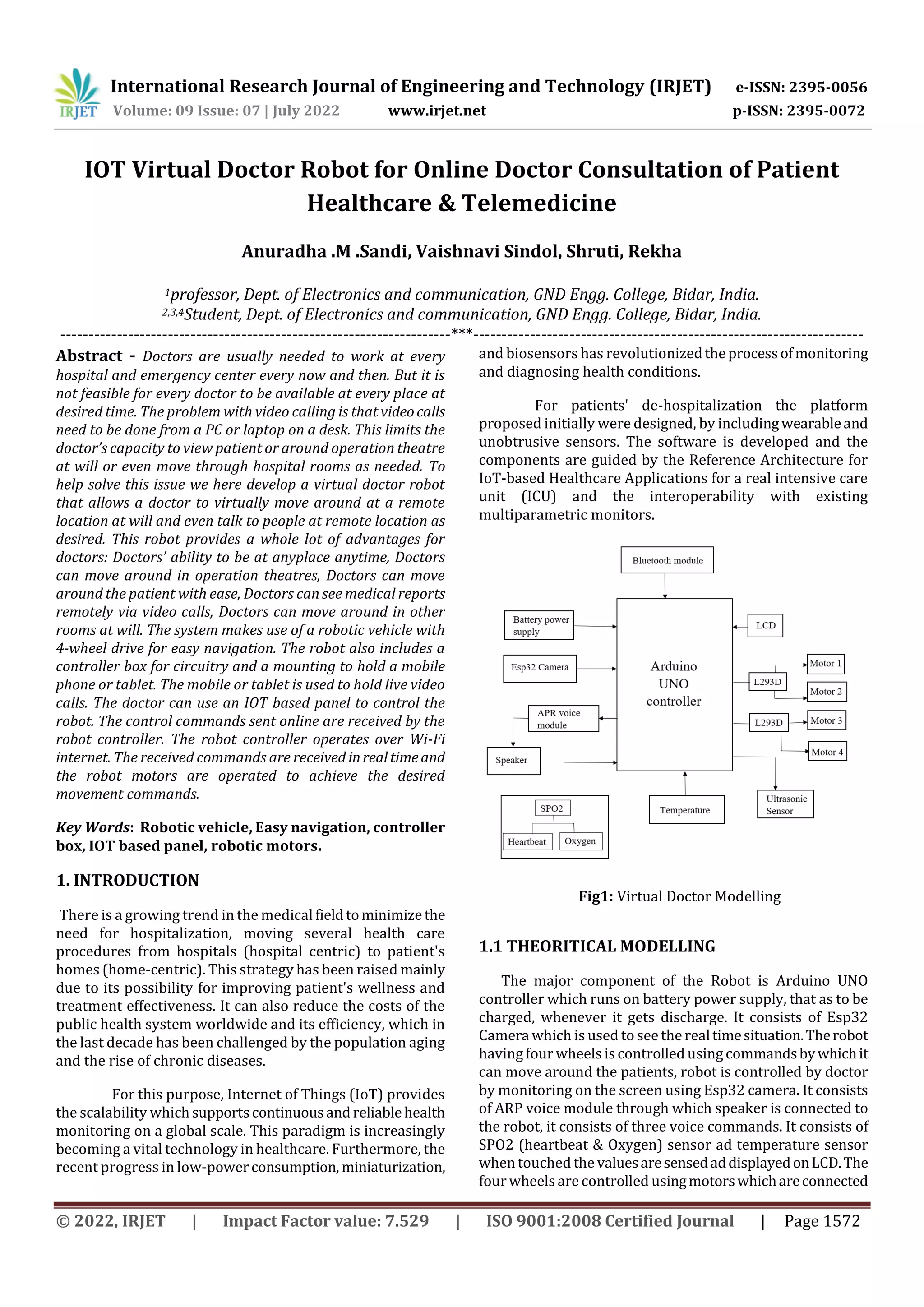
The major component of the Robot is Arduino UNO
controller which runs on battery power supply, that as to be
charged, whenever it gets discharge. It consists of Esp32
Camera which is used to see the realtimesituation.Therobot
having four wheels iscontrolled using commandsbywhichit
can move around the patients, robot is controlled by doctor
by monitoring on the screen using Esp32 camera. It consists
of ARP voice module through which speaker is connected to
the robot, it consists of three voice commands. It consists of
SPO2 (heartbeat & Oxygen) sensor ad temperature sensor
when touched the valuesaresensedaddisplayedonLCD.The
four wheelsare controlled usingmotorswhichareconnected
Fig1: Virtual Doctor Modelling
International Research Journal of Engineering and Technology (IRJET) e-ISSN: 2395-0056
Volume: 09 Issue: 07 | July 2022 www.irjet.net p-ISSN: 2395-0072
© 2022, IRJET | Impact Factor value: 7.529 | ISO 9001:2008 Certified Journal | Page 1573
to the controller via L239D module. Ultrasonicsensorisused
to detect the obstacle, whenever it detects obstacle the robot
stops, again commands should be given to start the robot.
1.2 Hardware components
The required hardware components are: Arduino Uno,
16X2 LCD display, APR9600, DC motor, ESP32 cam,
ESP8266, L293D, LM35, LM7085, MAX30100, Ultrasonic
sensor
The additional components required are rod, cardboard,
transformer for charging the battery, PCB’s and soldering
gun.
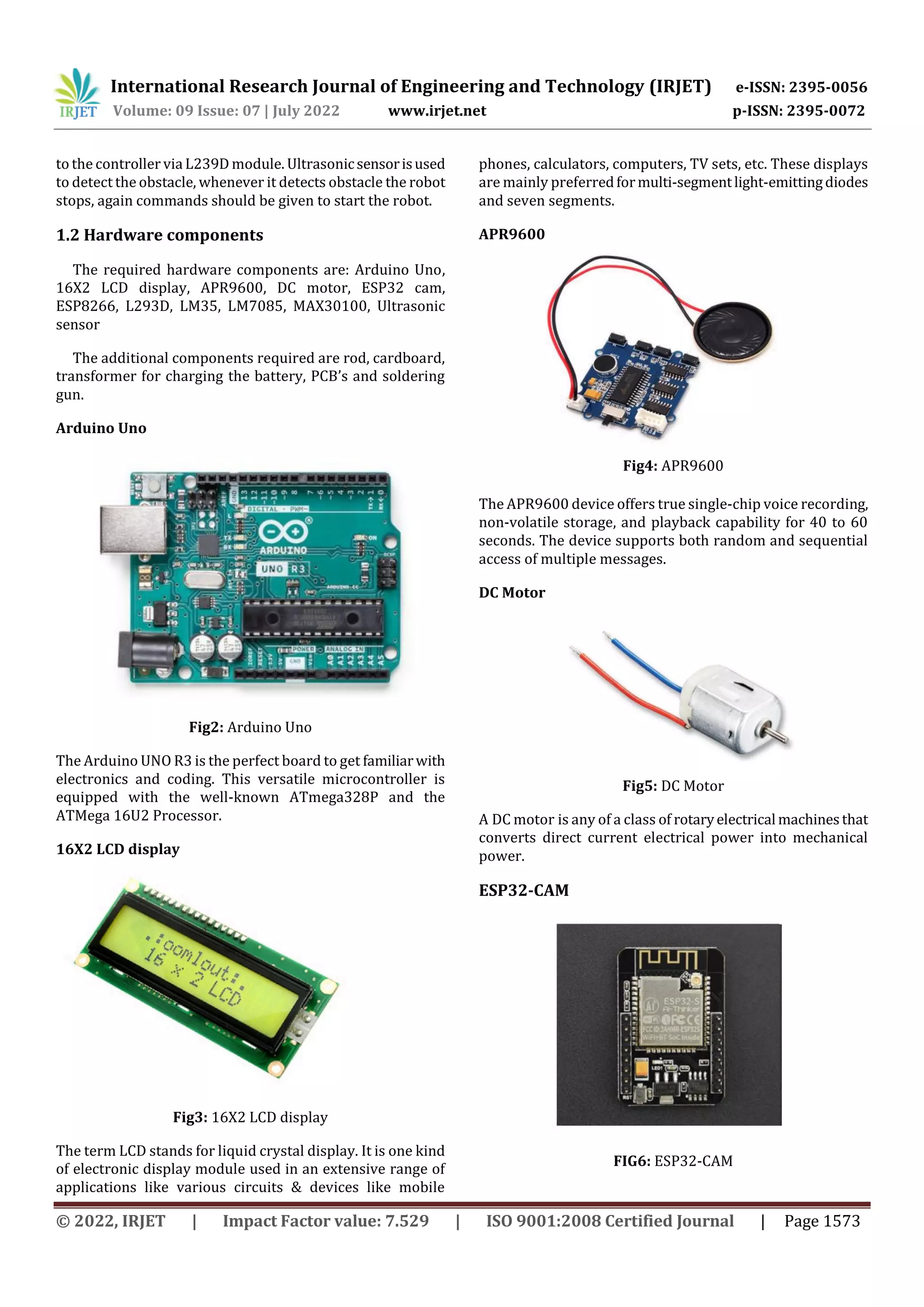
Arduino Uno
Fig2: Arduino Uno
The Arduino UNO R3 is the perfect board to get familiarwith
electronics and coding. This versatile microcontroller is
equipped with the well-known ATmega328P and the
ATMega 16U2 Processor.
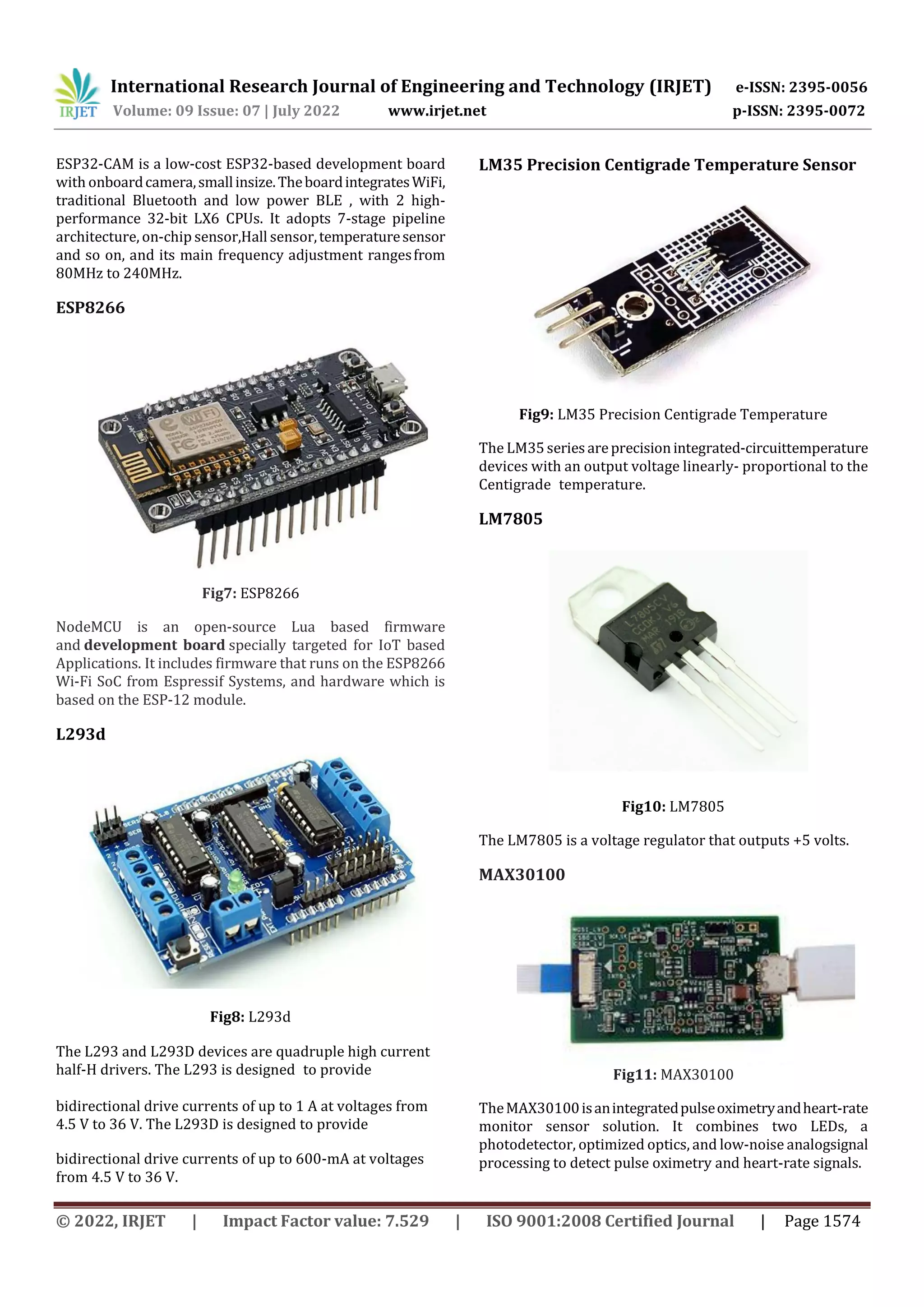
16X2 LCD display
Fig3: 16X2 LCD display
The term LCD stands for liquid crystal display. It is one kind
of electronic display module used in an extensive range of
applications like various circuits & devices like mobile
phones, calculators, computers, TV sets, etc. These displays
are mainly preferredformulti-segmentlight-emittingdiodes
and seven segments.
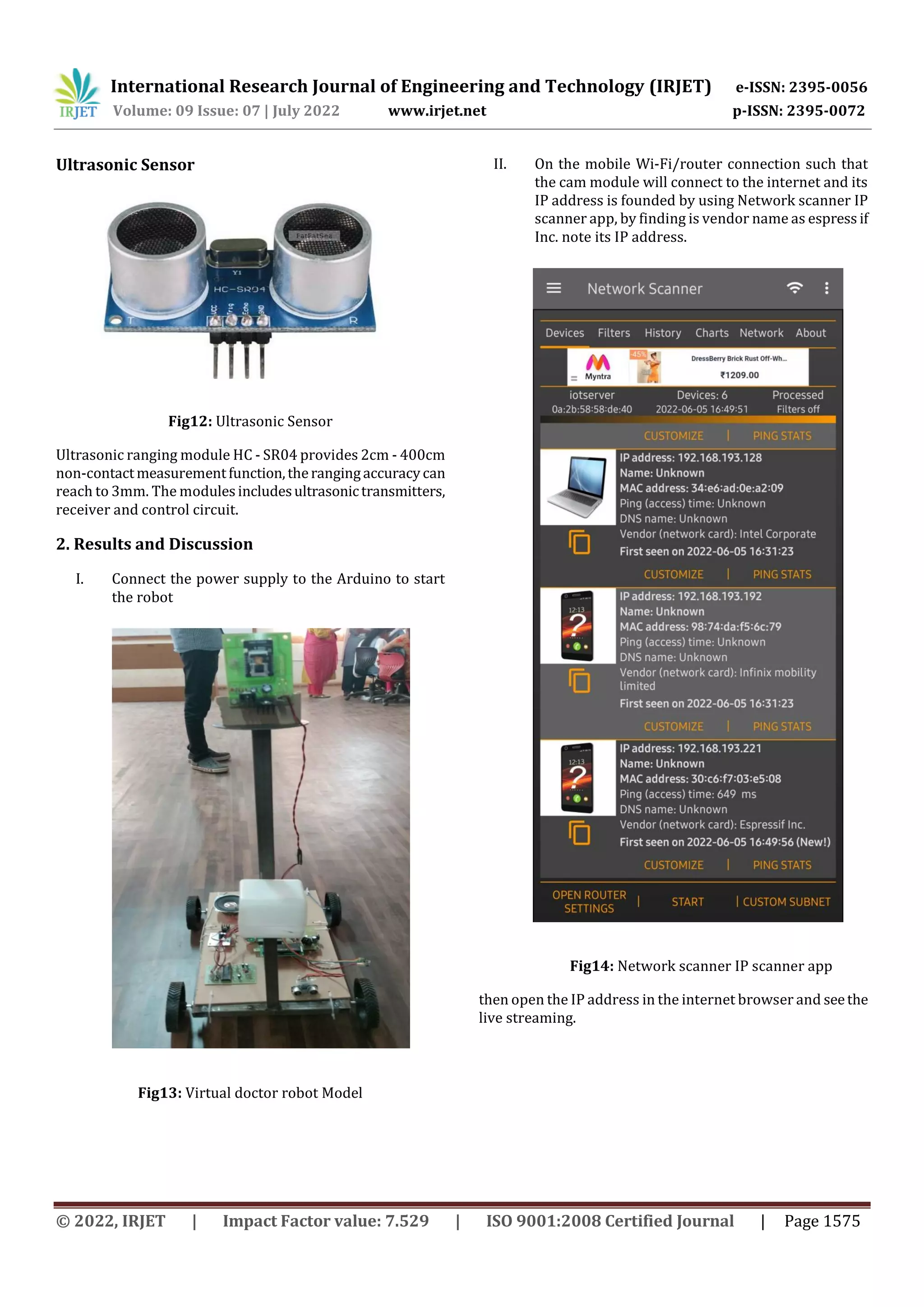
APR9600
Fig4: APR9600
The APR9600 device offers true single-chip voice recording,
non-volatile storage, and playback capability for 40 to 60
seconds. The device supports both random and sequential
access of multiple messages.
DC Motor
Fig5: DC Motor
A DC motor is any of a class of rotaryelectrical machinesthat
converts direct current electrical power into mechanical
power.
ESP32-CAM
FIG6: ESP32-CAM
International Research Journal of Engineering and Technology (IRJET) e-ISSN: 2395-0056
Volume: 09 Issue: 07 | July 2022 www.irjet.net p-ISSN: 2395-0072
© 2022, IRJET | Impact Factor value: 7.529 | ISO 9001:2008 Certified Journal | Page 1574
ESP32-CAM is a low-cost ESP32-based development board
with onboardcamera,smallinsize.TheboardintegratesWiFi,
traditional Bluetooth and low power BLE , with 2 high-
performance 32-bit LX6 CPUs. It adopts 7-stage pipeline
architecture, on-chip sensor,Hall sensor,temperaturesensor
and so on, and its main frequency adjustment rangesfrom
80MHz to 240MHz.
ESP8266
Fig7: ESP8266
NodeMCU is an open-source Lua based firmware
and development board specially targeted for IoT based
Applications. It includes firmware that runs on the ESP8266
Wi-Fi SoC from Espressif Systems, and hardware which is
based on the ESP-12 module.
L293d
Fig8: L293d
The L293 and L293D devices are quadruple high current
half-H drivers. The L293 is designed to provide
bidirectional drive currents of up to 1 A at voltages from
4.5 V to 36 V. The L293D is designed to provide
bidirectional drive currents of up to 600-mA at voltages
from 4.5 V to 36 V.
LM35 Precision Centigrade Temperature Sensor
Fig9: LM35 Precision Centigrade Temperature
The LM35seriesareprecisionintegrated-circuittemperature
devices with an output voltage linearly- proportional to the
Centigrade temperature.
LM7805
Fig10: LM7805
The LM7805 is a voltage regulator that outputs +5 volts.
MAX30100
Fig11: MAX30100
TheMAX30100isanintegratedpulseoximetryandheart-rate
monitor sensor solution. It combines two LEDs, a
photodetector, optimized optics, and low-noise analogsignal
processing to detect pulse oximetry and heart-rate signals.
International Research Journal of Engineering and Technology (IRJET) e-ISSN: 2395-0056
Volume: 09 Issue: 07 | July 2022 www.irjet.net p-ISSN: 2395-0072
© 2022, IRJET | Impact Factor value: 7.529 | ISO 9001:2008 Certified Journal | Page 1575
Ultrasonic Sensor
Fig12: Ultrasonic Sensor
Ultrasonic ranging module HC - SR04 provides 2cm - 400cm
non-contactmeasurementfunction,therangingaccuracycan
reach to 3mm. The modules includesultrasonictransmitters,
receiver and control circuit.
2. Results and Discussion
I. Connect the power supply to the Arduino to start
the robot
Fig13: Virtual doctor robot Model
II. On the mobile Wi-Fi/router connection such that
the cam module will connect to the internet and its
IP address is founded by using Network scanner IP
scanner app, by finding is vendor name as espress if
Inc. note its IP address.
Fig14: Network scanner IP scanner app
then open the IP address in the internet browser and seethe
live streaming.
International Research Journal of Engineering and Technology (IRJET) e-ISSN: 2395-0056
Volume: 09 Issue: 07 | July 2022 www.irjet.net p-ISSN: 2395-0072
© 2022, IRJET | Impact Factor value: 7.529 | ISO 9001:2008 Certified Journal | Page 1576
Fig15: Camera Display in web browser
III. ESP8266 Wi-Fi Module is connected to the telnet
app, type the Remote Host Name or Ip and then we
can give the commands to the robot movement i.e
left(*l#), right(*r#), front(*f#), back(*b#)andvoice
commands such as (*1#.) Placingfinger,(*2#.)Take
tablet, (*3#.) All ok, Take rest.
Fig 16: Telnet app
IV. After placing fingers on sensors we get the output
on LCD display as well as on the mobile screen
which is visible to the doctor.
Fig17: Telnet app display
Fig18: LCD display
International Research Journal of Engineering and Technology (IRJET) e-ISSN: 2395-0056
Volume: 09 Issue: 07 | July 2022 www.irjet.net p-ISSN: 2395-0072
© 2022, IRJET | Impact Factor value: 7.529 | ISO 9001:2008 Certified Journal | Page 1577
3. Conclusion
Using IoT based virtual doctor robot, the burden of a doctor
can be reduced during the busy schedule. The waiting time
of the patients can be reduced. Primary patient monitoring
and patient caring assistance withdailyactivitiesisachieved.
For user friendly, we designed "Doctor robot" with manual
and autonomous control system. Doctors from anywhere in
the world will be able to show the all-patient data without
touching the patient through the IOT system and make
communicate video calls with the patient. We believe this
robot will go a long way in alleviating the lack of adequate
doctors in medical services around the world.
Clinical robots help with a medical procedure, smooth out
emergency clinic coordinated factors, and empower
suppliers to concentrate on patients. Robots in the clinical
field are changing the way that medical procedures are
performed, smoothing out supply conveyance and
sanitization, and saving time for suppliers to draw in with
patients. Clinical robot market is relied upon to acquire
market development in the figure time of 2022 to 2028.
REFERENCES
[1] Mr.R.Ramadoss "Automated Virtual Robot-DOCTOR.”
International Journal of Engineering Science
Invention(IJESI), vol. 6, no. 12, 2017. M. Young, The
Technical Writer’s Handbook. Mill Valley,CA:University
Science, 1989.
[2] Xi Vincent Wang, Lihui Wang, KTH Royal Institute of
Technology.”robotic technologies during the COVID-19
pandemic”, August 2021.
[3] Supreet Thale, Bhushan N Chopda, Shreyas Deo, Viraj
Nyayadhish, P Srivalli, Unnati Choudhari, Serlin Agnes,
Nilofar Sameena. M,” Design of Smart Medical Assistant
Robot for Contactless Preliminary Health Check Up of
Patients”, International ResearchJournal ofEngineering
and Technology, Aug 2020.
[4] Torbjørn S. Dahl and Maged N. Kamel Boulos 2,”Robots
in Health and Social Care”, 30 Dec 2013.
[5] YANG SHEN , DEJUN GUO , FEI LONG , LUIS A. MATEOS ,
HOUZHU DING , ZHEN XIU , RANDALL B. HELLMAN ,
ADAM KING , SHIXUN CHEN , CHENGKUN ZHANG , AND
HUAN TAN,” Robots Under COVID-19 Pandemic”
December 18, 2020.
[6] IEEE,” A virtual doctorprototypeforquick diagnosisand
secure health information exchange”, 18 August 2014.
[7] Sergio D. Sierra Marín1 , Patricio Barria , Subramanian
Ramamoorthy , Marcelo Becker ,”Expectations and
Perceptions of Healthcare Professionals for Robot
Deployment in Hospital Environments During the
COVID-19 Pandemic”, 02 June 2021
[8] IEEE,” Telemedicine and Virtual Specialist Hospitals -
Virtual Presentia (VIP) and Virtual Absentia (VIA)
Hospitals”, 28 December 2009.
[9] Md. Anowar Hossain , Md. Jasim Uddin Qureshi,”IoT
Based Medical Assistant Robot (Docto-Bot)”, December
2021.

IOT Virtual Doctor Robot for Online Doctor Consultation of Patient Healthcare & Telemedicine

  • 1.
    International Research Journalof Engineering and Technology (IRJET) e-ISSN: 2395-0056 Volume: 09 Issue: 07 | July 2022 www.irjet.net p-ISSN: 2395-0072 © 2022, IRJET | Impact Factor value: 7.529 | ISO 9001:2008 Certified Journal | Page 1572 IOT Virtual Doctor Robot for Online Doctor Consultation of Patient Healthcare & Telemedicine Anuradha .M .Sandi, Vaishnavi Sindol, Shruti, Rekha 1professor, Dept. of Electronics and communication, GND Engg. College, Bidar, India. 2,3,4Student, Dept. of Electronics and communication, GND Engg. College, Bidar, India. ---------------------------------------------------------------------***--------------------------------------------------------------------- Abstract - Doctors are usually needed to work at every hospital and emergency center every now and then. But it is not feasible for every doctor to be available at every place at desired time. The problem with video calling is that videocalls need to be done from a PC or laptop on a desk. This limits the doctor’s capacity to view patient or around operation theatre at will or even move through hospital rooms as needed. To help solve this issue we here develop a virtual doctor robot that allows a doctor to virtually move around at a remote location at will and even talk to people at remote location as desired. This robot provides a whole lot of advantages for doctors: Doctors’ ability to be at anyplace anytime, Doctors can move around in operation theatres, Doctors can move around the patient with ease, Doctors can see medical reports remotely via video calls, Doctors can move around in other rooms at will. The system makes use of a robotic vehicle with 4-wheel drive for easy navigation. The robot also includes a controller box for circuitry and a mounting to hold a mobile phone or tablet. The mobile or tablet is used to hold live video calls. The doctor can use an IOT based panel to control the robot. The control commands sent online are received by the robot controller. The robot controller operates over Wi-Fi internet. The received commands are received inrealtimeand the robot motors are operated to achieve the desired movement commands. Key Words: Robotic vehicle, Easy navigation, controller box, IOT based panel, robotic motors. 1. INTRODUCTION There is a growing trend in the medical fieldtominimizethe need for hospitalization, moving several health care procedures from hospitals (hospital centric) to patient's homes (home-centric). This strategy has been raised mainly due to its possibility for improving patient's wellness and treatment effectiveness. It can also reduce the costs of the public health system worldwide and its efficiency, which in the last decade has been challenged by the population aging and the rise of chronic diseases. For this purpose, Internet of Things (IoT) provides the scalability whichsupportscontinuousandreliablehealth monitoring on a global scale. This paradigm is increasingly becoming a vital technology in healthcare. Furthermore, the recent progress in low-powerconsumption, miniaturization, and biosensors has revolutionizedtheprocessofmonitoring and diagnosing health conditions. For patients' de-hospitalization the platform proposed initially were designed, by includingwearableand unobtrusive sensors. The software is developed and the components are guided by the Reference Architecture for IoT-based Healthcare Applications for a real intensive care unit (ICU) and the interoperability with existing multiparametric monitors. 1.1 THEORITICAL MODELLING The major component of the Robot is Arduino UNO controller which runs on battery power supply, that as to be charged, whenever it gets discharge. It consists of Esp32 Camera which is used to see the realtimesituation.Therobot having four wheels iscontrolled using commandsbywhichit can move around the patients, robot is controlled by doctor by monitoring on the screen using Esp32 camera. It consists of ARP voice module through which speaker is connected to the robot, it consists of three voice commands. It consists of SPO2 (heartbeat & Oxygen) sensor ad temperature sensor when touched the valuesaresensedaddisplayedonLCD.The four wheelsare controlled usingmotorswhichareconnected Fig1: Virtual Doctor Modelling
  • 2.
    International Research Journalof Engineering and Technology (IRJET) e-ISSN: 2395-0056 Volume: 09 Issue: 07 | July 2022 www.irjet.net p-ISSN: 2395-0072 © 2022, IRJET | Impact Factor value: 7.529 | ISO 9001:2008 Certified Journal | Page 1573 to the controller via L239D module. Ultrasonicsensorisused to detect the obstacle, whenever it detects obstacle the robot stops, again commands should be given to start the robot. 1.2 Hardware components The required hardware components are: Arduino Uno, 16X2 LCD display, APR9600, DC motor, ESP32 cam, ESP8266, L293D, LM35, LM7085, MAX30100, Ultrasonic sensor The additional components required are rod, cardboard, transformer for charging the battery, PCB’s and soldering gun. Arduino Uno Fig2: Arduino Uno The Arduino UNO R3 is the perfect board to get familiarwith electronics and coding. This versatile microcontroller is equipped with the well-known ATmega328P and the ATMega 16U2 Processor. 16X2 LCD display Fig3: 16X2 LCD display The term LCD stands for liquid crystal display. It is one kind of electronic display module used in an extensive range of applications like various circuits & devices like mobile phones, calculators, computers, TV sets, etc. These displays are mainly preferredformulti-segmentlight-emittingdiodes and seven segments. APR9600 Fig4: APR9600 The APR9600 device offers true single-chip voice recording, non-volatile storage, and playback capability for 40 to 60 seconds. The device supports both random and sequential access of multiple messages. DC Motor Fig5: DC Motor A DC motor is any of a class of rotaryelectrical machinesthat converts direct current electrical power into mechanical power. ESP32-CAM FIG6: ESP32-CAM
  • 3.
    International Research Journalof Engineering and Technology (IRJET) e-ISSN: 2395-0056 Volume: 09 Issue: 07 | July 2022 www.irjet.net p-ISSN: 2395-0072 © 2022, IRJET | Impact Factor value: 7.529 | ISO 9001:2008 Certified Journal | Page 1574 ESP32-CAM is a low-cost ESP32-based development board with onboardcamera,smallinsize.TheboardintegratesWiFi, traditional Bluetooth and low power BLE , with 2 high- performance 32-bit LX6 CPUs. It adopts 7-stage pipeline architecture, on-chip sensor,Hall sensor,temperaturesensor and so on, and its main frequency adjustment rangesfrom 80MHz to 240MHz. ESP8266 Fig7: ESP8266 NodeMCU is an open-source Lua based firmware and development board specially targeted for IoT based Applications. It includes firmware that runs on the ESP8266 Wi-Fi SoC from Espressif Systems, and hardware which is based on the ESP-12 module. L293d Fig8: L293d The L293 and L293D devices are quadruple high current half-H drivers. The L293 is designed to provide bidirectional drive currents of up to 1 A at voltages from 4.5 V to 36 V. The L293D is designed to provide bidirectional drive currents of up to 600-mA at voltages from 4.5 V to 36 V. LM35 Precision Centigrade Temperature Sensor Fig9: LM35 Precision Centigrade Temperature The LM35seriesareprecisionintegrated-circuittemperature devices with an output voltage linearly- proportional to the Centigrade temperature. LM7805 Fig10: LM7805 The LM7805 is a voltage regulator that outputs +5 volts. MAX30100 Fig11: MAX30100 TheMAX30100isanintegratedpulseoximetryandheart-rate monitor sensor solution. It combines two LEDs, a photodetector, optimized optics, and low-noise analogsignal processing to detect pulse oximetry and heart-rate signals.
  • 4.
    International Research Journalof Engineering and Technology (IRJET) e-ISSN: 2395-0056 Volume: 09 Issue: 07 | July 2022 www.irjet.net p-ISSN: 2395-0072 © 2022, IRJET | Impact Factor value: 7.529 | ISO 9001:2008 Certified Journal | Page 1575 Ultrasonic Sensor Fig12: Ultrasonic Sensor Ultrasonic ranging module HC - SR04 provides 2cm - 400cm non-contactmeasurementfunction,therangingaccuracycan reach to 3mm. The modules includesultrasonictransmitters, receiver and control circuit. 2. Results and Discussion I. Connect the power supply to the Arduino to start the robot Fig13: Virtual doctor robot Model II. On the mobile Wi-Fi/router connection such that the cam module will connect to the internet and its IP address is founded by using Network scanner IP scanner app, by finding is vendor name as espress if Inc. note its IP address. Fig14: Network scanner IP scanner app then open the IP address in the internet browser and seethe live streaming.
  • 5.
    International Research Journalof Engineering and Technology (IRJET) e-ISSN: 2395-0056 Volume: 09 Issue: 07 | July 2022 www.irjet.net p-ISSN: 2395-0072 © 2022, IRJET | Impact Factor value: 7.529 | ISO 9001:2008 Certified Journal | Page 1576 Fig15: Camera Display in web browser III. ESP8266 Wi-Fi Module is connected to the telnet app, type the Remote Host Name or Ip and then we can give the commands to the robot movement i.e left(*l#), right(*r#), front(*f#), back(*b#)andvoice commands such as (*1#.) Placingfinger,(*2#.)Take tablet, (*3#.) All ok, Take rest. Fig 16: Telnet app IV. After placing fingers on sensors we get the output on LCD display as well as on the mobile screen which is visible to the doctor. Fig17: Telnet app display Fig18: LCD display
  • 6.
    International Research Journalof Engineering and Technology (IRJET) e-ISSN: 2395-0056 Volume: 09 Issue: 07 | July 2022 www.irjet.net p-ISSN: 2395-0072 © 2022, IRJET | Impact Factor value: 7.529 | ISO 9001:2008 Certified Journal | Page 1577 3. Conclusion Using IoT based virtual doctor robot, the burden of a doctor can be reduced during the busy schedule. The waiting time of the patients can be reduced. Primary patient monitoring and patient caring assistance withdailyactivitiesisachieved. For user friendly, we designed "Doctor robot" with manual and autonomous control system. Doctors from anywhere in the world will be able to show the all-patient data without touching the patient through the IOT system and make communicate video calls with the patient. We believe this robot will go a long way in alleviating the lack of adequate doctors in medical services around the world. Clinical robots help with a medical procedure, smooth out emergency clinic coordinated factors, and empower suppliers to concentrate on patients. Robots in the clinical field are changing the way that medical procedures are performed, smoothing out supply conveyance and sanitization, and saving time for suppliers to draw in with patients. Clinical robot market is relied upon to acquire market development in the figure time of 2022 to 2028. REFERENCES [1] Mr.R.Ramadoss "Automated Virtual Robot-DOCTOR.” International Journal of Engineering Science Invention(IJESI), vol. 6, no. 12, 2017. M. Young, The Technical Writer’s Handbook. Mill Valley,CA:University Science, 1989. [2] Xi Vincent Wang, Lihui Wang, KTH Royal Institute of Technology.”robotic technologies during the COVID-19 pandemic”, August 2021. [3] Supreet Thale, Bhushan N Chopda, Shreyas Deo, Viraj Nyayadhish, P Srivalli, Unnati Choudhari, Serlin Agnes, Nilofar Sameena. M,” Design of Smart Medical Assistant Robot for Contactless Preliminary Health Check Up of Patients”, International ResearchJournal ofEngineering and Technology, Aug 2020. [4] Torbjørn S. Dahl and Maged N. Kamel Boulos 2,”Robots in Health and Social Care”, 30 Dec 2013. [5] YANG SHEN , DEJUN GUO , FEI LONG , LUIS A. MATEOS , HOUZHU DING , ZHEN XIU , RANDALL B. HELLMAN , ADAM KING , SHIXUN CHEN , CHENGKUN ZHANG , AND HUAN TAN,” Robots Under COVID-19 Pandemic” December 18, 2020. [6] IEEE,” A virtual doctorprototypeforquick diagnosisand secure health information exchange”, 18 August 2014. [7] Sergio D. Sierra Marín1 , Patricio Barria , Subramanian Ramamoorthy , Marcelo Becker ,”Expectations and Perceptions of Healthcare Professionals for Robot Deployment in Hospital Environments During the COVID-19 Pandemic”, 02 June 2021 [8] IEEE,” Telemedicine and Virtual Specialist Hospitals - Virtual Presentia (VIP) and Virtual Absentia (VIA) Hospitals”, 28 December 2009. [9] Md. Anowar Hossain , Md. Jasim Uddin Qureshi,”IoT Based Medical Assistant Robot (Docto-Bot)”, December 2021.